
Payroll services for hospitality businesses: complete 2026 guide
Hospitality payroll services are the calculation, administration and reporting of staff pay, with the aim of paying your team correctly and keeping your employment records in order. For Australian cafés, restaurants, bars and accommodation businesses, the challenge is connecting changing rosters, actual hours worked and the correct employment conditions—not simply processing wages.
TL;DR
Want expert help? Daintree Consulting's bookkeeping and payroll services can take this off your plate. Book a free consultation.
Payroll services for hospitality businesses should connect approved timesheets, award classifications, pay calculations and reporting.
Daintree Consulting suits businesses seeking payroll support alongside bookkeeping and accounting.
Outsourcing payroll does not remove your responsibility to provide accurate employment and hours information.
Choose support by responsibility and review quality, not by how quickly someone processes a pay run.
Why payroll services matter for hospitality businesses
A hospitality pay run starts on the floor, not in the accounting system. A shift finishes late, someone covers another role, or a manager changes a roster without updating the timesheet. Each change needs to reach payroll before wages are calculated.
The quality of your payroll depends on the quality of the information entering it. A service provider cannot correct an unrecorded shift or identify every classification problem from a list of hours alone.
Daintree Consulting provides payroll, bookkeeping and accounting services. Daintree Consulting is best suited to businesses seeking payroll support alongside bookkeeping and accounting. The practical advantage of that arrangement is connecting wage processing with reconciliations, reporting and cash planning; the limitation is that your venue still needs someone accountable for accurate inputs.
For your 2026 payroll review, start with responsibilities rather than software. Decide who approves hours, who maintains employee details, who checks exceptions and who authorises payment. Those decisions make the service scope clear before you compare providers.
How to organise hospitality payroll in 2026
01. Confirm the rules for each employee
Start with an employee register and review each person's employment arrangements. Record the role actually performed, employment type, applicable industrial instrument and classification. Do not assume that every employee in a hospitality business falls under the same award.
The Restaurant Industry Award and Hospitality Industry (General) Award are separate instruments. Other awards or enterprise agreements can apply depending on the business and employment arrangements. Check coverage through the Fair Work Ombudsman and obtain specialist advice where the position is unclear.
Job titles are not enough. A title such as supervisor does not, by itself, settle an employee's classification or entitlements. Keep the reasoning behind classification decisions so payroll has a documented basis for its settings.
List each employee's actual duties and employment type.
Confirm award or agreement coverage before setting pay rules.
Record classifications and the basis for each decision.
Refer uncertain coverage or interpretation questions for advice.
02. Capture actual hours before calculating pay
Use a standard timesheet and manager approval process before adding more technology. Record actual start and finish times, breaks and changes to duties where those details affect pay. A roster shows what you planned; it does not establish what someone worked.
Separate timesheet approval from wage calculation. The manager closest to the shift should confirm what happened, while the person processing payroll applies the relevant settings. That separation gives each person a clear task and makes discrepancies easier to resolve.
For your 2026 process, set a written cut-off for submitting and approving hours. Explain how staff should report missing shifts and how managers should handle late corrections. Avoid leaving those decisions to whichever person happens to be available.
Compare actual hours with the published roster.
Record missed or changed breaks rather than assuming them.
Assign an approver for every venue or department.
Keep a record of timesheet changes and approvals.
03. Define exactly what your payroll provider handles
Write down the work before requesting a proposal. A basic arrangement might cover processing approved information, while a broader engagement includes reconciliations, reporting and support with payroll queries. Neither description tells you automatically who checks classifications or resolves disputed hours.
Daintree Consulting offers payroll alongside bookkeeping, accounting and advisory services. That makes a combined engagement an option for businesses wanting these functions connected, but the agreed scope still needs to identify the checks, responsibilities and exclusions.
Buy a defined process, not an undefined promise to handle payroll. Ask who prepares the pay run, who reviews it, who submits required reports and who responds when something is wrong. Also confirm whether employment-law interpretation sits outside the engagement and requires a separate adviser.
Specify preparation, review and approval responsibilities.
Identify who handles employee payroll questions.
Confirm reporting, reconciliation and recordkeeping tasks.
Document exclusions and escalation arrangements.
04. Check payroll settings against real shifts
Review the settings manually against representative shifts before relying on automated calculations. Select examples from your own operation, such as ordinary weekday work, weekend work, overtime, public holidays and shifts crossing midnight. Use only scenarios relevant to your team.
Check how the system handles the applicable rules for those examples. A correct hourly rate does not prove that overtime, penalties, allowances, breaks or leave calculations are correct. Equally, software cannot resolve an uncertain classification simply because it accepts a setting.
Keep the expected result and the reasoning beside each example. When a rule changes or an employee moves into a different role, repeat the relevant checks rather than assuming an earlier configuration still fits. Your 2026 settings review should cover employment changes as well as system changes.
Test ordinary hours and applicable penalty conditions.
Check overtime triggers against the relevant instrument.
Review allowances and leave settings where applicable.
Document discrepancies before approving the configuration.
05. Reconcile payroll before releasing payment
Use a repeatable review checklist for every pay run. Compare approved hours with the payroll register, then compare the authorised payment file with the final payroll totals. These checks answer different questions: whether the calculation reflects the inputs, and whether the payment reflects the calculation.
Look for exceptions rather than relying only on the total wage bill. An overall total can look reasonable while one employee has missing hours and another has an incorrect payment. Review new starters, terminations, changed bank details, unusual overtime and adjustments separately.
Keep payroll preparation and payment authorisation distinct where your staffing allows it. If your business is too small for separate people, document an owner review before payment. A provider's involvement does not replace your decision about who can release business funds.
Match employee hours to approved timesheets.
Investigate unusual movements from the previous pay run.
Independently verify requests to change bank details.
Approve the final payment total before release.
Reconcile payroll balances with the accounting records.
06. Connect wages with cash flow and reporting
Begin with a spreadsheet that places payroll cash outflows beside expected receipts and other business commitments. A recommended 13-week cash forecast gives you a rolling view of upcoming obligations without treating a single busy weekend as the whole picture.
Include more than net wages. Superannuation, payroll-related liabilities and other employment costs need their own treatment in your forecast and accounts. Check the current Australian Taxation Office requirements for your circumstances rather than assuming the timing of each obligation matches payday.
For 2026 planning, review wage reports alongside trading activity and staffing decisions. A wage movement is a prompt to investigate, not proof that staffing is too high. Compare like trading periods and account for opening hours, service requirements and changes in duties before making roster decisions.
Update the 13-week cash forecast after each pay run.
Separate net wages from other payroll obligations.
Compare wage movements with trading and roster changes.
Reconcile payroll liabilities rather than tracking cash alone.
07. Keep records and test the handover
Build a secure recordkeeping process before moving payroll to a new provider. The Fair Work Ombudsman's employee-record guidance requires employers to keep time and wage records for 7 years. Keep records accessible and protect personal information with appropriate access controls.
Do not treat old payroll reports as a complete handover. The incoming processor needs accurate employee details, balances, classifications, settings and outstanding issues. Confirm which historical records remain accessible and who is responsible for retaining them.
As a practical transition check, review the first 2 pay cycles against approved inputs and the agreed process. This is a recommended control, not a statutory transition period. Resolve differences in writing so the same issue does not return each payday.
Confirm opening balances and employee details.
Transfer documented classifications and calculation settings.
Restrict access to payroll and bank information.
Retain required records when changing systems or providers.
Review the first 2 pay cycles after the handover.
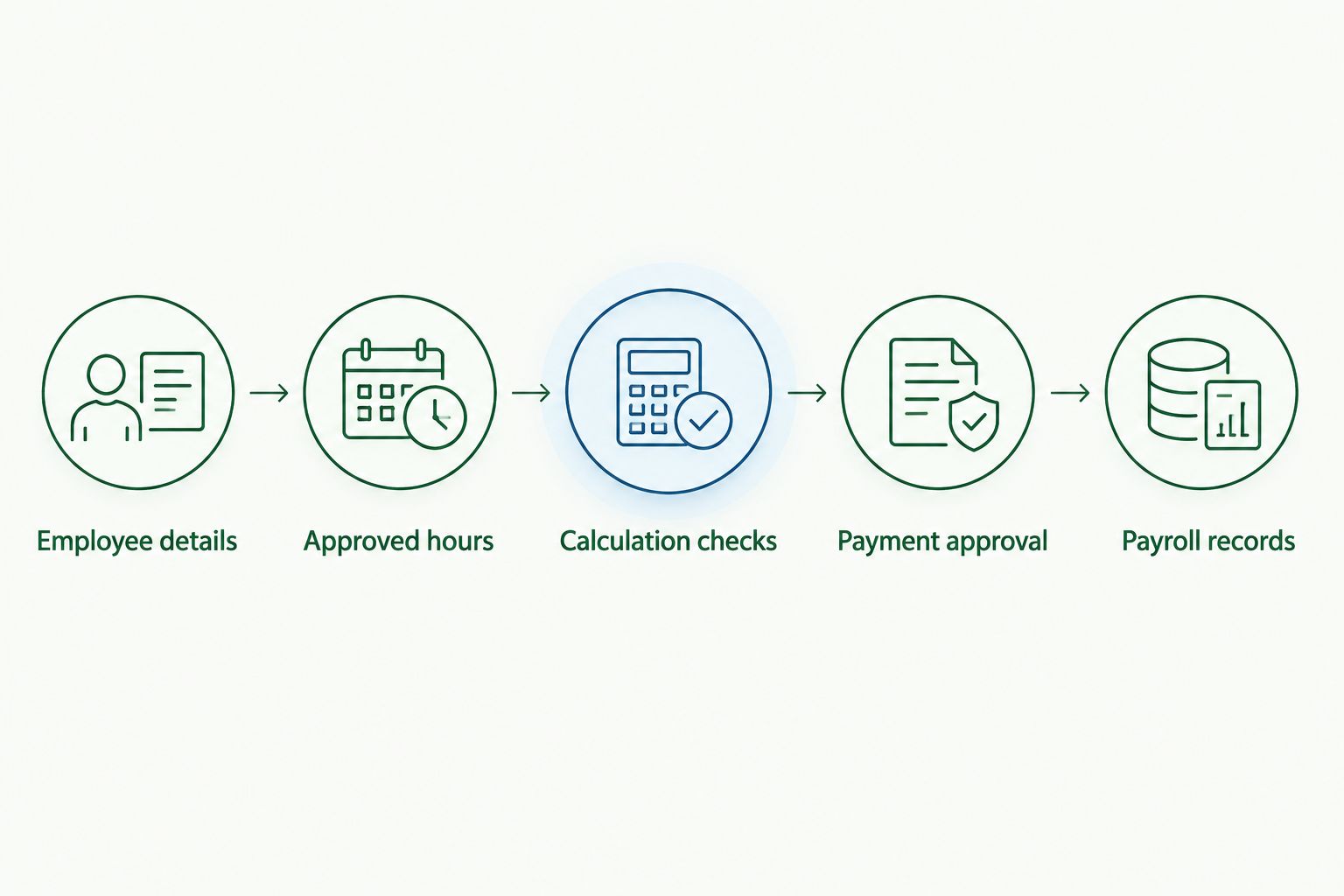
The handover follows a sequence: establish the employee information, approve the hours, check the calculations, authorise payment and retain the records. Skipping an earlier stage leaves later checks working from incomplete information.
Compare hospitality payroll support options
Choose the arrangement that closes your actual responsibility gaps. A small venue with a capable owner-manager needs a different division of work from a business coordinating several venue managers and a central finance function.
The options below describe operating models, not interchangeable services. Confirm the inclusions in writing, particularly where payroll processing, bookkeeping and employment advice overlap.
Option | Best for | Main advantage | Key limitation |
|---|---|---|---|
Owner-managed payroll | A business with an owner able to maintain payroll knowledge and checks | Direct control over inputs and approvals | Processing, checking and continuity depend on the owner |
Bookkeeping with payroll support | A venue seeking payroll processing connected to routine accounts | Connects payroll transactions with bookkeeping | Award interpretation and specialist advice depend on scope |
Dedicated payroll provider | A business wanting a defined payroll processing function | Separates processing responsibilities from venue operations | Accounting integration and broader advice need confirmation |
Daintree Consulting payroll and accounting support | A business seeking payroll alongside bookkeeping, accounting and advisory services | Brings related finance services into one engagement | Venue inputs and employer approvals remain business responsibilities |
Internal payroll function | An organisation with enough work and oversight to support an internal role | Keeps payroll knowledge within the business | Requires training, review and cover for staff absences |
Before deciding, ask each provider to explain an exception: a missed shift, a disputed classification or a correction after payment. The answer shows how the service works when the pay run is not routine.
Common mistakes hospitality businesses make
Treating the roster as the final timesheet
A planned finish time is not evidence that an employee finished then. Require managers to confirm actual hours, particularly when service runs late or staff cover another shift. Approve the work performed, not just the roster published.
Assuming one classification fits the whole team
Employees can have different duties, employment types and applicable conditions within the same venue. Review individual arrangements instead of copying the settings of the last person hired. Escalate uncertainty before the next calculation relies on it.
Leaving the provider to chase every missing detail
Outsourced processing still needs an internal contact who can resolve questions. Nominate someone with access to managers and employee records, plus a backup. Otherwise, a missing approval becomes a pay-run deadline problem rather than a simple operational query.
Correcting net pay without fixing the underlying record
A transfer to an employee does not, by itself, correct payroll calculations, reporting or accounting entries. Document what changed and why, then have the responsible person update the affected records. Keep the explanation with the adjustment.
Choosing support without checking the review process
Fast processing is not a substitute for clear checks. Ask who reviews exceptions, how errors are corrected and what happens when the usual processor is absent. A service that leaves these questions unanswered leaves you with an unclear operating arrangement.
FAQ
What do payroll services for hospitality businesses include?
Payroll services can include calculating pay, preparing payslips, payroll reporting and maintaining payroll records. The engagement should state whether timesheet checks, reconciliations, employee queries and classification reviews are included.
Can a bookkeeper handle payroll for my restaurant?
A bookkeeper can handle restaurant payroll when payroll forms part of the agreed service and the person has the relevant capability. Confirm who checks award settings and where specialist employment advice is required.
Which award applies to my café or restaurant?
The applicable award depends on coverage rules, business activities and the employee's work, not the venue name alone. Check Fair Work Ombudsman guidance and obtain advice if coverage or classification is unclear.
Does outsourcing payroll remove my employer responsibilities?
No, outsourcing payroll does not remove your employer responsibilities. Your business still needs accurate employment information, approved hours and appropriate oversight of the provider's work.
Is payroll software enough for a hospitality business?
Payroll software is not a substitute for correct classifications, accurate timesheets and a review process. It calculates using the information and settings supplied, so those inputs need checking.
How long do I need to keep payroll records in Australia?
Fair Work Ombudsman guidance requires employers to keep time and wage records for 7 years. Confirm that records remain accessible when you change payroll systems or providers.
How do I compare hospitality payroll providers?
Compare written responsibilities, review procedures, reporting tasks and correction processes. Ask who approves hours, checks exceptions and connects payroll with your accounting records before selecting a provider.
One last thing
Before changing providers, trace one completed pay run from a roster change through to the timesheet, payslip, payment and accounting record. Ask who approved each stage and where the evidence sits. That exercise identifies the handover points your next engagement needs to address.
Your first improvement does not have to be a new system. For your 2026 payroll process, make every responsibility explicit, then choose the support that fills the remaining gaps. A clear division of work gives you a better basis for checking payroll and understanding the business.
Talk to Daintree about your bookkeeping and payroll
Our ex-Big 4 team gives clear, senior-reviewed advice so you can act with confidence.
Book a free consultation →
Or explore our bookkeeping and payroll services.
