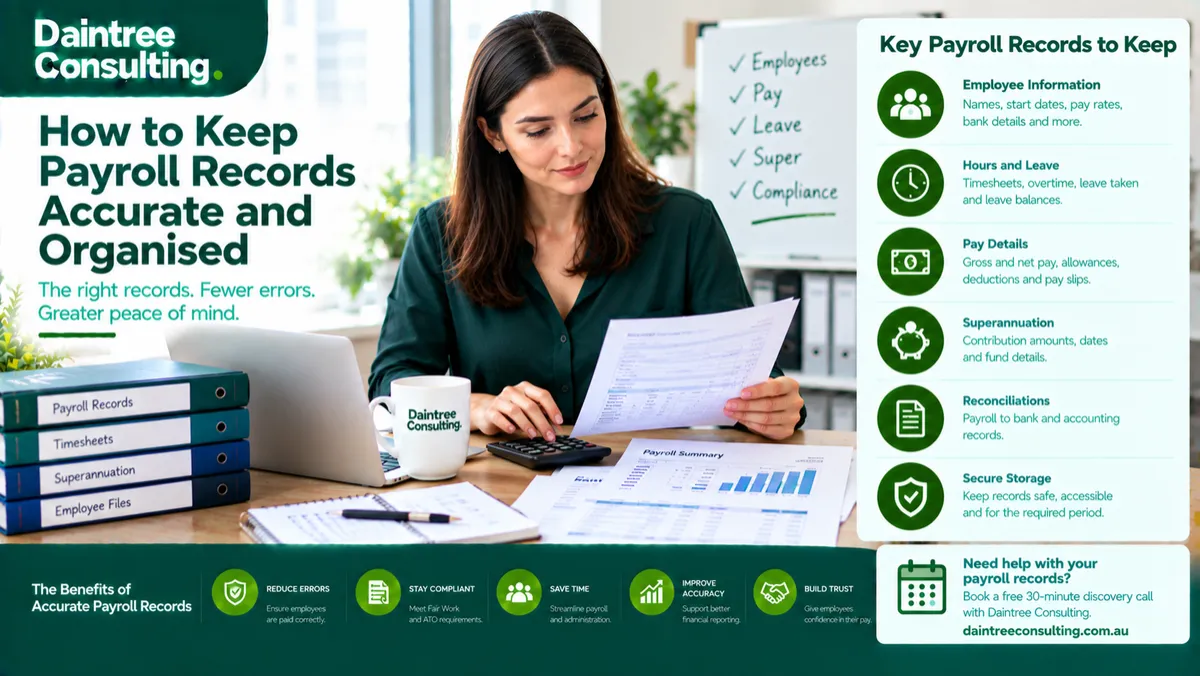
How to Keep Payroll Records Accurate and Organised
Payroll records are more than a collection of payslips and timesheets.
They form the financial and employment record of what your business has paid its employees, what hours they have worked, what leave they have taken, what deductions have been made and what superannuation obligations have been recorded.
Want expert help? Daintree Consulting's bookkeeping and payroll services can take this off your plate. Book a free consultation.
For Australian businesses, keeping these records accurate and organised is also an important compliance responsibility. Employers generally need to keep time and wages records for 7 years, and those records need to be accessible, legible and accurate.
The challenge for a growing business is that payroll information can quickly become spread across payroll software, timesheets, employment records, leave systems, bank accounts, superannuation records and accounting reports.
A good payroll records process brings these pieces together.
It makes it easier to:
Check that employees have been paid correctly
Identify payroll errors
Reconcile payroll to the accounting records
Track leave and employee changes
Support superannuation reporting and payments
Respond to employee questions
Prepare for reviews or inspections
Keep historical records organised
Reduce unnecessary payroll administration
This guide explains how Australian businesses can build a more reliable system for managing payroll records.
Quick answer: What are payroll records?
Payroll records are the documents and information a business keeps to support employee payments and employment-related obligations.
Depending on the business, payroll records can include:
Employee details
Employment commencement information
Pay rates
Hours worked
Overtime
Leave
Gross and net pay
Allowances
Bonuses
Penalty rates
Deductions
Superannuation contributions
Pay slips
Payroll reports
Payment records
Termination information
Records supporting changes to employee pay or conditions
Fair Work Ombudsman guidance requires employers to keep certain employee records, including information about pay, hours, leave, termination and superannuation.
The exact records required can depend on the employee's circumstances, award, agreement and other applicable requirements.
Why accurate payroll records matter
Payroll is one of the most sensitive areas of business accounting.
A small error can affect an employee's pay, leave balance, tax withholding, superannuation or accounting records.
If payroll records are poorly organised, it can also become difficult to work out why an error occurred.
For example, suppose an employee questions their overtime payment.
A well-organised payroll system should allow the business to trace:
Hours worked → approved timesheet → applicable pay rate → payroll calculation → payslip → bank payment → accounting entry
If those records are disconnected or incomplete, resolving the question can take considerably longer.
Good record keeping creates an audit trail.
It helps the business understand not only what was paid, but also how the amount was calculated.
What payroll records should a business keep?
The exact requirements vary depending on the employment arrangement and applicable workplace rules, but several categories are particularly important.
1. Employee information
Keep the core information needed to identify each employee and their employment arrangement.
This can include:
Employee name
Commencement date
Employment type
Relevant employment documentation
Pay rate
Applicable award or agreement information
Position or classification information
Bank payment details
Superannuation fund information
Tax-related information
Fair Work Ombudsman guidance states that general employment records must include information such as the employer's name and ABN, the employee's name, commencement date and basis of employment.
Employee information should also be kept securely because payroll records contain personal and financial information.
2. Hours worked
For employees whose pay depends on hours worked, accurate time records are essential.
Depending on the circumstances, records may need to capture:
Ordinary hours
Overtime
Start and finish times
Hours worked on particular days
Break information where relevant
Approved additional hours
Timesheet adjustments
Fair Work requires certain hours-of-work information to be recorded, including overtime details in specified circumstances.
A consistent timesheet process can make this information much easier to verify.
3. Pay information
Payroll records should clearly show how an employee's pay was calculated.
This can include:
Ordinary wages
Overtime
Penalty rates
Allowances
Bonuses
Incentive payments
Loadings
Deductions
Gross pay
Net pay
Fair Work's record-keeping guidance specifically identifies pay rates, gross and net amounts, deductions and separately identifiable payments such as bonuses, loadings, penalty rates and allowances as information that must be recorded.
4. Leave records
Leave balances should be kept up to date.
Depending on the employee and circumstances, records may cover:
Annual leave
Personal/carer's leave
Family and domestic violence leave
Other applicable leave
Leave taken
Leave accrued
Leave balances
Leave payments
Leave information should be checked regularly rather than waiting until an employee asks about their balance.
5. Superannuation records
Superannuation information is another important part of payroll records.
Records should allow the business to identify:
Amounts contributed
Dates contributions were made
Periods covered
Fund details
Relevant employee elections or arrangements
Supporting payment records
Fair Work's current record-keeping guidance specifically includes the amount and dates of super contributions, the period they relate to and the fund receiving the contribution.
Because superannuation rules and payment processes can change, businesses should also ensure their payroll systems and procedures reflect current requirements.
Keep payroll records together rather than in isolated systems
One common problem is having payroll information spread across too many places.
For example:
Timesheets: spreadsheet
Leave: email approvals
Payroll: accounting software
Super: separate portal
Employee changes: email
Bank payments: online banking
Accounting: separate reporting system
Each system may work independently, but the business can struggle to connect the information when something needs to be checked.
A better process establishes a clear source of truth for each type of information.
For example:
Employee master data is maintained in the payroll system
Hours are approved through a consistent timesheet process
Leave is recorded through the appropriate payroll or leave system
Payroll reports are saved for each pay run
Payment records are retained
Payroll is reconciled to the accounting records
Supporting documents are stored securely
The exact system will vary by business.
The important part is consistency.
Create a standard payroll record structure
Organisation becomes much easier when every pay period follows the same process.
For example, a business could maintain a payroll folder or digital record structure containing:
Employee records
Current employee information
Employment documentation
Pay-rate changes
Superannuation information
Pay runs
Payroll reports
Timesheet approvals
Leave reports
Pay-run summaries
Payment confirmations
Superannuation
Contribution reports
Payment records
Exception reports
Relevant supporting documentation
Reconciliations
Payroll-to-bank reconciliation
Payroll-to-general-ledger reconciliation
Superannuation reconciliation
Year-end
Final payroll reports
Employee payment summaries or relevant reporting records
Leave balances
Reconciliation documentation
Supporting year-end adjustments
The structure should be adapted to the business rather than copied mechanically.
The objective is to make information easy to locate.
Reconcile payroll records regularly
One of the most useful controls is payroll reconciliation.
A reconciliation compares payroll information against the accounting and payment records to identify differences.
For example, a business could compare:
Payroll report → accounting ledger → bank payment
The totals should make sense together.
If payroll shows $48,000 of net employee payments but the related bank transactions do not match, the difference should be investigated.
The same principle can be applied to:
Gross wages
PAYG withholding
Superannuation
Leave liabilities
Payroll-related expenses
Payroll clearing accounts
Reconciliation is particularly useful because it can identify errors that may not be obvious from the payroll system alone.
Review payroll records before finalising each pay run
A short review before payroll is finalised can prevent problems from becoming part of the permanent payroll history.
Useful checks can include:
Are all active employees included?
Have new employees been entered correctly?
Have terminated employees been removed or processed correctly?
Were approved timesheets received?
Are overtime hours reasonable?
Have pay-rate changes been applied?
Are leave requests correctly recorded?
Are unusual payments supported?
Are deductions authorised?
Are superannuation details correct?
Are there unexpected changes compared with the previous pay run?
A business does not need to manually inspect every number every time.
The objective is to identify exceptions and unusual movements.
Compare payroll with the previous pay period
Trend checks can be surprisingly effective.
Suppose a business normally has:
20 employees
Similar weekly hours
Stable salary costs
Consistent payroll expenses
Then the payroll expense suddenly increases by 18%.
That does not necessarily mean something is wrong.
It could be caused by:
New employees
Overtime
Bonuses
Leave payments
Pay-rate changes
A longer pay period
A termination payment
But the change should be explainable.
Comparing payroll reports from one period to the next helps identify movements that deserve investigation.
Keep a record of payroll changes
Employee information changes over time.
For example:
An employee receives a pay increase
Their employment classification changes
They change employment type
Their super fund details change
Their bank account changes
Their hours change
They move into a different role
They start or stop receiving an allowance
A good payroll process should retain appropriate evidence of these changes.
Do not rely on memory or informal conversations.
Where a change requires approval or written documentation, retain the relevant supporting record.
This creates a clear history of why the payroll information changed.
Keep pay slips organised
Pay slips are an important part of the payroll record.
Fair Work requires employers to provide employees with pay slips within one working day of pay day, whether electronically or in hard copy.
Pay slips must contain specified information about the employee's pay, including the pay period, payment date, gross and net pay and relevant allowances, deductions and superannuation information.
Businesses should therefore make sure pay slips are:
Generated consistently
Delivered on time
Accessible to employees
Stored appropriately
Consistent with the underlying payroll records
Electronic pay slips should also be provided in a way that allows employees to access them privately.
Keep payroll records secure
Payroll records contain sensitive information.
They can include:
Employee addresses
Bank details
Tax information
Salary information
Leave information
Superannuation details
Other personal information
Access should therefore be limited to people who need the information to perform their role.
For example:
Payroll staff
Relevant managers
Business owners
Authorised accountants
Other authorised personnel
Fair Work notes that employee records are private and confidential and may be accessed by employees, employers, relevant payroll staff and authorised individuals in appropriate circumstances.
Security is therefore part of good payroll record organisation.
Use payroll software, but don't rely on software alone
Payroll software can make record keeping considerably easier.
Modern systems can help businesses:
Store employee information
Process pay runs
Track leave
Generate pay slips
Calculate payroll amounts
Produce reports
Maintain payroll history
Integrate with accounting systems
But software does not automatically guarantee accurate payroll records.
Incorrect employee setup, wrong pay rates, incomplete timesheets or incorrect classifications can still produce incorrect results.
The system needs to be supported by good processes.
That means:
Good software + accurate inputs + appropriate review + regular reconciliation
is generally more useful than simply choosing a sophisticated payroll platform.
Create a payroll checklist
A simple checklist can help ensure the same controls are followed each pay period.
Before payroll
Review new employees
Check employee changes
Collect approved timesheets
Review leave
Check overtime
Confirm pay-rate changes
Review unusual payments
During payroll
Process the pay run
Review payroll reports
Check unusual movements
Confirm deductions
Review superannuation information
Check PAYG withholding information
After payroll
Issue pay slips
Process employee payments
Complete relevant superannuation processes
Reconcile payroll to the bank
Reconcile payroll to the accounting records
Save payroll reports
Record and investigate exceptions
The checklist should reflect the business's actual payroll process and current obligations.
Keep payroll records for the required period
Record retention is an important part of payroll administration.
Under Fair Work requirements, employers generally need to keep time and wages records for 7 years. Records must be accessible, legible and in English.
Records should not be altered except to correct an error, and employers must not knowingly keep false or misleading employee records.
This means businesses should think carefully before deleting old payroll information simply because the employee has left.
A former employee's records can still be relevant after employment ends.
What happens when an employee leaves?
Termination creates another point where payroll records need to be accurate.
The business may need to process:
Final wages
Unused leave payments where applicable
Notice-related amounts
Other termination payments
Final deductions
Superannuation information
Termination date
Relevant employment records
Fair Work requires certain termination information to be recorded, including how employment ended and, where relevant, notice details.
The payroll file should be updated so that the employee's final position is clear.
Common payroll record-keeping problems
Even businesses with payroll software can experience record-keeping problems.
1. Missing timesheets
If hours are not properly recorded or approved, it becomes difficult to verify the basis of the payment.
2. Outdated employee information
Old bank, superannuation or employment information can create unnecessary payroll issues.
3. Unrecorded pay-rate changes
A payroll system may continue using an old rate if employee changes are not properly documented and updated.
4. Poor leave records
Leave balances can become difficult to reconcile when leave is approved through email but not promptly entered into the payroll system.
5. Payroll not reconciled to accounting
The payroll system can appear correct while the accounting ledger contains unexplained differences.
6. Missing supporting documents
If there is no evidence supporting an unusual payment or payroll adjustment, it can take much longer to resolve questions later.
7. Multiple versions of spreadsheets
Using several spreadsheets as unofficial payroll records can create confusion about which version is current.
8. Keeping records but not organising them
Having thousands of files does not necessarily mean the records are well managed.
The information should be searchable and understandable.
How often should payroll records be reviewed?
Payroll records should be maintained continuously rather than reviewed only at the end of the financial year.
A practical approach is to use different levels of review.
Every pay run
Check:
Employee changes
Timesheets
Leave
Unusual payments
Payroll totals
Pay-run exceptions
Monthly
Review:
Payroll-to-bank reconciliation
Payroll-to-ledger reconciliation
Superannuation balances
Leave liabilities
Significant payroll movements
Periodically
Review:
Employee master data
Pay rates
Payroll processes
User access
Record storage
Software settings
Payroll controls
At financial year-end
Complete appropriate year-end checks and ensure payroll records support the business's accounting and reporting requirements.
The exact process should reflect the size and complexity of the business.
When should a business outsource payroll record management?
Managing payroll internally can work well when a business has a straightforward workforce and appropriate systems.
However, payroll administration can become more difficult as the business grows.
Outsourcing may be worth considering when:
Payroll takes significant management time
There are frequent employee changes
The workforce has grown
Payroll errors are becoming more common
Payroll is handled through spreadsheets
Reconciliations are regularly delayed
Superannuation administration is difficult to manage
No one internally has clear payroll responsibility
The owner is spending too much time resolving payroll questions
Outsourcing does not remove the employer's responsibilities.
Instead, it can provide a more structured process and access to people experienced in payroll administration.
How Daintree Consulting can help with payroll records
Keeping payroll records accurate requires more than processing payments.
It requires a consistent process covering employee information, timesheets, leave, payroll processing, superannuation, reconciliations, reporting and record storage.
Daintree Consulting's Bookkeeping & Payroll service can support Australian businesses with payroll processing, superannuation administration, bookkeeping, reconciliations, month-end processes and coordination with accounting requirements.
The objective is to help businesses maintain reliable records while reducing the administrative burden of managing payroll internally.
If your payroll records are spread across spreadsheets, emails and different systems, explore Daintree's Bookkeeping & Payroll service or book a free 30-minute discovery call to discuss your requirements.
Frequently Asked Questions
What are payroll records?
Payroll records are the information and documents a business keeps to support employee payments and employment-related obligations. They can include employee details, pay rates, hours worked, leave, wages, deductions, superannuation records, pay slips and payroll reports.
How long do Australian businesses need to keep payroll records?
Under Fair Work requirements, employers generally need to keep time and wages records for 7 years. The records must be accessible, legible and in English.
Other tax, superannuation or business records may have different retention requirements, so businesses should consider the applicable requirements for each record type.
How long does an employer have to provide a pay slip?
A pay slip must generally be provided within one working day of pay day, including when an employee is on leave.
What should payroll records include?
Depending on the circumstances, payroll records can include employee information, pay rates, hours worked, overtime, leave, gross and net pay, deductions, allowances, bonuses, penalty rates, superannuation contributions and termination information.
Should payroll be reconciled to the accounting records?
Yes. Regular reconciliation can help identify differences between payroll reports, bank transactions and the accounting ledger. It is a useful control for detecting errors and keeping financial records accurate.
Can payroll records be kept electronically?
Yes. Payroll and employee records can be maintained electronically, provided the applicable requirements are met. Businesses should ensure records remain accessible, legible, secure and capable of being produced when required.
Who should have access to payroll records?
Access should generally be restricted to people who need the information for their role, such as authorised payroll staff, management and authorised accountants. Payroll records contain personal and financial information and should be handled confidentially.
Can payroll records be corrected?
Errors can be corrected, but employers must not knowingly keep false or misleading records. Fair Work guidance states that records should not be altered except for correcting an error.
It is good practice to maintain an appropriate record of what was corrected and why.
Final takeaway
Accurate payroll records give a business a reliable history of what it paid, why it paid it and how employee entitlements were calculated.
A strong process should connect:
Employee information → hours and leave → payroll calculation → pay slip → payment → superannuation → accounting records → reconciliation
The system does not need to be complicated.
What matters is that records are accurate, consistently maintained, securely stored and easy to retrieve.
For Australian businesses, this is also about more than good administration. Fair Work requirements generally require employers to keep time and wages records for seven years and provide employees with compliant pay slips within one working day of payment.
As your workforce grows, putting a structured payroll record process in place can make payroll easier to review, reconcile and manage.
If your business needs help keeping payroll and bookkeeping organised, book a free 30-minute discovery call with Daintree Consulting.
Talk to Daintree about your bookkeeping and payroll
Our ex-Big 4 team gives clear, senior-reviewed advice so you can act with confidence.
Book a free consultation →
Or explore our bookkeeping and payroll services.
