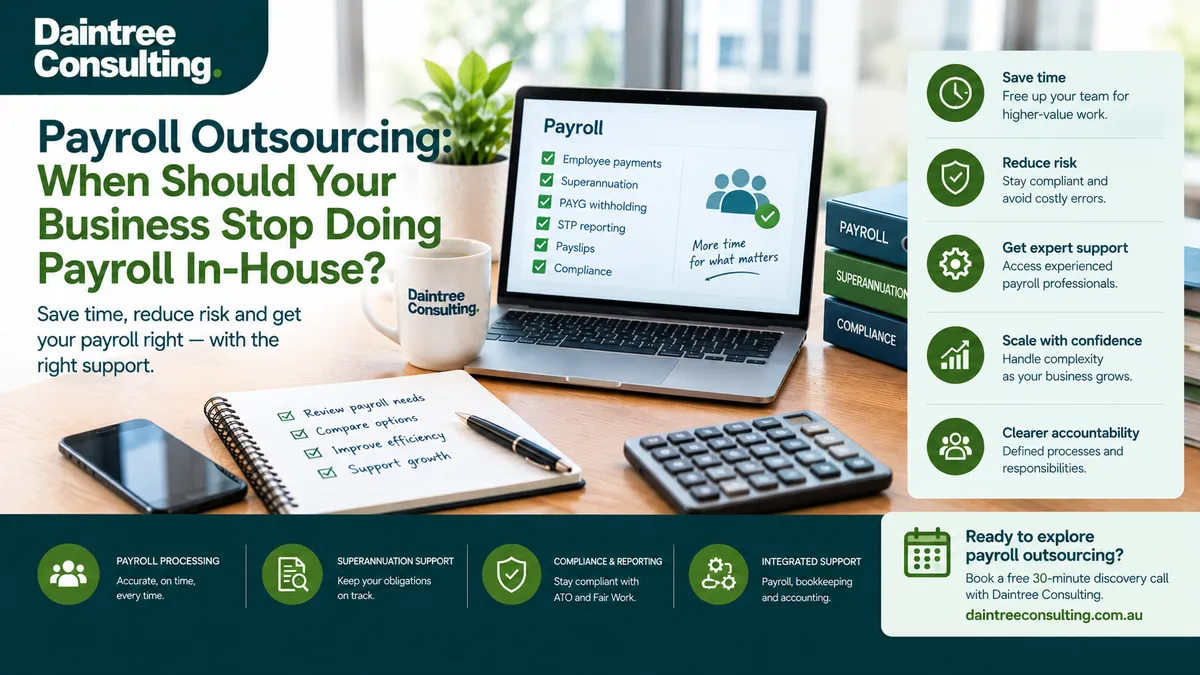
Payroll Outsourcing: When Should Your Business Stop Doing Payroll In-House?
Payroll can start as one of those tasks that seems easy enough to handle internally.
A business owner, office manager or administrator processes the pay run, checks the figures, sends payments and moves on to the next task.
Want expert help? Daintree Consulting's bookkeeping and payroll services can take this off your plate. Book a free consultation.
That approach can work when a business is small.
But as the team grows, payroll becomes more than simply paying employees. You are dealing with wages, leave, PAYG withholding, superannuation, pay slips, employee records, payroll software, reporting requirements and the practical risk of getting someone's pay wrong.
At some point, the question changes from:
"Can we do payroll ourselves?"
to:
"Is keeping payroll in-house still the best use of our time and resources?"
For some Australian businesses, payroll outsourcing can provide a more structured way to manage the process, reduce administrative pressure and create clearer ownership of recurring payroll tasks.
The key is knowing when outsourcing solves a genuine business problem rather than simply adding another external provider.
Quick Answer: When Should You Outsource Payroll?
You should consider payroll outsourcing when payroll has become too time-consuming, too dependent on one person, difficult to manage accurately or risky to keep handling informally.
Common signs include:
Payroll takes too much management time.
Payroll errors are becoming more frequent.
One employee is the only person who understands the process.
The business has grown significantly.
Payroll involves multiple employees, pay rates or arrangements.
Superannuation and reporting deadlines create ongoing pressure.
Your existing payroll system is poorly configured.
Employees regularly have questions about their pay.
Your internal team is spending time fixing payroll problems instead of higher-value work.
You want clearer controls and documented responsibilities.
Outsourcing does not remove the business owner's responsibilities. Instead, it can provide a more structured process for preparing payroll, maintaining records and managing recurring deadlines.
Daintree Consulting currently provides payroll processing and payroll records support, superannuation processing support and coordination with broader bookkeeping and accounting functions.
What Does Payroll Outsourcing Actually Mean?
Payroll outsourcing means engaging an external provider to perform some or all of your payroll-related processes.
The exact scope can vary.
Depending on your arrangement, an outsourced payroll provider may help with:
Employee payroll setup
Payroll processing
Pay-run preparation
Payroll records
Leave tracking
Payroll reconciliations
Superannuation processing support
PAYG withholding information
Single Touch Payroll processes
Payslip administration
Payroll reporting
Year-end payroll processes
Payroll system administration
Payroll-related bookkeeping
You don't necessarily need to outsource everything.
For example, your business might retain responsibility for approving the final payroll while an external provider prepares the pay run.
That can create a useful separation between processing and approval.
Daintree's current approach is to agree access, responsibilities and approval controls during onboarding rather than removing governance responsibilities from business owners or authorised officers.
Why Is Payroll Becoming Harder to Manage?
Payroll isn't just a calculation.
Australian employers need to manage several overlapping obligations.
For example, employers must keep accurate and complete employment records, including information relating to pay, hours worked, leave and superannuation. Fair Work requires employee records to be kept for seven years.
Employees must also receive pay slips within one working day of being paid, with prescribed information included on the payslip.
There are also tax and superannuation obligations.
Single Touch Payroll requires employers to report payroll information to the ATO each time employees are paid through STP-enabled software.
The current general superannuation guarantee rate is 12% from 1 July 2025, and employers must ensure required super contributions reach employees' funds by the relevant due dates.
That means payroll can become a significant recurring finance operation as the business grows.
7 Signs Your Business May Be Ready for Payroll Outsourcing
1. Payroll Is Taking Too Much Time
One of the clearest signs is simply the amount of time payroll consumes.
Maybe payroll takes:
Several hours every week
Most of a day each fortnight
Significant time each month
Additional time whenever someone takes leave
Extra administration around new employees
More time at the end of the financial year
The cost isn't just the employee's salary.
You also need to consider the opportunity cost.
What else could that person be doing?
If an experienced manager or business owner spends hours each pay cycle checking payroll spreadsheets, chasing timesheets and fixing employee records, the business is using valuable management capacity on an administrative process.
Payroll outsourcing can shift some of that recurring workload to a specialist provider.
2. Payroll Has Become Dependent on One Person
This is a common problem in growing businesses.
One person knows:
Where the payroll files are
How the software is configured
Which employees have special arrangements
When payroll needs to be processed
How leave is entered
How super is handled
Which reports need to be checked
What to do when something goes wrong
Then that person goes on leave.
Suddenly, nobody is completely sure what to do.
This creates key-person risk.
A properly documented outsourced payroll process can reduce that dependency by creating clearer responsibilities, access arrangements and recurring procedures.
It also makes handovers easier.
3. Payroll Errors Are Becoming More Frequent
Payroll mistakes can quickly become more than an administrative inconvenience.
An error may affect:
Employee pay
Leave balances
Superannuation
PAYG withholding
Payroll reporting
Financial records
It can also damage employee confidence.
Fair Work's record-keeping requirements exist partly to help ensure employees receive the correct wages and entitlements. Employers are required to keep accurate records and can face consequences when records are not properly maintained.
If payroll errors are becoming a recurring issue, it may be time to review the process rather than simply fixing each individual mistake.
4. Your Workforce Has Become More Complex
Payroll often becomes harder as the workforce becomes more diverse.
For example, you may have:
Full-time employees
Part-time employees
Casual employees
Employees working different hours
Different pay rates
Overtime
Penalty rates
Allowances
Bonuses
Leave arrangements
Employees covered by different awards or agreements
The more variables involved, the more important it becomes to have a reliable payroll process.
Fair Work notes that employers need to keep records covering matters such as pay, hours worked, overtime, leave and superannuation.
Payroll outsourcing doesn't automatically solve award interpretation or workplace-relations questions, but it can create a more controlled payroll administration process.
5. You Are Growing Quickly
Growth can expose weaknesses in a payroll process that previously worked perfectly well.
Imagine a business growing from:
5 employees → 15 → 30 → 50
The payroll process doesn't necessarily become five or ten times harder.
It can become more complex.
There are more employees, more transactions, more changes, more records and more opportunities for exceptions.
At the same time, the owner may have less time to supervise every payroll detail.
That is often the point where outsourcing becomes worth considering.
6. Payroll Deadlines Are Creating Stress
Payroll has recurring deadlines.
You cannot simply decide to process wages whenever someone has time.
The business needs a reliable payroll calendar covering things such as:
Pay days
Timesheet cut-offs
Payroll approvals
Payslip delivery
PAYG obligations
Superannuation processing
STP reporting
Leave updates
Employee changes
Superannuation is particularly important because contributions generally need to reach the employee's fund by the quarterly due dates. Employers can pay more frequently, but must still ensure the required quarterly amount is paid by the applicable deadline.
A structured payroll service can help turn these recurring obligations into a defined workflow.
7. Payroll Is Distracting Your Finance Team
Sometimes the problem isn't that payroll is being done badly.
It's that the right people are spending too much time doing it.
Your bookkeeper or finance administrator may be capable of processing payroll.
But ask whether their time could be better spent on:
Financial reconciliations
Accounts receivable
Accounts payable
Month-end close
Management reporting
Cash-flow monitoring
Financial analysis
If payroll consumes a significant amount of their working week, outsourcing may allow the internal finance function to focus on higher-value responsibilities.
Should You Outsource All Payroll?
Not necessarily.
This is an important point.
Payroll outsourcing doesn't have to mean giving an external provider complete control.
You can design the arrangement around your business.
For example:
Option 1: Payroll processing only
The external provider processes payroll while your business retains approvals and payment authority.
Option 2: Payroll + super support
The provider handles payroll and supports the superannuation process.
Option 3: Payroll + bookkeeping
Payroll is integrated with broader bookkeeping and reconciliation.
Option 4: Complete bookkeeping and payroll
The external provider manages recurring bookkeeping and payroll processes as one connected finance function.
Daintree explicitly offers engagements that can cover payroll only, bookkeeping only or an integrated bookkeeping and payroll service.
That flexibility can be useful because businesses don't all have the same finance structure.
What Are the Benefits of Payroll Outsourcing?
Save Internal Time
Payroll is recurring.
Once a process is established, outsourcing can remove a significant amount of repetitive administration from your internal team.
That gives employees more time for work that directly supports operations and growth.
Create Clearer Accountability
A good outsourced arrangement should clearly define:
Who prepares payroll
Who checks payroll
Who approves payroll
Who makes payments
Who manages employee changes
Who handles exceptions
Who maintains records
Daintree's onboarding process includes confirming access, responsibilities and approval controls before recurring work is transitioned.
This is important because outsourcing without clear ownership can simply move confusion outside the business.
Reduce Key-Person Risk
Documented processes and shared responsibility can make payroll less dependent on one internal employee.
If someone leaves, takes annual leave or becomes unavailable, the business is less exposed to a single point of failure.
Improve Payroll Consistency
A defined payroll timetable can make recurring processes easier to manage.
Instead of:
"Someone usually does payroll on Thursday."
you can have:
Timesheets → Review → Payroll preparation → Approval → Payment → Reporting → Reconciliation
That is a much more controlled process.
Improve Financial Records
Payroll is also an accounting transaction.
When payroll is properly processed and integrated with bookkeeping, management has better visibility over labour costs.
That can improve reporting around:
Wages
Superannuation
Payroll liabilities
Leave
Labour costs
Profitability
Cash flow
This becomes particularly useful as the business grows.
What Are the Risks of Outsourcing Payroll?
Outsourcing isn't automatically better.
There are risks to consider.
Poor Provider Communication
If the provider is difficult to reach when payroll issues arise, outsourcing can create frustration instead of reducing it.
Unclear Responsibilities
If nobody knows who approves payroll, who changes employee records or who handles errors, problems can fall between the cracks.
Lack of Business Context
A provider needs enough context to understand your payroll workflow and exceptions.
Access and Security
Payroll contains sensitive employee information.
Access should be limited to appropriate people and managed carefully.
Poor Transition
If the handover is rushed, errors can occur during the transition.
This is why the implementation process matters almost as much as the ongoing service.
How to Choose a Payroll Outsourcing Provider
Before selecting a provider, ask practical questions.
1. What exactly is included?
Clarify whether the service includes:
Payroll processing
Payslips
STP
Superannuation support
Leave records
Employee setup
Payroll reporting
Reconciliations
Year-end support
Don't assume everything is included.
2. Who approves payroll?
You should understand exactly where responsibility sits.
A good process can allow the provider to prepare payroll while authorised people within the business retain approval control.
3. What software do they use?
Find out whether the provider can work with your existing payroll/accounting platform.
Daintree states that it can often work with existing software, subject to the needs of the engagement.
4. How are errors handled?
Ask what happens if:
An employee is underpaid
A timesheet is missing
An employee's bank details change
A payroll run needs correction
Super information doesn't reconcile
A reporting issue is identified
You want a clear escalation process.
5. How is the transition managed?
A proper handover should consider:
Existing employee records
Payroll history
Leave balances
Software configuration
Pay schedules
Access permissions
Reporting requirements
Upcoming deadlines
Daintree's current process includes a documented handover when transitioning from an internal bookkeeper.
Payroll Outsourcing vs Keeping Payroll In-House
The right decision depends on the business.
Keeping payroll in-house may make sense when:
The workforce is small
Payroll is straightforward
The process is well documented
Internal expertise is available
Errors are rare
Payroll doesn't consume excessive time
Outsourcing may make more sense when:
The business is growing
Payroll complexity is increasing
Internal staff are overloaded
Payroll is dependent on one person
Errors are becoming more frequent
Compliance deadlines create stress
You want clearer process ownership
You want payroll connected with bookkeeping
The decision shouldn't be based solely on the cheapest option.
Consider the total cost of payroll.
That includes:
Staff time + software + administration + training + error correction + management oversight + compliance risk
An in-house payroll process may appear inexpensive until all of these costs are considered.
What Does a Good Outsourced Payroll Process Look Like?
A strong process might look something like this:
Step 1: Employee information is maintained
New starters, departures, pay changes and other relevant updates are documented.
Step 2: Timesheets and payroll inputs are collected
Required information is provided before the agreed payroll cut-off.
Step 3: Payroll is prepared
The provider processes wages and relevant payroll information.
Step 4: Payroll is reviewed
Exceptions and unusual movements are identified.
Step 5: Authorised person approves payroll
The business retains appropriate approval control.
Step 6: Employees are paid and payslips issued
Pay occurs according to the agreed timetable and payslip obligations are met.
Step 7: Required reporting is completed
Relevant STP, PAYG and other payroll reporting processes are handled.
Step 8: Payroll records are reconciled
Payroll information is connected back to the broader financial records.
This creates a repeatable process rather than relying on memory.
Payroll Outsourcing Doesn't Remove Employer Responsibility
This is one of the most important points for business owners.
Outsourcing a function does not necessarily mean outsourcing your legal responsibilities as an employer.
You remain responsible for ensuring your business meets its applicable obligations.
For example, Fair Work requires employers to maintain accurate and complete employee records and issue compliant pay slips.
Similarly, PAYG withholding and reporting obligations remain relevant to the employer, and non-compliance can result in penalties and, in some circumstances, affect the deductibility of payments.
The role of an outsourced provider is therefore to help create a reliable process—not to make the business's responsibilities disappear.
Payroll Outsourcing and Business Growth
Payroll often becomes an operational issue before business owners realise it.
At five employees, you might manage it yourself.
At ten, it starts taking more time.
At twenty, you may need systems.
At thirty or fifty, payroll may need clearly defined ownership, controls and specialist support.
There is no magic employee number at which every business should outsource payroll.
The better question is:
Has payroll become too important, too complex or too time-consuming to remain an informal internal task?
If the answer is yes, it may be time to consider outsourcing.
A Simple Payroll Outsourcing Checklist
Before making the decision, ask:
How many hours does payroll consume each pay cycle?
Who currently owns the process?
What happens if that person is unavailable?
How often do payroll errors occur?
Are employee records complete?
Are payslips issued correctly and on time?
Is STP reporting handled consistently?
Are super obligations being monitored?
Are payroll accounts reconciled?
Does the payroll system integrate with accounting?
Are approvals clearly separated from processing?
Does the finance team have enough time for higher-value work?
Would outsourcing improve accountability?
Can the provider work with your existing software?
Can the provider take over without disrupting employees?
If several answers concern you, it's worth reviewing the current arrangement.
Frequently Asked Questions
What is payroll outsourcing?
Payroll outsourcing is the use of an external provider to manage some or all payroll-related processes, such as payroll processing, payroll records, payslips, reporting and superannuation processing support.
Is payroll outsourcing suitable for small businesses?
Yes. Small businesses can benefit when payroll takes too much owner or staff time, becomes difficult to manage or creates unnecessary administrative risk. However, outsourcing isn't automatically necessary for every small business.
Is payroll outsourcing cheaper than doing payroll in-house?
It depends. You need to compare the provider's fees with the total internal cost of payroll, including employee time, software, administration, training, error correction and management oversight.
Does outsourcing payroll mean losing control?
No. A properly designed arrangement can retain internal approval and payment controls while the external provider handles processing and recurring administration. Daintree specifically states that approval roles and controls are agreed during onboarding.
Can I outsource payroll without outsourcing bookkeeping?
Yes. Payroll can be outsourced as a standalone service. Daintree currently states that an engagement can cover payroll only, bookkeeping only or an integrated bookkeeping and payroll service.
Does outsourced payroll handle Single Touch Payroll?
It can, depending on the provider and agreed scope. STP requires employers to report payroll information to the ATO through STP-enabled software each time employees are paid.
How long do payroll records need to be kept in Australia?
Fair Work requires employers to keep employee time and wage records for seven years. Records need to be accurate, accessible and maintained appropriately.
Does payroll outsourcing remove my employer obligations?
No. Outsourcing can help you manage payroll processes, but employers remain responsible for meeting their applicable workplace, tax and superannuation obligations.
When Should You Stop Doing Payroll In-House?
The answer isn't simply when you reach a particular number of employees.
It's when the cost, complexity and risk of keeping payroll internal outweigh the benefits.
If payroll is taking valuable time away from your team, relying too heavily on one person, generating repeated errors or becoming increasingly difficult to manage, outsourcing may be worth considering.
The best outsourced payroll arrangement isn't about handing over everything and forgetting about it.
It's about creating a clear, controlled and repeatable process with defined responsibilities.
Daintree Consulting provides structured bookkeeping and payroll support for Australian businesses, including payroll processing and records, superannuation processing support, month-end bookkeeping and coordination with broader accounting functions.
If you're unsure whether your current payroll process still makes sense for the size and complexity of your business, a free 30-minute discovery call can help you identify the gaps and decide what level of support you actually need.
Daintree Consulting – Bookkeeping & Payroll
Talk to Daintree about your bookkeeping and payroll
Our ex-Big 4 team gives clear, senior-reviewed advice so you can act with confidence.
Book a free consultation →
Or explore our bookkeeping and payroll services.
