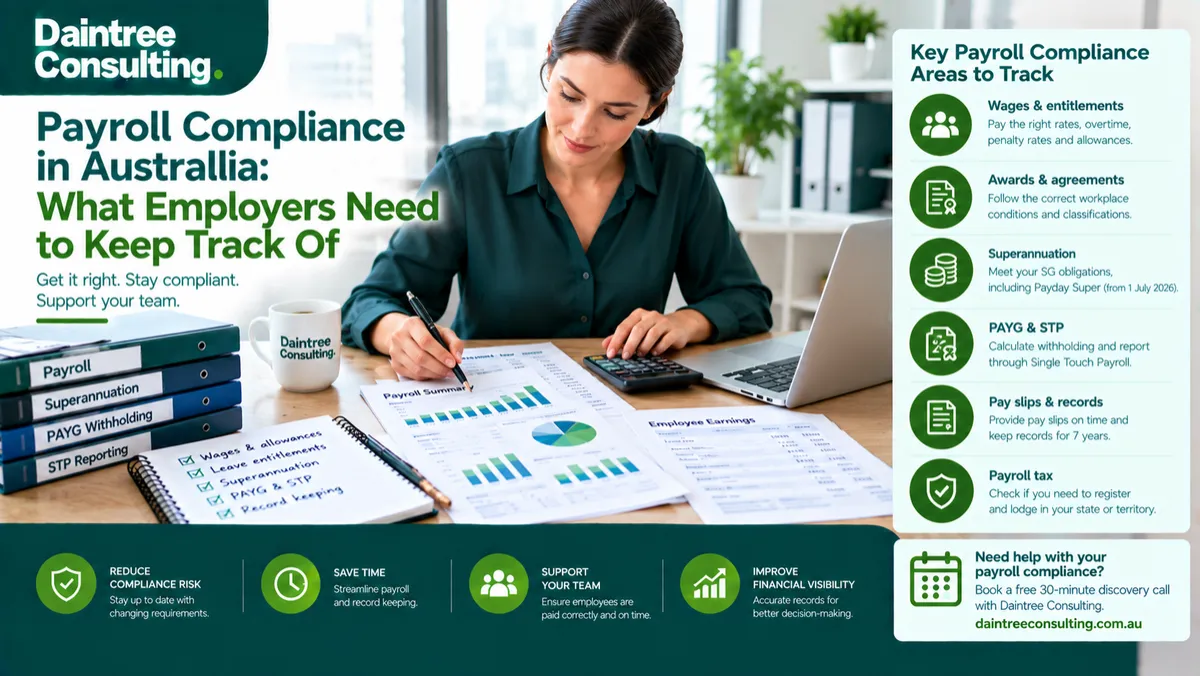
Payroll Compliance in Australia: What Employers Need to Keep Track Of
Payroll compliance in Australia involves much more than paying employees the correct amount each pay cycle.
Employers need to keep track of wages, employment conditions, tax withholding, superannuation, pay slips, employee records, leave, overtime, penalty rates and, in some circumstances, payroll tax.
Want expert help? Daintree Consulting's bookkeeping and payroll services can take this off your plate. Book a free consultation.
For growing businesses, payroll can become increasingly difficult to manage as the number of employees increases and different awards, employment arrangements and pay conditions need to be considered.
The introduction of Payday Super from 1 July 2026 has also changed the timing of superannuation obligations, making accurate payroll processes even more important. Employers now need to pay super guarantee contributions on payday, with contributions generally required to reach the employee's super fund within 7 business days, subject to applicable exceptions and extended timeframes.
A payroll error can affect employees, cash flow, tax reporting and compliance at the same time.
That is why Australian businesses should treat payroll compliance as an ongoing process rather than something to check only when a problem occurs.
Quick Answer: What Does Payroll Compliance in Australia Involve?
Payroll compliance in Australia generally involves making sure employees are paid correctly and that the business meets its workplace, tax and superannuation obligations.
Key areas include:
Correct employee classification
Applicable awards or enterprise agreements
Minimum rates of pay
Ordinary hours and overtime
Penalty rates and allowances
Leave entitlements
Accurate payroll calculations
PAYG withholding
Single Touch Payroll reporting
Superannuation guarantee
Payday Super requirements
Pay slips
Employee record keeping
Payroll tax where applicable
Final payments when employment ends
The exact obligations vary according to the business, employee, award, agreement, employment arrangement and state or territory.
For that reason, payroll compliance should be reviewed against the current requirements that apply to your business rather than relying on an old payroll checklist.
Why Payroll Compliance Matters
Payroll is one of the most regular financial processes in a business.
Unlike some compliance obligations that occur monthly, quarterly or annually, payroll can happen every week, fortnight or month.
That means a small process error can potentially be repeated many times.
For example, if an employee's ordinary rate is incorrect, the issue may affect every pay cycle.
Likewise, an incorrect treatment of overtime, allowances or superannuation can accumulate over time.
Payroll compliance therefore matters for two reasons.
First, employees need to receive the wages and entitlements they are legally owed.
Second, businesses need reliable records and reporting processes to meet their own obligations.
Fair Work states that employers must keep accurate and complete employee records and issue pay slips. These records are designed to help ensure employees receive their correct wages and entitlements.
1. Know Which Award or Employment Arrangement Applies
One of the first steps in payroll compliance is understanding the employment conditions that apply to each employee.
Employees may be covered by:
A modern award
An enterprise agreement
An employment contract
The National Employment Standards
Another applicable workplace arrangement
Modern awards establish minimum pay rates and employment conditions for employees covered by them. These can include pay rates, overtime, penalty rates, allowances, hours of work, breaks and other conditions.
This means an employer cannot simply choose a payroll rate because it seems commercially reasonable.
The business needs to determine which workplace instrument applies and then calculate the employee's entitlements accordingly.
This becomes particularly important when employees work different hours, perform different duties or receive additional payments.
2. Check Minimum Pay Rates
Payroll compliance starts with paying employees correctly.
For employees covered by an award or registered agreement, the applicable minimum rates may include:
Ordinary hourly rates
Overtime rates
Penalty rates
Casual loading
Allowances
Other specific entitlements
For employees not covered by an award or registered agreement, the National Minimum Wage may apply.
As of 1 July 2026, the National Minimum Wage is $26.44 per hour or $1,004.90 per week for a 38-hour week, although employees covered by an award or registered agreement may have higher applicable minimum rates.
Businesses should also remember that wage rates can change.
An annual payroll review is therefore important, particularly after Fair Work Commission wage and award changes.
3. Understand Overtime and Penalty Rates
Employees may be entitled to additional pay when they work outside their ordinary hours or at particular times.
This can include work:
Above ordinary hours
On weekends
On public holidays
Late at night
Early in the morning
Outside ordinary rostered hours
The exact entitlement depends on the applicable award, agreement or other workplace arrangement.
This is one reason accurate time records are important.
Payroll staff need reliable information about when employees worked, particularly where additional rates apply.
A payroll system cannot necessarily determine the correct entitlement if the underlying employee data is incomplete or incorrectly classified.
4. Keep Accurate Records of Hours Worked
Accurate time records are an important part of payroll compliance.
Depending on the circumstances, employers may need to record:
Hours worked
Overtime hours
Start and finish times
Leave taken
Pay rates
Allowances
Penalty rates
Other employment-related information
Fair Work requires employers to keep time and wages records for 7 years. Records must be accessible, legible and in English, and must not be false or misleading.
For businesses with employees working different rosters or variable hours, having a reliable timesheet or time-tracking process can make payroll significantly easier to manage.
5. Get Leave Entitlements Right
Payroll compliance also involves accurately recording and processing employee leave.
Depending on the employee and applicable workplace arrangements, payroll may need to account for:
Annual leave
Personal or carer's leave
Compassionate leave
Family and domestic violence leave
Long service leave
Other applicable leave arrangements
Businesses should maintain accurate records of leave taken and leave balances where required.
Fair Work's record-keeping guidance states that employers need to keep records of leave taken and the balance of an employee's entitlement.
Incorrect leave balances can become particularly problematic when employees leave the business and final payments need to be calculated.
6. Calculate PAYG Withholding Correctly
Employers generally need to withhold tax from employee payments and report the relevant information to the Australian Taxation Office.
This is known as Pay As You Go (PAYG) withholding.
The amount withheld depends on factors such as:
Employee earnings
Tax file number information
Tax residency
Withholding declarations
Study or training loan obligations where applicable
Other relevant circumstances
The ATO's current 2026 withholding schedules apply from 1 July 2026, so payroll systems should be using the applicable current tax tables and settings.
Payroll errors can occur when outdated tax tables are used or employee information has not been updated.
Businesses should therefore make sure their payroll software and processes are maintained appropriately.
7. Stay Compliant With Single Touch Payroll
Single Touch Payroll, commonly known as STP, is a major part of Australian payroll reporting.
Through STP-enabled payroll software, employers report payroll information to the ATO when employees are paid.
This can include information about:
Salaries and wages
PAYG withholding
Superannuation information
Other relevant payroll data
The ATO describes STP as a system that allows employers to report salary and wage, PAYG withholding and super information from payroll software at the same time employees are paid.
Employers also need to complete their required end-of-year STP finalisation processes.
Good payroll compliance therefore requires more than producing payslips.
The payroll information needs to flow accurately into the business's reporting obligations.
8. Understand the 2026 Payday Super Changes
One of the biggest payroll compliance changes for Australian employers in 2026 is Payday Super.
From 1 July 2026, employers must pay employees' super guarantee contributions on payday rather than waiting for the previous quarterly payment cycle.
The super guarantee rate is 12% for eligible employees, and under Payday Super the contribution generally needs to reach the employee's super fund within 7 business days of payday, subject to applicable exceptions or extended timeframes.
This makes payroll timing more important.
Businesses need processes that can:
Calculate super correctly
Include the relevant earnings
Process contributions promptly
Send contributions through the appropriate system
Resolve payment or fund-detail errors
Keep appropriate records
Reconcile payroll and super payments
The change means superannuation should be treated as an integrated part of each payroll cycle.
9. Make Sure Superannuation Goes to the Correct Fund
Employers also need to manage employee super fund details correctly.
Where an eligible employee chooses a super fund, the employer generally needs to contribute to that fund.
Where an eligible new employee does not choose a fund, employers may need to request the employee's stapled super fund details from the ATO before contributing to the appropriate fund, subject to the applicable rules and circumstances.
Payroll processes should therefore maintain accurate information about:
Employee super fund
Fund identifiers
Contribution amounts
Contribution dates
Employee fund choice
Relevant stapled fund information
Incorrect fund information can create delays and compliance issues.
10. Issue Correct Pay Slips
Pay slips are another important part of payroll compliance.
Employers must generally provide employees with a pay slip within one working day of payday, including when an employee is on leave. Pay slips can be electronic or paper-based.
Depending on the employee and payment arrangement, a pay slip needs to contain information such as:
Employer name
Employer ABN
Employee name
Pay period
Payment date
Gross pay
Net pay
Hours and hourly rates where applicable
Allowances
Bonuses
Penalty rates
Deductions
Superannuation information
The exact requirements should be checked against current Fair Work guidance.
Payroll software can help automate payslips, but employers remain responsible for making sure the underlying information is correct.
11. Keep Payroll Records for the Required Period
Payroll records should not simply disappear after the pay run.
Employers have record-keeping obligations covering areas such as:
Employee details
Pay
Hours worked
Overtime
Leave
Superannuation
Employment arrangements
Termination information
Other relevant employment records
Fair Work states that time and wage records generally need to be retained for 7 years.
Businesses should also consider how records are stored and protected.
Payroll information contains sensitive employee information, so access should be appropriately controlled.
12. Check Deductions Carefully
Payroll deductions can include items such as:
Tax withholding
Salary sacrifice arrangements
Employee-authorised deductions
Certain other permitted deductions
Not every deduction is automatically allowed.
Businesses should ensure deductions comply with the applicable workplace requirements and that appropriate employee authorisation exists where required.
Payroll systems should also clearly record what was deducted and why.
This is particularly important for recurring deductions because an incorrect setting can potentially affect multiple pay cycles.
13. Understand Payroll Tax
Payroll tax is separate from PAYG withholding and superannuation.
It is a state or territory tax that may apply when an employer's total Australian wages exceed the relevant threshold.
The thresholds and rates vary between states and territories.
This means a business with employees in multiple states may need to consider its payroll tax position across different jurisdictions.
Businesses should monitor their total wage bill and determine whether they have registration or reporting obligations in the states or territories where they operate.
Payroll tax should not be confused with PAYG withholding.
They are separate obligations administered by different authorities.
14. Check Whether Contractors Create Payroll Obligations
Calling someone a “contractor” does not automatically mean the business has no payroll-related obligations.
Some contractors can be treated as employees for particular tax or superannuation purposes.
For example, the ATO notes that certain independent contractors paid mainly for their labour can be eligible for superannuation.
Businesses should therefore consider the actual working arrangement rather than relying solely on the label used in a contract.
Worker classification can affect:
PAYG withholding
Superannuation
Workplace entitlements
Record keeping
Workers compensation
Other obligations
Where the classification is unclear, professional advice can help determine the appropriate treatment.
15. Reconcile Payroll Regularly
A payroll run should not simply be processed and forgotten.
Regular reconciliation can help identify discrepancies between:
Payroll reports
Bank payments
General ledger accounts
PAYG withholding
Superannuation
Leave balances
Employee records
For example, if the payroll system shows one amount but the bank payment is different, the discrepancy should be investigated.
Similarly, payroll-related balance-sheet accounts should be reviewed to ensure outstanding liabilities are understood.
A consistent reconciliation process can make errors easier to identify before they become larger problems.
16. Review Payroll When Employees Join or Leave
Employee changes can create additional compliance risks.
When someone starts, the business may need to collect and process information relating to:
Employment classification
Award coverage
Pay rate
Tax information
Super fund
Bank details
Leave arrangements
When someone leaves, payroll may need to process:
Final wages
Unused leave where applicable
Other outstanding entitlements
Tax withholding
Superannuation
Termination information
A documented onboarding and offboarding process can help prevent important payroll steps from being missed.
17. Keep Payroll Software Up to Date
Payroll software can significantly reduce administrative work, but it does not eliminate the need for compliance oversight.
Businesses should ensure their payroll system is configured correctly for:
Current tax tables
Current award rates
Employee classifications
Superannuation
STP reporting
Payday Super
Leave calculations
Pay schedules
Deductions
The introduction of Payday Super makes software capability particularly important because employers now need to process super more closely alongside each payroll cycle.
Software can automate calculations, but incorrect settings can automate mistakes just as efficiently.
18. Keep Payroll and Accounting Connected
Payroll should not operate separately from the broader accounting function.
A reliable finance process should connect:
Payroll → Bank payments → General ledger → Superannuation → PAYG → Reporting
This makes it easier to reconcile payroll liabilities and understand the true cost of employing staff.
For example, management accounts may need to reflect:
Wages
Superannuation
Leave liabilities
Payroll tax
Other employee costs
Accurate payroll therefore contributes to more reliable financial reporting.
Common Payroll Compliance Mistakes
Australian businesses should watch for several recurring problem areas.
Using outdated pay rates
Award and minimum wage rates can change.
Misclassifying employees
An employee may be placed under the wrong award, classification or employment arrangement.
Missing overtime
Additional hours may not be correctly captured or paid.
Incorrect penalty rates
Weekend, public holiday or out-of-hours work may require different rates depending on the applicable award or agreement.
Incorrect leave balances
Leave accruals or leave taken may not be recorded correctly.
Incorrect PAYG withholding
Outdated tax tables or incorrect employee information can affect withholding.
Late or incorrect super payments
This is particularly important under the 2026 Payday Super regime.
Incorrect pay slips
Required information may be missing or incorrect.
Poor record keeping
Businesses may not retain complete payroll records for the required period.
Failing to reconcile payroll
Errors can remain hidden when payroll reports are not compared with accounting and payment records.
A Practical Payroll Compliance Checklist
Before considering your payroll process complete, ask:
Are all employees correctly classified?
Do you know which award or agreement applies?
Are current pay rates being used?
Are overtime hours recorded?
Are penalty rates and allowances being calculated correctly?
Are leave records current?
Is PAYG withholding being calculated using current requirements?
Is STP reporting being completed correctly?
Is super being calculated correctly?
Are Payday Super contributions being processed on time?
Are employee super fund details correct?
Are pay slips issued within the required timeframe?
Are payroll records retained for the required period?
Are payroll deductions properly authorised?
Are payroll tax obligations being monitored?
Are payroll accounts reconciled?
Is your payroll software configured for current requirements?
Are onboarding and termination processes documented?
Are payroll responsibilities clearly assigned?
If several of these questions cannot be answered confidently, your payroll process may benefit from a more structured review.
When Should a Business Consider Outsourcing Payroll?
Payroll outsourcing can become useful when payroll is taking too much internal time or when compliance requirements are becoming difficult to manage.
Businesses may consider payroll support when:
The employee count is growing
Payroll is being processed manually
Payroll errors are occurring regularly
Award interpretation is becoming complicated
Internal staff lack payroll experience
Superannuation administration is becoming more demanding
The business operates across multiple states
Payroll responsibilities are concentrated with one employee
Management wants stronger payroll controls
The business needs a more reliable payroll and bookkeeping process
Outsourcing does not remove the employer's underlying responsibilities.
Instead, it can provide additional systems, processes and professional support for carrying out payroll accurately.
How Daintree Consulting Can Help With Payroll
Daintree Consulting provides bookkeeping and payroll support for Australian businesses that need more reliable financial administration.
Depending on the engagement, support can include:
Payroll processing
Payroll records
Superannuation processing support
Bank and account reconciliations
Month-end bookkeeping close
BAS-ready records
Coordination with accounting and tax functions
Working with existing payroll or accounting software
Transition support when moving from an internal bookkeeper
A connected approach can help ensure payroll information flows into the broader accounting and reporting process.
For businesses that already have an internal bookkeeper, Daintree can also work alongside the existing team where that is appropriate.
Final Thoughts: Payroll Compliance Needs an Ongoing Process
Payroll compliance in Australia is not just about making sure employees receive their wages.
It involves a connected set of responsibilities covering workplace conditions, pay rates, record keeping, PAYG withholding, STP reporting, superannuation, pay slips and, where applicable, payroll tax.
The introduction of Payday Super from 1 July 2026 makes payroll timing and superannuation processing even more important.
The strongest payroll processes are built around:
Accurate employee information → Correct pay calculations → Timely reporting → Correct super payments → Reliable records → Regular reconciliation
Businesses do not need to manage every part of this process manually.
The right payroll software, documented procedures and professional bookkeeping or payroll support can make compliance more manageable.
If your business is spending too much time on payroll administration or you are concerned about payroll errors and compliance, Daintree Consulting can help review your current process.
Book a free 30-minute discovery call to discuss your payroll and bookkeeping requirements.
Frequently Asked Questions
What is payroll compliance in Australia?
Payroll compliance is the process of ensuring an employer meets the workplace, tax, superannuation, reporting and record-keeping obligations associated with paying employees.
What are the main payroll compliance requirements?
Key areas include correct wages and entitlements, award or agreement compliance, overtime, penalty rates, leave, PAYG withholding, STP reporting, superannuation, pay slips and employee record keeping. Payroll tax may also apply depending on the business's circumstances.
What changed with Payday Super in 2026?
From 1 July 2026, employers are required to pay super guarantee contributions on payday, with contributions generally required to reach the employee's super fund within 7 business days, subject to applicable exceptions and extended timeframes.
What is the current super guarantee rate?
The super guarantee rate is 12% for eligible employees. From 1 July 2026, Payday Super also changes the timing of when those contributions must be paid.
How long do Australian employers need to keep payroll records?
Fair Work requires employers to keep time and wage records for 7 years. Employers should also ensure records are accurate, accessible and appropriately protected.
When must employees receive their pay slips?
Pay slips generally need to be provided within one working day of payday, whether electronically or in hard copy.
Does every business have to pay payroll tax?
No. Payroll tax generally applies when an employer's Australian wages exceed the relevant state or territory threshold. Thresholds and rates vary between jurisdictions.
Do contractors count for payroll compliance?
Some contractors can create payroll-related obligations depending on the nature of the arrangement. For example, certain contractors can be eligible for superannuation purposes. Businesses should assess the actual working arrangement rather than relying only on the contract label.
Can payroll be outsourced?
Yes. Businesses can outsource some or all payroll processing and administration. However, outsourcing does not automatically remove the employer's legal responsibilities. Employers should ensure the service provider, systems and processes are appropriately managed.
Is payroll software enough to ensure compliance?
Not by itself. Payroll software can automate calculations and reporting, but the business still needs to configure the system correctly, maintain accurate employee information and review payroll results.
Talk to Daintree about your bookkeeping and payroll
Our ex-Big 4 team gives clear, senior-reviewed advice so you can act with confidence.
Book a free consultation →
Or explore our bookkeeping and payroll services.
