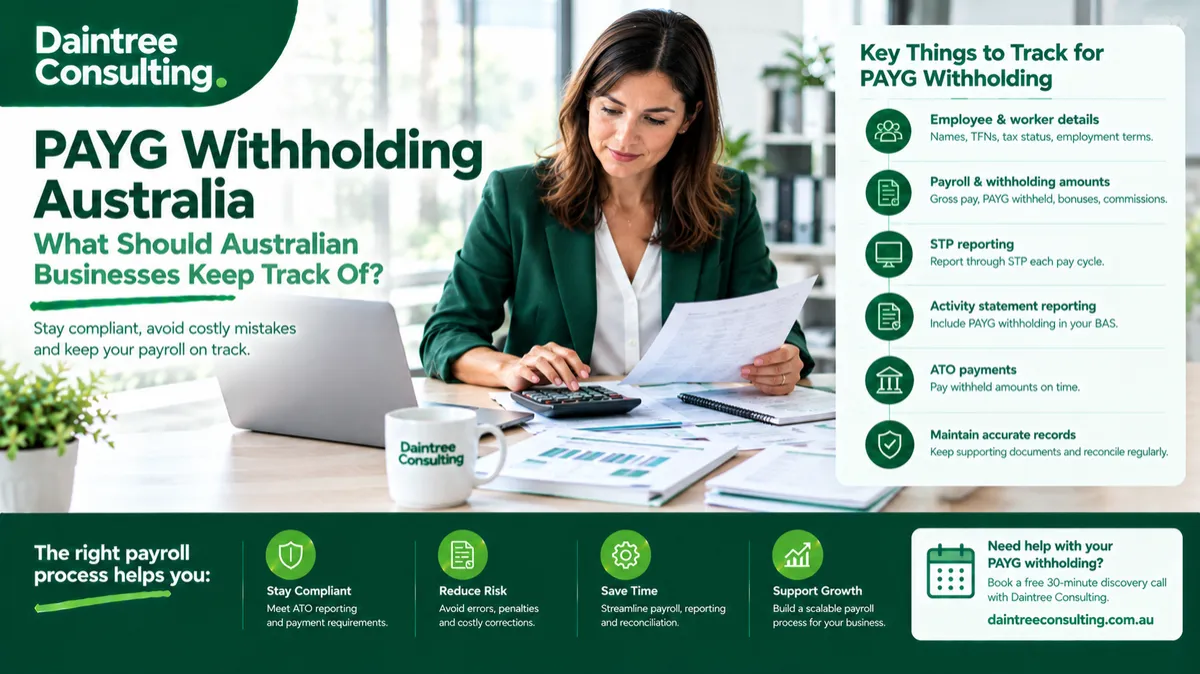
PAYG Withholding Australia: What Employers Should Track
When you employ people in Australia, payroll is more than calculating wages and transferring money into employee bank accounts.
Your business may also need to calculate PAYG withholding, report the amounts withheld to the Australian Taxation Office (ATO), keep appropriate payroll records and ensure the information reported through your payroll system remains accurate.
Want expert help? Daintree Consulting's tax and BAS services can take this off your plate. Book a free consultation.
For growing businesses, PAYG withholding can become difficult to manage when employee numbers increase, payroll becomes more complex or different types of payments are introduced.
A missed withholding amount, incorrect tax treatment or payroll reporting error can create additional work later.
The good news is that PAYG withholding becomes much easier to manage when businesses have a consistent process for collecting employee information, calculating withholding, reconciling payroll and reviewing what is reported.
This guide explains what Australian employers should keep track of and how PAYG withholding fits into the broader bookkeeping, payroll and BAS process.
Quick answer: What should employers keep track of for PAYG withholding?
Australian businesses with PAYG withholding obligations should generally keep track of:
Employee and worker details
Tax file number (TFN) declarations
Withholding declarations and relevant employee updates
Gross payments and taxable earnings
PAYG withholding amounts
Bonuses, commissions and other additional payments
Single Touch Payroll (STP) reporting
Payroll records and supporting documentation
PAYG withholding amounts reported on activity statements
Payments made to the ATO
Year-to-date payroll information
STP finalisation
Corrections and payroll adjustments
Records supporting unusual or non-standard payments
Reconciliations between payroll, accounting records and ATO reporting
The exact obligations depend on the business, workers, payment types and circumstances.
For that reason, PAYG withholding should be treated as an ongoing payroll process rather than something only reviewed at tax time.
What is PAYG withholding?
PAYG withholding is the system businesses use to withhold amounts of tax from certain payments they make to employees and other payees.
Instead of an employee receiving their full gross wage and paying all of their income tax at the end of the year, the employer generally withholds an amount from their pay and sends it to the ATO.
The employee receives their net pay.
The business is responsible for withholding and reporting the appropriate amount.
PAYG withholding can apply to payments such as salary and wages and may also apply to certain other types of payments or workers depending on the circumstances.
Businesses may need to register for PAYG withholding when they have obligations to withhold tax from payments they make.
It is important not to confuse PAYG withholding with PAYG instalments.
PAYG withholding generally relates to amounts withheld from payments to employees and other payees.
PAYG instalments are generally payments made towards a business or individual's own expected income tax liability.
They are different obligations.
Why PAYG withholding needs to be managed carefully
PAYG withholding sits directly within the payroll process.
That means an error in payroll can potentially flow into several areas at once.
For example, an incorrect employee setup could affect:
The employee's gross pay
PAYG withholding
Net pay
STP reporting
Payroll records
Activity statement reporting
Employee income information
End-of-year payroll finalisation
This is why payroll should not be treated as simply a payment-processing task.
A reliable payroll process should connect the underlying employee information, payroll calculations, accounting records and tax reporting.
For Australian businesses, that connection becomes particularly important as the business grows.
1. Keep employee information accurate
One of the first things an employer should keep track of is the information used to determine payroll and PAYG withholding.
This can include:
Employee name
Tax file number information
Tax residency information where relevant
Tax-free threshold election
Study and training support loan information
Withholding declarations
Employment commencement date
Employment status
Pay frequency
Salary or wage arrangements
Relevant payroll classifications
The information supplied by an employee can affect how much tax should be withheld.
If an employee provides an updated declaration, the payroll system needs to reflect the change appropriately.
This is why employee records should be reviewed whenever circumstances change rather than relying on old payroll information indefinitely.
2. Use the correct PAYG withholding tax tables
PAYG withholding calculations are not simply a fixed percentage of every employee's wages.
The amount withheld can depend on factors including:
The employee's earnings
Pay frequency
Tax-free threshold
Residency status
Study and training support loan obligations
Other information provided by the employee
The type of payment being made
The ATO publishes PAYG withholding tax tables and schedules that employers use to calculate withholding.
For the 2026–27 income year, the ATO's current PAYG withholding tax tables apply from 1 July 2026.
Businesses should make sure their payroll software and processes are using the appropriate current tables rather than relying on an outdated calculation or manually maintained spreadsheet.
The ATO also provides tools that can help employers check withholding calculations.
3. Keep track of gross pay and PAYG withheld
For each pay run, businesses should be able to clearly identify:
Gross wages
PAYG withholding
Net wages
Relevant deductions
Other payroll components
Employer superannuation obligations
Year-to-date amounts
The PAYG withholding amount is particularly important because it represents money withheld from employees that the business is required to account for to the ATO.
It should not be treated as additional business revenue or ordinary operating cash.
A common practical mistake is allowing withheld amounts to remain mixed with general business cash without considering upcoming payment obligations.
A stronger approach is to make PAYG withholding visible in the business's cash-flow planning.
4. Keep track of bonuses and additional payments
Payroll can become more complicated when employees receive payments outside their normal salary or wage.
Examples include:
Bonuses
Commissions
Back payments
Certain allowances
Additional payments
Employment termination payments
Different types of payments can have different withholding treatment.
For example, the ATO has specific methods and schedules for calculating withholding on certain additional payments such as bonuses and commissions.
This means a business should not automatically apply its standard payroll calculation to every unusual payment.
Before processing a significant or unusual payment, the payroll process should identify what type of payment it is and whether a different withholding calculation applies.
5. Keep track of Single Touch Payroll reporting
Single Touch Payroll (STP) is an important part of modern Australian payroll administration.
Employers generally report payroll information to the ATO through STP-enabled software.
The information can include employee payments and amounts withheld, along with other payroll information required under the STP reporting framework.
For most employers, STP reporting occurs each time employees are paid.
This means payroll accuracy matters throughout the year.
A business should not wait until the end of the financial year to discover that payroll information has been incorrectly reported for multiple pay periods.
Regular payroll reviews can help identify discrepancies earlier.
6. Reconcile payroll before reporting
One of the most useful controls for PAYG withholding is a regular payroll reconciliation.
The objective is to compare the information in different records and identify differences.
Depending on the business, this may include comparing:
Payroll software
General ledger
Payroll clearing account
Bank payments
PAYG withholding liability
STP reporting
Activity statement information
Employee payroll reports
For example, if payroll software shows $25,000 of PAYG withholding for a reporting period but the accounting records show a different amount, the difference should be investigated.
It may be caused by:
A payroll adjustment
A journal entry
A duplicated transaction
A missed pay run
A correction
A timing difference
Incorrect account coding
The important point is that the difference should be identified and explained rather than simply carried forward.
7. Keep track of activity statement reporting
PAYG withholding amounts generally need to be reported and paid to the ATO according to the business's applicable reporting cycle.
The timing depends on the employer's circumstances and withholding obligations.
The business's activity statement provides the relevant reporting information and due dates.
For businesses that also have GST and other BAS obligations, PAYG withholding becomes part of a wider activity statement process.
This creates an important connection between payroll and BAS preparation.
Before an activity statement is lodged, businesses should ensure that the PAYG withholding figure being reported is supported by the underlying payroll records.
This can help prevent payroll and BAS records from becoming disconnected.
8. Keep track of payments made to the ATO
Reporting PAYG withholding is only part of the process.
The amounts withheld also need to be paid to the ATO in accordance with the applicable payment requirements.
Businesses should therefore maintain a clear record of:
Amount withheld
Reporting period
Amount reported
Amount paid
Payment date
ATO account records
Any outstanding balance
Adjustments or corrections
This makes it easier to reconcile the PAYG withholding liability.
It also helps management understand whether payroll-related tax obligations have actually been paid rather than simply reported.
9. Review the PAYG withholding liability account
In the accounting system, PAYG withholding is generally tracked as a liability.
The balance should represent amounts that have been withheld but have not yet been paid or otherwise accounted for.
A payroll reconciliation can help determine whether the balance makes sense.
If the account continues to accumulate an unexpected balance, that can be a warning sign.
Potential causes might include:
Payments to the ATO not correctly allocated
Payroll journals posted incorrectly
Duplicate payroll entries
Incorrect withholding amounts
Unrecorded payroll transactions
Timing differences
Historical errors
A monthly balance-sheet reconciliation can therefore be a valuable payroll control.
10. Keep employee payroll records organised
Businesses should maintain appropriate records supporting their payroll and PAYG withholding obligations.
Depending on the business, this can include:
TFN declarations
Withholding declarations
Payroll reports
Payslips
Employment records
Payroll journals
STP reports
Bank payment records
ATO activity statements
ATO payment confirmations
Payroll adjustments
Leave records
Bonus calculations
Commission calculations
Termination payment records
Good record keeping is particularly important when payroll contains unusual transactions.
If a question arises later, management should be able to trace the amount from the accounting records back to the underlying payroll information.
11. Review employee changes promptly
Payroll information can become inaccurate when employee changes are not processed promptly.
Examples include:
New employees
Employees leaving the business
Changes to salary
Changes in employment arrangements
Changes to withholding declarations
Changes in tax residency
Changes relating to study and training support loans
Changes to deductions
Changes to payment frequency
A good payroll workflow should have a clear process for notifying whoever manages payroll when employee circumstances change.
The payroll system should then be updated before the next relevant payment is processed.
12. Check STP finalisation at the end of the financial year
The end of the financial year is an important checkpoint.
Employers reporting through STP generally need to make a finalisation declaration by 14 July each year.
Before finalising, businesses should review year-to-date payroll information and check for obvious discrepancies.
This can include reviewing:
Gross payments
PAYG withholding
Employee details
Terminated employees
Reportable fringe benefits where applicable
Other relevant STP amounts
Once STP information is correctly reported and finalised, employees can access their income statement information through ATO online services.
The finalisation process is therefore not something that should be treated as a quick administrative task.
It is a final check of the payroll information reported for the financial year.
13. Keep track of corrections and adjustments
Payroll errors can happen.
An employee may be paid incorrectly, a withholding amount may need to be corrected or a payroll entry may have been coded to the wrong account.
The important thing is to identify and document the correction.
Businesses should be able to explain:
What the original error was
When it occurred
What caused it
How it was corrected
Whether the correction affected PAYG withholding
Whether STP reporting was affected
Whether the accounting records were updated
Avoid making unexplained manual adjustments to payroll accounts.
A clear audit trail makes future reconciliation and review much easier.
14. Be careful when paying contractors
Not every worker is an employee.
Businesses may also engage independent contractors.
The tax treatment can differ depending on the circumstances.
Some contractor arrangements can involve PAYG withholding obligations, including situations involving voluntary withholding agreements.
There can also be separate reporting obligations for certain payments to contractors.
This is why businesses should not assume that simply receiving an invoice from a contractor means no PAYG withholding or reporting obligations exist.
Worker classification should be considered carefully based on the actual arrangement and applicable rules.
15. Keep track of payments where an ABN is not quoted
There are also circumstances where PAYG withholding can apply to payments to suppliers that have not provided an ABN.
This is an area where businesses should have a consistent accounts payable process.
When a new supplier is established, the business should capture the relevant information and determine whether withholding obligations apply.
This helps prevent the issue from being discovered only after a payment has already been made.
PAYG withholding and BAS: how do they connect?
PAYG withholding and BAS obligations are closely connected for many Australian businesses.
A business may be dealing with several obligations through its activity statement, including:
GST
PAYG withholding
PAYG instalments
Other applicable amounts
This means BAS preparation should not be treated as a completely separate process from bookkeeping and payroll.
If payroll records are inaccurate, the PAYG withholding figure used in the activity statement may also be wrong.
A strong BAS process therefore starts with accurate underlying records.
For businesses using external bookkeeping or accounting support, payroll and BAS processes should be coordinated rather than managed as completely separate functions.
Common PAYG withholding mistakes businesses should avoid
Several problems appear repeatedly when payroll processes are not reviewed regularly.
Using outdated tax tables
Tax tables and withholding schedules can change.
Payroll software should be kept up to date and businesses should check that current withholding information is being used.
Failing to update employee declarations
An employee's circumstances can change.
If updated information is not reflected in payroll, withholding may be incorrect.
Treating every payment the same
Bonuses, commissions, back payments and other payments can require different withholding treatment.
Not reconciling payroll
A payroll system can appear to work correctly while accounting records contain discrepancies.
Regular reconciliation can identify problems earlier.
Treating PAYG withholding as ordinary business cash
PAYG withholding represents amounts withheld from payments and payable to the ATO.
Businesses should account for these obligations when managing cash flow.
Ignoring contractor arrangements
A contractor relationship does not automatically mean there are no withholding or reporting obligations.
Leaving payroll corrections unexplained
Manual adjustments without supporting documentation can make later reconciliation difficult.
Waiting until year-end
The longer an error remains undetected, the more difficult it can become to identify and correct.
A practical PAYG withholding checklist for Australian businesses
A business can use the following checklist as part of its payroll review process.
Each pay run
Check:
Employee details
Gross wages
PAYG withholding
Net wages
Deductions
Additional payments
Payroll approval
STP reporting
Each month
Review:
Payroll reports
PAYG withholding liability
Payroll bank payments
General ledger
ATO account
Unusual payroll transactions
Outstanding payroll adjustments
Before BAS or activity statement lodgement
Check:
PAYG withholding figure
Payroll records
STP information
PAYG liability account
Previous reporting periods
ATO payments
Unresolved differences
At financial year-end
Review:
Employee year-to-date information
PAYG withholding totals
STP records
Employee changes
Terminations
Reportable fringe benefits where applicable
Payroll corrections
STP finalisation requirements
This type of recurring process can make payroll compliance much easier to manage.
How can businesses make PAYG withholding easier to manage?
PAYG withholding is easier when it is integrated into a broader bookkeeping and payroll workflow.
A good process should connect:
Employee information → Payroll → PAYG withholding → STP → Accounting records → BAS/activity statement → ATO payment
If one part of the process is disconnected, errors can remain hidden.
For example, payroll may be processed correctly but the accounting entry may be wrong.
Or the accounting records may be correct but the STP information may contain an error.
Regular reconciliation provides a way to identify these differences.
For growing businesses, it can also make sense to document who is responsible for:
Setting up employees
Reviewing payroll
Approving payroll
Processing payments
Checking PAYG withholding
Reconciling payroll accounts
Reviewing STP reporting
Preparing BAS information
Responding to ATO queries
Clear responsibilities reduce the risk of payroll tasks falling between different people.
When should a business get help with payroll and PAYG withholding?
You may want additional bookkeeping or accounting support when:
Payroll is becoming more complex
Employee numbers are increasing
Payroll errors are occurring regularly
PAYG withholding accounts do not reconcile
BAS preparation takes too long
STP corrections are becoming frequent
Contractors and employees are being managed together
Management is unsure whether payroll records are complete
Payroll is being handled manually
There is no documented payroll process
Business owners are spending too much time fixing payroll issues
The objective is not simply to outsource data entry.
A well-managed payroll process should give the business confidence that payroll information is accurate, reconciled and properly connected to its wider financial records.
How Daintree can help with payroll and PAYG withholding
Daintree Consulting helps Australian businesses maintain more organised bookkeeping and payroll processes.
Support can include:
Payroll processing support
PAYG withholding records
Payroll reconciliations
Bank and payroll account reconciliations
Payroll reporting
BAS-ready records
Payroll record organisation
Bookkeeping support
Coordination with accounting and tax requirements
Review of payroll processes
Financial reporting support
The goal is to help businesses keep their financial records organised and make recurring compliance processes easier to manage.
For businesses that are growing, accurate payroll records can also provide a stronger foundation for management reporting and cash-flow visibility.
Need help managing payroll and PAYG withholding?
If your business is spending too much time checking payroll, reconciling PAYG withholding or preparing records for BAS and tax requirements, Daintree Consulting can help.
Book a free 30-minute discovery call with Daintree Consulting to discuss your bookkeeping and payroll requirements.
Frequently Asked Questions
What is PAYG withholding in Australia?
PAYG withholding is the system used to withhold amounts of tax from certain payments made to employees and other payees and remit those amounts to the ATO.
What should employers keep track of for PAYG withholding?
Employers should keep track of employee information, withholding declarations, gross payments, PAYG withholding amounts, payroll records, STP reporting, activity statement reporting, ATO payments and year-end finalisation.
Is PAYG withholding the same as PAYG instalments?
No.
PAYG withholding generally involves amounts withheld from payments made to employees and other payees. PAYG instalments generally relate to payments towards a taxpayer's own expected income tax liability.
Do employers need to register for PAYG withholding?
Businesses generally need to register when they have an obligation to withhold tax from payments they make to workers or other payees. The exact circumstances should be checked against current ATO requirements.
How often does a business report PAYG withholding?
The reporting and payment cycle depends on the business's circumstances and applicable PAYG withholding requirements. Businesses should follow the reporting period and due dates specified by the ATO.
Does PAYG withholding need to be reported through STP?
PAYG withholding associated with payroll is generally reported as part of the employer's STP reporting obligations where applicable.
What happens if payroll information is incorrect?
The business should identify the error, determine whether payroll, STP, accounting or ATO reporting is affected, and make the appropriate correction. Keeping a clear record of the correction is important.
Should payroll be reconciled?
Yes.
Regular payroll reconciliation can help identify differences between payroll software, accounting records, bank payments, PAYG withholding liabilities and ATO reporting.
Do contractors have PAYG withholding?
Not every contractor payment is subject to PAYG withholding. The treatment depends on the circumstances and the nature of the arrangement. Certain contractor arrangements can create withholding or reporting obligations.
Can PAYG withholding affect BAS preparation?
Yes.
For businesses that report PAYG withholding through their activity statement, payroll information needs to support the PAYG withholding amount being reported.
What happens at the end of the financial year?
Employers reporting through STP generally need to review and finalise their payroll information and make a finalisation declaration by 14 July each year.
How can Daintree Consulting help with PAYG withholding?
Daintree Consulting can support Australian businesses with bookkeeping, payroll, reconciliations, payroll records and BAS-ready financial information, helping create a more organised process around recurring financial obligations.
Talk to Daintree about your tax and BAS
Our ex-Big 4 team gives clear, senior-reviewed advice so you can act with confidence.
Book a free consultation →
Or explore our tax and BAS services.
