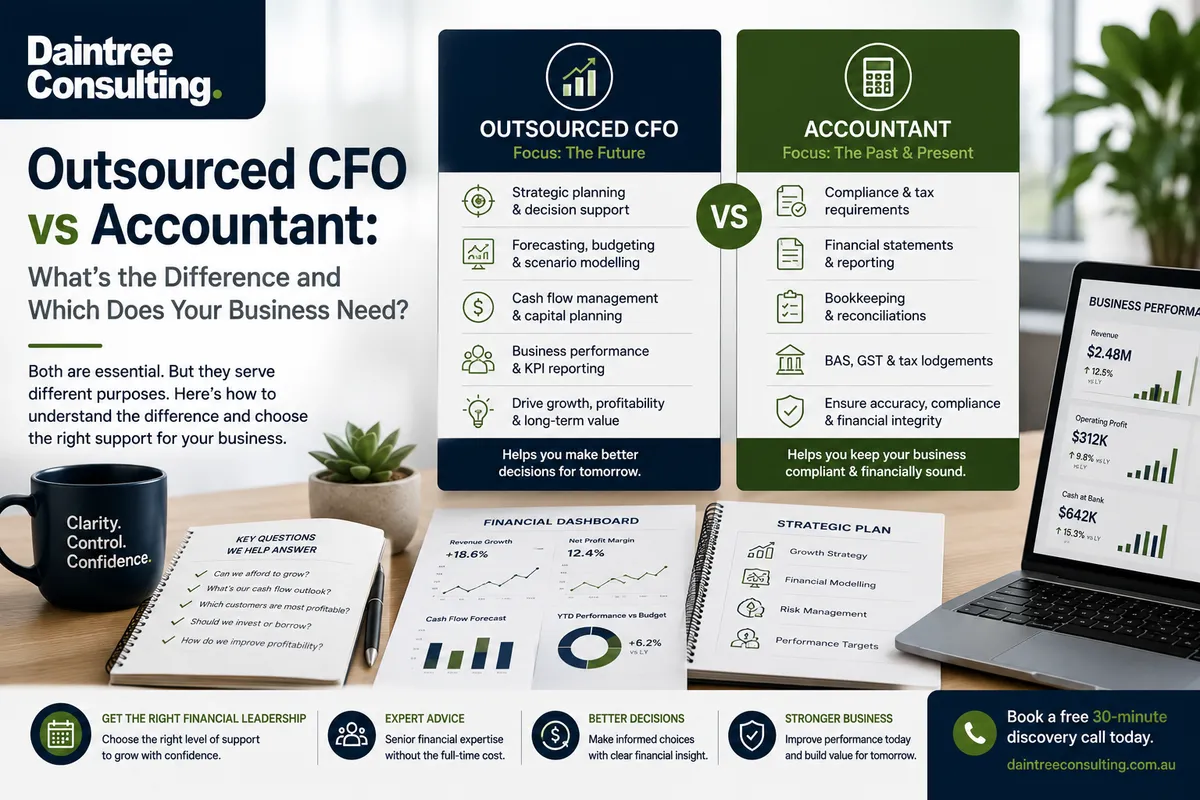
Outsourced CFO vs Accountant: Which Does Your Business Need?
As a business grows, the financial questions become more complicated.
Your accountant may have handled your tax returns, BAS, financial statements and compliance for years. But eventually, you may start asking different questions:
Want expert help? Daintree Consulting's outsourced CFO services can take this off your plate. Book a free consultation.
Can we afford to hire another 10 people?
Why is revenue growing but cash flow still tight?
Should we open another location?
What will happen to profitability if we increase our prices?
Are we financially ready to borrow, invest or acquire another business?
These are not simply compliance questions.
They require forward-looking financial analysis, modelling and commercial judgement.
That is where the difference between an accountant and an outsourced CFO becomes important.
An accountant generally helps ensure your financial records are accurate and your compliance obligations are managed.
An outsourced CFO goes further by helping leadership understand what the numbers mean, what is likely to happen next and what decisions should be considered.
The two roles are not competitors.
For many growing Australian businesses, the best solution is an integrated finance function where accounting and CFO-level support work together.
Quick Answer: Outsourced CFO vs Accountant
The simplest distinction is:
An accountant primarily helps you understand and manage your financial records, reporting and compliance.
An outsourced CFO helps you use financial information to make strategic business decisions.
An accountant may focus on:
Tax returns
BAS
Financial statements
Accounting records
Compliance
Reconciliations
Tax planning
Historical financial reporting
An outsourced CFO may focus on:
Cash-flow forecasting
Financial modelling
Budgets and forecasts
Scenario planning
Business performance
Growth strategy
Funding and capital planning
Management reporting
Profit improvement
Strategic decision support
There is some overlap between the two roles.
The important difference is generally the level of forward-looking financial leadership and commercial decision support required.
What Does an Accountant Do?
An accountant is responsible for a broad range of financial and compliance activities.
Depending on the firm and engagement, an accountant may help with:
Financial statements
Tax returns
BAS and GST matters
Tax planning
Accounting records
Year-end accounts
Compliance requirements
Management reports
Financial analysis
Business structuring
General financial advice
A good accountant can also provide valuable commercial guidance.
The misconception is that every accountant performs exactly the same role.
They don't.
Some firms are heavily focused on compliance. Others offer extensive business advisory and management accounting services.
So when comparing an accountant with an outsourced CFO, the question should not simply be:
"What qualification does this person have?"
Instead, ask:
"What financial problem do I need them to solve?"
What Does an Outsourced CFO Do?
An outsourced CFO provides senior financial leadership without the business necessarily needing to employ a full-time Chief Financial Officer.
The role is usually more strategic and forward-looking.
An outsourced CFO may help leadership with:
Cash-flow forecasting
Rather than simply showing the current bank balance, the CFO helps forecast where cash is heading.
This can identify potential funding requirements before they become urgent.
Financial modelling
The CFO can model different scenarios before management commits to a major decision.
For example:
Hiring additional employees
Increasing prices
Opening another location
Purchasing equipment
Taking on debt
Launching a new product
Acquiring another business
Budgeting and forecasting
An outsourced CFO can help establish realistic budgets and rolling forecasts, then compare actual performance against expectations.
Management reporting
Instead of relying solely on statutory financial statements, leadership receives information designed specifically for decision-making.
Profit improvement
A CFO can analyse margins, pricing, overheads, customer profitability and operational performance to identify opportunities to improve profitability.
Strategic decision support
The CFO becomes a financial sounding board for the leadership team.
The objective is not simply to tell management what happened.
It is to help answer:
"What should we do next?"
Accountant vs Outsourced CFO: The Main Difference
The easiest way to understand the difference is to consider the time horizon.
An accountant often spends significant time looking at:
What happened?
An outsourced CFO spends more time considering:
What is happening?
and:
What could happen next?
For example, an accountant might report that the business generated $2 million in revenue last financial year.
A CFO may take that information and ask:
What drove the growth?
Was the growth profitable?
Which customers generated the strongest margins?
What happens if revenue grows another 20%?
Can the current team support that growth?
How much working capital will be required?
Can the business afford the planned investment?
What happens to cash flow under different scenarios?
The accountant provides the financial foundation.
The CFO helps leadership use that foundation to make decisions.
Do You Need an Accountant or an Outsourced CFO?
For many businesses, the answer is both.
An outsourced CFO does not replace the need for accurate accounting.
In fact, CFO-level advice depends on reliable underlying financial information.
A useful finance structure can look like this:
Bookkeeping → Accounting & Compliance → Management Reporting → CFO Analysis → Strategic Decisions
Each layer serves a different purpose.
If the bookkeeping is unreliable, management reporting becomes questionable.
If management reporting is poor, CFO analysis becomes less useful.
If there is no forward-looking analysis, leadership may struggle to understand the financial consequences of major decisions.
When an Accountant May Be Enough
You may not need CFO-level support if your business is relatively straightforward.
An accountant may be sufficient when:
The business is small and stable
Transactions are relatively simple
Cash flow is predictable
There are few employees
There are no major expansion plans
The owner understands the financial position
Compliance is the primary requirement
Major financial decisions are relatively infrequent
In this situation, paying for a full CFO service may provide more support than the business actually needs.
The goal should always be to match the level of financial support to the complexity of the business.
7 Signs Your Business May Need an Outsourced CFO
1. Revenue Is Growing but Cash Flow Is Tight
This is one of the most common warning signs.
Growth can consume cash.
You may need to purchase inventory, hire employees, pay suppliers and fund expansion before customers pay you.
A CFO can help model the cash requirements of growth and identify potential funding gaps.
2. You're Making Major Decisions Without Financial Modelling
If you are making decisions based largely on intuition, it may be time for more financial leadership.
Before opening another location, hiring a senior employee or taking on significant debt, leadership should understand the likely financial consequences.
Scenario modelling can turn:
"I think we can afford this."
into:
"Here is what happens to profit and cash flow under three different scenarios."
3. Your Financial Reports Arrive Too Late
Financial reports are much less valuable when they arrive long after the period they describe.
If you only discover problems at year-end, you have missed the opportunity to respond earlier.
A CFO-focused reporting process aims to give leadership timely information that can influence decisions while there is still time to act.
4. You Don't Know Your True Profit Margins
Revenue is easy to celebrate.
Profitability requires more analysis.
If you don't know which products, services, customers or locations generate the strongest margins, it can be difficult to allocate resources effectively.
An outsourced CFO can help develop reporting that makes these differences visible.
5. The Owner Is Still the Finance Department
As a business grows, the owner can become the bottleneck.
You may still be:
Reviewing every payment
Checking cash balances
Answering finance questions
Chasing financial reports
Building spreadsheets
Trying to understand forecasts
Making every financial decision personally
That may work at a smaller scale.
Eventually, leadership needs a finance function that supports the business rather than depending entirely on the owner.
6. You're Preparing for Funding, Acquisition or Sale
Major financial events require more than historical accounts.
If you're preparing for:
Bank funding
Investment
Acquisition
Business sale
Succession
Major expansion
you may need forecasts, financial models, scenario analysis and stronger management reporting.
CFO-level support can help prepare the business and its financial information for those conversations.
7. You Want to Grow but Don't Know What Growth Will Cost
Growth sounds positive.
But growth requires resources.
You may need:
More employees
More stock
More equipment
Larger premises
Additional marketing
New systems
Additional working capital
An outsourced CFO can help determine whether the business has the financial capacity to support the next stage.
Outsourced CFO vs Accountant: What’s the Difference?
The easiest way to understand the difference is to look at the primary focus of each role.
An Accountant Typically Focuses On
Bookkeeping and accounting records
Financial statements
BAS and tax compliance
Tax returns and tax planning
Reconciliations
Historical financial reporting
Accounting accuracy and compliance
General financial reporting
The accountant's role is often centred on making sure the financial records are accurate, compliant and useful.
An Outsourced CFO Typically Focuses On
Cash-flow forecasting
Budgeting and financial forecasting
Scenario and financial modelling
Management reporting
Business performance analysis
Profit improvement
Growth planning
Funding and capital planning
KPI reporting
Strategic financial decision-making
The outsourced CFO's role is more forward-looking, helping leadership understand what the numbers mean and what decisions should be considered next.
Where the Two Roles Overlap
There can be significant overlap between accounting and CFO services.
An experienced accountant may already provide:
Management reporting
Forecasting
Business advisory
Financial modelling
Strategic planning
Likewise, an outsourced CFO may work closely with the accounting team to ensure that the information being used for strategic decisions is accurate.
The important distinction is not the job title. It is the level and type of financial support your business needs.
Can an Accountant Also Be Your CFO?
Yes.
There is no rule saying that an accountant cannot provide CFO-level services.
In fact, many experienced accountants have the commercial knowledge required to act as a fractional or outsourced CFO.
The important distinction is the service being provided, not simply the person's job title.
Ask whether your current accountant provides:
Regular management reporting
Cash-flow forecasting
Financial modelling
Scenario analysis
Budgeting
KPI reporting
Strategic financial advice
Funding support
Ongoing leadership-level decision support
If they do, you may already have access to CFO-level support without needing another provider.
What Does an Outsourced CFO Cost in Australia?
Outsourced CFO pricing varies significantly depending on the business.
Factors that can influence cost include:
Business size
Number of entities
Revenue
Transaction complexity
Number of employees
Reporting requirements
Forecasting requirements
Frequency of meetings
Financial modelling needs
Funding or transaction activity
Some businesses need only a few hours of senior financial support each month.
Others require a much more involved finance function.
This is why a fixed universal price is usually misleading.
The right question is:
What level of financial leadership does the business actually need?
A part-time CFO arrangement can provide senior financial expertise without the full employment cost of hiring a permanent CFO.
Why Outsourcing Can Make Sense for Growing SMEs
Hiring a full-time CFO can be a significant commitment.
Beyond salary, there can be:
Superannuation
Leave
Recruitment costs
Employment overhead
Technology
Training
Management costs
An outsourced CFO provides access to senior expertise on a flexible basis.
The business can scale the level of support according to its needs.
For an SME that needs strategic financial leadership but does not yet require a full-time CFO, this can be an effective middle ground.
What Should You Look for in an Outsourced CFO?
Not all outsourced CFO services are the same.
Before engaging a provider, ask:
Do they understand your industry?
Industry knowledge can help an advisor identify relevant risks and benchmarks more quickly.
Can they work with your existing accountant?
An effective CFO should complement the accounting function rather than create unnecessary duplication.
Do they provide forward-looking analysis?
Forecasting and scenario modelling should be more than simply producing historical reports.
Can they explain financial information clearly?
The best CFOs can translate complex financial information into practical business decisions.
Do they understand the underlying numbers?
CFO advice is stronger when it is built on reliable accounting data.
Are they commercially focused?
You need someone who understands that the purpose of financial reporting is ultimately to help the business make better decisions.
The Best Finance Structure May Be Integrated
The debate between outsourced CFO vs accountant can sometimes create a false choice.
Growing businesses often need both.
A strong integrated finance function can provide:
Bookkeeping
Accurate day-to-day financial records.
Accounting
Financial reporting and compliance.
Management reporting
Clear information about business performance.
Business advisory
Practical support for important decisions.
Outsourced CFO
Senior financial leadership, forecasting and strategic analysis.
This creates a connected system rather than separate providers working independently.
How Daintree Consulting Approaches Accounting and CFO Support
At Daintree Consulting, we believe financial support should evolve with the business.
A company may initially need reliable bookkeeping and compliance.
As it grows, it may need management reporting, forecasting and business advisory.
Eventually, it may need senior financial leadership without the cost of employing a full-time CFO.
Our integrated approach can combine:
Accounting
Bookkeeping
Payroll
Tax and compliance
Management reporting
Business advisory
Financial forecasting
Cash-flow reporting
Outsourced CFO services
The benefit is that strategic advice is connected to the underlying financial information.
You don't have to explain your business from scratch to multiple providers.
The goal is simple:
Give leadership the financial clarity and senior support required to make confident decisions as the business grows.
So, Which Does Your Business Need?
If your primary concern is tax, compliance and accurate financial records, an accountant may be the right starting point.
If your business is increasingly focused on growth, cash flow, forecasting, profitability and major strategic decisions, CFO-level support may be appropriate.
And if you are growing quickly, you may benefit from an integrated approach that combines both.
A useful test is to ask:
Are we mainly trying to understand what happened, or do we need help deciding what happens next?
If the answer is increasingly the second, it may be time to consider outsourced CFO support.
Ready to Find the Right Level of Financial Support?
You don't necessarily need a full-time CFO to gain access to senior financial expertise.
An outsourced CFO can provide the forecasting, reporting, financial modelling and strategic support your business needs while allowing the level of service to grow with you.
If you're unsure whether your business needs an accountant, business advisor, outsourced CFO or an integrated finance function, Daintree Consulting can help you assess the right approach.
Book a free 30-minute discovery call. We'll look at your current financial setup, reporting needs and business priorities and identify a practical next step — with no pressure and no obligation.
Frequently Asked Questions
What is the difference between an outsourced CFO and an accountant?
An accountant generally focuses on accounting, reporting and compliance, while an outsourced CFO provides more forward-looking financial leadership, including forecasting, financial modelling, performance analysis and strategic decision support.
Does an outsourced CFO replace an accountant?
Usually not. An outsourced CFO and accountant can perform complementary roles. The CFO uses reliable financial information to help leadership make decisions, while accounting functions maintain the underlying financial and compliance framework.
Is an outsourced CFO worth it for a small business?
It can be, particularly when the business is growing, experiencing cash-flow challenges or making increasingly complex financial decisions. Very small or straightforward businesses may only need traditional accounting support.
When should a business hire an outsourced CFO?
Common triggers include rapid growth, unpredictable cash flow, increasing financial complexity, major investment decisions, funding requirements, expansion or the need for better management reporting and forecasting.
Can my accountant become my outsourced CFO?
Yes. Some accounting firms provide both traditional accounting and CFO-level advisory services. The important question is whether your accountant has the experience and systems to provide the forward-looking support your business needs.
What does an outsourced CFO actually do each month?
Depending on the engagement, an outsourced CFO may review financial performance, update forecasts, analyse cash flow, monitor KPIs, prepare management reports, model scenarios and meet with leadership to discuss financial decisions.
Is a virtual CFO the same as an outsourced CFO?
The terms are often used interchangeably. Both generally describe a CFO-level service provided externally rather than through a full-time internal CFO. The exact scope depends on the provider and engagement.
How much does an outsourced CFO cost in Australia?
There is no single standard price. Fees depend on the level of involvement, business complexity, reporting requirements and scope of services. Some businesses need light monthly support, while others require a more comprehensive outsourced finance function.
Does Daintree Consulting provide outsourced CFO services?
Yes. Daintree Consulting provides outsourced CFO and financial advisory support for Australian businesses, alongside accounting, bookkeeping, payroll and management reporting services.
Important Publishing Note
Forecasts, budgets and financial projections are based on assumptions and professional judgement and are not guarantees of future business performance. Actual results may differ due to changes in market conditions, business decisions, inaccurate assumptions and other factors. The appropriate level of financial support depends on the individual circumstances, structure and needs of each business.
Talk to Daintree about your finance function
Our ex-Big 4 team gives clear, senior-reviewed advice so you can act with confidence.
Book a free consultation →
Or explore our outsourced CFO services.
