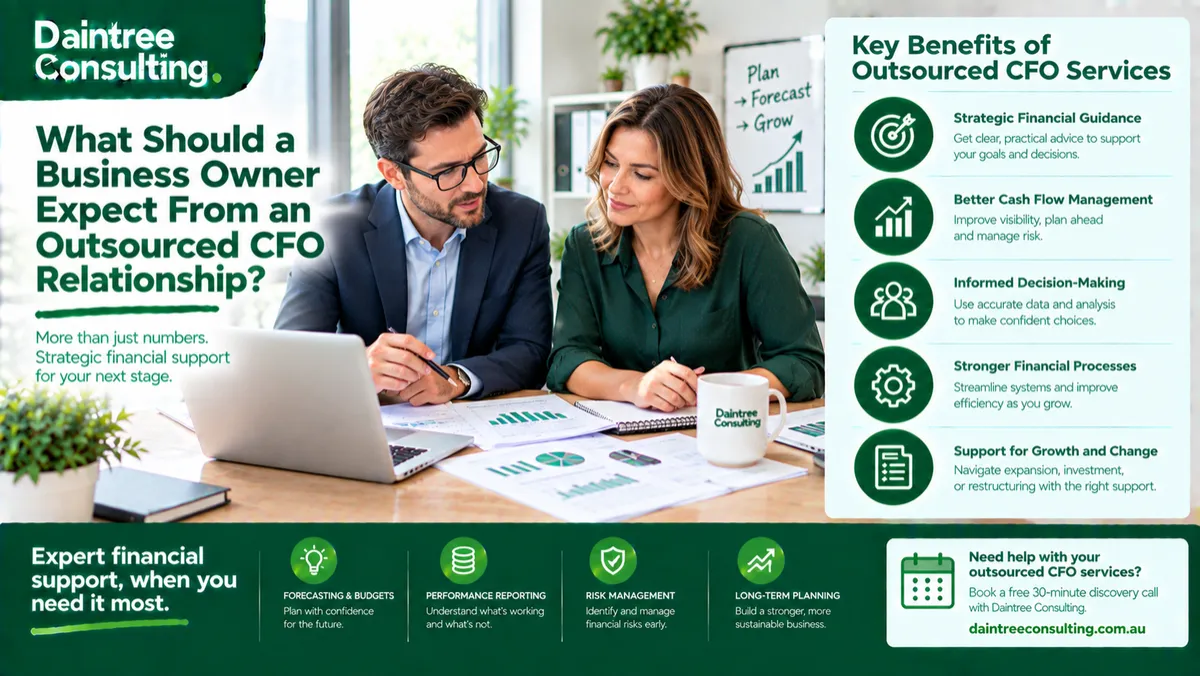
What Should a Business Owner Expect From an Outsourced CFO Relationship?
An outsourced CFO relationship should be about more than receiving another financial report at the end of the month.
For a growing Australian business, the real value of outsourced CFO services is having access to senior financial thinking when important decisions need to be made.
Want expert help? Daintree Consulting's outsourced CFO services can take this off your plate. Book a free consultation.
That might mean understanding whether the business can afford to hire, assessing whether expansion is financially realistic, improving cash flow visibility, preparing for funding discussions, reviewing performance, or deciding what financial information leadership should actually be monitoring.
The relationship should also work both ways. An outsourced CFO needs reliable financial information and access to the people making decisions, while the business should expect clear communication, practical advice and a defined understanding of what the CFO is responsible for.
So, what should a business owner actually expect?
What Is an Outsourced CFO Relationship?
An outsourced CFO relationship gives a business access to CFO-level financial leadership without necessarily employing a full-time Chief Financial Officer.
The arrangement may be ongoing, part-time, monthly, project-based or structured around particular business milestones.
The important point is that the relationship should be designed around the business's financial needs.
A good outsourced CFO does not simply take over bookkeeping or prepare historical reports. The role is generally more forward-looking.
It can involve:
Financial forecasting and scenario modelling
Cash-flow and working-capital oversight
Management and board reporting
KPI development and performance reviews
Financial planning
Funding and due-diligence preparation
Finance-team leadership
Support for significant business decisions
Identifying financial risks and areas requiring attention
The exact scope depends on the business, its existing finance function and the reason for engaging the CFO.
For example, a business with a capable bookkeeper may need an outsourced CFO primarily for forecasting, management reporting and strategic decision support.
Another business may need more hands-on support because its finance processes, reporting and internal team require greater structure.
The relationship should reflect that difference.
1. Expect a Clear Understanding of Your Business
An outsourced CFO should not begin with a generic financial checklist and assume every business needs the same thing.
Before providing ongoing advice, the CFO needs to understand how the business actually operates.
That includes questions such as:
How does the business generate revenue?
What are the major costs?
What drives profitability?
How quickly does the business convert sales into cash?
What working-capital pressures exist?
What financial decisions are coming up?
What reporting does management currently receive?
What accounting and bookkeeping systems are already in place?
Who is responsible for finance internally?
What are the owner's current priorities?
This context matters because the same financial result can mean very different things depending on the business model.
A professional services business, construction company, retailer and technology business may all have different cash-flow cycles, cost structures and performance measures.
The outsourced CFO should therefore spend time understanding the commercial drivers behind the numbers.
2. Expect More Than Historical Financial Reporting
Traditional accounting reports are important, but an outsourced CFO relationship should generally move beyond simply explaining what happened.
Historical reporting answers questions such as:
What happened last month?
CFO-level support should also help answer:
What could happen next, and what should we do about it?
That may involve:
Cash-flow forecasts
Budgets and reforecasts
Scenario modelling
Profitability analysis
KPI reporting
Working-capital analysis
Sensitivity analysis
Financial planning around major decisions
For example, if a business is considering opening another location, the conversation should not stop at whether the business made a profit last year.
The business owner may need to understand the expected investment, additional operating costs, timing of cash outflows, likely revenue ramp-up, funding requirements and potential downside scenarios.
That is where the relationship moves from accounting information towards financial decision support.
3. Expect Regular Communication
An outsourced CFO should not feel like someone you only hear from when the monthly report is ready.
The communication cadence should be agreed at the beginning of the engagement.
Depending on the business and scope, that could mean:
Monthly management meetings
Fortnightly financial reviews
Quarterly strategic sessions
Project-based meetings
Additional discussions around significant decisions
There is no single correct frequency.
A business undergoing rapid growth, funding preparation or restructuring may require more frequent interaction than a stable business using CFO support primarily for monthly reporting and strategic review.
The important thing is that the cadence supports decision-making.
You should know when financial information will be available, when performance will be reviewed and how issues requiring attention will be raised.
4. Expect Questions, Not Just Answers
One of the most useful parts of an outsourced CFO relationship can be having someone who asks questions that the business owner may not have considered.
For example:
Why has revenue increased but cash remained tight?
Why is gross margin changing?
Which customers or services are generating the strongest contribution?
Are overheads increasing faster than revenue?
What happens to cash flow if sales fall by 10%?
Can the business afford the planned hiring?
What happens if a major customer pays late?
Are current reporting systems adequate for the next stage of growth?
Which financial risks deserve attention now?
The role is not simply to produce numbers.
It is to help leadership understand what the numbers may mean in the context of the business.
That can lead to better questions, clearer priorities and more disciplined decision-making.
5. Expect Clear Management Reporting
A business owner should expect financial information to be presented in a way that supports decisions.
That does not necessarily mean producing a huge monthly report.
In many cases, a focused management reporting pack can be more useful than pages of financial data.
Depending on the business, reporting may include:
Profit and loss
Balance sheet
Cash-flow position
Cash-flow forecast
Budget versus actual results
Key performance indicators
Revenue trends
Gross margin
Operating expenses
Accounts receivable
Accounts payable
Working capital
Relevant business-specific metrics
The purpose should be clarity.
A report should help the owner identify what is performing as expected, what has changed, what requires investigation and where a decision may be needed.
6. Expect Cash Flow to Be a Regular Conversation
Profit and cash are not the same thing.
A business can report accounting profit while still experiencing significant cash pressure.
That is why cash-flow management should often form an important part of an outsourced CFO relationship.
The CFO may help management understand:
Expected cash inflows
Upcoming payments
Debtor collection timing
Supplier commitments
Payroll requirements
Tax and other obligations
Working-capital movements
Planned capital expenditure
Debt commitments
Potential funding requirements
The objective is not to predict the future perfectly.
Forecasts are based on assumptions and can change as circumstances change.
The value comes from creating a structured view of the likely cash position and updating it when important assumptions move.
7. Expect Financial Forecasts to Be Challenged and Updated
A forecast should not be treated as a document that is prepared once and then forgotten.
Business conditions change.
Sales assumptions may change. Costs may increase. Customers may delay payments. A new contract may be signed. A planned investment may be postponed.
An outsourced CFO should therefore help the business understand which assumptions sit behind its forecast and what happens when those assumptions change.
Scenario modelling can be particularly useful.
For example, management might consider:
Base case:
What happens if current expectations broadly hold?
Upside case:
What happens if sales growth is stronger than expected?
Downside case:
What happens if revenue falls, costs increase or cash receipts are delayed?
The objective is not to predict exactly which scenario will occur.
It is to help management understand its financial exposure and prepare for different possibilities.
8. Expect the CFO to Work With Your Existing Finance Team
An outsourced CFO does not necessarily replace your accountant or bookkeeper.
In many businesses, the relationship works alongside existing finance professionals.
For example:
Bookkeeper:
Maintains day-to-day financial records and transactions.
Accountant:
May handle accounting, tax, compliance and financial reporting requirements.
Outsourced CFO:
Provides higher-level financial leadership, forecasting, performance analysis and decision support.
The exact division of responsibilities will vary.
The important thing is to establish who owns each responsibility.
A good outsourced CFO relationship should reduce confusion rather than create another layer of it.
That means clarifying who prepares reports, who reviews them, who handles compliance, who communicates with the owner and who is responsible for particular finance processes.
9. Expect the CFO to Help Turn Financial Information Into Decisions
Financial information is only useful if it helps management make better-informed decisions.
Suppose a business is considering hiring three additional employees.
The CFO may help analyse:
Current profitability
Existing cash reserves
Expected salary and employment costs
Revenue required to support the additional cost
Timing of the investment
Cash-flow impact
Potential downside scenarios
Whether the business has sufficient operational capacity
The CFO does not make the business owner's decision for them.
Instead, the role is to provide financial analysis and context so the owner can make the decision with a clearer understanding of the financial implications.
That distinction matters.
10. Expect Greater Accountability Around Financial Priorities
An outsourced CFO can also provide an additional layer of financial accountability.
Once the business has agreed on particular targets or priorities, someone needs to monitor whether progress is actually occurring.
That might involve reviewing:
Revenue targets
Gross margins
Operating costs
Cash-flow objectives
Debtor days
Working capital
Forecast accuracy
Key project performance
Financial milestones
This does not mean turning every business decision into a KPI.
It means identifying the measures that genuinely matter and reviewing them consistently.
11. Expect Support During Important Business Events
The value of an outsourced CFO relationship can become particularly visible when the business reaches an important financial decision.
Examples may include:
Expanding into a new location
Hiring a larger team
Purchasing significant assets
Taking on additional debt
Preparing for funding discussions
Reviewing business profitability
Restructuring operations
Changing ownership arrangements
Preparing for due diligence
Considering an acquisition
Planning for a future exit
These decisions can involve financial consequences that extend well beyond the immediate transaction.
An outsourced CFO can help model the numbers, identify assumptions and prepare financial information for the decision.
12. Expect the Relationship to Evolve
Your business may not need exactly the same CFO support 12 months from now that it needs today.
A business may initially engage an outsourced CFO because cash flow is difficult to understand.
Later, the priority might become growth planning.
Then the focus may shift towards funding, management reporting, financial controls or preparing for a transaction.
The relationship should therefore be capable of changing as the business changes.
This is one of the practical advantages of outsourced CFO services.
Rather than designing the role around a permanent job description, the engagement can be shaped around the business's current financial leadership requirements.
What Should the First 90 Days Look Like?
There is no universal 90-day process, but the early stages of an outsourced CFO relationship will often involve understanding the current position before trying to change everything.
Stage 1: Understand the Current Position
The CFO reviews the existing financial information, systems, reporting, forecasts and business priorities.
The objective is to identify the biggest gaps rather than immediately introduce unnecessary processes.
Stage 2: Establish a Financial Baseline
The business needs a reliable starting point.
That may include reviewing financial reporting, cash flow, working capital, profitability and existing forecasts.
If the underlying information is incomplete or unreliable, improving the quality of the inputs may need to happen before sophisticated forecasting or analysis can be useful.
Stage 3: Establish the Reporting Rhythm
The business and CFO agree on what should be reported, when it should be reported and who needs to review it.
This creates a repeatable management process.
Stage 4: Identify the Key Financial Priorities
Not every issue needs to be solved simultaneously.
The CFO should help identify the areas that matter most to the business now.
That could be cash flow, profitability, reporting, forecasting, funding preparation, financial controls or another commercial priority.
Stage 5: Move Into Ongoing Decision Support
Once the reporting foundation is working, the relationship can become more forward-looking.
The focus shifts towards reviewing performance, updating forecasts, evaluating decisions and helping management respond to changes.
What Should a Business Owner Bring to the Relationship?
The relationship works best when the business owner is willing to provide context rather than simply handing over the numbers.
A CFO needs to understand what is happening operationally.
That means communicating things such as:
Planned hiring
New contracts
Major customer changes
Pricing changes
Expansion plans
Supplier issues
Potential investments
Funding discussions
Operational problems
Strategic priorities
Financial reports do not always reveal these developments early.
The CFO can only provide useful analysis when they understand what is changing inside the business.
What Should You Not Expect From an Outsourced CFO?
Clear expectations are just as important as understanding the benefits.
An outsourced CFO should not automatically be expected to:
Replace every bookkeeping function
Replace the business owner's responsibilities
Guarantee profitability
Guarantee funding approval
Predict future results with certainty
Make every commercial decision for management
Resolve every operational problem
Provide regulated financial advice outside the agreed scope
Forecasts and financial models are based on assumptions and professional judgement. Actual results can differ.
Similarly, funding support can help prepare financial models, forecasts and information for lenders or investors, but the final funding decision belongs to the relevant lender or investor.
Defining these boundaries early helps create a healthier working relationship.
How Do You Know If the Relationship Is Working?
The value of an outsourced CFO relationship should not be measured only by the number of reports produced.
Instead, ask whether the relationship is improving the quality of financial decision-making.
Useful questions include:
Do we understand our current financial position?
Do we have better visibility over future cash flow?
Are financial issues being identified earlier?
Do we understand the reasons behind major changes in performance?
Are our management reports useful?
Are forecasts being reviewed and updated?
Do we know which KPIs actually matter?
Can we assess major decisions using financial information?
Are financial responsibilities clear across the team?
Do we have better visibility over financial risks?
Is the finance function supporting the direction of the business?
If the answer to these questions is consistently yes, the relationship is doing more than producing financial information.
It is helping build stronger financial leadership.
Outsourced CFO Services Should Be Built Around the Business
There is no single outsourced CFO model that works for every Australian business.
A business with a strong internal finance team may need senior oversight and strategic decision support.
A growing business may need forecasting, cash-flow management and management reporting.
Another business may need support preparing for funding, expansion, restructuring or due diligence.
The important thing is that the CFO relationship should be built around the decisions the business needs to make.
At Daintree Consulting, outsourced CFO services are structured around flexible financial leadership for growing and complex businesses. The current service scope includes forecasting and scenario modelling, cash-flow and working-capital oversight, management reporting, KPI design, funding and due-diligence preparation, and finance-team leadership.
The engagement process is designed to begin by diagnosing the finance and decision-making gap, stabilising reporting inputs and the baseline forecast, establishing an executive reporting cadence, and then supporting decisions and continuous improvement.
Frequently Asked Questions
Is an outsourced CFO the same as an accountant?
No. There can be overlap, but the focus is generally different.
An accountant may focus on accounting records, financial statements, tax and compliance, while an outsourced CFO typically provides more forward-looking financial leadership, forecasting, performance analysis and decision support.
The roles can work together rather than being mutually exclusive.
How often should I meet with an outsourced CFO?
It depends on the business and engagement scope.
Some businesses may benefit from monthly meetings, while others may need fortnightly or project-based support. Daintree's current outsourced CFO service notes that engagement cadence can be monthly, fortnightly, quarterly or project-based depending on the circumstances.
Can an outsourced CFO work with my existing bookkeeper?
Yes.
An outsourced CFO can work alongside an internal finance team, external bookkeeper or broader outsourced finance arrangement. The key is establishing clear responsibilities and communication between everyone involved.
Can an outsourced CFO help with funding?
An outsourced CFO can help prepare forecasts, financial models and information for funding or due diligence.
However, the CFO cannot guarantee that a lender or investor will approve funding. The final decision remains with the relevant lender or investor.
Is an outsourced CFO only for large businesses?
No.
The relevant question is not simply business size. It is whether the business has financial complexity or decision-making requirements that would benefit from senior financial leadership.
A growing SME may reach a point where annual accounting and basic bookkeeping no longer provide enough forward-looking financial visibility.
What should I prepare before speaking with an outsourced CFO?
Useful information can include current financial reports, cash-flow information, budgets or forecasts, details of major financial commitments and a clear explanation of the decisions or challenges currently facing the business.
You do not necessarily need everything to be perfect before the first conversation.
A good initial discussion should help identify where the biggest finance and decision-support gaps are.
Final Takeaway
An outsourced CFO relationship should be more than outsourced reporting.
For the right business, it can provide a structured source of senior financial leadership that connects accounting information with cash flow, performance, forecasting and commercial decision-making.
The business owner should expect clear responsibilities, regular communication, useful reporting, practical financial analysis and support when important decisions arise.
Most importantly, the relationship should evolve with the business.
If your business has reached the point where financial decisions are becoming more complex, cash flow is harder to predict, or you need more forward-looking insight than your current finance function provides, it may be worth considering whether outsourced CFO services could fill that gap.
Need greater clarity around your business finances?
Daintree Consulting provides flexible outsourced CFO services for Australian businesses that need stronger forecasting, reporting, financial oversight and decision support.
Book a free 30-minute discovery call with Daintree Consulting to discuss the financial decisions in front of your business and identify a practical next step.
Talk to Daintree about your finance function
Our ex-Big 4 team gives clear, senior-reviewed advice so you can act with confidence.
Book a free consultation →
Or explore our outsourced CFO services.
