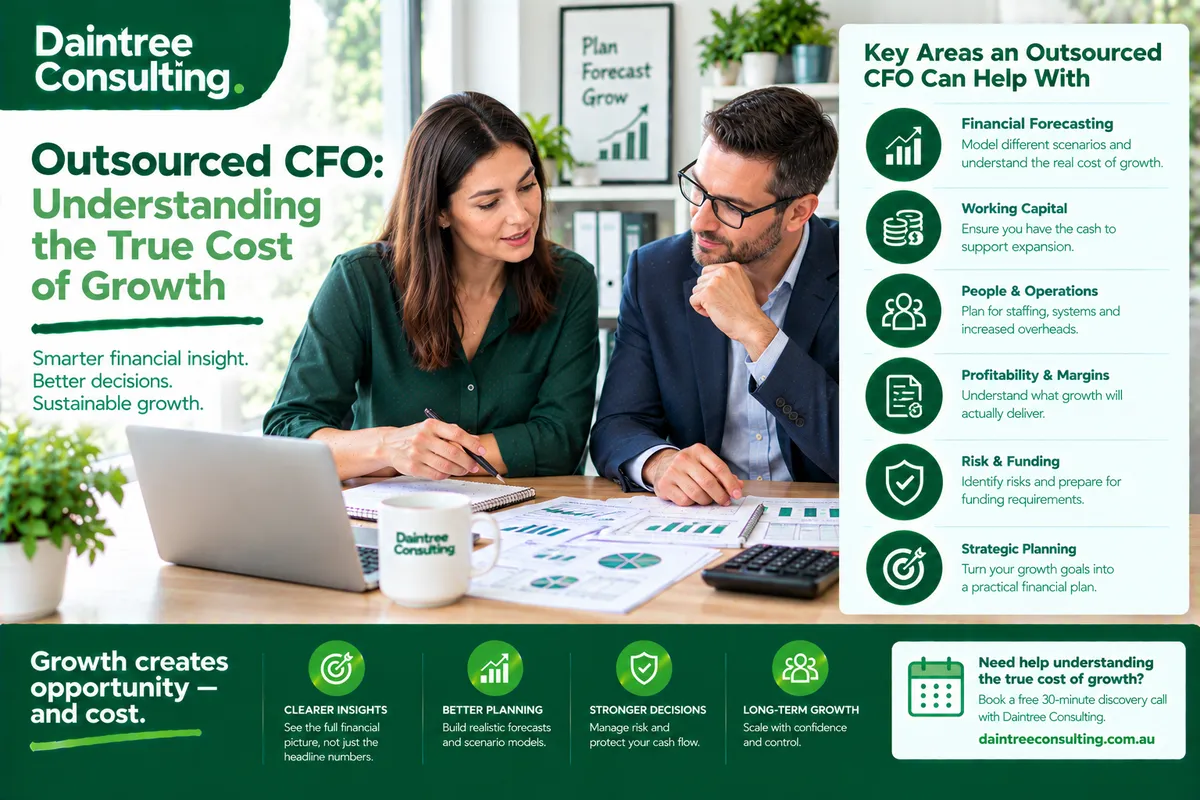
Outsourced CFO Cost of Growth: Understanding the True Cost
Business growth is usually treated as a positive thing.
More customers. More revenue. More employees. More projects. More locations. More opportunities.
Want expert help? Daintree Consulting's outsourced CFO services can take this off your plate. Book a free consultation.
But growth also costs money.
And the true cost of growth is often much higher than the obvious expenses appearing on an invoice or budget.
A business may win a major new contract and immediately see revenue increase. What may be less obvious is the additional working capital required to deliver that work, the cost of hiring people, additional software and systems, higher supplier commitments, increased management time and the financial pressure created when customers take longer to pay.
This is why revenue growth does not automatically mean stronger cash flow or higher profitability.
For owners considering expansion, an outsourced CFO can help identify the financial impact of growth before major commitments are made.
The focus is not simply on how much the business could earn. It is on understanding what the business needs to spend, fund and absorb to achieve that growth.
What is the true cost of growth?
The true cost of growth is the total financial and operational investment required to generate and sustain additional revenue.
Some costs are easy to identify.
For example:
Additional employees
Marketing expenditure
New equipment
Additional premises
Software subscriptions
Inventory
Contractors
Professional fees
Other costs are less visible.
Growth can also create:
Higher working-capital requirements
Longer cash-conversion cycles
Increased management workload
More complex financial reporting
Additional administrative requirements
Greater exposure to customer concentration
Higher debt or funding requirements
Increased operational risk
Greater pressure on systems and processes
These costs can become significant when growth happens quickly.
A business therefore needs to understand not just “How much additional revenue can we generate?”
It also needs to ask:
“How much will it cost us to generate that revenue, and when will the cash actually arrive?”
Revenue growth is not the same as profitable growth
One of the first distinctions an owner needs to make is between revenue growth and profitable growth.
Suppose a business increases annual revenue from $3 million to $4 million.
At first glance, that additional $1 million may look like a strong result.
But what happens if generating the additional revenue requires:
$500,000 in direct costs
$250,000 in additional staff costs
$100,000 in marketing and sales costs
$75,000 in technology and operating costs
Significant additional working capital?
The additional revenue may look impressive while the incremental profit is much smaller than expected.
This is why owners need to understand margins, incremental costs and cash requirements alongside revenue targets.
An outsourced CFO can help build a financial model that separates the expected revenue increase from the costs and funding requirements associated with achieving it.
That creates a more realistic picture of the opportunity.
The hidden working-capital cost of growth
One of the most common challenges with growth is that the business may need to spend money before it receives the associated customer cash.
Consider a business that wins a large new contract.
Before receiving payment, it may need to:
Purchase materials.
Pay suppliers.
Employ or allocate additional staff.
Increase production capacity.
Pay contractors.
Deliver the work.
Issue the invoice.
Wait for the customer to pay.
The business can therefore become more profitable on paper while simultaneously experiencing greater pressure on its bank account.
Australian government guidance also highlights cash-flow forecasting as a way to understand future income and costs, identify potential shortages and plan for upcoming payments.
This is one reason growth needs to be considered through both a profit-and-loss and cash-flow lens.
Growth can consume cash before it creates cash
Timing matters.
Imagine a business needs to spend $300,000 over several months to support a new revenue opportunity, but customers do not pay until 30 or 60 days after invoices are issued.
The business may ultimately make money from the opportunity.
However, it still needs enough cash or available funding to bridge the gap between spending and collection.
An outsourced CFO can help model this timing.
A useful forecast may show:
Expected sales
Customer payment timing
Supplier payments
Payroll
Tax and other obligations
Capital expenditure
Loan repayments
Existing commitments
New working-capital requirements
Expected cash balance
This can help an owner see whether the business can realistically fund its planned growth.
The cost of hiring ahead of revenue
People are often one of the largest costs associated with growth.
But hiring decisions are not always as simple as comparing a salary with expected additional revenue.
An employee can create additional costs such as:
Superannuation
Payroll-related costs
Recruitment
Onboarding
Training
Equipment
Software
Office or workspace requirements
Management time
Leave and other employment-related costs
There may also be a period where the employee is being paid before their full productive capacity is reached.
For a growing business, this means hiring decisions should be connected to financial forecasts rather than made solely on the basis of expected demand.
A CFO can help model different hiring scenarios.
For example:
Scenario A: Hire immediately.
Scenario B: Hire after reaching a specific revenue threshold.
Scenario C: Use contractors while demand is tested.
Scenario D: Hire gradually as workload increases.
Each approach creates a different financial profile.
Growth can increase overhead faster than expected
Some costs increase directly with revenue.
Others increase because the business becomes more complex.
A business may need additional:
Finance staff
Management systems
Technology
Insurance
Professional services
Compliance support
Office space
Vehicles or equipment
Reporting processes
Operational management
These expenses may not appear in the original growth plan.
This is why an owner should consider the infrastructure required to support growth, not just the sales opportunity itself.
An outsourced CFO can help identify these costs and incorporate them into budgets and forecasts.
The cost of complexity
Growth can also make a business harder to manage.
A business with five employees may have relatively simple processes.
A business with 50 employees may require more structured:
Financial reporting
Payroll processes
Budgeting
Cash-flow management
Performance monitoring
Approval controls
Management reporting
Delegation
Forecasting
The financial cost of this complexity may not be obvious when the growth plan is first developed.
But if systems and processes do not keep pace with the business, owners can lose visibility over what is happening.
This can result in late reporting, unreliable forecasts or increased dependence on the owner to answer financial questions.
An outsourced CFO can help establish a reporting rhythm and financial structure that gives management better visibility as the organisation becomes more complex.
The cost of funding growth
Growth may require external funding.
That could involve:
Business loans
Equipment finance
Overdraft facilities
Investor capital
Additional working-capital arrangements
Funding can help a business pursue an opportunity, but it also creates financial commitments.
The owner needs to understand:
How much funding is required
When it will be required
What the funds will be used for
How repayments affect cash flow
What happens if growth is slower than expected
Whether the business has sufficient capacity to service the funding
An outsourced CFO can help prepare forecasts, financial models and information for funding discussions.
However, funding approval remains the decision of the relevant lender or investor.
The cost of growth when margins are misunderstood
Another problem occurs when businesses focus on revenue without understanding which revenue is actually profitable.
Not every customer, product, service or project necessarily produces the same margin.
For example, one customer may generate $500,000 of annual revenue but require substantial servicing, discounting, staffing and delivery costs.
Another customer may generate $250,000 but require significantly fewer resources.
The larger customer is not automatically the better commercial opportunity.
This is why growth planning should consider:
Gross margin
Contribution margin
Customer profitability
Product or service profitability
Delivery costs
Acquisition costs
Customer servicing costs
Overhead allocation
Understanding these measures can help owners identify where growth is actually creating economic value.
The cost of growth can include the owner's time
One of the least visible costs of growth is management capacity.
When a business grows, the owner may spend increasing amounts of time dealing with:
Cash-flow questions
Staffing decisions
Financial approvals
Customer issues
Supplier negotiations
Reporting
Forecasting
Funding discussions
Operational problems
This can become a problem when the owner remains the default person for every financial decision.
The business may be growing, but the owner's ability to lead strategically is being consumed by financial and operational issues.
Daintree's current outsourced CFO model specifically addresses situations where owners remain the default person for financial questions or where decisions have outgrown annual accounting.
What an outsourced CFO can analyse before you grow
Before committing to a significant growth initiative, an outsourced CFO can help bring several financial questions together.
1. What is the revenue opportunity?
How much additional revenue is realistically achievable?
What assumptions support the forecast?
2. What will it cost to generate?
What additional staff, suppliers, marketing, equipment and systems are required?
3. What happens to margins?
Will the additional revenue generate an acceptable contribution after incremental costs?
4. How much working capital is required?
How much cash needs to be committed before customers pay?
5. When does the investment become financially sustainable?
How long will it take before the additional revenue covers the associated costs?
6. What could go wrong?
What happens if revenue is lower, costs are higher or customers pay more slowly than expected?
7. What does the business need to fund?
Can the business fund the growth internally, or will external funding be required?
8. What happens to cash flow?
Will the growth plan create temporary or ongoing pressure on available cash?
These questions turn a broad growth ambition into a financial decision that can be tested.
Scenario modelling can reveal the real cost of growth
No growth plan is certain.
There may be several possible outcomes.
A useful model might consider:
Base case: Growth occurs broadly as expected.
Downside case: Sales are slower and costs are higher.
Upside case: Demand exceeds expectations and additional investment is required sooner.
This type of scenario modelling can help owners understand how sensitive the business is to changes in key assumptions.
For example, a growth plan may look financially attractive under the base case but create significant cash pressure under a slower-sales scenario.
That does not automatically mean the plan should be abandoned.
It means the owner has better information about the conditions that need to be managed.
Daintree's outsourced CFO service includes integrated financial forecasts and scenario modelling, cash-flow and working-capital oversight, management reporting and KPI review.
What should a growth model include?
There is no single model that suits every business.
However, a useful growth model may consider:
Revenue assumptions
Sales volumes
Pricing
Gross margins
Direct costs
Staffing
Overheads
Capital expenditure
Working capital
Debtor collection timing
Supplier payment timing
Tax and other obligations
Existing debt
New funding
Cash reserves
Key performance indicators
The objective is not to create a complicated spreadsheet for its own sake.
The objective is to create a model that helps management understand the financial consequences of different decisions.
Growth should be measured after the decision, not just before it
Financial modelling should not stop when the growth decision has been made.
Once the business begins implementing the plan, actual performance can be compared with the original assumptions.
For example:
Forecast revenue: $1.2 million
Actual revenue: $1.0 million
Forecast staffing cost: $400,000
Actual staffing cost: $450,000
Forecast cash requirement: $250,000
Actual cash requirement: $330,000
These differences provide useful information.
They may show that assumptions need to change, costs need to be controlled or the growth strategy needs to be adjusted.
This is where regular management reporting becomes valuable.
A CFO can help establish a reporting cadence that allows owners and leadership teams to see whether the growth plan is tracking as expected.
When does an outsourced CFO make sense?
An outsourced CFO can be useful when the financial decisions facing the business have become more complex than the existing finance function can comfortably support.
This may happen when:
Growth requires significant investment
Cash flow becomes harder to predict
The business is considering funding
Hiring decisions have significant financial consequences
Management needs forward-looking forecasts
Existing reports are too focused on historical results
The owner is still handling every major financial question
The business needs scenario modelling
Leadership needs more structured performance reporting
An outsourced CFO does not necessarily mean creating a full-time CFO position.
Daintree positions its service as flexible financial leadership that can work alongside an internal team, external bookkeeper or broader outsourced finance arrangement.
Understanding the true cost of growth leads to better decisions
Growth can create substantial opportunities for a business.
But growth also consumes cash, people, management capacity, systems and working capital.
The businesses that understand these requirements are in a stronger position to plan for them.
The question is therefore not simply:
“How much revenue can we add?”
A more useful question is:
“What will it take to generate that revenue, how much cash will we need, and what happens if our assumptions are wrong?”
That is where an outsourced CFO can provide value.
By connecting forecasting, scenario modelling, cash flow, working capital, profitability and management reporting, CFO support can help owners understand the financial reality behind their growth plans.
Daintree Consulting provides outsourced CFO services for growing and complex businesses that need forward-looking financial leadership and stronger decision support. The engagement can be shaped around the organisation's existing finance function and the decisions ahead.
If your business is growing and you are unsure what that growth is really costing, a focused financial review can help identify the gap between revenue growth and financially sustainable growth.
Book a free 30-minute discovery call with Daintree Consulting to discuss your growth plans, financial visibility and the level of CFO support your business may need.
Talk to Daintree about your finance function
Our ex-Big 4 team gives clear, senior-reviewed advice so you can act with confidence.
Book a free consultation →
Or explore our outsourced CFO services.
