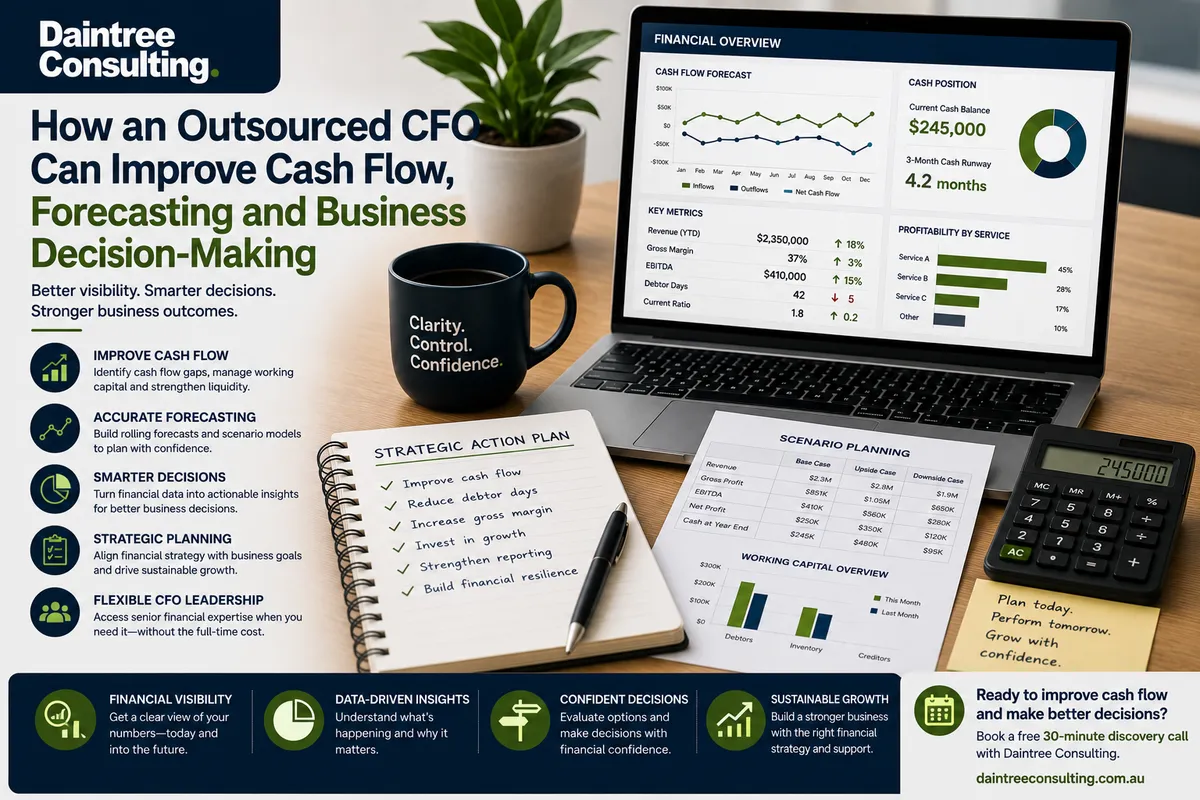
Outsourced CFO Cash Flow: Improve Forecasting & Decisions
Cash flow can become one of the biggest challenges as a business grows.
Revenue may be increasing. The sales pipeline may look healthy. Profit may appear reasonable. Yet the business owner can still find themselves asking:
Want expert help? Daintree Consulting's outsourced CFO services can take this off your plate. Book a free consultation.
"Why does cash always feel tight?"
That question often points to a gap between financial reporting and financial leadership.
Traditional accounting can tell you what happened. An outsourced CFO can help you understand what is likely to happen next, why it matters and what decisions may improve the outcome.
For growing Australian businesses, this can be particularly valuable when cash-flow management, forecasting and major financial decisions become too complex for the owner or existing finance team to manage alone.
Daintree Consulting positions its outsourced CFO service around forward-looking forecasts, scenario modelling, cash-flow and working-capital oversight, management reporting, KPI design and senior decision support.
The objective is not simply to produce more financial reports.
It is to create better financial visibility so leadership can make better decisions.
Quick Answer: How Can an Outsourced CFO Improve Cash Flow?
An outsourced CFO can improve cash-flow management by helping a business understand its current financial position, forecast future cash requirements, identify working-capital pressures, model different scenarios and connect financial information to business decisions.
This may include:
building rolling cash-flow forecasts
monitoring accounts receivable and payable
identifying working-capital requirements
modelling growth scenarios
reviewing margins and profitability
identifying upcoming funding requirements
establishing useful financial KPIs
improving management reporting
supporting major investment decisions
helping leadership understand the financial consequences of different options.
The key difference is forward-looking financial leadership.
Instead of asking only:
"What happened last month?"
an outsourced CFO helps leadership ask:
"What is likely to happen next, and what should we do about it?"
Why Cash Flow Becomes More Difficult as a Business Grows
Growth is usually positive.
But growth can also consume cash.
Consider a business that wins a major new contract.
Revenue is expected to increase significantly.
That sounds like good news.
But before the additional revenue arrives, the business may need to:
hire employees
purchase equipment
increase inventory
pay suppliers
invest in technology
increase marketing
expand premises
fund additional working capital.
The business may therefore need to spend cash before it receives the corresponding customer payments.
This is one reason a profitable business can still experience cash-flow pressure.
The problem becomes even more complicated when management does not have a reliable forecast showing when cash is expected to enter and leave the business.
Daintree identifies cash-flow uncertainty as a common sign that a business may have outgrown the finance function supporting it.
Profit Is Not the Same as Cash
One of the most important concepts in financial management is understanding the difference between profit and cash.
A business can report a profit while having limited cash available.
For example, suppose a business completes $200,000 of work but has only collected $100,000 from customers.
The profit-and-loss statement may reflect revenue from the work, while the bank account reflects only the cash actually received.
At the same time, the business may need to pay:
employee wages
suppliers
rent
tax obligations
loan repayments
software
insurance
other operating expenses.
This creates a working-capital gap.
An outsourced CFO can help leadership identify these gaps earlier by connecting profitability analysis with cash-flow forecasting and working-capital management.
What Does an Outsourced CFO Do for Cash Flow?
An outsourced CFO does not simply monitor the bank balance.
The role is broader.
It is about understanding the drivers of cash flow and helping leadership make decisions before problems become urgent.
Here are some of the most valuable areas.
1. Build a Rolling Cash-Flow Forecast
A cash-flow forecast can help answer one of the most important questions in business:
How much cash will we have in the future?
Instead of looking only at today's bank balance, management can consider expected:
customer receipts
supplier payments
payroll
tax obligations
debt repayments
capital expenditure
financing
investments
other significant cash movements.
A rolling forecast can then be updated as actual results become available.
This creates a moving view of the business's expected cash position.
The value is not that the forecast will predict the future perfectly.
It is that management can identify potential pressure points before they arrive.
2. Identify Working-Capital Problems
Working capital can have a significant impact on cash flow.
An outsourced CFO can help examine areas such as:
Accounts receivable
How quickly are customers paying?
Are overdue invoices increasing?
Are payment terms appropriate?
Accounts payable
Are supplier payments being managed effectively?
Are there opportunities to better align payment timing with customer receipts?
Inventory
Is too much cash tied up in stock?
Are slow-moving products consuming working capital?
Revenue growth
Is growth creating additional funding requirements?
This matters because a business can become more profitable while simultaneously needing more cash to fund its growth.
Daintree's outsourced CFO scope specifically includes cash-flow and working-capital oversight.
3. Improve Cash-Flow Visibility
Many business owners know how much money is in the bank today.
Fewer have a clear view of where the balance is likely to be in four, eight or twelve weeks.
That difference matters.
Good cash-flow visibility can help leadership anticipate:
periods of tight liquidity
upcoming large payments
funding requirements
seasonal fluctuations
major investment needs
changes in customer payment behaviour.
Instead of reacting when the bank balance becomes uncomfortable, management has an opportunity to respond earlier.
That might mean:
accelerating collections
delaying non-essential expenditure
changing purchasing decisions
adjusting hiring timing
arranging funding
reviewing pricing
modifying growth plans.
The earlier the issue is identified, the more options the business generally has.
4. Build Better Financial Forecasts
Cash-flow forecasting is only one part of forward-looking financial management.
An outsourced CFO can also help develop broader financial forecasts covering:
revenue
gross margins
operating expenses
EBITDA or operating profit where relevant
working capital
capital expenditure
debt
cash
key financial ratios.
This allows management to consider the financial implications of its plans before committing resources.
For example:
What happens if revenue grows 20%?
What happens if revenue grows only 5%?
What happens if wages increase faster than expected?
What happens if a major customer pays 30 days later?
What happens if we hire three additional employees?
What happens if we open another location?
Forecasting turns these questions into financial scenarios that can be evaluated.
5. Use Scenario Planning for Major Decisions
A single forecast can create a false sense of certainty.
Scenario modelling is often more useful.
An outsourced CFO can help leadership model different outcomes.
Base case
The business performs broadly according to expectations.
Growth case
Revenue increases faster than expected and additional resources are required.
Downside case
Revenue slows, margins contract or cash collections weaken.
The purpose is not to predict exactly which scenario will occur.
It is to understand:
What would happen if it did?
This gives leadership more time to prepare.
Daintree's current outsourced CFO service includes integrated financial forecasts and scenario modelling specifically for higher-stakes decisions.
6. Help Management Understand the Financial Impact of Growth
Growth decisions often sound simple:
hire more people
increase marketing
launch a new product
expand into another market
purchase equipment
acquire a business.
But every growth decision has financial consequences.
Consider hiring.
The cost is not simply the employee's salary.
There may also be:
superannuation
recruitment costs
equipment
software
training
office costs
management time
additional working capital.
An outsourced CFO can help model the financial effect before the decision is made.
The question becomes:
Can the business comfortably support this growth, and what needs to happen for the investment to generate an acceptable return?
7. Improve Management Reporting
Financial information is only useful if decision-makers can understand it.
A growing business may have accounting software, bookkeeping records and financial statements but still lack a useful management reporting rhythm.
An outsourced CFO can help determine:
what should be reported
how frequently it should be reviewed
which KPIs matter
which variances require attention
which information leadership needs for decisions.
Daintree describes its outsourced CFO service as providing a decision-ready management reporting rhythm alongside KPI design and performance review.
This can shift financial reporting from:
"Here is what happened."
to:
"Here is what happened, why it happened and what we should consider doing next."
8. Identify the Drivers Behind Profitability
Cash flow problems are not always caused by a lack of sales.
Sometimes the underlying issue is profitability.
For example:
prices may be too low
labour costs may have increased
supplier costs may have risen
discounts may be reducing margins
certain customers may be unprofitable
some services may consume disproportionate resources.
An outsourced CFO can help management analyse profitability at a deeper level.
Instead of asking:
"Are we making money?"
the business can ask:
"Which parts of the business are actually generating the strongest financial contribution?"
That information can influence:
pricing
sales strategy
customer selection
service mix
staffing
resource allocation.
9. Connect Cash Flow to Business Decisions
This is where an outsourced CFO can provide value beyond traditional financial reporting.
Suppose management is considering a $500,000 investment.
The decision should not be based solely on whether the investment appears profitable.
Leadership may also need to consider:
cash available
timing of expenditure
expected return
financing requirements
impact on working capital
downside risk
alternative uses for the capital.
The CFO perspective connects the decision to the wider financial position.
Daintree's business advisory service similarly focuses on evaluating options, scenarios and risks before agreeing actions and review rhythms.
10. Help Prepare for Funding
Growth can create situations where external funding becomes relevant.
An investor or lender may want to understand:
historical performance
forecasts
cash requirements
debt
profitability
assumptions
business risks
future growth.
An outsourced CFO can help prepare financial models, forecasts and supporting information.
Daintree specifically lists funding and due-diligence preparation support within its outsourced CFO scope, while noting that funding approval remains the decision of the lender or investor.
Good preparation can make financial discussions more structured.
11. Give Business Owners Better Financial Decision Support
As businesses grow, the owner can become the default person for every financial question.
That can create a bottleneck.
Questions such as:
Can we afford to hire?
Should we buy this equipment?
Can we open another location?
Why has profit fallen?
How much cash should we keep?
Should we increase prices?
Can we afford this investment?
Do we need funding?
may all end up with the owner.
An outsourced CFO can provide senior financial leadership without requiring the business to employ a full-time CFO.
Daintree describes its service as flexible financial leadership for growing and complex businesses that need forecasting, performance insight and stronger decision support.
Outsourced CFO vs Accountant: What's the Difference?
This is one of the most common questions business owners ask.
The roles can overlap, but the primary focus is different.
Accountant
An accountant typically focuses on areas such as:
financial records
reporting
tax
compliance
financial statements
accounting treatment.
Outsourced CFO
An outsourced CFO generally focuses more heavily on:
forecasting
cash flow
scenario modelling
performance
KPIs
financial strategy
funding preparation
management reporting
major financial decisions.
Daintree describes the distinction in similar terms: accounting establishes reliable financial information, while an outsourced CFO adds forward-looking financial leadership and decision support.
Importantly, you do not necessarily have to choose one or the other.
An outsourced CFO can work alongside an existing accountant, bookkeeper or internal finance team.
When Does a Business Need an Outsourced CFO?
There is no single revenue threshold that determines when a business needs a CFO.
The more useful question is:
Has the complexity of financial decision-making outgrown the current finance function?
Some signs include:
1. Cash flow is difficult to predict
You know today's balance but not what the next few months look like.
2. Growth is creating financial pressure
Revenue is increasing but so are staffing, inventory and working-capital requirements.
3. You are making bigger financial decisions
Expansion, investment, acquisitions or funding decisions require more sophisticated analysis.
4. Reports arrive too late
By the time you see the numbers, the opportunity to respond may have passed.
5. The owner is still the finance department
Every financial question comes back to one person.
6. You lack a reliable forecast
The business is operating based on intuition rather than a structured forward view.
7. Your finance team needs senior direction
You may have capable bookkeeping and accounting support but need higher-level financial leadership.
Daintree identifies these types of circumstances—including decisions outgrowing annual accounting, the need for credible growth or funding forecasts, internal finance teams needing senior direction and owners remaining the default financial decision-maker—as situations where outsourced CFO support may be useful.
What Does an Outsourced CFO Cash-Flow Process Look Like?
A practical process might follow these steps:
Step 1: Understand
Review the current:
financial reports
cash position
working capital
accounting processes
reporting
business objectives.
Step 2: Establish the baseline
Create a reliable starting point using accurate financial information.
Step 3: Build the forecast
Develop cash-flow and financial forecasts based on reasonable assumptions.
Step 4: Identify pressure points
Look for:
cash shortages
margin pressure
debtor issues
upcoming commitments
funding requirements.
Step 5: Model scenarios
Test important decisions and potential changes.
Step 6: Set KPIs
Identify the measures management should monitor.
Step 7: Establish a reporting rhythm
Create regular management reporting that supports decision-making.
Step 8: Review and adjust
Compare actual performance with the forecast and update assumptions as conditions change.
This creates a continuous cycle:
Accurate data → Forecast → Scenario → Decision → Action → Review → Updated forecast
How to Get More Value From an Outsourced CFO
An outsourced CFO relationship works best when the business provides timely and reliable information.
Before starting, make sure you have clarity around:
accounting systems
bookkeeping
payroll
bank accounts
reporting
existing forecasts
budgets
debt
major contracts
business objectives.
The quality of financial decisions depends partly on the quality of information available.
Daintree's broader approach begins with discovering the business, clarifying records and priorities, designing the appropriate scope and then moving forward with ongoing review and adaptation.
The CFO should also understand the business—not just the numbers.
That means understanding:
how revenue is generated
how customers pay
what drives costs
how the business delivers its services
where capacity constraints exist
what management is trying to achieve.
Financial strategy is more useful when it is connected to commercial reality.
Why Outsourced CFO Support Can Be More Flexible Than Hiring a Full-Time CFO
Not every business needs a full-time CFO.
A business may need senior financial expertise for:
a growth period
funding preparation
an acquisition
restructuring
a major investment
cash-flow pressure
financial transformation
improving management reporting.
An outsourced model can provide access to CFO-level support without creating a permanent executive role.
Daintree describes its outsourced CFO service as flexible financial leadership designed around the organisation, and states that the engagement cadence can be monthly, fortnightly, quarterly or project-based depending on the engagement.
This can make the model suitable for businesses that need additional financial leadership but do not yet require a traditional full-time CFO structure.
Common Mistakes Businesses Make With Cash Flow
Mistake 1: Looking Only at the Bank Balance
The bank balance tells you what is available now.
It does not necessarily tell you what will be available next month.
Mistake 2: Confusing Profit With Cash
A profitable business can still experience liquidity pressure.
Mistake 3: Forecasting Once a Year
A forecast becomes less useful when it is not updated as circumstances change.
Mistake 4: Ignoring Working Capital
Growth can consume cash through receivables, inventory and other working-capital requirements.
Mistake 5: Making Decisions Without Scenario Modelling
A major investment may look attractive under one set of assumptions and much less attractive under another.
Mistake 6: Waiting Until There Is a Crisis
Financial leadership is most valuable when there is still time to make decisions—not after all the options have disappeared.
Final Thoughts: Better Cash Flow Starts With Better Visibility
Improving cash flow is not simply about spending less or collecting invoices faster.
It starts with understanding the financial mechanics of the business.
An outsourced CFO can help connect:
Financial data
→ Cash-flow forecasting
→ Working-capital management
→ Scenario planning
→ Strategic decisions
→ Ongoing performance review
That connection can be particularly valuable when a growing business is making larger decisions and the owner or existing finance team no longer has enough time or capacity to provide the required level of financial oversight.
The goal is not to predict the future perfectly.
It is to make the future more visible.
When leadership can see the likely cash position, understand the financial consequences of different choices and identify potential risks earlier, decisions can become more deliberate and less reactive.
If your business is growing but cash flow remains difficult to predict—or if major decisions increasingly require financial modelling and senior insight—it may be time to consider whether your finance function needs another level of support.
Book a free 30-minute discovery call with Daintree Consulting to discuss your current financial position, cash-flow challenges and the decisions ahead. Daintree Consulting
Frequently Asked Questions
What is an outsourced CFO?
An outsourced CFO provides senior financial leadership to a business without requiring the business to employ a full-time CFO. The role can include forecasting, cash-flow oversight, scenario modelling, management reporting, KPI design and financial decision support.
How can an outsourced CFO improve cash flow?
An outsourced CFO can improve cash-flow visibility by developing forecasts, reviewing working capital, identifying cash-flow pressure points, modelling scenarios and helping management make decisions based on the expected financial impact.
Does an outsourced CFO manage bookkeeping?
Not necessarily. Bookkeeping and CFO services have different functions. An outsourced CFO can work alongside an internal bookkeeper, external bookkeeper or broader outsourced finance team. Daintree states that it can work with an existing finance team or external bookkeeper.
Can an outsourced CFO help with forecasting?
Yes. Forecasting and scenario modelling are core components of Daintree's current outsourced CFO service.
How often should a business review its cash-flow forecast?
The appropriate frequency depends on the business. A growing business with significant cash movements may need more frequent reviews, while a more stable business may use a monthly management rhythm. The important point is that forecasts should be updated when actual results or assumptions change.
Is an outsourced CFO only for large businesses?
No. The need for CFO support is not determined solely by revenue. It can become relevant when financial decisions become more complex, forecasting requirements increase or the existing finance function needs senior direction. Daintree supports growing SMEs as well as established organisations.
What is the difference between an outsourced CFO and a business advisor?
There can be overlap. An outsourced CFO generally focuses on financial leadership, forecasting, cash flow, performance and financial decision support. Business advisory can cover a broader range of commercial issues including strategic planning, profitability, risk, structure, growth and succession. Daintree offers both capabilities and can shape the engagement around the business's needs.
Can an outsourced CFO help prepare a business for funding?
Yes. An outsourced CFO may support forecasts, financial models and information preparation for funding or due diligence. However, approval of funding remains the decision of the lender or investor.
Important Note
Forecasting, budgeting, scenario modelling and outsourced CFO services involve estimates, assumptions and professional judgement. Forecasts and projections are not guarantees of future business performance. Actual results may differ due to market conditions, business decisions, inaccurate assumptions, third-party actions and other factors outside the business's control. Daintree's current financial-services disclaimer specifically applies these limitations to business advisory, forecasting, budgeting, scenario modelling and outsourced CFO services.
This article provides general information only and should not be treated as individual accounting, tax, legal or financial advice. The appropriate level of financial support depends on the individual circumstances, structure, complexity and objectives of each business. Written engagement terms prevail where applicable.
Talk to Daintree about your finance function
Our ex-Big 4 team gives clear, senior-reviewed advice so you can act with confidence.
Book a free consultation →
Or explore our outsourced CFO services.
