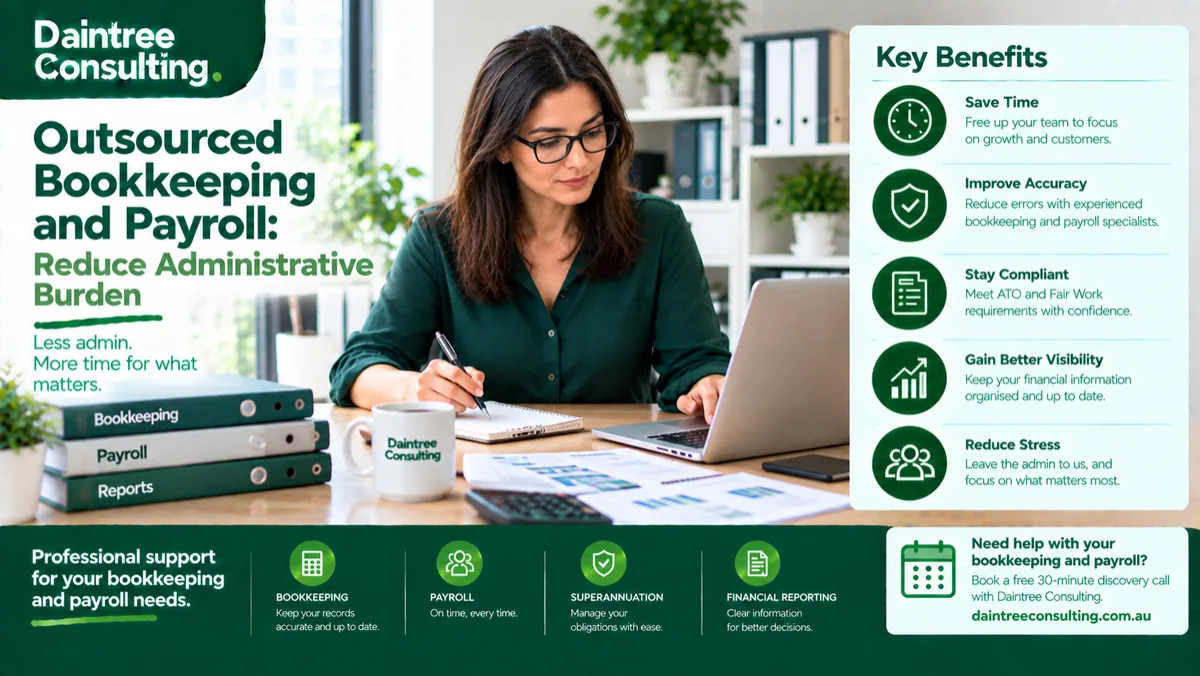
How Outsourcing Bookkeeping and Payroll Can Reduce the Administrative Burden
Running a business involves far more administration than most owners expect.
It is not just about serving customers, managing staff and generating sales. There are invoices to process, transactions to reconcile, bills to pay, payroll to prepare, employee records to maintain, superannuation to manage and financial information to keep organised.
Want expert help? Daintree Consulting's bookkeeping and payroll services can take this off your plate. Book a free consultation.
As the business grows, these tasks can consume an increasing amount of the owner’s and management team’s time.
This is where outsourced bookkeeping and payroll can become a practical option.
Instead of managing every financial administration task internally, a business can use an external bookkeeping and payroll provider to take responsibility for defined processes, maintain accurate records and keep routine finance work moving.
The goal is not simply to remove tasks from an owner's to-do list. A well-structured outsourced arrangement can also create more consistent processes, improve financial visibility and give business owners more time to focus on customers, employees, growth and decision-making.
What is outsourced bookkeeping and payroll?
Outsourced bookkeeping and payroll means engaging an external accounting or bookkeeping provider to manage some or all of the business's routine bookkeeping and payroll functions.
Depending on the business, this may include:
Recording and categorising financial transactions
Bank and credit-card reconciliations
Accounts payable and accounts receivable
Customer invoicing
Supplier bills
Payroll processing
Employee pay runs
Leave and payroll records
Superannuation administration
Payroll-related reporting
Month-end bookkeeping
BAS-ready financial records
Financial reports and management information
Coordination with the business's accountant or adviser
The exact scope should be agreed with the provider before work begins.
For some businesses, outsourcing may mean handing over the entire bookkeeping function. For others, it may involve keeping certain responsibilities in-house while an external provider handles payroll, reconciliations, month-end work or other time-consuming tasks.
The important point is that outsourcing should create a clear division of responsibilities rather than simply moving administrative work from one person's desk to another.
Why does bookkeeping and payroll create such a large administrative burden?
Bookkeeping and payroll are often described as routine tasks.
That does not necessarily mean they are simple.
They need to be completed regularly, accurately and within appropriate timeframes. They also depend on information coming from different parts of the business.
For example, payroll may depend on:
Employee hours
Leave information
Pay rates
Allowances
Overtime
Bonuses
Employment arrangements
Changes to employee details
Superannuation information
Bookkeeping may depend on:
Bank transactions
Supplier invoices
Customer invoices
Receipts
Expense claims
Credit notes
Payments
Business purchases
Loan transactions
Asset purchases
When one person is responsible for collecting, checking and processing all of this information, administration can quickly become difficult to manage.
The problem becomes more noticeable as transaction volumes and employee numbers increase.
1. Outsourcing can reduce the amount of routine work handled by business owners
One of the most obvious benefits of outsourced bookkeeping and payroll is that it can reduce the amount of routine financial administration sitting with the business owner.
An owner might otherwise spend hours each week:
Checking bank transactions
Entering bills
Following up invoices
Preparing payroll
Checking employee hours
Reviewing leave
Reconciling accounts
Organising receipts
Fixing bookkeeping errors
Preparing information for the accountant
None of these tasks are necessarily unimportant.
But they can take time away from higher-value responsibilities.
An owner may be better placed using that time to work on sales, customer relationships, business development, staffing, supplier negotiations or strategic planning.
Outsourcing does not eliminate the owner's responsibility to oversee the business. It can, however, reduce the amount of routine processing the owner needs to personally complete.
2. It can create a more consistent bookkeeping process
A common problem in growing businesses is that financial administration develops informally.
One person may know how everything works.
Invoices might be stored in one location, receipts somewhere else and payroll information in a spreadsheet. Reconciliations may happen when someone has time rather than according to a defined schedule.
This can work for a very small business.
As the business grows, it becomes harder to maintain.
An outsourced bookkeeping service can help establish a repeatable process around areas such as transaction processing, reconciliations, accounts payable, accounts receivable and month-end reporting.
The objective is to make the process less dependent on one person's memory.
That becomes particularly important when employees take leave, responsibilities change or the business grows.
3. Outsourcing can help keep bookkeeping up to date
Financial information becomes less useful when it is consistently behind.
If transactions have not been entered or accounts have not been reconciled, an owner may be looking at financial reports that do not accurately reflect the current position of the business.
This can affect decisions about:
Cash flow
Spending
Hiring
Supplier payments
Customer collections
Business growth
Tax obligations
Working capital
Regular bookkeeping can provide a clearer picture of what has happened financially.
The Australian Taxation Office also recommends keeping accurate business records and regularly reconciling bank records so businesses can understand what money is moving through their accounts and why.
Accurate and timely records can therefore support both compliance and better financial management.
4. It can reduce the administrative pressure of payroll
Payroll can be particularly demanding because it is recurring and employee-facing.
If payroll is incorrect or delayed, employees notice immediately.
Australian employers have specific obligations around pay slips and employee records. For example, employees generally need to receive a pay slip within one working day of being paid, while time and wage records generally need to be retained for seven years.
Payroll records can include information about:
Pay rates
Gross and net pay
Deductions
Hours worked
Overtime
Leave
Allowances
Bonuses
Penalty rates
Superannuation contributions
This creates an administrative workload that becomes more significant as the number of employees increases.
Outsourcing payroll can give the business a dedicated process for collecting payroll information, preparing pay runs, maintaining records and coordinating the relevant payroll administration.
It does not transfer the legal responsibility for employment compliance away from the employer, but it can reduce the amount of payroll processing the employer has to manage personally.
5. It can help businesses keep payroll information organised
Payroll problems are not always caused by the payroll calculation itself.
Sometimes the underlying information is incomplete or arrives too late.
For example, an employee may submit hours late, a manager may forget to approve leave or a change in employment conditions may not be communicated to whoever processes payroll.
A structured outsourced payroll process can establish clearer deadlines and responsibilities.
This might include:
Employees submit timesheets or relevant information.
Managers review and approve the information.
Payroll information is provided to the payroll team.
The payroll is prepared and checked.
The pay run is processed.
Pay slips are issued.
Payroll records are maintained.
Relevant payroll and superannuation processes are completed.
The exact workflow will depend on the business and payroll system.
The benefit is having a repeatable process rather than relying on last-minute administration.
6. Outsourcing can reduce the number of finance tasks competing for attention
For a growing business, administrative pressure often comes from the number of small tasks rather than one particularly difficult task.
A business owner might have 20 minutes to check the bank account, then need to answer an employee question, approve a supplier invoice, follow up a customer and review a payroll issue.
The result can be constant context switching.
Outsourcing bookkeeping and payroll can consolidate many of these routine financial tasks into a defined external process.
Instead of constantly dealing with individual bookkeeping and payroll issues, the owner can receive information through agreed reporting and communication processes.
That can make financial administration more predictable.
7. It can make month-end processes easier to manage
Month-end can become particularly stressful when bookkeeping has been allowed to accumulate throughout the month.
If transactions have not been entered, accounts have not been reconciled and outstanding issues have not been investigated, the business may have to rush to prepare its financial information.
A consistent bookkeeping process can help spread this work throughout the month.
Depending on the arrangement, an outsourced bookkeeping provider may handle:
Bank reconciliations
Credit-card reconciliations
Accounts payable
Accounts receivable
Transaction processing
Payroll reconciliation
General ledger review
Balance-sheet reconciliations
Month-end reporting
This can give the business a more structured pathway from daily transactions to monthly financial information.
For businesses already using an accountant or outsourced CFO, better bookkeeping can also make the information they receive more useful.
8. It can reduce the administrative burden of preparing for BAS and tax work
Bookkeeping and tax compliance are closely connected.
When financial records are incomplete or poorly organised, preparing information for BAS and tax work can take longer.
A bookkeeping process that keeps transactions, invoices, expenses and reconciliations organised can make it easier to identify what information is available and what still needs attention.
This does not mean a bookkeeping provider automatically takes responsibility for all tax obligations.
The scope of work should be clearly defined between the business, bookkeeper and accountant or tax professional.
The benefit is that the underlying financial records can be maintained in a more organised state, reducing the amount of administrative cleanup required before compliance work begins.
9. Outsourcing can help reduce dependence on one internal employee
Some businesses become heavily dependent on one employee who knows how their bookkeeping and payroll work.
That person may know:
Where invoices are stored
How payroll is processed
Which suppliers need special treatment
How bank reconciliations are handled
Which reports the owner wants
How recurring transactions are recorded
This creates a knowledge concentration risk.
If that employee takes extended leave or leaves the business, someone else may have difficulty taking over.
An outsourced process can provide greater continuity because the work is performed under an agreed system rather than existing entirely in one employee's head.
This is particularly useful as businesses grow or restructure.
10. It can give business owners better visibility without requiring them to do all the processing
Outsourcing should not mean losing visibility.
In fact, the right arrangement should make financial information easier to understand.
A business owner may not need to personally process every transaction to know:
How much cash is available
What customers owe
What bills are outstanding
What payroll is costing
How revenue is tracking
Whether expenses are increasing
Whether the business is meeting its budget
Where financial pressure is developing
The processing can be delegated while oversight remains with the owner or management team.
This is an important distinction.
Outsourcing administration is not the same as outsourcing financial responsibility.
The business still needs appropriate oversight and decision-making.
What about the new Payday Super requirements?
Payroll administration has also become more important as Australia's superannuation payment requirements change.
From 1 July 2026, employers are required to pay superannuation contributions on payday under the Payday Super changes. Fair Work currently states that the superannuation guarantee rate is 12% for eligible employees.
This is one example of why payroll processes need to be properly configured and maintained.
Businesses should not assume that outsourcing payroll automatically makes them compliant. The employer remains responsible for meeting its obligations, and the payroll provider's scope and processes should be clearly understood.
Where requirements change, businesses should also review their payroll systems and processes rather than relying on old settings or assumptions.
When does outsourced bookkeeping and payroll make sense?
Outsourcing can be worth considering when financial administration is becoming a distraction from running the business.
Some common signs include:
The owner is doing too much bookkeeping
If the owner regularly spends evenings or weekends processing transactions, reconciling accounts or preparing payroll, the business may be using valuable management time for routine administration.
Payroll is becoming difficult to manage
More employees generally means more payroll information, more leave records, more timesheets and more opportunities for administrative errors.
Bookkeeping is falling behind
If reconciliations or transaction processing are regularly delayed, financial reports may not provide the timely information management needs.
The business has outgrown its informal systems
Spreadsheets and manual processes can become difficult to control as transaction volumes increase.
There is no clear backup
If only one person knows how bookkeeping or payroll works, the business may have an avoidable continuity risk.
The accountant is spending too much time cleaning up records
An accountant should not necessarily have to reconstruct months of bookkeeping before completing higher-level accounting or tax work.
Management wants better financial information
If the business wants regular reporting but the underlying bookkeeping is not consistent, improving the bookkeeping process may be the first step.
What should you look for in an outsourced bookkeeping and payroll provider?
Cost is important, but it should not be the only consideration.
A business should also understand exactly what the provider will do.
Consider asking:
What bookkeeping tasks are included?
Is payroll included?
Who processes payroll?
How are timesheets and leave information collected?
How are bank accounts reconciled?
How often will bookkeeping be updated?
What happens when an issue is identified?
What reports will the business receive?
Who communicates with the accountant?
How are employee records handled?
What accounting and payroll software is supported?
How is access to financial and employee information controlled?
What happens when an employee or provider contact is unavailable?
What responsibilities remain with the business owner?
Clear answers to these questions can help prevent scope confusion later.
Outsourcing does not mean giving up control
Some business owners hesitate to outsource bookkeeping or payroll because they worry about losing control over their financial information.
The opposite can happen when the process is designed properly.
A good outsourced arrangement should define:
Who has access
Who approves transactions
Who approves payroll
Who can make changes
Who prepares reports
Who reviews the reports
How issues are escalated
What information the owner receives
How responsibilities are documented
This creates a separation between processing and oversight.
The business owner can remain involved in important decisions without having to perform every administrative task personally.
Outsourced bookkeeping and payroll vs hiring internally
There is no single structure that suits every business.
An internal employee may make sense where the business has enough ongoing finance administration to justify a dedicated role.
Outsourcing can be attractive when the business wants access to bookkeeping and payroll capability without building the entire function internally.
The right question is not simply:
“Should we outsource?”
It is:
“What financial administration should remain internal, and what can be handled more efficiently through an external process?”
Some businesses may outsource most bookkeeping and payroll while retaining financial oversight internally.
Others may use an external provider for bookkeeping but keep payroll management in-house.
The arrangement should reflect the business's size, complexity, systems, transaction volume and internal capabilities.
How to make outsourced bookkeeping and payroll work effectively
Outsourcing works best when the business has clear processes on both sides.
Start by documenting:
1. Responsibilities
Define who does what.
Avoid vague arrangements where everyone assumes someone else is handling a task.
2. Deadlines
Set clear cut-off dates for invoices, timesheets, leave approvals and payroll information.
3. Approval processes
Determine who approves payments, payroll and adjustments.
4. Communication
Establish how questions and exceptions will be handled.
5. Reporting
Decide what financial information management needs and how often it should be provided.
6. Systems
Make sure accounting, payroll and other relevant systems are configured consistently.
7. Review
Regularly review whether the arrangement is still appropriate as the business changes.
The objective is not merely to outsource tasks.
It is to create a financial administration process that works reliably.
The broader benefit: giving owners more time to run the business
The real value of outsourced bookkeeping and payroll is not simply the number of hours spent entering transactions or processing wages.
It is what the business can do with the time and attention that becomes available.
Instead of spending another evening fixing bookkeeping issues, an owner may be able to review sales performance.
Instead of preparing payroll manually, management may have more time to focus on staffing and operations.
Instead of searching for missing transactions before BAS or tax work, the business may have more organised financial records throughout the year.
And instead of reacting to financial administration problems, management can spend more time looking ahead.
That is where outsourcing can become a business improvement decision rather than simply an administrative decision.
How Daintree Consulting can help with bookkeeping and payroll
Daintree Consulting provides bookkeeping and payroll support for Australian businesses that need reliable financial administration without carrying every routine task internally.
Support can include bookkeeping, payroll and superannuation administration, accounts payable and receivable, bank and card reconciliations, month-end processes and maintaining BAS-ready financial records.
The focus is on creating organised financial processes that support the wider business.
If your bookkeeping and payroll administration is taking too much time, falling behind or becoming increasingly difficult to manage, it may be worth reviewing how the function is structured.
Bookkeeping and payroll should support the business — not become another full-time job for the owner.
Book a free 30-minute discovery call with Daintree Consulting to discuss your current bookkeeping and payroll processes and where external support may fit.
Frequently Asked Questions
What is outsourced bookkeeping and payroll?
Outsourced bookkeeping and payroll involves engaging an external provider to manage agreed bookkeeping and payroll tasks for a business. Services may include transaction processing, reconciliations, accounts payable and receivable, payroll processing, employee records and month-end bookkeeping.
Can outsourcing bookkeeping and payroll save a business time?
It can reduce the amount of routine financial administration handled internally. The amount of time saved depends on the business's transaction volume, employee numbers, existing processes and the scope of work outsourced.
Is outsourced payroll responsible for employer compliance?
No. Outsourcing payroll does not automatically transfer the employer's legal responsibilities. Employers remain responsible for meeting their workplace, tax and superannuation obligations. The provider's responsibilities should be clearly defined in the engagement.
Is outsourced bookkeeping suitable for a small business?
It can be. Small businesses may use outsourced bookkeeping to avoid having the owner spend significant time on routine financial administration while still maintaining organised financial records.
Can bookkeeping and payroll be outsourced together?
Yes. Combining the functions can create a more connected financial administration process, particularly where payroll transactions, employee costs, reconciliations and reporting need to work together.
How often should outsourced bookkeeping be completed?
The appropriate frequency depends on transaction volume, business complexity and reporting needs. Some businesses require regular weekly processing, while others may have different arrangements. The important point is that bookkeeping should be maintained frequently enough to support the business's reporting and compliance needs.
Final takeaway
Outsourced bookkeeping and payroll can reduce administrative pressure by moving routine financial processing into a structured external workflow.
For a growing Australian business, that can mean fewer manual tasks for the owner, more consistent bookkeeping, better-organised payroll records and more time available for running the business.
The key is not simply to outsource as many tasks as possible.
It is to build a clear process where responsibilities, approvals, deadlines and reporting are understood.
When bookkeeping and payroll are organised properly, they become less of an administrative burden and more of a reliable foundation for the business's financial management.
Important Publishing Note: Payroll, superannuation, tax, record-keeping and employment requirements can change and may depend on the business, employees, awards, agreements and other circumstances. The article is general information only and should not replace professional advice or current guidance from the relevant Australian authorities. Daintree Consulting should confirm its current service scope, payroll processes and compliance-related wording before publication.
