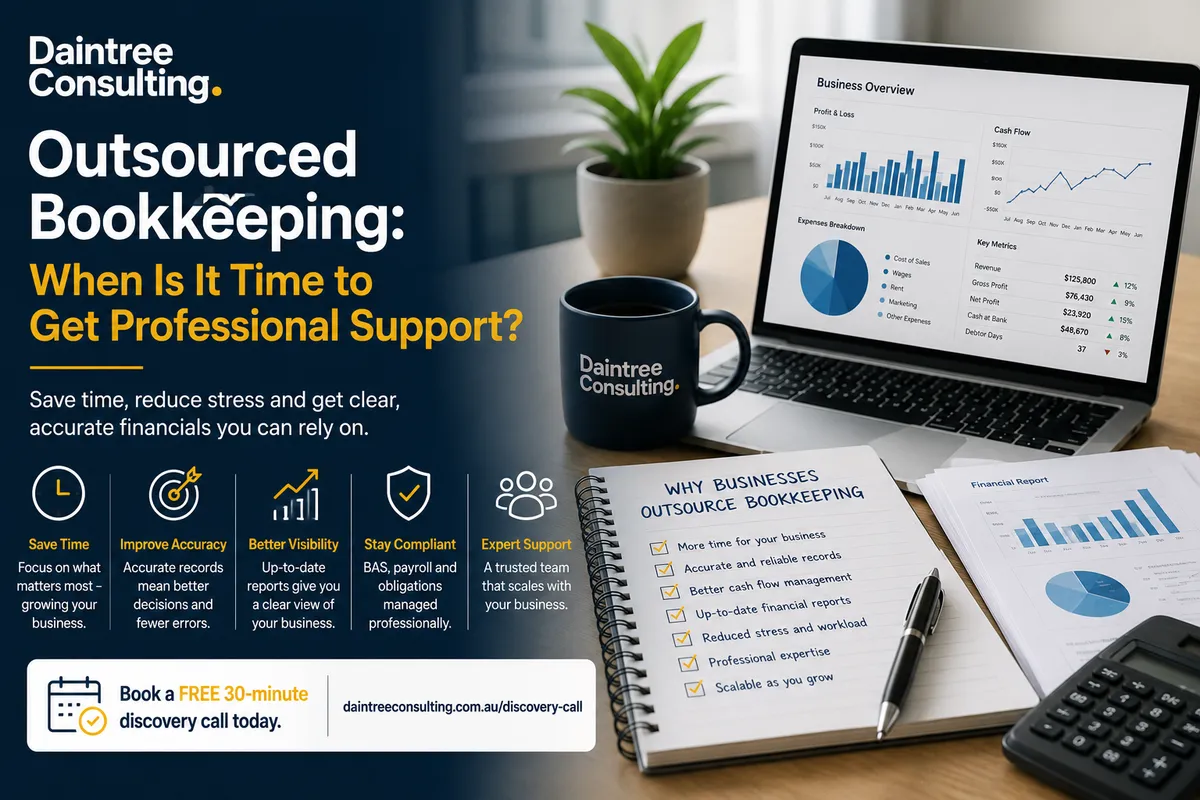
Outsourced Bookkeeping: When Is It Time to Get Professional Support?
Bookkeeping is one of those business functions that can work perfectly well in the early stages of a business. You issue invoices, pay bills, reconcile the bank account and keep your accounting software reasonably up to date.
Then the business grows.
Want expert help? Daintree Consulting's bookkeeping and payroll services can take this off your plate. Book a free consultation.
Suddenly, there are more transactions, more suppliers, more employees, more GST obligations and more financial decisions to make. What once took a few hours a week can start consuming valuable management time.
That is often when business owners start considering outsourced bookkeeping.
Outsourcing your bookkeeping means engaging an external professional or accounting firm to manage some or all of your day-to-day financial recordkeeping. Done properly, it can give you cleaner financial information, reduce administrative pressure and give you more time to focus on running the business.
But how do you know when it is actually time to outsource?
The answer is not simply "when the business gets big enough."
For some businesses, outsourcing makes sense from the beginning. For others, it becomes worthwhile when the owner or internal team can no longer maintain accurate records consistently.
This guide explains the signs to look for, what outsourced bookkeeping can include, how it differs from managing your books internally and what to consider before choosing a provider in Australia.
Quick Answer: When Should You Outsource Your Bookkeeping?
If your bookkeeping is taking too much of your time, falling behind, becoming difficult to manage or no longer giving you reliable financial information, it may be time to consider professional support.
Some of the most common signs include:
Your bookkeeping is regularly behind
You spend several hours each week managing financial records
Bank reconciliations are not up to date
BAS preparation has become stressful
Your business is growing quickly
You are hiring more employees
Your accounting system is becoming harder to manage
Your accountant is regularly cleaning up your books
You cannot confidently see your actual profitability or cash position
An internal employee is trying to manage bookkeeping alongside several other responsibilities
The key point is simple: outsourced bookkeeping is not only for businesses in trouble. It can be a proactive decision that helps a growing business stay organised.
What Is Outsourced Bookkeeping?
Outsourced bookkeeping is when a business engages an external bookkeeping professional or accounting firm to manage some or all of its bookkeeping activities.
Instead of the owner, office manager or internal administration team handling everything, an external provider takes responsibility for agreed bookkeeping tasks.
Depending on the arrangement, this may include:
Recording sales and expenses
Bank reconciliations
Credit card reconciliations
Accounts payable
Accounts receivable
GST coding
Payroll support
Financial reporting
BAS support
Maintaining accounting software
Managing bookkeeping processes and deadlines
The exact scope depends on the provider and your business requirements.
For some businesses, outsourcing means handing over the entire bookkeeping function.
For others, it means keeping some tasks internally while an external bookkeeper handles reconciliations, reporting, BAS preparation or more technical work.
The best arrangement is the one that gives you clear responsibility, reliable records and useful financial information without creating unnecessary complexity.
7 Signs It May Be Time for Outsourced Bookkeeping
There is no universal revenue threshold that tells you when to outsource.
Instead, look at what is happening inside your business.
1. Your Bookkeeping Is Always Behind
One of the clearest signs is a growing bookkeeping backlog.
Perhaps the bank account has not been reconciled for several weeks. Supplier invoices are sitting in your inbox. Receipts have not been entered. Your accounting software is technically active, but the information inside it is outdated.
This creates a problem beyond administration.
When your records are behind, you may not know your actual cash position, profitability or outstanding debts.
You could be making business decisions based on financial information that is weeks or months out of date.
Professional outsourced bookkeeping can create a consistent process for keeping your records current.
2. Bookkeeping Is Taking You Away From Running the Business
Business owners often start doing their own bookkeeping because it appears cheaper.
The problem is that "free" bookkeeping is not actually free if it takes you away from activities that generate revenue or improve the business.
Consider how much time you spend each month:
Entering transactions
Chasing invoices
Reconciling accounts
Fixing accounting software errors
Reviewing expenses
Preparing information for your accountant
Dealing with payroll
Preparing for BAS
If these tasks are taking significant management time, calculate what that time is worth.
Outsourcing may allow you to redirect those hours towards sales, customers, staff, operations and strategic decisions.
The question is not simply:
"Can I do the bookkeeping myself?"
It is:
"Is doing the bookkeeping myself the best use of my time?"
3. You Are Growing Faster Than Your Systems
Growth is positive, but it also creates financial complexity.
A business with a small number of transactions is very different from one processing hundreds of transactions across multiple bank accounts, suppliers, customers and employees.
As you grow, you may introduce:
More employees
Multiple locations
New suppliers
Larger customer accounts
Additional bank accounts
More complex payment processes
Inventory
Recurring subscriptions
Different revenue streams
Your bookkeeping process needs to grow with the business.
If the systems that worked when you were small are becoming difficult to maintain, outsourced bookkeeping can provide additional capacity without requiring you to immediately build a larger internal finance department.
4. Your BAS and GST Obligations Are Becoming Stressful
Australian businesses registered for GST need accurate financial records to support their BAS reporting.
If your bookkeeping is incomplete or incorrectly coded, preparing a BAS can become a stressful exercise.
Common problems can include:
Transactions coded to the wrong GST treatment
Missing invoices
Unreconciled bank accounts
Incorrect expense classifications
Poor recordkeeping
Last-minute adjustments
A professional bookkeeping process helps keep the underlying records organised throughout the reporting period.
If BAS preparation or lodgement is included in the engagement, an appropriately registered BAS Agent may also be able to handle this work.
The important point is that BAS compliance depends on the quality of the underlying financial records.
5. You Cannot Reliably Answer Basic Financial Questions
A healthy bookkeeping system should help you answer questions such as:
How much cash do we actually have?
What do customers currently owe us?
What bills are coming due?
How profitable was the business last month?
What are our biggest expenses?
Are our margins improving or declining?
How much GST and PAYG is likely to be payable?
Are we on track against budget?
If answering these questions requires opening multiple spreadsheets, searching through emails or waiting for someone to work out the numbers, your financial information may not be functioning as a useful management tool.
Good bookkeeping is not simply about compliance.
It creates the foundation for better business decisions.
6. Your Internal Team Is Doing Too Many Financial Tasks
Some businesses do not have a dedicated bookkeeper.
Instead, bookkeeping is handled by:
The business owner
An office manager
An administrator
A receptionist
A family member
A general operations employee
This can work for a period of time.
But as responsibilities increase, financial tasks can become mixed with other duties.
That can create uncertainty about who is responsible for:
Bank reconciliations
Supplier payments
Customer invoices
Payroll
BAS information
Financial reporting
Recordkeeping
Outsourcing can establish clearer ownership of the bookkeeping function while allowing internal staff to focus on their primary responsibilities.
7. Your Accountant Is Spending Too Much Time Cleaning Up the Books
This is an especially important warning sign.
If your accountant regularly needs to fix bookkeeping issues before preparing financial statements or tax returns, you may have a bookkeeping problem rather than an accounting problem.
Examples might include:
Unreconciled transactions
Incorrect account classifications
Missing documentation
Old outstanding balances
Duplicate transactions
Poorly maintained debtor records
Incorrect GST coding
Your accountant should be able to work from reliable financial records.
A professional bookkeeping function can help reduce the amount of cleanup required at year-end and make the relationship between bookkeeping, accounting and tax much more efficient.
What Does an Outsourced Bookkeeper Actually Do?
The answer depends on the engagement.
A comprehensive outsourced bookkeeping arrangement may cover several areas.
Day-to-Day Bookkeeping
This can include recording transactions, reconciling bank accounts, managing expenses and maintaining your accounting records.
Accounts Payable
Your provider may help organise supplier invoices, payment information and outstanding bills.
Accounts Receivable
This can include invoicing processes, debtor reporting and monitoring outstanding customer balances.
Payroll
Some bookkeeping providers also handle payroll, including payroll processing and related reporting.
Payroll should not be assumed to be included simply because a provider offers bookkeeping, so confirm the scope before engaging them.
BAS Support
A registered BAS Agent may be able to prepare and lodge BAS where permitted.
Businesses should confirm the provider's registration and the exact services included in the engagement.
Financial Reporting
Your bookkeeping provider may also produce regular financial reports that allow you, your accountant or your business advisor to understand business performance.
The goal should not be to produce reports simply because they are available.
The goal is to produce information that helps you understand what is happening financially.
Outsourced Bookkeeping vs Hiring a Bookkeeper
One of the biggest questions business owners ask is whether they should outsource or employ a bookkeeper internally.
There is no single answer.
An internal employee can make sense when bookkeeping is substantial enough to justify a dedicated role and the business wants that capability inside the organisation.
Outsourcing can make sense when you want professional bookkeeping capability without building a full internal finance function.
Consider the broader picture rather than simply comparing hourly rates.
An employee may involve:
Salary
Superannuation
Leave
Recruitment
Training
Software
Management time
Backup during holidays or illness
An outsourced provider may provide access to a broader finance team and established systems without those employment responsibilities.
For many small and medium businesses, this flexibility can be attractive.
What Are the Benefits of Outsourced Bookkeeping?
When properly structured, outsourcing can provide several practical benefits.
Better Financial Visibility
Regularly maintained books give you a clearer picture of business performance and cash flow.
More Time for the Owner
Removing repetitive bookkeeping work can give owners more time for customers, employees, sales and strategy.
Greater Consistency
A defined bookkeeping process makes it easier to keep financial records current.
Access to Professional Expertise
Instead of relying on someone who happens to know basic accounting software, you can engage professionals whose role is specifically focused on financial administration and bookkeeping.
Easier Collaboration With Your Accountant
Clean bookkeeping makes it easier for your accountant, tax professional or business advisor to work from reliable information.
Scalability
An external provider can potentially increase support as your business grows without requiring you to immediately build an entire finance department.
What Should You Look for in an Outsourced Bookkeeping Provider?
Choosing a provider is about more than finding someone who can enter transactions.
Ask questions about the complete process.
1. What Exactly Is Included?
Get the scope in writing.
Ask whether the service includes:
Bank reconciliations
Accounts payable
Accounts receivable
Payroll
BAS preparation or lodgement
Financial reporting
Accounting software support
2. Who Will Actually Do the Work?
Understand who is responsible for your account and who reviews the work.
You should know who to contact when you have a question and whether there is backup support if your usual contact is unavailable.
3. How Often Will the Books Be Updated?
Weekly, fortnightly and monthly arrangements can all work depending on transaction volume and business needs.
The important thing is that the frequency is appropriate for your business.
4. How Will You Communicate?
You should know how questions, approvals and urgent matters will be handled.
Clear communication is especially important when your provider is responsible for payments, payroll or reporting deadlines.
5. Can They Work With Your Existing Software?
Cloud accounting platforms can make collaboration easier, but the provider should understand your particular setup and be comfortable working within your existing systems where appropriate.
6. Can They Scale With Your Business?
Ideally, your bookkeeping provider should be able to adjust the scope of support as transaction volume, staffing, reporting and financial complexity increase.
You should not have to replace your bookkeeping provider every time the business reaches another stage of growth.
How Much Does Outsourced Bookkeeping Cost?
There is no single price for outsourced bookkeeping in Australia.
Fees depend on factors such as:
Number of transactions
Number of bank accounts
Payroll complexity
Number of employees
Accounts payable requirements
Accounts receivable requirements
BAS requirements
Reporting requirements
Accounting software
Industry complexity
Frequency of service
Some providers charge hourly rates. Others use fixed monthly packages based on scope and transaction volume.
The cheapest option is not necessarily the most cost-effective.
A better comparison is the total value you receive for the fee.
If professional bookkeeping saves management time, reduces errors, improves reporting and makes tax and BAS work easier, the value can extend well beyond the bookkeeping itself.
When Outsourcing May Not Be the Right Choice
Outsourced bookkeeping is not automatically the best solution for every business.
You may prefer to keep bookkeeping internally when:
Transaction volume is very low
Your existing employee has appropriate bookkeeping expertise
You have strong internal financial processes
Management genuinely has the time and capability to oversee the function
You require highly specialised internal financial operations
The important thing is to assess the business based on its actual requirements rather than assuming outsourcing is always better.
How Daintree Consulting Approaches Outsourced Bookkeeping
At Daintree Consulting, bookkeeping is treated as part of a broader financial function rather than simply data entry.
The objective is to keep the underlying records accurate, organised and useful so business owners have greater confidence in their numbers.
Depending on the engagement, support can connect bookkeeping with areas such as:
Payroll
BAS and taxation compliance
Financial reporting
Business advisory
Outsourced CFO support
This integrated approach can reduce unnecessary handovers between different providers and create a clearer connection between day-to-day financial records and higher-level business decisions.
For a growing business, that distinction matters.
Your bookkeeping should not simply tell you what happened.
It should help create reliable information that supports what you decide to do next.
The Real Question: Is Your Bookkeeping Supporting the Business?
You do not need to wait until your bookkeeping becomes a serious problem before getting professional support.
If financial records are regularly behind, the owner is spending too much time on administration, BAS preparation is stressful or management cannot confidently see what is happening financially, those are all signals worth investigating.
The right bookkeeping arrangement should give you:
Accurate records.
Clear responsibility.
Timely information.
Less administrative pressure.
A stronger foundation for business decisions.
If your business has reached the point where bookkeeping is taking you away from higher-value work, it may be time to consider outsourced bookkeeping.
Ready to Get Your Bookkeeping Under Control?
If you are unsure whether your business needs full outsourced bookkeeping, additional support or simply a better financial process, a short conversation can help clarify the options.
Book a free 30-minute discovery call with Daintree Consulting.
We can look at your current bookkeeping setup, identify where the pressure points are and discuss a practical next step — with no pressure and no obligation.
Book your free discovery call:
https://daintreeconsulting.com.au/discovery-call/
Frequently Asked Questions
What is outsourced bookkeeping?
Outsourced bookkeeping is when a business engages an external professional or accounting firm to manage some or all of its bookkeeping activities rather than completing them entirely in-house.
Is outsourced bookkeeping suitable for small businesses?
Yes. Small businesses can benefit when bookkeeping is taking too much owner time, records are falling behind or the business needs more reliable financial information.
What does an outsourced bookkeeper do?
Depending on the engagement, an outsourced bookkeeper may handle transaction recording, reconciliations, accounts payable, accounts receivable, payroll, BAS support and financial reporting.
Is outsourced bookkeeping better than hiring a bookkeeper?
It depends on the business. Outsourcing can provide professional capability and flexibility without the employment responsibilities associated with hiring internally. An internal bookkeeper may make sense when the business has sufficient ongoing workload for a dedicated role.
How often should outsourced bookkeeping be done?
The appropriate frequency depends on transaction volume, payroll, reporting needs and business complexity. Some businesses need weekly support, while others may only require fortnightly or monthly services.
Can an outsourced bookkeeper handle BAS?
A registered BAS Agent may prepare and lodge BAS where permitted. Businesses should confirm the provider's registration and the exact services included in the engagement.
When should I outsource my bookkeeping?
Common signs include consistently overdue books, increasing transaction volume, growing payroll requirements, stressful BAS preparation, unreliable financial reports and an owner spending too much time on bookkeeping.
Can outsourced bookkeeping grow with my business?
Yes. A suitable provider can adjust the scope of bookkeeping support as transaction volume, staffing, reporting and financial complexity increase.
Does Daintree Consulting provide outsourced bookkeeping?
Yes. Daintree Consulting provides bookkeeping and related financial support for Australian businesses, with services that can connect bookkeeping, payroll, BAS, reporting and broader financial advisory needs.
