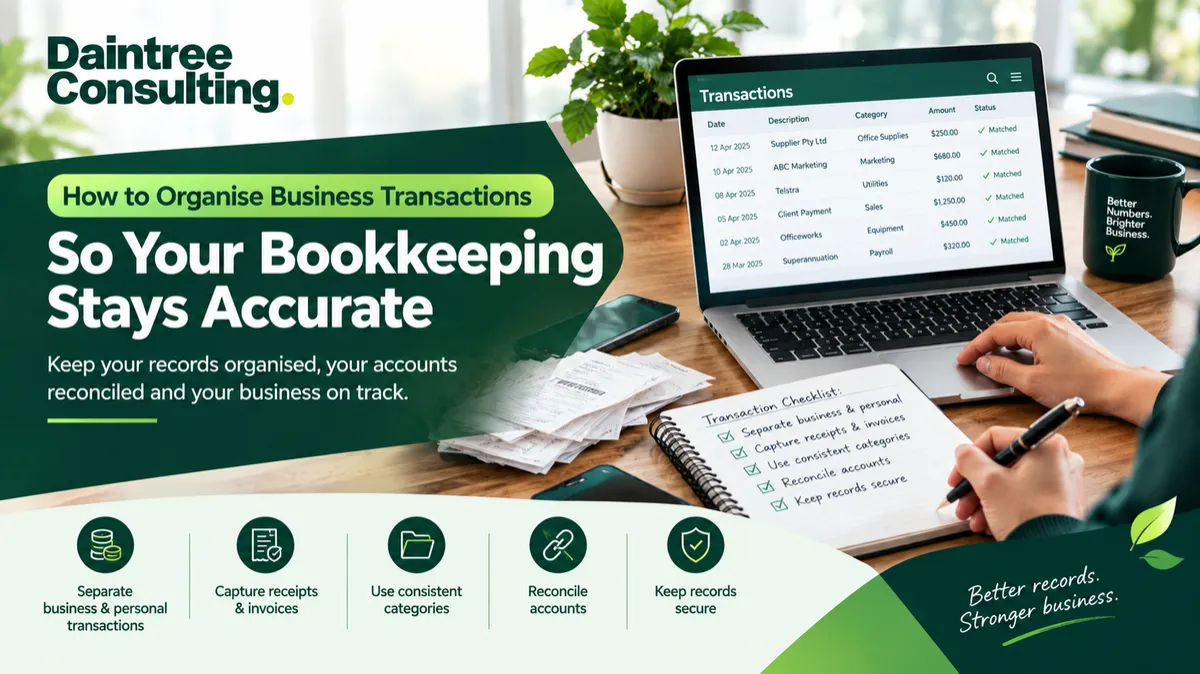
How to Organise Business Transactions for Accurate Bookkeeping
Bookkeeping becomes much harder when business transactions are scattered across bank accounts, credit cards, emails, receipts, payment platforms and spreadsheets.
A business might have all the information it needs, but if transactions are not organised consistently, it becomes difficult to determine what was purchased, when it happened, which account it belongs to and how it should be recorded.
Want expert help? Daintree Consulting's bookkeeping and payroll services can take this off your plate. Book a free consultation.
That can lead to duplicated transactions, missing records, incorrect expense categories, unreconciled accounts and more work at BAS and tax time.
Learning how to organise business transactions is therefore not just an administrative exercise. It is part of maintaining reliable financial records.
For Australian businesses, organised transaction records can also make it easier to reconcile accounts, prepare financial reports, support BAS and tax work, respond to accountant requests and identify financial issues earlier.
Quick answer: How should you organise business transactions?
A practical transaction organisation system should:
Keep business and personal transactions separate.
Use dedicated business bank and payment accounts where appropriate.
Capture invoices and receipts as transactions occur.
Use consistent transaction categories.
Record the date, amount, supplier or customer and business purpose.
Match transactions to the correct bank or payment account.
Keep supporting documents with the relevant transaction.
Separate recurring transactions from unusual or one-off purchases.
Review uncategorised and unusual transactions regularly.
Reconcile bank, credit card and other accounts regularly.
Keep records securely and maintain appropriate backups.
Review the bookkeeping process as the business grows.
The goal is simple:
Every transaction should be understandable, traceable and supported by appropriate records.
Why does organising business transactions matter?
Bookkeeping is based on transactions.
Sales, purchases, wages, supplier payments, loan repayments, subscriptions, asset purchases and other financial activity eventually flow into the accounting records.
If the underlying transactions are poorly organised, the bookkeeping system can become unreliable even when the accounting software itself is configured correctly.
For example, imagine a business owner has:
Three business bank accounts
Two business credit cards
Several online payment platforms
Personal purchases accidentally made on a business card
Supplier invoices arriving by email
Paper receipts stored in a vehicle
Subscription payments appearing under different descriptions
Customer payments arriving through different channels
The business may still have every transaction somewhere.
The problem is that nobody has a consistent system for organising them.
That creates additional work for the person responsible for bookkeeping.
It can also make financial reports less useful because the quality of the reports depends heavily on the quality of the underlying records.
ASIC states that companies must keep financial records that correctly record and explain transactions and the company's financial position and performance. Proper records also need to support the preparation and audit of financial statements where applicable.
For that reason, transaction organisation should be treated as part of the financial management process rather than something that only matters at tax time.
1. Separate business and personal transactions
One of the simplest ways to improve bookkeeping accuracy is to keep business and personal financial activity separate.
Ideally, business income and expenses should flow through accounts used for business purposes.
When personal purchases are mixed into business accounts, the bookkeeper has to determine which transactions relate to the business and which do not.
For example, a business credit card might contain:
Business software
Client lunches
Office supplies
Personal groceries
Family purchases
Fuel
Business travel
Personal entertainment
The bookkeeping system now needs an additional process for identifying and dealing with the personal transactions.
This creates unnecessary complexity.
It can also increase the risk of transactions being incorrectly classified.
A better approach
Use dedicated business accounts for business activity wherever practical.
That can include:
Business bank accounts
Business credit cards
Business payment platforms
Business expense cards
Business payment gateways
If a personal transaction is accidentally made through a business account, identify it promptly rather than allowing it to remain mixed with legitimate business expenses.
2. Create a consistent transaction capture process
A transaction should not have to be rediscovered weeks or months later.
The business should have a consistent way of capturing financial information when transactions occur.
For example, when a business purchases equipment, the transaction process could be:
Purchase made → invoice or receipt captured → transaction recorded → supporting document attached → transaction reconciled
The same principle can apply to sales.
Invoice issued → payment received → transaction matched → supporting documentation retained → account reconciled
The exact workflow will depend on the business and accounting system.
The important point is consistency.
If one employee saves receipts in an accounting platform, another sends them by email and a third keeps paper copies in a drawer, the business does not really have a transaction-management system.
It has several disconnected systems.
3. Capture receipts and invoices as they occur
A common bookkeeping problem is trying to reconstruct transactions later.
A business owner might remember buying something but no longer have the receipt.
Or an invoice might be buried in an email from six months earlier.
Or a supplier might have issued a credit that was never matched against the original invoice.
Capturing supporting documentation when a transaction occurs can reduce these problems.
Depending on the business, supporting documents may include:
Tax invoices
Receipts
Supplier invoices
Customer invoices
Credit notes
Contracts
Purchase orders
Bank statements
Loan documents
Expense claims
Payment confirmations
Asset purchase documentation
Electronic record keeping can make this easier.
The ATO recognises electronic records as a valid way to maintain business transaction records, provided the relevant record-keeping requirements are met.
The objective should be to create a clear connection between the transaction and the document that explains it.
4. Use clear and consistent transaction categories
Good bookkeeping depends on transactions being classified consistently.
For example, a business might have separate categories for:
Advertising
Software subscriptions
Motor vehicle expenses
Office expenses
Professional fees
Travel
Insurance
Telephone and internet
Rent
Repairs and maintenance
Equipment
Wages
Bank fees
The exact chart of accounts should reflect the business.
The important point is consistency.
If the same type of software subscription is recorded as "Software", "IT", "Subscriptions" and "Office expenses" depending on who processes the transaction, financial reporting becomes less useful.
Inconsistent categories can also make it harder to compare results from one month to another.
Avoid overcomplicating categories
More categories do not automatically mean better bookkeeping.
A business can create so many expense categories that nobody knows which one to use.
The better approach is to create categories that provide useful financial information without making transaction processing unnecessarily complicated.
The chart of accounts should support the reporting the business actually needs.
5. Record the business purpose
Some transactions are obvious.
A payment to a known software provider may be easy to identify.
Others may not be.
A transaction described only as "PAYMENT" or "TRANSFER" may not tell the bookkeeper why the money was spent.
Where appropriate, record enough information to explain the business purpose.
For example:
Less useful:
$1,850 — Equipment
More useful:
$1,850 — Replacement office equipment for Melbourne office
The additional context can make future review easier.
This can be particularly useful for:
Large purchases
Unusual expenses
Travel
Entertainment
Professional services
Asset purchases
Owner transactions
Related-party transactions
One-off payments
The aim is not to write a long explanation for every transaction.
It is to provide enough information that someone reviewing the records later can understand what happened.
6. Organise transactions by source
Businesses often receive transaction information from multiple sources.
Common sources include:
Bank accounts
Credit cards
Point-of-sale systems
E-commerce platforms
Payment gateways
Payroll systems
Expense management platforms
Loan accounts
Investment accounts
Cash transactions
Each source should have a defined place in the bookkeeping process.
For example, a business could maintain a simple transaction map:
Business bank account → bank feed → accounting software
Business credit card → card feed → accounting software
Online sales platform → sales report → accounting software
Payroll system → payroll records → accounting software
This makes it easier to identify where transactions originate and whether any sources are missing from the bookkeeping process.
7. Do not rely entirely on bank feeds
Bank feeds can save considerable time, but they do not eliminate the need for bookkeeping review.
A bank feed may tell you:
The date
The amount
The transaction description
The account
Sometimes additional information
But it may not tell you exactly what the transaction was for or how it should be treated.
For example, a payment of $4,500 to a supplier could relate to:
Stock
Equipment
Professional services
A deposit
A loan repayment
A combination of invoices
The bank transaction alone may not provide enough context.
This is why supporting documentation and transaction review remain important.
Automation should make bookkeeping more efficient.
It should not replace judgement where judgement is required.
8. Match payments to invoices
Businesses that buy from suppliers on credit should have a process for matching payments to the relevant invoices.
Suppose a business receives three invoices from the same supplier:
Invoice 101 — $2,000
Invoice 102 — $3,500
Invoice 103 — $1,200
A later bank payment of $3,500 should be matched to the appropriate invoice rather than simply coded as a generic supplier expense.
This helps maintain accurate accounts payable records.
The same principle applies to customer receipts.
A customer payment should ideally be matched to the relevant invoice or invoices.
This helps the business understand:
Which customers have paid
Which invoices remain outstanding
How much is overdue
Whether a payment has been allocated incorrectly
Whether an account balance is accurate
9. Separate recurring transactions from unusual transactions
Recurring transactions are often easier to manage because the business knows what to expect.
Examples include:
Rent
Software subscriptions
Insurance
Phone services
Regular supplier payments
Loan repayments
Payroll
Unusual transactions require more attention.
Examples include:
Large equipment purchases
Legal settlements
Business acquisitions
Unusual refunds
Large customer credits
Owner withdrawals
New financing
Related-party transactions
A useful bookkeeping process should flag unusual transactions rather than allowing them to disappear into the normal monthly workflow.
This is particularly important when the transaction could affect the balance sheet, tax treatment or management reporting.
10. Create a process for owner transactions
Owner transactions can become confusing when they are not clearly identified.
For example, money moving between the business and an owner may relate to:
Salary or wages
Director remuneration
Drawings
Capital introduced
Reimbursement
Loan
Dividend
Personal expense paid by the business
Business expense paid personally
These transactions should not simply be coded based on the bank description.
The correct treatment depends on the business structure and circumstances.
A clear process should identify owner-related transactions quickly and ensure they are reviewed appropriately.
This is especially important for companies where the distinction between company transactions and personal transactions needs to be maintained carefully.
11. Keep a clear process for business reimbursements
Employees and owners sometimes pay business expenses personally.
For example:
An employee purchases $280 of supplies using their personal card and submits the receipt to the business.
That transaction should not simply disappear because it did not go through the business bank account.
The business should have a process for:
Capturing the receipt
Identifying the business purpose
Recording the expense
Recording the amount payable to the employee or owner
Processing the reimbursement
Matching the reimbursement to the relevant record
A consistent reimbursement process prevents expenses from being lost or recorded twice.
12. Reconcile transactions regularly
Transaction organisation and reconciliation work together.
A transaction may be recorded in the accounting system, but that does not necessarily mean the record is correct.
Regular reconciliation helps compare the accounting records against external information such as bank or credit card statements.
For example:
Accounting records: $82,450
Bank statement: $81,950
A difference of $500 needs to be investigated.
It might relate to:
A missing transaction
A duplicate transaction
A bank fee
A payment recorded incorrectly
A transaction recorded in the wrong account
A timing difference
An unreconciled transfer
Regular reconciliation means these differences can be identified while the information is still relatively easy to trace.
13. Review uncategorised transactions
Most accounting systems provide some way to identify transactions that have not been properly categorised or reconciled.
These should not be allowed to accumulate indefinitely.
An uncategorised transaction may indicate:
Missing information
An unusual transaction
A bookkeeping error
A bank feed issue
A transaction requiring management clarification
A transaction that needs supporting documentation
Set a regular review point for these items.
For example, they could be reviewed during the weekly or monthly bookkeeping process.
The objective is to prevent a growing backlog of transactions that nobody wants to investigate at year-end.
14. Use a transaction naming convention where appropriate
Businesses with high transaction volumes may benefit from consistent naming conventions.
This can be particularly useful for:
Projects
Locations
Departments
Vehicles
Property
Business divisions
Customer accounts
Cost centres
For example, a business operating across multiple locations might identify transactions using a consistent location or project reference.
This can make it easier to analyse costs later.
However, naming conventions should be practical.
If the system becomes too complicated, staff may stop using it consistently.
15. Create a month-end transaction review
A monthly transaction review can catch problems before they become larger bookkeeping issues.
A basic review might include:
Uncategorised transactions
Unreconciled bank items
Unreconciled credit cards
Large expenses
Unusual transactions
Owner transactions
Supplier balances
Customer receipts
Missing invoices
Duplicate transactions
Transfers between accounts
Loan transactions
Asset purchases
Payroll-related transactions
This does not have to be a massive exercise.
The goal is to identify transactions that require attention before the books are considered complete for the month.
How should you organise business transactions for BAS?
Transaction organisation is particularly important when financial records feed into GST and BAS reporting.
The accounting system needs enough information to determine how transactions should be treated under the applicable GST rules.
Poorly organised records can create additional work when preparing a BAS because transactions may need to be reviewed and reclassified.
A good process therefore aims to identify relevant transaction information before BAS preparation begins.
This can include:
Sales
Purchases
GST-related transactions
Business expenses
Asset purchases
Payments received
Payments made
Adjustments
Relevant supporting documents
The exact GST treatment depends on the transaction and the business's circumstances.
This is why businesses should not assume that every expense or purchase receives the same treatment simply because it appears in the bank account.
How transaction organisation helps at tax time
Tax preparation becomes easier when the underlying transactions are already organised.
Instead of starting with a large collection of bank transactions, the business can work from records that have already been:
Categorised
Reconciled
Supported
Reviewed
Matched
Explained where necessary
This can reduce the amount of reconstruction required at year-end.
It can also make it easier to identify transactions that require professional review.
For example, a large asset purchase should not necessarily be treated in exactly the same way as an ordinary operating expense.
Similarly, financing transactions, private expenses and owner transactions may require different treatment.
Organised bookkeeping helps surface these matters earlier.
What should you do with digital transaction records?
Digital record keeping is now standard for many businesses.
Invoices, receipts and supporting documents may be stored electronically in accounting software, document management systems, cloud storage or other digital platforms.
The system should make it easy to:
Find documents
Connect documents to transactions
Restrict inappropriate access
Back up important information
Retrieve records when required
Maintain records for the required period
ASIC notes that company financial records can be electronic, but companies must still be able to produce records in hard copy within a reasonable timeframe if required.
The ATO also accepts electronic record keeping where the relevant requirements are satisfied.
The important point is not whether records are paper or digital.
It is whether the system allows the business to maintain complete, accessible and reliable records.
Common transaction organisation mistakes
Even businesses with accounting software can develop inefficient transaction processes.
Here are some of the most common problems.
Mixing personal and business expenses
This creates unnecessary classification work and can make the records harder to interpret.
Keeping receipts in multiple places
Receipts stored across emails, phones, vehicles and paper folders are easy to lose.
Using inconsistent expense categories
This reduces the usefulness of management reports.
Leaving transactions uncategorised
A backlog makes month-end and year-end work harder.
Recording transactions without supporting documents
The amount may be visible, but the reason for the transaction may not be clear.
Relying entirely on automated bank feeds
Automation can import transactions but does not necessarily determine the correct accounting treatment.
Failing to reconcile regularly
Errors can accumulate when differences are not investigated promptly.
Not identifying owner transactions
Personal, business, loan and capital transactions can become mixed together.
Waiting until tax time
Reconstructing months of transactions at year-end is usually more difficult than maintaining the records throughout the year.
How to create a simple transaction organisation system
You do not need a complicated process.
Start with a few clear rules.
Rule 1: Every transaction has a source
Know whether it came from a bank account, credit card, payment platform, payroll system or another source.
Rule 2: Every transaction has a purpose
The bookkeeping record should make it possible to understand why the transaction occurred.
Rule 3: Every significant transaction has supporting evidence
Keep the invoice, receipt, contract or other appropriate documentation.
Rule 4: Every transaction goes to an appropriate category
Use consistent categories that support useful reporting.
Rule 5: Every account is reconciled
Compare the accounting records with the relevant external records regularly.
Rule 6: Unusual transactions are reviewed
Do not allow significant or unusual transactions to pass through the system without appropriate consideration.
Rule 7: Problems are resolved promptly
Do not allow uncategorised or unreconciled transactions to become a permanent backlog.
What should a business transaction checklist include?
A practical bookkeeping checklist might look like this:
Business and personal transactions are separated
All business bank accounts are connected or accounted for
Business credit cards are included
Payment platforms are included
Sales transactions are captured
Supplier invoices are recorded
Receipts are stored
Transactions are categorised consistently
Unusual transactions are identified
Owner transactions are reviewed
Employee reimbursements are recorded
Bank accounts are reconciled
Credit cards are reconciled
Uncategorised transactions are reviewed
Supporting documents are accessible
Records are backed up appropriately
Month-end issues are resolved before the next reporting period
The checklist can be adjusted as the business becomes more complex.
When should you review your transaction organisation process?
Your transaction process should evolve as the business grows.
A system that works for a small business with 50 transactions a month may become inefficient when the business is processing thousands of transactions.
Consider reviewing the process when:
Transaction volume increases
You open another bank account
You add a new payment platform
You start selling online
You expand into another location
You employ more staff
You introduce new expense cards
You begin purchasing significant assets
You add new business divisions
Your BAS preparation becomes difficult
Your monthly reporting takes too long
Your accountant frequently asks for clarification
Reconciliations are falling behind
Growth does not just create more transactions.
It can create more transaction types and more opportunities for records to become inconsistent.
That is why bookkeeping processes should grow with the business.
Organised transactions lead to better bookkeeping
Accurate bookkeeping starts before the transaction reaches the general ledger.
It starts with how the business captures, documents, classifies and reviews its financial activity.
When transactions are organised consistently, the business can make bookkeeping easier to manage and financial information easier to understand.
It can also reduce the amount of time spent searching for documents, correcting classifications and reconstructing transactions at BAS or tax time.
For Australian companies, maintaining proper financial records is more than good administration. ASIC states that companies have obligations to keep financial records that correctly record and explain transactions and financial position and performance.
The practical lesson is straightforward:
Do not wait until the books are messy to create a transaction process.
Build the process first, then make the bookkeeping follow it.
How Daintree Consulting can help organise your business bookkeeping
You do not necessarily need a complicated bookkeeping system.
You need a process that fits the way your business actually operates.
Daintree Consulting can help Australian businesses establish and maintain more organised bookkeeping processes, including:
Transaction processing
Bank and credit card reconciliations
Accounts payable and receivable
Payroll processing and records
Month-end bookkeeping
BAS-ready financial records
Management reporting
Chart of accounts review
Financial record organisation
Coordination with accountants and other advisers
The aim is to help your business maintain financial records that are organised, current and useful for decision-making.
If your bookkeeping is becoming harder to keep up with, the issue may not simply be the number of transactions.
It may be the process used to organise them.
Need help keeping your business transactions organised?
Daintree Consulting provides Bookkeeping & Payroll and Accounting Services for Australian businesses that need reliable records and clearer financial information.
If your transactions are becoming difficult to manage, book a free 30-minute discovery call with Daintree Consulting to discuss what your business needs.
Frequently Asked Questions
What is the best way to organise business transactions?
Start by separating business and personal transactions, using dedicated business accounts, capturing supporting documents, applying consistent categories and reconciling accounts regularly.
The exact process should reflect the size, structure and transaction volume of the business.
How often should business transactions be recorded?
Transactions should generally be captured as part of an ongoing bookkeeping process rather than left until the end of the financial year.
The appropriate frequency depends on transaction volume and the reporting needs of the business.
Should business and personal transactions be separated?
Yes. Keeping business and personal financial activity separate generally makes bookkeeping easier and reduces unnecessary classification and reconciliation work.
Should I keep receipts for business expenses?
Businesses should retain appropriate records that support their transactions and tax obligations. The specific records required depend on the transaction and applicable requirements.
Are bank feeds enough for accurate bookkeeping?
No. Bank feeds can automate transaction imports, but transactions may still need to be categorised, matched, reconciled and supported with appropriate documentation.
How can I avoid duplicate transactions?
Use a consistent process for importing transactions and reconciling them against bank and other source records. Review duplicate entries before completing each reporting period.
What should I do with uncategorised transactions?
Review them regularly rather than allowing them to accumulate. Determine what each transaction relates to, obtain supporting documentation where necessary and classify it appropriately.
How does organised bookkeeping help with BAS?
Organised transaction records can make it easier to identify sales, purchases and other transactions that need to be considered when preparing the BAS.
The GST treatment of individual transactions depends on the circumstances and applicable rules.
Can bookkeeping be outsourced?
Yes. Businesses can outsource bookkeeping while retaining appropriate oversight of their financial records and processes.
ASIC notes that company record-keeping obligations continue to apply even where bookkeeping or financial records are maintained by an external provider.
When should a business review its bookkeeping process?
Review the process when transaction volumes increase, new payment systems are introduced, the business expands, reconciliations fall behind or financial reporting becomes difficult to maintain.
Talk to Daintree about your bookkeeping and payroll
Our ex-Big 4 team gives clear, senior-reviewed advice so you can act with confidence.
Book a free consultation →
Or explore our bookkeeping and payroll services.
