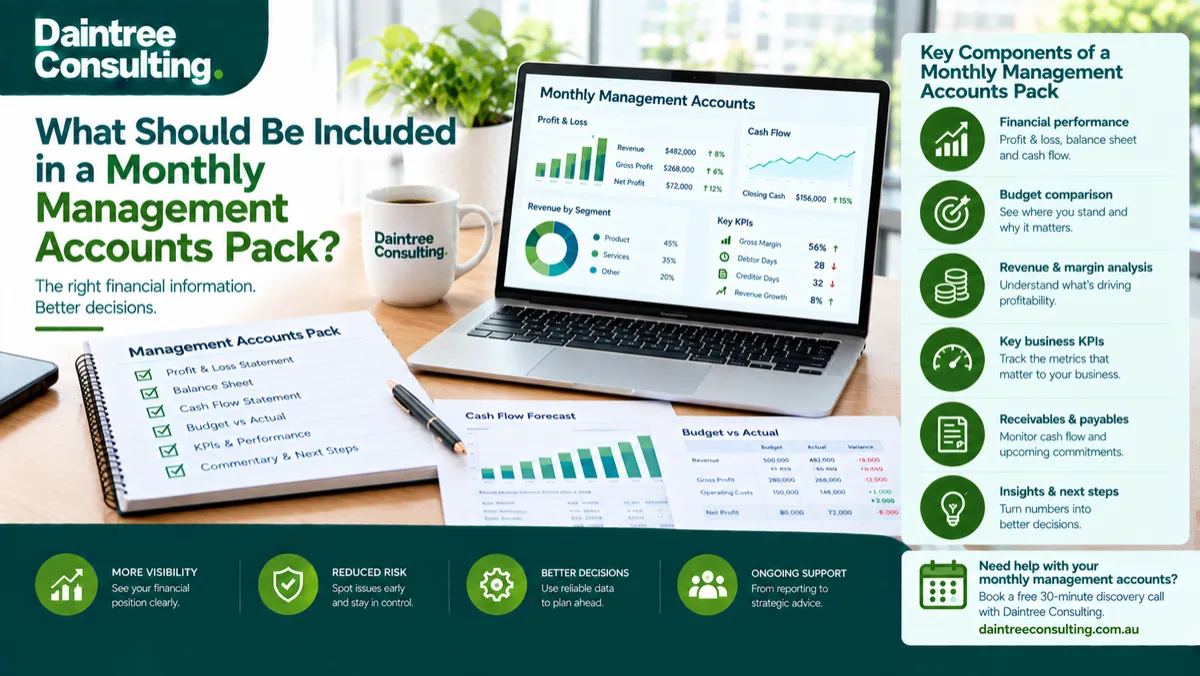
What Should Be Included in a Monthly Management Accounts Pack?
A monthly management accounts pack should do more than tell you whether the business made a profit.
For business owners and leadership teams, the real value of monthly management accounts is understanding what happened during the month, why it happened and what needs attention next.
Want expert help? Daintree Consulting's accounting services can take this off your plate. Book a free consultation.
A well-designed pack brings key financial information together in a consistent format. It can show revenue, costs, profitability, cash flow, balance-sheet movements and key performance indicators while highlighting significant changes from previous periods or the business budget.
The exact contents will vary depending on the size, industry and complexity of the business.
A small professional-services firm may need a relatively simple monthly pack, while a growing business with multiple locations, employees, inventory or external funding may require much more detailed reporting.
The important thing is that the information is accurate, timely and relevant to the decisions management actually needs to make.
Quick Answer: What Should a Monthly Management Accounts Pack Include?
A monthly management accounts pack will commonly include:
Profit and loss statement
Balance sheet
Cash flow information
Budget vs actual analysis
Revenue and gross-margin analysis
Key business KPIs
Accounts receivable and payable information
Significant balance-sheet movements
Commentary on major variances
Forecast or outlook information
Key issues requiring management attention
Not every business needs every report.
The best monthly management accounts pack is one that gives the leadership team enough information to understand financial performance and make better decisions without overwhelming them with unnecessary detail.
What Are Monthly Management Accounts?
Monthly management accounts are internal financial reports prepared regularly to help management understand the financial performance and position of a business.
Unlike statutory financial statements, management accounts are primarily designed for internal decision-making.
They can be tailored to the needs of the business.
For example, management may want to know:
Are sales on track?
Are gross margins improving or declining?
Are operating costs under control?
Which areas are driving the largest variances?
Is cash flow becoming tighter?
Are customers paying on time?
Is the business performing against its budget?
Are particular locations, products or services more profitable?
Can the business afford planned expenditure?
What should management focus on next month?
A good monthly management accounts process turns financial records into information that can actually be used.
1. Executive Summary
A monthly management accounts pack should ideally begin with a concise summary.
Business owners and directors do not always have time to work through every line of a financial report.
An executive summary can highlight the most important points from the month.
For example:
Revenue:
Revenue was above or below budget.
Profitability:
Gross profit or operating profit changed compared with the previous period.
Cash:
The cash position increased or decreased, with the major drivers identified.
Key variances:
Significant differences from budget or expectations are highlighted.
Issues:
Management attention is required in specific areas.
Outlook:
The current position suggests particular priorities for the coming month or quarter.
The purpose is not to replace the detailed reports.
It is to make the important information easier to identify.
2. Profit and Loss Statement
The profit and loss statement is usually one of the central components of monthly management accounts.
It shows the business's financial performance over the reporting period.
Depending on the business, it may include:
Revenue
Cost of sales
Gross profit
Operating expenses
EBITDA or another relevant operating measure
Depreciation
Interest
Net profit or loss
The structure should reflect how management thinks about the business.
For example, a service business may focus heavily on revenue, employee costs, utilisation and gross margin.
A retail or product-based business may need greater visibility over sales, inventory, cost of goods sold and gross margin.
The report should therefore be structured around meaningful management information rather than simply reproducing a standard accounting report.
3. Budget vs Actual Analysis
A profit and loss statement tells you what happened.
A budget vs actual report helps explain whether what happened was in line with expectations.
For example, suppose a business budgeted for:
$500,000 revenue
$300,000 cost of sales
$120,000 operating expenses
If actual results differ significantly, management needs to understand why.
Revenue might be below budget because sales volumes were weaker.
Expenses might be above budget because staffing costs increased.
Gross margin might have declined because supplier costs increased.
The value of the report comes from investigating the reasons behind significant variances.
A useful monthly management accounts pack should therefore highlight material or commercially important differences rather than expecting management to identify every variance manually.
4. Revenue Analysis
Revenue is one of the most important indicators of business performance, but total revenue alone may not provide enough insight.
Depending on the business, management may benefit from seeing revenue broken down by:
Product
Service
Location
Business unit
Customer type
Sales channel
Geographic market
Recurring vs non-recurring revenue
For example, total sales may be increasing while a previously profitable service line is declining.
Alternatively, revenue may be growing because of one large customer, creating a concentration risk that would not be obvious from the total revenue figure alone.
The right revenue analysis depends on what drives the business.
5. Gross Profit and Gross Margin
Revenue growth does not automatically mean stronger profitability.
That is why gross profit and gross margin are important components of monthly management accounts.
Gross profit generally reflects revenue after the directly attributable cost of producing or delivering the goods or services.
Gross margin expresses gross profit as a percentage of revenue.
Management may want to monitor whether margins are:
Improving
Declining
Consistent
Different across products or services
Different from budget
Changing because of pricing or supplier costs
A business can experience strong sales growth while margins deteriorate.
Monthly management accounts can help identify this trend earlier.
6. Operating Expense Analysis
Operating expenses should be reviewed in the context of the business model.
Depending on the organisation, this might include:
Employee costs
Rent
Software
Marketing
Insurance
Professional fees
Travel
Utilities
Vehicle expenses
Technology costs
Other overheads
The important question is not simply whether an expense increased.
Management should consider why it increased and whether the change was expected or commercially justified.
For example, higher marketing expenditure may be deliberate because the business is launching a new service.
Higher staffing costs may reflect planned growth.
Alternatively, an unexpected increase in a recurring expense may require investigation.
Monthly management accounts should make these movements visible.
7. Balance Sheet
The balance sheet is sometimes overlooked because business owners naturally focus on revenue and profit.
However, it can provide important information about the financial health of the business.
A monthly management accounts pack may include key balance-sheet categories such as:
Cash
Accounts receivable
Inventory
Fixed assets
Accounts payable
Loans and other liabilities
Tax-related balances
Equity
Management can then investigate significant movements.
For example, a profitable business may still experience cash pressure if accounts receivable is increasing significantly.
Likewise, a substantial increase in inventory may indicate that more cash is being tied up in stock.
The balance sheet therefore provides context that a profit and loss statement alone cannot provide.
8. Cash Flow Information
Cash flow deserves a prominent place in many monthly management accounts packs.
Profit does not necessarily equal cash available to spend.
A business may have recorded revenue without receiving payment yet, while cash may also have been used to purchase inventory, equipment or other assets.
Monthly cash flow information can help management understand:
Opening cash
Cash received
Major cash payments
Operating cash movements
Financing movements
Capital expenditure
Closing cash position
For businesses with more complex or volatile cash flows, a forward-looking cash flow forecast can be particularly useful.
This allows management to consider not only what happened to cash during the month but where the cash position may be heading.
9. Accounts Receivable
Accounts receivable information can be highly relevant to cash flow management.
A monthly management accounts pack may show:
Total outstanding receivables
Current invoices
Overdue invoices
Ageing of outstanding amounts
Significant customer balances
Changes from the previous month
This can help management identify whether customers are paying within expected terms.
For example, if revenue is growing but overdue receivables are also increasing, the business may need to investigate its collection process.
The objective is not necessarily to focus on every individual invoice.
It is to identify trends and balances that could have a meaningful impact on cash flow.
10. Accounts Payable
Accounts payable can provide another useful view of the business's short-term financial commitments.
The management accounts pack may show:
Amounts owed to suppliers
Overdue supplier balances
Upcoming significant payments
Changes in creditor balances
Major supplier commitments
This can help management understand what cash commitments are approaching.
It can also highlight unusual movements.
For example, a sharp increase in accounts payable might reflect a timing issue, increased purchasing, delayed payments or another operational change.
The underlying reason should be investigated rather than assuming that the movement is automatically positive or negative.
11. Key Business KPIs
Financial statements are important, but financial information may not tell the entire story.
A monthly management accounts pack can include selected business KPIs that help explain what is driving the financial results.
Depending on the business, these might include:
Sales volume
Average transaction value
Gross margin
Customer acquisition cost
Customer retention
Recurring revenue
Utilisation
Billable hours
Headcount
Revenue per employee
Inventory turnover
Debtor days
The KPIs should be relevant to the business.
Adding dozens of metrics simply because they are available can make the management accounts pack harder to use.
A smaller number of meaningful KPIs is often more useful than a long list of statistics.
12. Variance Commentary
Numbers are important, but management often needs context to understand them.
This is where commentary becomes valuable.
Suppose revenue was $80,000 below budget.
The number itself does not explain what happened.
The commentary might identify that:
Two major projects started later than expected
A customer delayed an order
A particular service line underperformed
Sales activity was lower than forecast
Similarly, if expenses were $40,000 above budget, management needs to understand the reason.
Was it:
Planned recruitment?
Unexpected repairs?
Higher supplier costs?
A one-off professional fee?
Incorrect budgeting?
An accounting issue?
Good management accounts commentary focuses attention on the drivers behind the numbers.
13. Forecast or Financial Outlook
Historical reporting tells management where the business has been.
A forward-looking component helps answer where it may be going.
Depending on the business, the monthly pack may include:
Updated revenue forecast
Profit forecast
Cash flow forecast
Expected major expenditure
Working capital outlook
Funding requirements
Scenario analysis
Forecasts should be based on reasonable assumptions and updated as new information becomes available.
They are not guarantees of future performance.
Their purpose is to provide management with a current view of the likely financial direction of the business and help identify decisions that may need to be made.
14. Working Capital Analysis
For businesses with significant receivables, inventory or supplier balances, working capital can be an important part of monthly financial management.
A management accounts pack can help answer:
Are customers paying within expected terms?
Is inventory increasing?
Are supplier balances changing?
Is cash being tied up in the operating cycle?
Is growth creating additional working capital requirements?
This becomes particularly important during periods of rapid growth.
A business may be increasing sales while simultaneously requiring more cash to fund inventory, staffing and receivables.
Monthly reporting can help management recognise this relationship.
15. Significant Balance-Sheet Reconciliations
Reliable management accounts depend on reliable accounting records.
Significant balance-sheet accounts should generally be reconciled as part of the finance process.
Depending on the business, this may include:
Bank accounts
Credit cards
Accounts receivable
Accounts payable
Payroll-related balances
GST and tax-related accounts
Loans
Fixed assets
Other control accounts
Reconciliations help identify errors, missing transactions and unexplained differences.
This is one reason the quality of monthly management accounts depends heavily on the quality of the underlying bookkeeping and accounting processes.
16. Key Actions for Management
A strong monthly management accounts pack should ideally end with practical conclusions.
The leadership team should be able to identify:
What needs attention?
What has changed?
Why has it changed?
What decisions need to be made?
Who needs to take action?
For example:
Review overdue customer balances
Investigate margin decline
Adjust spending
Review staffing requirements
Update the cash flow forecast
Revisit sales targets
Assess upcoming capital expenditure
Review supplier costs
This turns management accounts from a reporting exercise into a management tool.
What Should Not Be Included in Every Management Accounts Pack?
More information is not always better.
A management accounts pack can become difficult to use if it contains every report available from the accounting system.
Avoid adding reports simply because they can be generated.
Instead, ask:
Does this report help management make a decision?
If the answer is no, it may not need to appear in the core monthly pack.
Additional reports can still be maintained separately when required.
The core pack should remain focused on the information leadership actually needs.
How Often Should Management Accounts Be Prepared?
For many businesses, monthly reporting provides a useful balance between timely information and the effort required to prepare it.
Monthly management accounts can provide a regular rhythm for:
Reviewing performance
Comparing actual results with budget
Monitoring cash
Reviewing working capital
Identifying emerging issues
Updating forecasts
Setting priorities
Some businesses may need more frequent reporting, particularly where cash flow or operational conditions change quickly.
Others may use monthly reporting as the core management cycle while reviewing selected metrics more frequently.
The appropriate reporting cadence depends on the business.
How Accurate Do Monthly Management Accounts Need to Be?
Management accounts do not necessarily need to be presented with the same level of detail as year-end statutory financial statements.
However, they still need to be reliable enough to support decisions.
If major transactions are missing, reconciliations are incomplete or important expenses are consistently recorded late, management may make decisions based on misleading information.
This is why a monthly close process is important.
A business should establish a consistent process for:
Completing bookkeeping
Reconciling key accounts
Reviewing unusual transactions
Recording relevant accruals or adjustments
Closing the reporting period
Preparing management reports
Reviewing results with management
The exact process will vary by business.
Who Should Review the Monthly Management Accounts?
The reports are most valuable when they are actually discussed.
Depending on the organisation, the review might involve:
Business owners
Directors
Managing directors
Finance managers
Operations leaders
CFOs
External accountants or advisers
The review should focus on the business rather than simply reading numbers aloud.
A useful discussion might ask:
What changed this month?
Was the change expected?
What caused it?
Is it temporary or ongoing?
What does it mean for cash?
Does the forecast need updating?
What action should management take?
That is where management accounting becomes commercially useful.
What If Your Business Does Not Have a CFO?
Many growing businesses reach a point where their accounting information is available but they do not have someone internally responsible for turning that information into management insight.
The business may have:
A bookkeeper
An accountant
Accounting software
Financial statements
Yet management may still struggle to answer:
Are we on track?
Why is cash tighter than expected?
Which costs are increasing?
Can we afford the next stage of growth?
What should we be watching over the next few months?
An outsourced CFO can help bridge this gap.
Depending on the engagement, an outsourced CFO can help design the monthly management accounts pack, establish reporting processes, analyse results, develop forecasts and provide financial insight to management.
How Daintree Consulting Can Help With Monthly Management Accounts
Daintree Consulting works with Australian businesses that need clearer financial reporting and better visibility over business performance.
Monthly management accounts can form part of a broader finance function that connects:
Bookkeeping → Accounting → Management reporting → Cash flow visibility → Business decisions
Support may include:
Monthly or periodic management accounts
Balance-sheet and control-account reconciliations
Budget-to-actual reporting
Variance analysis
Cash flow reporting
Financial dashboards
Fixed-asset and ledger oversight
Coordination with bookkeeping
Forward-looking financial analysis
The appropriate reporting structure depends on your business, existing finance team and management requirements.
For businesses that need more senior financial leadership, Daintree's outsourced CFO services can also provide support with forecasting, scenario analysis, working capital, KPIs and strategic financial decisions.
Final Thoughts: Your Management Accounts Pack Should Help You Run the Business
A monthly management accounts pack should not be a collection of financial reports that arrives in your inbox without explanation.
It should help answer the questions that matter to management.
How did we perform?
Why did performance change?
What is happening with cash?
Are we on budget?
What risks are emerging?
What should we do next?
A useful pack might include a profit and loss statement, balance sheet, cash flow information, budget comparisons, KPIs, working capital analysis, variance commentary and a forward-looking outlook.
But the right combination depends on the business.
The objective is not to produce more reports.
It is to produce better information for better decisions.
If your business has financial reports but still lacks a clear monthly view of performance, cash flow and what needs attention, Daintree Consulting can help review your reporting process and build a management accounts approach suited to your business.
Book a free 30-minute discovery call to discuss your current reporting process and what a more useful monthly management accounts pack could look like.
Frequently Asked Questions
What are monthly management accounts?
Monthly management accounts are internal financial reports prepared regularly to help business owners and management understand financial performance, financial position, cash flow and key business trends.
What should be included in monthly management accounts?
A typical pack may include a profit and loss statement, balance sheet, cash flow information, budget vs actual analysis, KPIs, working capital information, accounts receivable and payable, variance commentary and a financial outlook.
Do monthly management accounts include a balance sheet?
They often do. A balance sheet can provide important information about cash, receivables, inventory, liabilities and other financial positions that cannot be seen from the profit and loss statement alone.
Should monthly management accounts include cash flow?
For many businesses, yes. Cash flow information can help management understand available cash, major movements and potential future cash requirements.
What is budget vs actual reporting?
Budget vs actual reporting compares the business's actual financial results with its budget or expectations. It helps management identify significant differences and investigate the reasons behind them.
How often should management accounts be prepared?
Monthly is a common reporting frequency, although the appropriate cadence depends on the business. Some businesses may require more frequent reporting of particular financial or operational metrics.
Who prepares monthly management accounts?
They may be prepared internally by a finance team or with support from an external accountant, management accountant, finance professional or outsourced CFO. The appropriate arrangement depends on the size and needs of the business.
Are management accounts the same as statutory financial statements?
No. Management accounts are primarily designed for internal management and can be tailored to the business's needs. Statutory financial statements have different reporting purposes and requirements.
How accurate should monthly management accounts be?
They should be sufficiently reliable to support management decisions. This requires timely bookkeeping, appropriate reconciliations and a consistent month-end close process.
Can an outsourced CFO prepare monthly management accounts?
Depending on the engagement, an outsourced CFO can help design, oversee or analyse monthly management reporting. They can also help connect the reporting process with cash flow forecasting, KPIs and broader financial decision-making.
Talk to Daintree about your accounting
Our ex-Big 4 team gives clear, senior-reviewed advice so you can act with confidence.
Book a free consultation →
Or explore our accounting services.
