What Is Month-End Close and Why Does It Matter for Your Business?
For many Australian businesses, month end close is treated as an accounting task that simply needs to be completed before the next month begins.
But a good month-end close is more than ticking off bookkeeping tasks.
Want expert help? Daintree Consulting's accounting services can take this off your plate. Book a free consultation.
It is the process of making sure your financial records are complete, reconciled and reliable so your business can understand what actually happened during the month.
When the month-end close process is inconsistent, business owners can end up making decisions using incomplete revenue figures, unreconciled accounts, outdated expenses or inaccurate cash information. When the process is structured properly, monthly financial reporting becomes much more useful.
So, what is month end close, and why does it matter for your business?
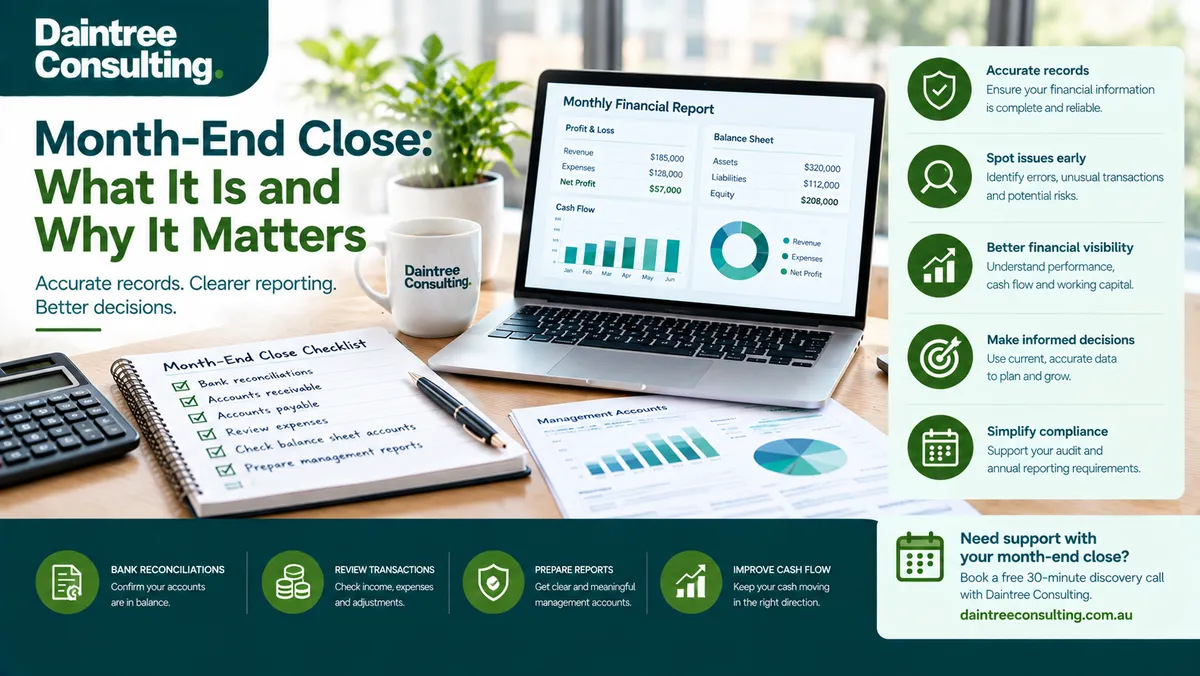
A month-end close is the process of reviewing, reconciling and finalising your financial records for a particular month. It typically includes bank reconciliations, reviewing income and expenses, checking balance-sheet accounts, recording relevant adjustments and preparing management reports.
For growing Australian businesses, a reliable month-end close can create a much clearer connection between accurate records, financial reporting and better business decisions.
Quick Answer: What Is Month-End Close?
Month-end close is the process of finalising a business's accounting records at the end of each month so financial information can be reviewed and reported accurately.
A typical month-end close may include:
Reconciling bank and credit-card accounts
Reviewing accounts receivable and accounts payable
Checking revenue and expenses
Reviewing balance-sheet accounts
Recording necessary adjustments
Checking payroll and related liabilities
Reviewing GST and other relevant balances
Investigating unusual transactions
Reviewing cash flow
Preparing monthly management accounts
Comparing actual results with budgets or forecasts
The exact process varies depending on the size, structure and complexity of the business.
For a small business, the close may be relatively straightforward.
For a larger or growing business, it may involve several people across bookkeeping, finance, management and external advisers.
The important thing is not simply how many steps are included.
It is whether the process consistently produces financial information that management can rely on.
Why Does Month-End Close Matter?
The biggest reason month-end close matters is simple:
You cannot make good financial decisions if you do not trust the numbers.
Business owners and leadership teams often need to make decisions about:
Hiring
Pricing
Cash management
Inventory
Capital expenditure
Business growth
Financing
Cost control
Marketing expenditure
Profitability
Working capital
Those decisions depend on financial information.
If your accounts are incomplete or significantly delayed, you may be looking at a financial picture that no longer reflects the current position of the business.
A structured month-end close helps reduce that uncertainty.
It creates a regular point where the business stops, reviews its financial information and asks:
What happened this month, and what does it mean for the business?
What Happens During a Month-End Close?
There is no single month-end close checklist that applies to every business.
However, the process commonly follows a logical sequence.
1. Collect the Month's Financial Information
The first step is making sure the finance team has the information needed to close the month.
This may include:
Bank statements
Credit-card statements
Sales invoices
Supplier bills
Payroll records
Expense receipts
Loan statements
Investment information
Asset purchases
Customer receipts
Other relevant financial records
If information is missing, the accounts may not provide a complete picture of the month.
This is why a month-end close is closely connected to good bookkeeping processes.
If transactions are consistently entered and records are maintained throughout the month, closing the accounts becomes much easier.
2. Reconcile Bank and Credit-Card Accounts
Bank reconciliation is one of the most important parts of the close.
The objective is to make sure the accounting records agree with the actual transactions shown by the bank.
The process can identify:
Missing transactions
Duplicate entries
Incorrect amounts
Unpresented transactions
Unexplained differences
Incorrect account coding
Bank fees or interest that have not been recorded
Credit-card accounts may need to be reconciled in the same way.
A business may have strong sales and apparently healthy cash flow, but if its bank accounts are not properly reconciled, management may not have a reliable understanding of the actual position.
3. Review Accounts Receivable
Month-end is also a useful time to review money owed by customers.
The accounts receivable review may consider:
Outstanding invoices
Overdue accounts
Customer payment patterns
Long-outstanding balances
Disputed invoices
Expected collections
This is particularly important for businesses that operate on payment terms.
Revenue recorded in the accounts does not necessarily mean cash has been received.
A business can report a profit while experiencing cash-flow pressure because customers are taking too long to pay.
That is why monthly reporting should look beyond profit alone.
4. Review Accounts Payable
The other side of working capital is money the business owes suppliers and other parties.
A month-end review of accounts payable can help identify:
Outstanding supplier invoices
Overdue bills
Upcoming payment commitments
Duplicate invoices
Unusual expenses
Bills that belong to a different accounting period
This helps management understand both current obligations and upcoming cash requirements.
For businesses experiencing growth, this becomes increasingly important.
More sales can mean more supplier commitments, payroll obligations, inventory purchases and operating expenses.
Without clear visibility over those commitments, cash can become tighter even while revenue is increasing.
5. Review Revenue
Revenue should be reviewed to make sure the month's reported sales are complete and appropriately recorded.
Depending on the business, this might involve checking:
Sales invoices
Point-of-sale records
Subscription revenue
Recurring billing
Customer receipts
Credit notes
Refunds
Unusual sales transactions
The objective is not simply to find a total.
Management should be able to understand whether revenue for the month makes sense compared with:
Previous months
Budget
Forecast
Seasonal expectations
Business activity
A significant change may be perfectly legitimate, but it is worth understanding why it occurred.
6. Review Expenses
Expenses should also be reviewed for completeness and accuracy.
This can include:
Rent
Utilities
Insurance
Software subscriptions
Professional fees
Advertising
Travel
Motor vehicle costs
Wages
Superannuation
Interest
Other operating expenses
Month-end review can reveal unusual movements that deserve investigation.
For example, if software expenses suddenly increase by a significant amount, management may want to determine whether:
A new subscription was added
An annual renewal was processed
A duplicate charge occurred
An expense was incorrectly coded
The purpose is not to scrutinise every dollar unnecessarily.
It is to identify information that could affect the accuracy or interpretation of the financial reports.
7. Review Balance-Sheet Accounts
A common mistake is to focus heavily on the profit and loss statement while giving less attention to the balance sheet.
A proper month-end close should include a review of relevant balance-sheet accounts.
These may include:
Bank accounts
Accounts receivable
Inventory
Fixed assets
Loans
Accounts payable
GST and tax-related balances
Payroll liabilities
Other provisions or liabilities
Equity accounts
The balance sheet can reveal issues that are not immediately obvious from the profit and loss statement.
For example, an unreconciled balance or unexpected movement in a liability account may indicate that a transaction has been recorded incorrectly or that additional information is required.
8. Record Relevant Adjustments
Some accounting information cannot be understood properly without appropriate adjustments.
Depending on the business, month-end adjustments might relate to:
Depreciation
Accrued expenses
Prepaid expenses
Deferred revenue
Other timing differences
Provisions
Asset movements
The exact adjustments depend on the accounting approach and circumstances of the business.
The important point is that the monthly financial reports should provide a meaningful representation of the period being reviewed.
A business should not rely on a monthly report simply because the accounting software generated one.
The underlying records and accounting treatment still need to make sense.
9. Review Payroll and Related Balances
For businesses with employees, payroll is another important part of the month-end process.
The review may include:
Wages
Superannuation
PAYG withholding
Payroll liabilities
Leave balances
Payroll-related expenses
Payroll information can affect both the profit and loss statement and the balance sheet.
Errors or missing information can therefore distort the monthly financial results.
This is one reason why businesses often benefit from having clear ownership between payroll, bookkeeping and accounting functions.
10. Review GST and Other Tax-Related Balances
Depending on the business and reporting arrangements, month-end close may also include reviewing GST and other tax-related accounts.
This does not necessarily mean the business is lodging a BAS every month.
Instead, the accounting team may review the relevant balances and records to identify unusual movements or potential issues before the formal reporting deadline.
Regular review can make BAS preparation and other compliance work more manageable because problems are less likely to accumulate unnoticed.
For Australian businesses, the exact reporting and payment obligations depend on the business's circumstances and registrations.
11. Compare Actual Results With Expectations
Once the accounts have been reviewed, the numbers become more useful when they are compared with something.
For example:
Actual revenue vs budget
Did sales meet expectations?
Actual expenses vs budget
Were costs higher or lower than planned?
Current month vs previous month
What changed?
Actual cash flow vs forecast
Is cash moving as expected?
Gross margin vs target
Is the business generating the expected return from sales?
This is where month-end close starts to move beyond accounting administration and into business management.
The objective is not simply to produce reports.
It is to understand what the reports are telling you.
Month-End Close vs Month-End Reporting
These terms are related but they are not exactly the same.
Month-end close is the process of finalising and reviewing the accounting records.
Month-end reporting is the presentation and interpretation of the resulting financial information.
Think of it this way:
Close → Reliable numbers → Reports → Analysis → Decisions
If the close is weak, the reporting can be weak.
If the reporting is weak, management may struggle to understand what the numbers mean.
This is why improving reporting without improving the underlying accounting process may not solve the real problem.
How Long Should a Month-End Close Take?
There is no universal number of days that every business should target.
The appropriate timeframe depends on:
Business size
Transaction volume
Number of entities
Accounting complexity
Number of bank accounts
Payroll arrangements
Inventory
Revenue recognition
Investment activity
Quality of bookkeeping
Finance team capacity
Reporting requirements
A small business with relatively straightforward transactions may be able to close its accounts quickly.
A more complex organisation may require considerably more time.
The more important question is:
Can the business close its accounts consistently and produce reliable information soon enough for management to use it?
A report that is accurate but arrives long after the month has ended may have less practical value for decision-making.
What Happens When Month-End Close Is Not Done Properly?
A weak close process can create several problems.
Delayed financial information
If accounts are not finalised promptly, management may be making decisions based on old information.
Unexplained variances
Unexpected changes in revenue, expenses or margins can remain unnoticed.
Poor cash-flow visibility
Unreconciled accounts and incomplete liabilities can make cash forecasts less reliable.
More work at year end
Problems that could have been identified monthly may accumulate until the end of the financial year.
Greater risk of errors
The longer discrepancies remain unresolved, the harder they can be to trace.
Limited management insight
Business owners may receive financial statements without understanding what is driving the numbers.
The problem is therefore not just that the accounts are "late".
The bigger issue is that management loses visibility.
Signs Your Month-End Close Process Needs Improvement
Your business may benefit from reviewing its month-end process if:
1. You regularly receive financial reports weeks after month end
Delayed reporting reduces the value of the information.
2. Bank accounts are frequently unreconciled
This can undermine confidence in the numbers.
3. You discover accounting errors months later
Recurring errors may indicate that the close process lacks appropriate review controls.
4. Nobody clearly owns the close
If everyone assumes someone else is responsible, tasks can easily be missed.
5. Your reports change significantly after they are issued
Frequent revisions may indicate that the accounts are being reported before the underlying records are sufficiently reviewed.
6. You cannot explain major monthly movements
Financial reports should help management understand what is happening, not create more questions.
7. Budget vs actual reporting is inconsistent
Without consistent monthly reporting, it becomes harder to identify trends and respond to changes.
8. Year-end accounting becomes a major clean-up exercise
A good month-end process should reduce the amount of unresolved work accumulating throughout the year.
How to Build a Better Month-End Close Process
You do not necessarily need a large finance department to improve your close.
A practical process starts with clearly defining what needs to happen every month.
Create a standard checklist
Document the recurring tasks involved in your close.
For example:
Complete bank reconciliations
Reconcile credit cards
Review receivables
Review payables
Check payroll balances
Review balance-sheet accounts
Record required adjustments
Review GST and relevant tax balances
Review unusual transactions
Prepare management reports
Compare actual results with budget
Review key financial movements
The exact checklist should reflect the business.
Set deadlines
Each task should have a clear owner and expected completion date.
This makes the process repeatable rather than dependent on someone remembering what needs to be done.
Define review responsibilities
Preparation and review do not always need to be performed by the same person.
Having an appropriate review step can help identify errors before reports are distributed.
Standardise reporting
Management should know what reports they will receive each month and when.
This might include:
Profit and loss
Balance sheet
Cash-flow report
Budget vs actual
Key performance indicators
Investigate exceptions
Not every transaction requires the same level of attention.
Focus review time on unusual, material or unexplained movements.
Month-End Close Is More Than Bookkeeping
This distinction is important for growing businesses.
Bookkeeping is essential because financial records need to be kept current and accurate.
But month-end close adds a structured review and finalisation process around those records.
And management reporting goes one step further by turning the financial information into something leadership can use.
A business may therefore have:
Bookkeeping → Month-end close → Management reporting → Business decisions
When those functions work together, financial information becomes much more useful.
This is particularly relevant when a business has grown beyond the point where the owner can confidently keep track of every financial movement themselves.
How Daintree Consulting Can Help With Month-End Close
A reliable month-end close does not necessarily require hiring a full-time finance department.
Daintree Consulting provides accounting support for Australian businesses that need accurate records, clearer reporting and better financial visibility.
Depending on the business's needs, support can include:
Monthly or periodic management accounts
Balance-sheet and control-account reconciliations
Budget-to-actual reporting
Variance analysis
Cash-flow reporting
Financial dashboards
Fixed-asset and ledger oversight
Coordination with bookkeeping
Support alongside an existing internal finance team
The aim is to create a reporting process that gives business owners and leadership teams information they can actually use.
For some businesses, that may mean improving an existing month-end process.
For others, it may mean taking over specific accounting responsibilities or building a more connected finance function.
Daintree can work alongside an existing bookkeeper, internal team or other professional advisers rather than requiring you to replace everything that is already working.
You can learn more about Daintree Consulting's Accounting Services or discuss what your current reporting process looks like through a free discovery call.
Frequently Asked Questions About Month-End Close
What does month-end close mean?
Month-end close is the process of reviewing, reconciling and finalising a business's accounting records for the month. It helps ensure financial reports are based on reliable and complete information.
What is included in a month-end close?
A typical close may include bank reconciliations, reviewing receivables and payables, checking revenue and expenses, reviewing balance-sheet accounts, recording adjustments, checking payroll-related balances and preparing management reports.
Why is month-end close important?
It helps businesses produce more reliable financial information on a regular basis. This gives owners and management better visibility over profitability, cash flow, expenses and financial performance.
How long should month-end close take?
There is no universal timeframe. It depends on the size and complexity of the business. The key objective is to complete the process consistently and soon enough that management can use the information for decision-making.
Is month-end close the same as bookkeeping?
No. Bookkeeping involves recording and maintaining financial transactions. Month-end close is the structured process of reconciling, reviewing and finalising those records for the reporting period.
Does every business need a month-end close?
The level of formality will vary. A very small business may have a simple monthly review process, while a growing or more complex business may require a documented close with defined responsibilities, reconciliations and management reporting.
What reports should I receive after month-end close?
This depends on the business, but useful monthly reporting can include the profit and loss, balance sheet, cash-flow information, budget vs actual results and selected business KPIs.
Can an accountant help with month-end close?
Yes. An accountant or accounting team can help with reconciliations, financial statements, management reporting, variance analysis and other parts of the month-end process. The appropriate scope depends on what the business already has internally.
Final Takeaway
Month-end close is the process that turns a month's financial transactions into information management can trust.
It involves more than entering invoices and reconciling a bank account.
A good close process helps your business:
Keep financial records accurate
Identify errors earlier
Understand monthly performance
Improve cash-flow visibility
Compare actual results with expectations
Prepare better management reports
Reduce year-end clean-up
Make decisions using more current information
As a business grows, the importance of a reliable month-end close usually grows with it.
If your monthly accounts are consistently delayed, difficult to understand or require significant clean-up, it may be time to review how your accounting and reporting process is structured.
Daintree Consulting can help Australian businesses build a more reliable month-end accounting and reporting process, whether you need additional support or a more connected finance function.
Book a free discovery call to discuss your business's accounting and reporting needs.
Talk to Daintree about your accounting
Our ex-Big 4 team gives clear, senior-reviewed advice so you can act with confidence.
Book a free consultation →
Or explore our accounting services.
