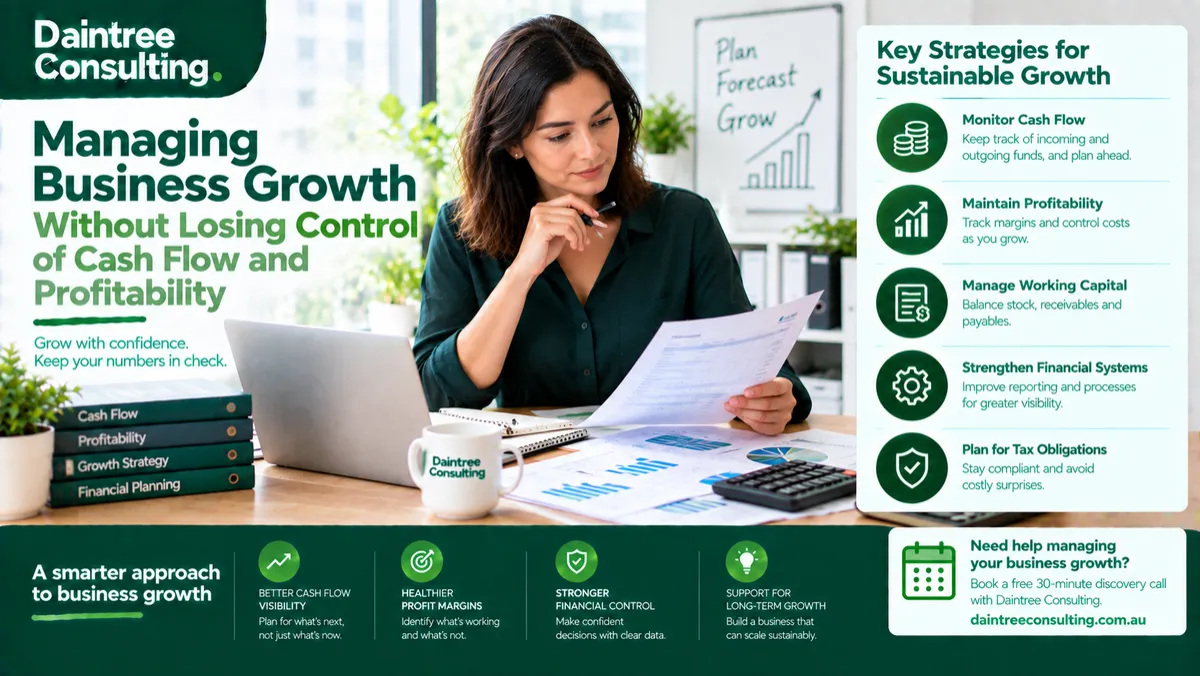
How to Manage Business Growth Without Losing Control of Cash Flow and Profitability
Growing a business is exciting, but growth can create financial pressure surprisingly quickly.
More customers can mean more staff. More sales can require more stock, equipment, technology, premises or contractors. Larger projects may increase the time between delivering work and receiving payment. At the same time, overheads can rise before the additional revenue has turned into reliable cash flow.
Want expert help? Daintree Consulting's business advisory services can take this off your plate. Book a free consultation.
That is why managing business growth is not simply about increasing sales.
Sustainable growth requires you to understand whether the business is generating enough cash, whether margins remain healthy, whether costs are under control and whether your financial systems can keep up with the increased complexity.
A business can be profitable on paper and still experience cash-flow pressure. It can also generate strong revenue while becoming less profitable because costs are increasing faster than sales.
The challenge for business owners is keeping growth connected to financial reality.
Quick answer: How do you manage business growth without losing financial control?
To manage business growth effectively, focus on five areas:
Monitor cash flow regularly, not just revenue and profit.
Track profitability and margins as the business expands.
Forecast upcoming cash requirements before committing to major expenses.
Strengthen financial processes and reporting as transaction volumes increase.
Make growth decisions based on reliable financial information, rather than sales figures alone.
Australian Government guidance recommends using financial reports, budgets and cash-flow statements regularly to understand business performance and identify potential problems early.
Growth should give your business greater capacity and opportunity. It should not leave you guessing whether you can afford the next stage.
Why business growth can create cash-flow problems
One of the most common mistakes when managing business growth is assuming that more revenue automatically means more available cash.
It doesn't.
Imagine a business that increases monthly sales from $200,000 to $300,000. On the surface, that looks like a significant improvement.
But what happens if:
customers take longer to pay
suppliers require faster payment
additional employees need to be hired
wages and superannuation increase
inventory requirements increase
rent or technology costs rise
equipment needs to be purchased
marketing expenditure increases
tax and other obligations become larger
the business needs to fund larger projects before receiving payment?
The business may be growing while its cash position becomes tighter.
This is why cash flow needs to be considered alongside revenue and profitability.
A cash-flow statement helps show money coming into and leaving the business and can help identify periods where cash may be under pressure. business.gov.au recommends regularly updating cash-flow information so businesses can identify seasonal patterns, plan for future costs and maintain better visibility over their finances.
Growth consumes cash before it creates cash
This is particularly important for businesses experiencing rapid growth.
You may need to spend money today to support revenue that will not be collected for weeks or months.
For example:
New contract → additional staff → increased operating costs → work delivered → invoice issued → customer pays later
The revenue may already appear in your financial reporting, while the cash has not yet arrived.
If you are only watching sales, the business can appear healthier than its bank account suggests.
1. Know whether your growth is actually profitable
Revenue growth is only one part of the picture.
A business needs to understand whether additional sales are producing an acceptable level of gross profit and net profit after the associated costs are considered.
Start by regularly reviewing:
Revenue
Gross profit
Gross margin
Operating expenses
Net profit
Labour costs
Customer acquisition costs
Overheads
Cash generated from operations
Debtor balances
Supplier commitments
A growing business should ask a simple question:
“Are we becoming more profitable as we become larger?”
If revenue is increasing but margins are falling, growth may be putting more pressure on the business rather than strengthening it.
For example, discounting heavily to win new customers might increase sales while reducing gross margin. Hiring ahead of demand might increase capacity but temporarily reduce profitability. Taking on larger projects might increase revenue but create additional working-capital requirements.
The answer is not necessarily to stop growing.
Instead, the financial information should help you understand which parts of the growth are creating value and which are consuming resources without sufficient return.
2. Build a cash-flow forecast before you need one
A cash-flow forecast is one of the most useful tools for managing business growth.
It can help you look ahead rather than simply reacting to what is already happening.
Your forecast should consider expected:
Cash inflows
Customer payments
Deposits
Recurring revenue
Asset sales
Funding
Other expected receipts
Cash outflows
Wages and superannuation
Supplier payments
Rent
Loan repayments
Tax and BAS-related payments
Software and technology
Marketing
Equipment purchases
Professional fees
Other operating expenses
The goal is not to predict the future perfectly.
The goal is to identify potential cash shortages early enough that you can do something about them.
For example, a forecast might show that a business has sufficient cash today but could face a shortfall in three months because of:
a major equipment purchase
annual insurance
increased payroll
a seasonal downturn
several large supplier payments
delayed customer collections
Knowing this before the pressure arrives gives management more options.
You might adjust spending, accelerate collections, revise the timing of a purchase, negotiate supplier arrangements or assess appropriate funding.
business.gov.au recommends forecasting cash flow and using financial reports when making changes to cash inflows and outflows.
3. Don't let accounts receivable grow faster than your business
A growing sales ledger can look impressive.
A growing overdue debtor balance is a different story.
When sales increase, the amount of money owed by customers can increase as well. If customers take 30, 60 or 90 days to pay, the business may effectively be financing its customers while waiting for payment.
Track:
Total accounts receivable
Overdue invoices
Average collection time
Large individual debtor balances
Customer payment patterns
Credit terms
Concentration of outstanding debt
Make invoicing timely and make payment terms clear.
Follow up overdue invoices consistently rather than allowing them to accumulate.
The Australian Government's cash-flow guidance specifically recommends monitoring unpaid invoices, setting appropriate payment terms and following up customers who have not paid.
For businesses growing quickly, this becomes even more important.
A 20% increase in sales does not help much if the associated cash remains trapped in unpaid invoices.
4. Watch working capital as the business gets bigger
Working capital is closely connected to growth.
You may have more money tied up in:
Accounts receivable
Inventory
Work in progress
Prepayments
Deposits
Other operating assets
At the same time, you may have increasing obligations to:
Suppliers
Employees
Tax authorities
Lenders
Contractors
Other creditors
The important question is not simply whether the business has assets.
It is whether the timing of cash coming in and cash going out supports the way the business operates.
For example, a business may win a large contract but need to purchase materials and employ additional staff several months before the customer pays.
That growth opportunity may be commercially attractive, but it needs to be assessed alongside its working-capital requirements.
5. Review your margins as costs change
Growth can hide margin problems.
A business might be selling more while becoming less efficient.
This can happen when:
supplier prices increase
wages increase
discounts become more common
delivery costs increase
projects take longer than expected
rework increases
overheads rise
low-margin customers account for more revenue
Review margins by the areas that matter to your business.
Depending on your business model, that might mean looking at:
Product
Service
Customer
Project
Location
Business unit
Sales channel
This can reveal where growth is creating profitable revenue and where it is creating additional workload without enough margin.
A pricing review can also be useful.
business.gov.au recommends reviewing pricing regularly to ensure prices cover costs and remain appropriate as market conditions change.
6. Don't allow overheads to grow faster than the business
Some additional costs are necessary for growth.
Others simply accumulate.
As the business expands, review major overhead categories such as:
Salaries and wages
Office or premises costs
Software subscriptions
Vehicles
Insurance
Professional services
Marketing
Technology
Contractors
Financing costs
Ask whether each major cost:
supports revenue, protects the business, improves efficiency or provides a measurable strategic benefit.
This does not mean cutting costs indiscriminately.
A cheap system that creates errors may cost more than a reliable system. Cutting administrative support might save money while creating significant management time costs.
The goal is to understand the relationship between expenditure and business performance.
7. Upgrade financial reporting as the business grows
The accounting system that worked when the business had a small number of transactions may not provide enough information once the business becomes more complex.
As you grow, you may need better visibility over:
Revenue by business unit
Gross margins
Customer profitability
Project profitability
Cash flow
Accounts receivable
Accounts payable
Budget versus actual results
Payroll costs
Inventory
Capital expenditure
Key performance indicators
Monthly management reporting can help leadership understand what happened and, more importantly, identify what requires attention.
Your financial reports should answer practical questions such as:
Where are we making money?
Where are margins changing?
Where is cash being tied up?
Which costs are increasing?
Are we tracking against budget?
What could put pressure on cash over the next three to six months?
The Australian Government recommends regularly reviewing key financial documents such as the profit and loss statement, balance sheet, cash-flow statement and budget to identify trends or unusual results.
8. Use budgets and forecasts together
A budget provides a financial plan.
A forecast helps you understand what may happen based on the latest information.
They are not the same thing.
A business might begin the financial year expecting $2 million in revenue. Six months later, sales could be tracking significantly above or below that original expectation.
The original budget still provides a useful benchmark.
But management also needs an updated view of what is likely to happen next.
That is where forecasting becomes valuable.
Review:
Original budget
Actual results
Current forecast
Major variances
Changes in assumptions
Expected cash requirements
Upcoming investment decisions
This creates a more useful financial conversation than simply asking whether the business is “on budget”.
9. Be careful about hiring ahead of growth
Hiring can be necessary to support expansion.
But employee costs are generally ongoing commitments, while future revenue may not be guaranteed.
Before adding significant payroll costs, consider:
Current workload
Confirmed contracts
Expected sales pipeline
Gross margin
Cash reserves
Training costs
Superannuation and other employment costs
Management capacity
Break-even requirements
The question is not simply:
“Can we afford another employee today?”
A better question is:
“Can the business sustainably support this additional cost under realistic revenue scenarios?”
This distinction becomes especially important when growth is based on forecasts rather than contracted revenue.
10. Plan major purchases around cash flow
Growth often creates pressure to invest.
You may need:
New equipment
Vehicles
Technology
Premises
Inventory
Marketing
Additional systems
Professional services
Before committing to a major purchase, assess both the commercial benefit and cash-flow impact.
Consider:
Purchase price
Financing costs
Ongoing operating costs
Maintenance
Expected revenue contribution
Expected margin
Timing of payments
Available cash
Alternative uses of the money
A purchase can make sense strategically while still creating a short-term cash-flow problem.
Planning the timing can therefore be just as important as deciding whether to make the investment.
11. Don't ignore tax and other financial obligations during growth
Tax obligations can become more significant as a business grows.
Depending on the business and its circumstances, this may involve GST, PAYG withholding, PAYG instalments, income tax, payroll-related obligations or other requirements.
Set aside funds for known obligations and include expected payments in your cash-flow planning.
business.gov.au recommends planning for tax payments and employee costs as part of cash-flow management rather than treating them as unexpected expenses.
The exact obligations and timing depend on factors such as business structure, activities, employees and registrations, so businesses should confirm their current requirements.
12. Identify financial warning signs early
Growth problems are easier to address when they are identified early.
Warning signs can include:
Cash balances consistently falling
Increasing reliance on overdrafts or credit
Customers taking longer to pay
Increasing overdue invoices
Supplier payments being delayed
Falling gross margins
Increasing debt
Costs rising faster than revenue
Difficulty meeting tax or employee obligations
Regularly missing budgets
Needing personal funds to support operations
business.gov.au identifies reduced cash flow, late customer payments, difficulty paying suppliers or debts and low profit margins as potential signs of financial trouble.
ASIC has also highlighted increasing cash-flow pressure, overdue tax or superannuation, unpaid suppliers and reliance on personal funds as warning signs that financial difficulty may be developing.
These signs do not automatically mean a business is failing.
They do mean the numbers deserve closer attention.
The earlier an underlying problem is identified, the more opportunity management may have to respond.
13. Make financial reviews part of your growth routine
Financial management should not only happen at tax time.
A growing business benefits from a regular review rhythm.
Weekly
Depending on the business, monitor:
Bank balances
Major receipts
Major payments
Overdue invoices
Immediate cash requirements
Monthly
Review:
Profit and loss
Balance sheet
Cash flow
Budget versus actual
Accounts receivable
Accounts payable
Gross margins
Key KPIs
Quarterly
Consider:
Updated cash-flow forecasts
Pricing
Cost structure
Customer profitability
Growth plans
Funding requirements
Major capital expenditure
Business risks
Annually
Conduct a broader financial health review and reassess:
Business performance
Strategy
Financial goals
Budget
Cash requirements
Capital structure
Growth priorities
The exact frequency should reflect the size, complexity and volatility of the business.
When should you get professional financial support?
Managing business growth becomes more difficult when the financial picture is becoming more complex.
You may benefit from additional accounting or advisory support when:
Revenue is increasing quickly
Cash flow is becoming harder to predict
You are hiring significantly
The business has multiple revenue streams
You are entering new markets
You are taking on substantial debt
You are considering an acquisition
You are investing heavily in equipment or infrastructure
Management reporting is becoming difficult to maintain
You are spending too much time trying to understand the numbers
You need financial forecasts or scenario planning
You want more structured performance reporting
This does not necessarily mean you need a full-time finance executive.
Depending on your circumstances, support may come from an accountant, business adviser, bookkeeper, or outsourced CFO.
The important thing is matching the level of financial support to the complexity and decisions facing the business.
How Daintree Consulting can support business growth
Managing business growth requires more than keeping the accounts up to date.
Business owners need reliable information about cash flow, profitability, financial performance and future requirements.
Daintree Consulting supports Australian businesses with accounting, management reporting, cash-flow visibility and business advisory services designed to help owners and leadership teams understand the numbers behind their decisions.
For businesses dealing with more complex growth, Daintree's Outsourced CFO Services can provide additional financial leadership around forecasting, scenarios, management reporting, working capital, KPIs, funding and major business decisions.
The right support depends on the business's structure, size, financial position and objectives.
If your business is growing but your financial processes are struggling to keep pace, it may be time to review what needs to change.
Book a free 30-minute discovery call with Daintree Consulting to discuss your business and where additional financial support may be useful.
FAQs About Managing Business Growth
What does managing business growth involve?
Managing business growth involves increasing revenue and capacity while maintaining control over cash flow, profitability, costs, financial reporting, working capital and business risks.
It means making sure the financial infrastructure of the business grows alongside its sales and operations.
Why can a growing business have cash-flow problems?
A growing business can experience cash-flow problems because expenses often need to be paid before customers pay their invoices. Growth can also increase payroll, inventory, supplier payments, equipment purchases and other operating costs.
Revenue growth therefore does not automatically translate into available cash.
How often should a growing business review cash flow?
There is no single frequency that suits every business. Businesses experiencing rapid growth, seasonal fluctuations or significant changes in costs may need more frequent cash-flow monitoring.
At a minimum, management should have a current view of expected cash inflows, outflows and upcoming obligations.
What financial reports should a growing business monitor?
Common reports include:
Profit and loss statement
Balance sheet
Cash-flow statement
Budget versus actual reporting
Accounts receivable
Accounts payable
Management accounts
Relevant business KPIs
The most useful reports depend on the business model and the decisions management needs to make.
Is revenue growth always a good sign?
Not necessarily.
Revenue growth can be accompanied by falling margins, increasing costs, greater debt or worsening cash flow.
The quality and profitability of growth matter alongside the headline revenue figure.
When should a business consider an outsourced CFO?
An outsourced CFO may be useful when financial decisions become more complex but the business does not require, or is not ready for, a full-time CFO.
This may include situations involving rapid growth, cash-flow pressure, forecasting, funding, acquisitions, management reporting or more sophisticated financial planning.
What is the biggest financial risk when growing a business?
There is no single risk that applies to every business.
However, losing visibility over cash flow and profitability can make it harder for management to identify problems early and make informed decisions.
Regular reporting, forecasting and financial review can help maintain that visibility.
Final takeaway
Managing business growth means managing the financial consequences of growth — not just increasing sales.
A growing business needs to know where its cash is going, whether its margins remain healthy, how much working capital it needs and whether its financial systems can support increasing complexity.
The key is to stay ahead of the numbers.
Monitor cash flow. Review profitability. Forecast upcoming requirements. Track working capital. Strengthen reporting. Review costs. And make major growth decisions with reliable financial information.
Growth is much easier to manage when the business has financial visibility before problems become urgent.
For Australian businesses looking to strengthen their financial reporting, cash-flow management and decision-making as they grow, Daintree Consulting can help.
Talk to Daintree about your next business decision
Our ex-Big 4 team gives clear, senior-reviewed advice so you can act with confidence.
Book a free consultation →
Or explore our business advisory services.
