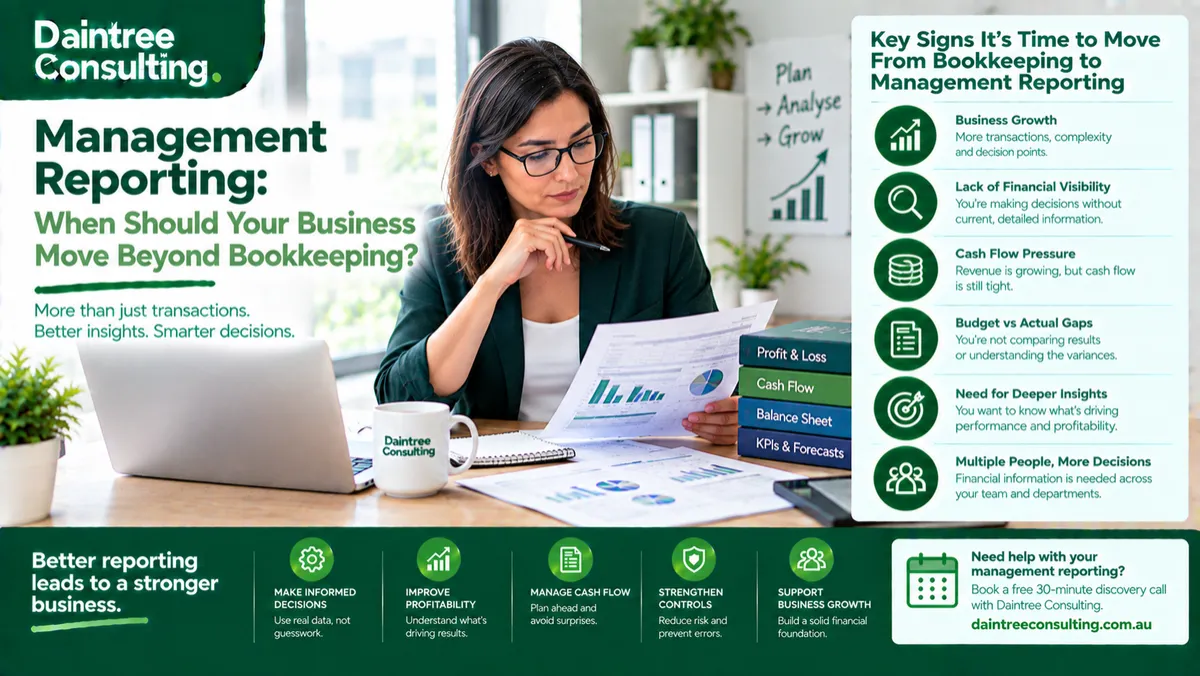
Management Reporting: When Should Your Business Move Beyond Bookkeeping?
Basic bookkeeping is essential for every business.
You need accurate records of sales, expenses, bank transactions, invoices, bills and other financial activity. Without reliable bookkeeping, it becomes difficult to understand what is happening financially or meet important tax and reporting obligations.
Want expert help? Daintree Consulting's accounting services can take this off your plate. Book a free consultation.
But there comes a point when simply recording transactions is no longer enough.
As a business grows, owners and leadership teams usually need more than a list of what has already happened. They need to understand why financial performance is changing, where the business is making or losing money, whether actual results are matching expectations and what may need attention next.
That is where management reporting becomes increasingly valuable.
Management reporting takes financial information and turns it into information that management can use to monitor performance and make decisions.
For some businesses, the transition may happen relatively early. For others, basic bookkeeping may be sufficient for longer. The important question is not simply how large the business is.
It is whether the financial information available to management is detailed and timely enough to support the decisions the business is making.
What Is the Difference Between Bookkeeping and Management Reporting?
The simplest distinction is this:
Bookkeeping records what happened.
Management reporting helps you understand what happened and decide what to do next.
Bookkeeping may involve recording:
sales
supplier bills
expenses
bank transactions
payroll transactions
customer invoices
supplier payments
GST-related transactions
other financial activity
Management reporting builds on that information.
A management reporting process may include:
profit and loss reporting
balance-sheet reporting
cash-flow reporting
budget vs actual analysis
revenue analysis
gross-margin analysis
accounts receivable reporting
accounts payable reporting
key performance indicators
departmental or location reporting
financial trends
management commentary
forecasts and forward-looking information
The exact contents should reflect the business.
A small service business may need a relatively simple monthly management pack. A larger organisation may need reporting by department, location, service line or business unit.
The purpose is not to create more reports for the sake of reporting.
The purpose is to give decision-makers information they can actually use.
Why Basic Bookkeeping May Eventually Stop Being Enough
When a business is small, the owner may have a close understanding of nearly every transaction.
They may know which customers have paid, which suppliers are waiting for payment, what expenses have increased and whether the bank balance looks healthy.
As the business grows, that becomes harder.
More customers can mean more invoices.
More employees can mean higher payroll and more operating costs.
More products or services can make profitability harder to assess.
Additional locations can make performance less obvious.
More debt can create additional cash-flow pressure.
At the same time, the owner may spend less time personally handling transactions.
The business therefore becomes more dependent on financial reporting to provide visibility.
A bookkeeping system can tell you that transactions have been recorded.
Management reporting can help answer questions such as:
Are sales growing?
Is profit growing at the same rate?
Which products or services generate the strongest margins?
Are expenses increasing faster than revenue?
Are customers paying more slowly?
Is cash flow keeping pace with growth?
Are we meeting the budget?
What changed this month?
Why did it change?
What needs management attention?
Those are management questions rather than purely bookkeeping questions.
1. Your Business Is Growing
Growth is one of the clearest reasons to consider moving towards more structured management reporting.
As revenue, transaction volumes, employees and operating costs increase, financial information becomes more difficult to interpret from accounting software screens or basic reports alone.
A growing business may need to understand performance across different areas rather than simply looking at one overall profit figure.
For example, management might want to see:
revenue by service
revenue by location
gross margin by product
labour costs
overheads
customer receivables
monthly cash movement
budget vs actual performance
The larger and more complex the business becomes, the more useful structured reporting can be.
2. You Are Making Decisions Without Current Financial Information
This is one of the strongest signs that your business may need more than basic bookkeeping.
Imagine you are considering:
hiring another employee
opening another location
purchasing equipment
increasing marketing expenditure
changing prices
taking on additional debt
launching a new service
reducing costs
investing in technology
If you cannot quickly understand the financial position of the business, decisions may rely heavily on intuition.
Business.gov.au recommends regularly reviewing key financial documents to understand business performance, identify trends and support better decisions.
Management reporting can make that information easier to access and interpret.
3. Your Bookkeeping Is Accurate but You Still Don't Know How the Business Is Performing
A business can have accurate bookkeeping and still have poor financial visibility.
This distinction is important.
Your transactions may be correctly recorded, but management may not have the reports needed to interpret them.
For example, your accounting system might contain all the information required to determine that revenue increased by 12%.
But management may still need to know:
Which customers generated the increase?
Which services contributed?
Did gross margin improve?
Did labour costs rise?
Did overheads increase?
Did cash flow improve?
Was the growth consistent with the budget?
Accurate data is the foundation.
Management reporting is how that data becomes more useful for management.
4. You Are Looking at the Bank Balance to Judge Business Performance
The bank balance is important, but it is not a complete measure of business performance.
A business can have cash in the bank while profitability is falling.
It can also be profitable while experiencing cash-flow pressure.
Business.gov.au specifically highlights the importance of understanding the differences between cash flow, profit and budgets, and recommends reviewing financial information regularly.
Management reporting can bring several pieces of information together.
For example, a monthly reporting pack might show:
Profit and loss:
How the business performed over the period.
Balance sheet:
What the business owns, owes and has invested in the business.
Cash flow:
How cash moved through the business.
Budget vs actual:
Whether actual performance matched expectations.
Looking at these reports together can provide a much clearer picture than relying on the bank balance alone.
5. You Keep Asking “Why Did Profit Change?”
A basic P&L can tell you that profit changed.
Management reporting can help investigate why.
Suppose monthly profit falls.
Management may need to determine whether the change came from:
lower sales
reduced gross margins
higher wages
increased supplier costs
additional marketing expenditure
higher rent
increased software costs
one-off expenses
timing differences
changes in customer or product mix
This is where management commentary and variance analysis become useful.
Rather than simply reporting:
“Profit decreased by $25,000.”
A useful management report might identify the major movements contributing to the result.
That gives management something to act on.
6. You Are Growing Revenue but Cash Flow Still Feels Tight
Revenue growth does not automatically mean stronger cash flow.
If customers take longer to pay, inventory requirements increase or operating costs rise ahead of collections, a growing business can still experience financial pressure.
Business.gov.au recommends regularly updating cash-flow information and comparing estimated and actual income and costs to identify shortfalls and adjust plans.
Management reporting can bring cash-flow information into regular management discussions.
A monthly report might highlight:
outstanding customer invoices
overdue receivables
upcoming supplier payments
payroll commitments
tax obligations
debt repayments
expected cash receipts
major upcoming expenditure
This gives management a better basis for planning.
7. You Have Started Budgeting but Don't Compare Actual Results
Creating a budget is only part of financial planning.
The next question is whether actual results are being compared against it.
Business.gov.au recommends comparing actual income and costs with the budget to identify where the business is over or under budget and adjust planning where necessary.
For example:
Area | Budget | Actual | Variance |
|---|---|---|---|
Revenue | $500,000 | $475,000 | -$25,000 |
Labour | $140,000 | $152,000 | +$12,000 |
Marketing | $30,000 | $25,000 | -$5,000 |
The numbers themselves are not enough.
Management needs to ask:
Why did these variances occur?
A useful management reporting process can identify significant movements and provide commentary around them.
That is much more valuable than simply filing the budget away at the beginning of the year.
8. You Cannot Easily Identify Your Most Profitable Areas
As a business becomes more diverse, overall profit can hide differences between individual areas of the business.
For example, a business might offer five services.
Overall revenue looks strong.
But management may not know whether:
Service A generates strong margins
Service B requires significant staff time
Service C has low margins
Service D is growing rapidly
Service E generates strong revenue but weak cash conversion
Management reporting can be designed to provide more useful breakdowns where the accounting system and available information support it.
This might include reporting by:
service
product
location
department
customer group
project
business unit
The appropriate level of detail depends on the decisions management needs to make.
More detail is not automatically better.
The goal is useful information.
9. You Have More Than One Person Making Financial Decisions
As businesses grow, financial decisions often become less concentrated in the owner.
Managers may become responsible for:
staffing
purchasing
sales
marketing
operations
project profitability
departmental budgets
Those managers may need financial information relevant to their responsibilities.
A structured management reporting process can create a common view of business performance.
Instead of each manager working from different information, management can use consistent reports and definitions.
This can improve the quality of financial discussions and make accountability clearer.
10. Your Financial Reports Arrive Too Late to Be Useful
Timing matters.
A financial report that arrives months after the period it describes may still contain useful historical information.
But it may be less useful for decisions that need to be made now.
For example, if a business discovers in December that a cost has been increasing since July, management has already missed several opportunities to investigate it.
Timely management reporting can help reduce this delay.
The exact reporting timetable will depend on the business, but many growing businesses benefit from establishing a regular monthly reporting cycle.
What Should Be Included in a Management Reporting Pack?
There is no universal management reporting pack.
The right reports depend on the business and the decisions management needs to make.
However, a monthly pack might include:
Profit and loss statement
Shows revenue, expenses and profit for the reporting period.
Balance sheet
Shows assets, liabilities and equity at a particular point in time. A balance sheet can also help management understand working capital and liquidity.
Cash-flow information
Shows cash coming into and going out of the business and can help management plan upcoming payments and identify potential cash shortages.
Budget vs actual
Highlights where actual performance differs from the original financial plan.
Accounts receivable
Shows outstanding customer balances and potentially overdue amounts.
Accounts payable
Provides visibility over amounts owed to suppliers.
Key performance indicators
Tracks the metrics that matter most to the particular business.
Commentary
Explains significant movements rather than leaving management to interpret every number independently.
Forecast information
Where appropriate, a forecast can use current financial data and recent trends to estimate what may happen next. Business.gov.au distinguishes forecasts from budgets, noting that forecasts are used to respond to changes and manage performance.
How Often Should Management Reports Be Prepared?
For many growing businesses, monthly reporting provides a practical balance between timeliness and effort.
But monthly reporting is not automatically appropriate for every business.
A business experiencing rapid changes in cash flow may need some information more frequently.
A relatively stable business may require less frequent reporting for certain metrics.
The key question is:
How quickly does management need financial information to make decisions?
If decisions are being made weekly but financial information is only reviewed quarterly, there may be a visibility gap.
What Does a Good Management Reporting Process Look Like?
A useful management reporting process should be:
Accurate
Reports need to be based on reliable accounting information.
Timely
Information should reach decision-makers while it is still useful.
Relevant
Reports should focus on the numbers and measures that actually matter to the business.
Consistent
Definitions and reporting formats should remain reasonably consistent so management can identify trends.
Actionable
The report should help management identify what needs attention.
Easy to understand
A report should not require management to be an accounting specialist to understand the major movements.
The goal is not to produce the largest possible reporting pack.
The goal is to produce information that supports better management decisions.
Does Moving to Management Reporting Mean You Need a Full-Time Finance Team?
Not necessarily.
A business can improve its management reporting without immediately hiring a full internal finance department.
Depending on its size and needs, a business might use a combination of:
internal bookkeeping
an external accountant
management accounting support
financial reporting support
outsourced finance resources
outsourced CFO support
The appropriate model depends on the complexity of the business and the level of financial oversight required.
The important thing is to make sure someone is responsible for turning the underlying accounting information into useful management information.
How Management Reporting Changes the Role of Bookkeeping
Moving towards management reporting does not make bookkeeping less important.
It makes good bookkeeping more valuable.
Management reports are only as reliable as the underlying financial information.
If bank accounts are not reconciled, invoices are missing, expenses are incorrectly classified or accounts remain incomplete, management reporting can produce misleading conclusions.
This is why businesses should view bookkeeping and management reporting as connected processes.
Bookkeeping creates the financial record.
Management reporting interprets that record for decision-making.
Both matter.
A Practical Transition From Basic Bookkeeping to Management Reporting
You do not necessarily need to introduce a complicated reporting system overnight.
A practical transition could look like this:
Step 1: Make sure bookkeeping is reliable
Start with reconciled accounts and accurate transaction records.
Step 2: Identify management's key questions
Ask what the owner and leadership team actually need to know.
For example:
Are we profitable?
Which services are most profitable?
Are costs increasing?
Are customers paying on time?
Do we have enough cash?
Are we meeting our budget?
Step 3: Choose the core reports
Start with the reports that answer those questions.
Step 4: Establish a regular reporting timetable
Monthly reporting may be appropriate for many growing businesses, but the frequency should reflect the business's needs.
Step 5: Introduce variance analysis
Compare actual results against budget or previous periods.
Step 6: Add commentary
Explain the most important movements.
Step 7: Use the information in management meetings
The reporting pack should become part of the management process rather than simply being generated and stored.
Step 8: Refine the reports over time
As the business changes, the reporting requirements will change too.
Signs Your Business May Be Ready for Management Reporting
If several of the following statements sound familiar, it may be time to review your financial reporting process:
The business has grown significantly.
The owner is no longer involved in every transaction.
There are multiple revenue streams.
The business has several locations or departments.
You have employees with financial responsibilities.
Revenue is growing but cash flow remains difficult to understand.
You have a budget but rarely compare it with actual results.
You receive financial reports too late.
You cannot easily explain changes in profit.
You are unsure which areas of the business are most profitable.
You are making major decisions without current financial information.
Your accountant provides annual accounts, but management needs information throughout the year.
You want better visibility over working capital.
You are preparing for growth, investment or additional financing.
You do not need to tick every box.
Even one or two significant changes in the business can justify reviewing whether your current reporting process is still appropriate.
Management Reporting Is About Better Decisions, Not More Numbers
It is easy to assume that management reporting means producing more spreadsheets.
That is not the objective.
A good reporting system should make financial information easier to understand.
If a report contains 50 pages but management cannot identify the three issues requiring attention, it may not be particularly useful.
Effective management reporting focuses on the information needed to answer the business's most important questions.
For example:
What changed?
Why did it change?
Is the change temporary or ongoing?
What effect could it have on cash flow or profitability?
Does management need to take action?
Those questions turn accounting information into management information.
How Daintree Consulting Can Help
Daintree Consulting provides accounting and financial oversight support for Australian businesses that need more than basic transaction processing.
Management reporting can include monthly or periodic management accounts, balance-sheet reconciliations, budget-to-actual analysis, cash-flow reporting and financial oversight.
For a growing business, the right reporting structure can help management move from simply looking backwards at recorded transactions to having clearer visibility over financial performance and emerging issues.
Daintree can also support businesses that need more senior financial input through Outsourced CFO Services, including forecasting, scenario analysis, management reporting, cash and working-capital oversight and financial decision support.
If your business has reached the point where basic bookkeeping no longer gives you enough visibility to manage confidently, it may be worth reviewing your reporting process.
Book a free 30-minute discovery call with Daintree Consulting to discuss what level of accounting and management reporting support may suit your business.
Frequently Asked Questions
What is management reporting?
Management reporting is the process of turning financial and operational information into reports that help business owners and management monitor performance and make decisions.
Is management reporting the same as bookkeeping?
No. Bookkeeping records business transactions. Management reporting uses financial information to analyse performance, identify trends, compare actual results with expectations and support decision-making.
When should a small business start management reporting?
There is no single revenue or employee threshold. A business may benefit from management reporting when its complexity increases, decisions become more difficult to make from basic reports, or management needs more timely information about profitability, cash flow and performance.
How often should management reports be prepared?
Monthly reporting is a practical option for many growing businesses, but the appropriate frequency depends on the business's size, complexity, transaction volume and decision-making needs.
What reports should management review?
Common reports include the profit and loss statement, balance sheet, cash-flow information, budget vs actual analysis, accounts receivable, accounts payable, KPIs and relevant forecasts.
Can management reporting help with business growth?
It can provide management with better visibility over profitability, cash flow, costs, working capital and performance. This can support planning and decision-making as the business grows.
Do I need an outsourced CFO for management reporting?
Not necessarily. Some businesses can meet their reporting needs through their existing accountant or internal finance team. Others may benefit from additional management accounting or outsourced CFO support as their financial complexity increases.
Final Takeaway
Basic bookkeeping is the foundation of good financial management.
But as a business grows, recording transactions may no longer provide enough information for management to understand what is happening and decide what to do next.
Management reporting bridges that gap.
It takes reliable accounting information and turns it into a clearer view of:
profitability
cash flow
financial position
budget performance
working capital
business trends
key performance indicators
areas requiring management attention
The right time to move towards management reporting is not determined by a particular revenue figure or employee count.
It is when the business needs more financial visibility than basic bookkeeping can provide.
For growing Australian businesses, establishing a practical management reporting process can make financial information more useful, timely and relevant to the decisions that matter.
Talk to Daintree about your accounting
Our ex-Big 4 team gives clear, senior-reviewed advice so you can act with confidence.
Book a free consultation →
Or explore our accounting services.
