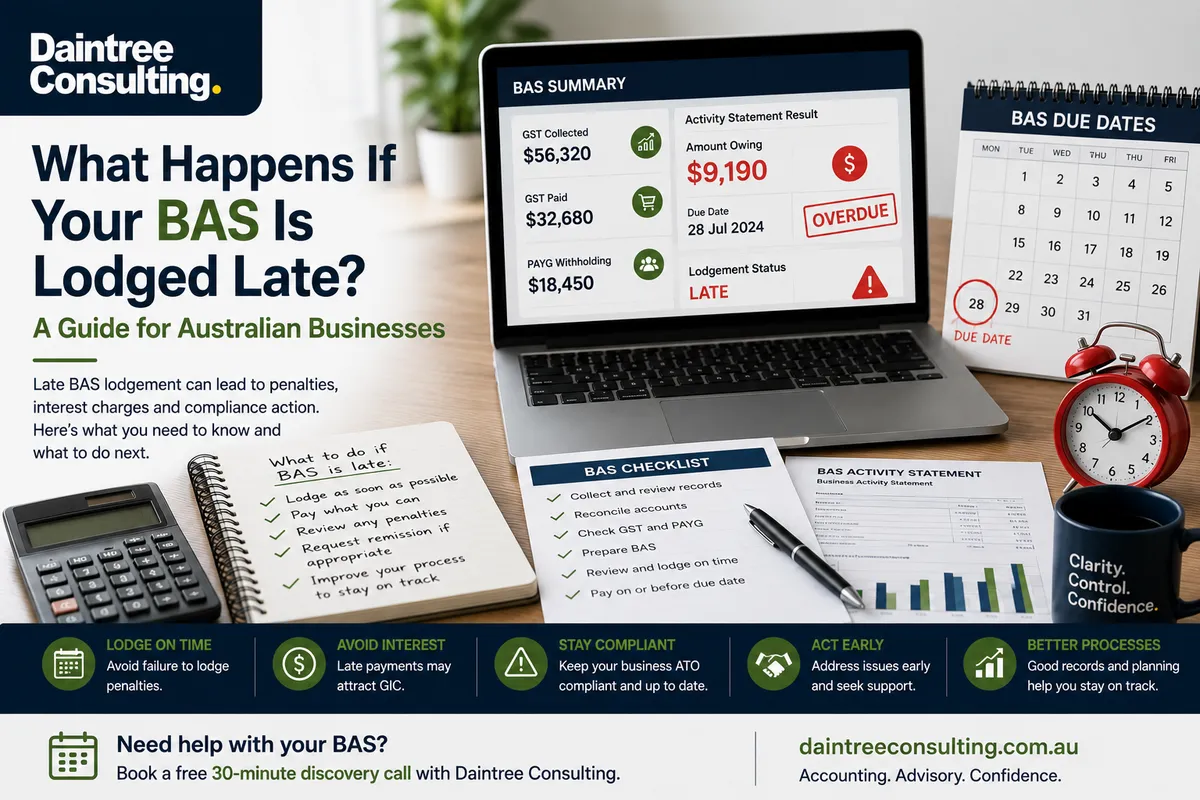
Late BAS Lodgement: Penalties, Interest & What to Do
Missing a BAS deadline can be stressful, particularly when you are unsure whether you will receive a penalty or what to do next.
The most important thing is not to ignore the overdue BAS.
Want expert help? Daintree Consulting's tax and BAS services can take this off your plate. Book a free consultation.
A Business Activity Statement is a formal reporting obligation. If your BAS is overdue, lodging it as soon as possible is generally better than allowing the outstanding obligation to remain unresolved.
Depending on the circumstances, late BAS lodgement can result in a failure-to-lodge penalty, while an unpaid tax liability may also attract the General Interest Charge (GIC). The ATO can consider individual circumstances when deciding whether a penalty should be remitted.
This guide explains what can happen when a BAS is lodged late, what to do if you have missed the deadline and how better bookkeeping and BAS preparation can help prevent the problem happening again.
Quick Answer: What Happens If You Lodge Your BAS Late?
If your BAS is lodged after the applicable due date:
The ATO may apply a failure-to-lodge (FTL) penalty.
GIC may apply to an amount that remains unpaid after its due date.
The ATO may contact you about the overdue statement.
Continued non-lodgement can lead to further compliance action.
You may be able to request penalty remission if there were circumstances that justify it.
You should generally lodge the outstanding BAS as soon as possible rather than waiting for the ATO to contact you.
Importantly, lodgement and payment are separate obligations. Being unable to pay does not automatically remove the obligation to lodge on time.
What Is Late BAS Lodgement?
Late BAS lodgement simply means submitting your Business Activity Statement after the due date that applies to your business.
Your BAS may report information such as:
GST collected
GST paid
PAYG withholding
PAYG instalments
Other applicable tax obligations
The exact information you need to report depends on your business circumstances and the activity statement issued to you.
The ATO expects businesses to meet their lodgement obligations even when the amount payable is zero or the business expects a refund.
Does a Late BAS Always Result in a Penalty?
Not necessarily.
The ATO's current guidance indicates that a penalty will generally not be applied to a late activity statement where the lodgement results in a refund or nil result, subject to exceptions. For example, an FTL penalty may still apply if it was imposed before the statement was lodged or in certain other circumstances.
This means you should not assume that every late BAS automatically results in a penalty.
At the same time, businesses should not rely on receiving an automatic waiver.
The safest approach is to lodge the BAS on time wherever possible.
What Is a Failure-to-Lodge Penalty?
A failure-to-lodge penalty is an administrative penalty that can apply when an entity does not lodge a required document by its due date.
The ATO's lodgement policy provides for FTL penalties as one of the compliance measures available when required documents are not lodged on time.
The amount of any penalty can depend on factors such as the type of entity, the document involved and how long the lodgement is overdue.
For this reason, it is better not to publish a single fixed dollar amount for every late BAS without checking the applicable ATO rules for the relevant financial year.
Can You Get a Penalty for a Nil BAS?
A nil BAS does not mean you can simply ignore the lodgement obligation.
If you are required to lodge an activity statement, you should lodge it by the applicable due date even when there is nothing to pay.
However, the ATO's current guidance says that a late activity statement resulting in a nil result will generally not attract an FTL penalty, subject to specified exceptions.
The practical lesson is simple:
Do not assume a nil BAS means no BAS needs to be lodged.
What Happens If You Owe GST and Lodge Late?
This situation can involve two separate issues.
1. Late lodgement
The ATO may consider an FTL penalty where the BAS was not lodged by the due date.
2. Late payment
If an amount remains unpaid after the applicable payment due date, the ATO may charge GIC.
These are different obligations.
Lodging the BAS late does not necessarily mean the same thing as paying late, and paying an amount does not replace the requirement to lodge the statement.
The ATO specifically notes that inability to pay is not, by itself, a valid reason for failing to lodge on time.
What Is the General Interest Charge?
The General Interest Charge (GIC) can apply when certain tax amounts are not paid by their due date.
For a business with an outstanding BAS liability, this means the cost of the unpaid amount can increase while the debt remains outstanding.
If you know you cannot pay the full amount immediately, do not simply stop communicating with the ATO.
Depending on your circumstances, you may need to discuss payment arrangements or other options.
The key point is that lodging the BAS and dealing with the resulting liability are both important.
What Should You Do If Your BAS Is Already Late?
If you have missed a BAS deadline, take action rather than waiting.
Step 1: Confirm which BAS is outstanding
Check your ATO account or speak with your registered BAS or tax agent.
Make sure you know:
Which reporting period is outstanding
The original due date
Whether other activity statements are also overdue
Whether there is an existing balance owing
Step 2: Bring the bookkeeping up to date
You need reliable records before you can prepare an accurate BAS.
Review:
Sales
Purchases
Bank transactions
GST coding
Expenses
Payroll
Other relevant transactions
Poor bookkeeping can turn a late BAS into an inaccurate BAS.
Step 3: Prepare the BAS
Once the underlying records are reliable, prepare the outstanding activity statement.
Do not delay further simply because you are concerned about the amount payable.
Step 4: Lodge it
Lodge the BAS as soon as possible through the appropriate channel or through your registered BAS or tax agent.
Step 5: Deal with any amount owing
If there is a payment required and you cannot pay it immediately, consider your options rather than ignoring the debt.
Step 6: Consider penalty remission if appropriate
If you receive an FTL penalty and there were circumstances outside your control, you may be able to request remission.
The ATO says examples of extenuating circumstances can include serious illness, natural disasters and other circumstances outside your control that could not reasonably have been predicted. Requests are considered according to the individual circumstances.
Can the ATO Remit a Late BAS Penalty?
Yes, in appropriate circumstances.
The ATO has discretion to remit an FTL penalty in whole or in part.
The circumstances matter.
For example, the ATO says remission may be considered where there were extenuating circumstances, including serious illness, natural disasters or other circumstances outside the taxpayer's control.
However, remission is not automatic.
If you believe a penalty should be remitted, you should explain the circumstances clearly and provide supporting information where appropriate.
What If You Use a BAS Agent?
Using a registered BAS agent can help businesses manage their BAS obligations and maintain a more structured lodgement process.
The ATO also has a safe harbour from FTL penalties in certain circumstances where a registered tax or BAS agent was engaged to lodge the relevant statement and the applicable conditions are satisfied.
This does not mean every BAS handled by an agent is automatically protected from penalties.
The specific conditions need to be checked against the circumstances.
Can You Request More Time to Lodge?
In some circumstances, a lodgement deferral may be available.
The ATO's lodgement policy explains that the Commissioner has discretionary powers to defer certain lodgement obligations where the law allows and the circumstances warrant it. Requests should generally be made by the lodgement due date.
If you know before the deadline that you cannot lodge, it is better to address the problem before the due date rather than waiting until the BAS becomes overdue.
Why BAS Lodgements Become Late
Late BAS lodgement is often not caused by the BAS itself.
The underlying problem is usually the financial process behind it.
Common causes include:
Bookkeeping falling behind
Missing invoices
Unreconciled bank accounts
Incorrect GST coding
Lack of internal responsibility
Payroll information not being finalised
The owner trying to manage everything themselves
Poor communication between the business and its accountant
Waiting until the deadline to discover errors
When these problems occur every quarter, BAS preparation becomes a recurring fire drill.
How Better Bookkeeping Can Prevent Late BAS Lodgement
A reliable bookkeeping process makes BAS preparation much easier.
Instead of trying to reconstruct three months of transactions immediately before the deadline, the business maintains its records continuously.
A good process may include:
Regular bookkeeping → Bank reconciliation → GST review → Payroll reconciliation → BAS preparation → Review → Lodgement
This approach creates fewer surprises and gives the business better visibility throughout the reporting period.
It can also improve the quality of management reporting because the underlying financial records are kept current.
Why BAS Preparation Should Start Before the Due Date
BAS preparation should not be treated as a single event that happens when the deadline arrives.
The quality of the BAS depends heavily on the quality of the bookkeeping throughout the reporting period.
Regular preparation allows you to identify issues such as:
Missing transactions
Incorrect GST treatment
Duplicate entries
Unusual expenses
Incorrect payroll postings
Reconciliation differences
Unexpected GST liabilities
Finding these problems early gives you time to investigate them.
What Happens If You Repeatedly Lodge BAS Late?
One late BAS does not necessarily mean a business has a serious compliance problem.
Repeated late lodgement is different.
A pattern of overdue activity statements can attract greater attention from the ATO and may lead to compliance action.
The ATO considers factors including an entity's compliance history and individual circumstances when dealing with overdue lodgements.
For a growing business, repeated late BAS lodgement is therefore a sign that the finance process needs attention.
How Daintree Consulting Can Help
At Daintree Consulting, BAS preparation can form part of an integrated bookkeeping, payroll and accounting process.
Rather than waiting until the end of each reporting period, the aim is to keep the underlying financial records accurate and current throughout the period.
Support can include:
Bookkeeping
Bank reconciliations
GST coding and review
BAS preparation
BAS lodgement
Payroll
Financial reporting
Management accounts
Cash-flow reporting
Business advisory
Outsourced CFO support
This integrated approach can make BAS obligations more predictable and reduce the last-minute pressure that often leads to errors or missed deadlines.
Already Have an Overdue BAS?
If your BAS is late, the worst option is usually to keep putting it off.
Start by finding out exactly what is outstanding, bring your bookkeeping up to date, prepare the BAS and lodge it as soon as possible.
If there is a penalty or outstanding amount, deal with that separately and investigate whether remission or a payment arrangement may be appropriate for your circumstances.
Book a free 30-minute discovery call with Daintree Consulting if you need help getting your bookkeeping and BAS process back under control.
Frequently Asked Questions
What happens if I lodge my BAS late?
The ATO may apply a failure-to-lodge penalty, depending on the circumstances. If an amount remains unpaid after its due date, GIC may also apply. The ATO can consider remission of penalties in appropriate circumstances.
Do I still need to lodge a BAS if I have nothing to report?
If you are required to lodge the activity statement, you should still lodge it. A nil result does not automatically remove the lodgement obligation.
Can a late BAS penalty be waived?
The ATO can consider requests for remission where appropriate. Extenuating circumstances may support a remission request, but the outcome depends on the individual circumstances.
What if I cannot afford to pay my BAS?
You should still address the lodgement obligation. If you cannot pay the resulting liability in full, investigate the payment options available through the ATO rather than ignoring the debt.
Does a BAS agent give you more time to lodge?
A registered BAS agent may have access to applicable lodgement concessions, and the ATO also has rules concerning safe harbour from certain FTL penalties. However, eligibility depends on the circumstances and applicable conditions.
Can I request an extension if I know my BAS will be late?
In some circumstances, the ATO may defer a lodgement obligation where the relevant rules allow and the circumstances warrant it. Requests should generally be made before the due date.
Should I lodge my BAS if I cannot pay it?
Generally, you should not use an inability to pay as a reason to avoid lodging. The ATO distinguishes between lodgement and payment obligations.
Important Publishing Note
BAS rules, lodgement requirements, penalties, interest rates, concessions and payment arrangements can change and may depend on the business's circumstances. Before publishing or updating this article, Daintree Consulting should verify any specific penalty amounts, interest rates, due dates and agent concessions against current ATO guidance for the relevant financial year. The ATO should be treated as the primary source for the business's actual BAS lodgement and payment obligations.
Talk to Daintree about your tax and BAS
Our ex-Big 4 team gives clear, senior-reviewed advice so you can act with confidence.
Book a free consultation →
Or explore our tax and BAS services.
