
Is quarterly BAS lodgement better than monthly for cash flow?
Quarterly BAS lodgement is better for cash flow when you are eligible, usually owe GST and keep the amount owing separate from operating cash; monthly lodgement is better when you regularly receive GST refunds or need more frequent payment discipline. Quarterly reporting delays the usual GST payment point, but it also concentrates the liability into a larger payment. The better choice depends on your GST position and cash controls, not simply how long you can retain the money.
TL;DR
Want expert help? Daintree Consulting's tax and BAS services can take this off your plate. Book a free consultation.
Is quarterly BAS lodgement better than monthly for cash flow? Yes for eligible GST payers with disciplined cash reserves.
Monthly GST reporting suits businesses with recurring GST refunds; quarterly reporting delays access to those credits.
Quarterly BAS reduces lodgement frequency, not the underlying GST liability.
Daintree Consulting provides BAS compliance and business advisory services for Australian businesses.
Why this matters
Your bank balance does not show how much cash is genuinely available to spend. When GST collected from customers remains in the operating account, it can look like money available for wages, suppliers or expansion even though a payment obligation is building.
The right BAS cycle makes that obligation easier to manage. It does not repair weak margins, late-paying customers or an unreliable bookkeeping process. Daintree Consulting provides accounting and advisory support across those connected areas, rather than treating lodgement as an isolated task.
For your 2026 cash flow plan, separate two questions: when must you report, and when must you have the money ready? The answers need to appear in your forecast before you decide whether a longer reporting cycle helps.
Is quarterly BAS lodgement better than monthly for cash flow?
Quarterly BAS helps eligible net GST payers retain cash for longer; monthly BAS helps recurring GST refund recipients claim credits sooner. Neither frequency is automatically better for every business.
Australian Taxation Office guidance distinguishes monthly and quarterly GST reporting by eligibility and turnover. Under the standard rules relevant to 2026 planning, businesses with GST turnover of $20 million or more must report GST monthly. Businesses below that threshold generally report quarterly unless they report monthly or qualify for another reporting arrangement.
Consideration | Quarterly GST reporting | Monthly GST reporting |
|---|---|---|
Best for | Eligible net GST payers with reliable cash reserves | Recurring GST refund recipients or businesses needing frequent settlement |
Reporting period | 3 months | 1 month |
Main cash flow advantage | Later payment point for GST accumulated during the quarter | Earlier opportunity to claim eligible GST refunds |
Main cash flow drawback | A larger liability accumulates before payment | Less time to retain GST collected from customers |
Administration | Fewer reporting periods | More frequent preparation and lodgement |
Main control needed | Regular reconciliation and a protected GST reserve | Reliable monthly records and timely reconciliation |
This comparison concerns the GST reporting cycle. A BAS can also include PAYG withholding, PAYG instalments and other obligations whose reporting or payment arrangements differ. Confirm each obligation rather than assuming every amount follows the GST timetable.
Quarterly BAS: best for disciplined net GST payers
Quarterly reporting suits an eligible business that generally collects more GST than it can claim back and reliably sets aside the difference. You retain the cash until the applicable payment date, while preparing fewer activity statements.
The benefit is timing, not a reduction in tax. Once you receive money that includes GST, the forecast should recognise the expected liability instead of treating the entire receipt as available working capital.
The drawback appears when the business spends that reserve. A quarterly payment then competes with payroll, rent and suppliers, even though the obligation has been accumulating throughout the reporting period.
Choose quarterly reporting for its timing benefit only when your cash controls protect the eventual payment. If your business needs to spend the GST reserve to meet ordinary expenses, investigate the operating cash shortfall rather than relying on the next lodgement date.
A quarterly cycle also needs current records. Waiting until the quarter ends to reconcile transactions leaves you making decisions without a clear view of what you owe.
Monthly BAS: best for recurring GST refunds
Monthly reporting suits businesses that regularly have eligible GST credits exceeding the GST payable on sales. Reporting sooner brings forward the opportunity to claim a refund, subject to processing and any ATO checks.
This can matter for businesses making GST-free sales while incurring creditable business expenses, or during periods of substantial eligible capital expenditure. The actual result depends on your transactions and entitlement to credits, not simply the industry you operate in.
Monthly reporting also shortens the interval between calculating and settling GST. That creates a more frequent payment routine, but it means a net GST payer gives up the timing benefit available under quarterly reporting.
The administrative trade-off is real: records must be ready for each monthly deadline. Monthly BAS works best when bookkeeping can support the reporting cycle without repeated catch-up work. More frequent lodgement is not a substitute for accurate coding, reconciled accounts or valid supporting documents.
Why the cash flow benefit varies
Your reporting frequency matters, but these factors determine whether it actually improves cash flow:
Net GST position: A regular amount payable favours retaining cash until the quarterly deadline; recurring refunds favour earlier reporting.
Customer payment timing: GST attribution and the timing of customer receipts affect when a liability arises relative to available cash.
GST accounting method: Cash and non-cash accounting apply different attribution rules. Reporting frequency does not change those rules.
Seasonal trading: A strong sales period can build a GST liability that falls due during a quieter cash collection period.
Expense and asset purchases: Eligible GST credits change the net amount payable or refundable in the relevant reporting period.
Reserve discipline: A separate reserve and current forecast determine whether the eventual payment is manageable.
For a 2026 review, assess these factors together. A business with seasonal sales and slow collections needs a different funding plan from a business with steady receipts, even when both lodge quarterly.
Do not choose a reporting cycle from turnover alone. Turnover determines eligibility in some circumstances; transaction timing and cash controls determine the practical effect.
How do you choose the right BAS cycle?
Use your actual transactions to compare the two cycles. The objective is to identify the lowest forecast cash balance under each arrangement, not merely which arrangement leaves more cash in the bank today.
1. Confirm eligibility
Check your GST reporting obligations, current election and any ATO direction. A business required to report monthly cannot choose quarterly reporting simply because the payment timing looks more attractive.
2. Review GST history
Identify whether recent reporting periods produced payments or refunds, then explain any unusual results. A large equipment purchase can create a refund that does not reflect the business's normal trading position.
3. Map cash timing
Place customer receipts, supplier payments, wages and tax payments on the same forecast. Use the expected payment dates rather than invoice dates alone, while applying the correct GST attribution rules.
4. Protect the reserve
Set aside the estimated net GST obligation as records are reconciled. Review the estimate when transactions change; transferring an arbitrary share of revenue does not account for differing GST treatments and credits.
5. Confirm the change
Before changing frequency, confirm the effective period, reporting requirements and conditions for changing back. Update the bookkeeping calendar and cash forecast together so neither reflects the old arrangement.
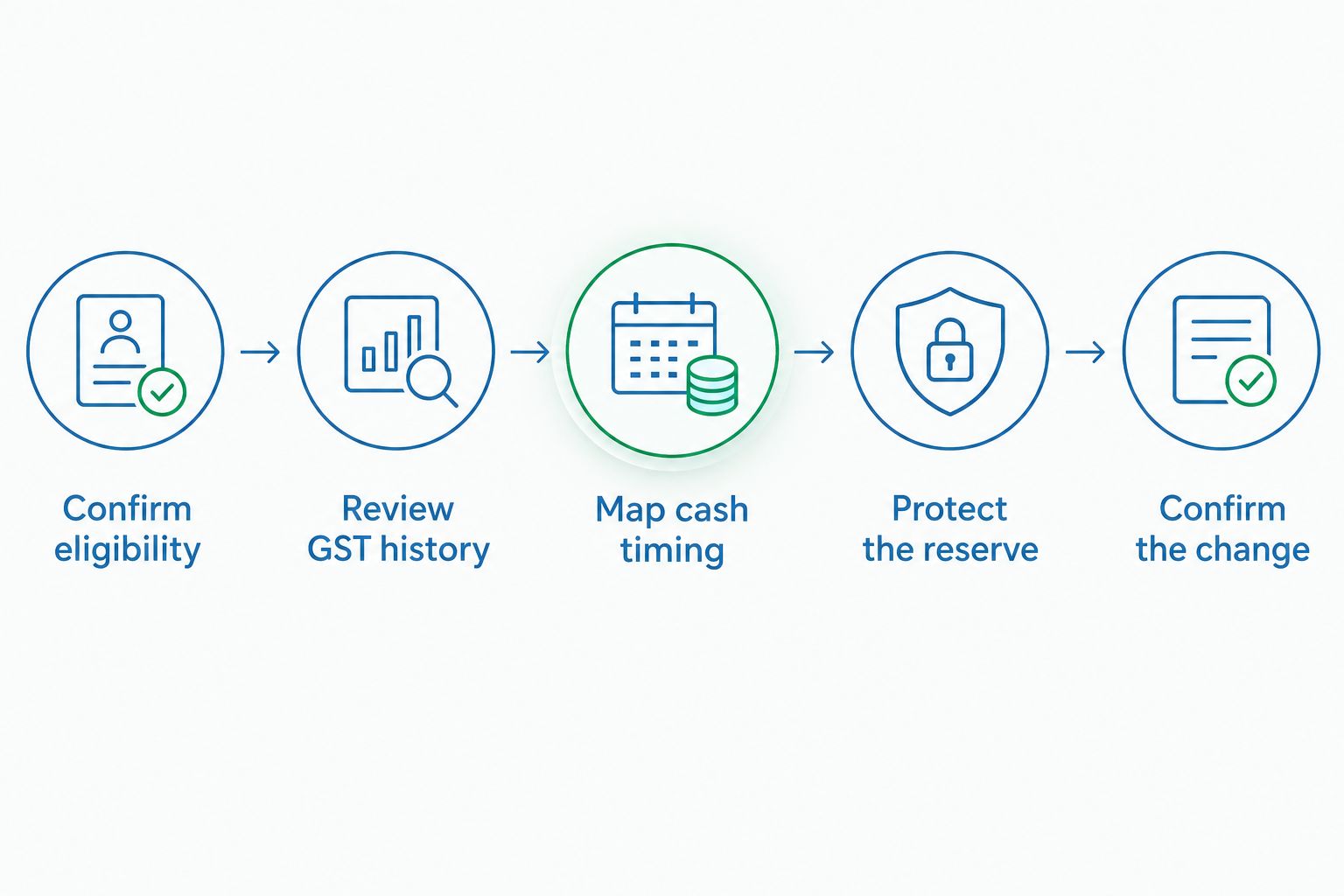
This process separates a genuine timing advantage from a temporary improvement in the bank balance. Keep the assumptions visible so you can revisit the decision when trading conditions change.
Keep a monthly close even when you lodge quarterly
Quarterly BAS does not require quarterly visibility. You can reconcile accounts, review GST and update the cash forecast each month while retaining an eligible quarterly lodgement cycle.
A practical monthly close checks bank reconciliations, sales and purchase coding, unpaid invoices, payroll liabilities and the estimated GST position. It should also identify transactions needing clarification before they become a deadline problem.
The scope of monthly bookkeeping services matters because reconciliations and timely transaction coding underpin a reliable GST reserve; transaction entry alone does not establish how much cash you can safely spend. Agree who resolves queries and who reviews the estimated liability.
For your 2026 reporting calendar, keep the monthly close separate from the BAS lodgement task. One maintains visibility; the other satisfies the relevant reporting obligation.
This distinction also helps when considering monthly lodgement for discipline alone. If monthly management information and a protected reserve solve the problem, changing your GST reporting frequency is not the only available control.
How do BAS deadlines affect your cash forecast?
Standard quarterly BAS due dates are 28 October, 28 February, 28 April and 28 July. Monthly activity statements are generally due on the 21st day of the following month.
Those are standard dates, not a substitute for checking your particular obligation. Weekends, public holidays, registered-agent arrangements and ATO extensions can affect the applicable deadline; use the date confirmed for your lodgement and payment.
For each 2026 forecast period, record the payment date alongside other major commitments. A BAS payment that is manageable in isolation can still create pressure when it coincides with wages and substantial supplier invoices.
Keep lodgement and payment responsibilities explicit. Preparing a BAS does not move money into the reserve, and lodging it does not itself ensure the payment has been scheduled.
Does quarterly BAS reduce how much GST you pay?
Quarterly BAS does not reduce the underlying GST liability simply by covering 3 months instead of 1 month. Frequency changes reporting periods and payment timing; taxable transactions, credits, adjustments and attribution rules determine the amount.
Avoid treating deferred payment as additional profit. Your management reporting should distinguish operating performance from cash temporarily held for tax obligations.
Can you change from quarterly BAS to monthly?
Monthly GST reporting is available by election for eligible quarterly reporters, subject to ATO requirements. Confirm when the change takes effect and the conditions attached before making the election.
Do not assume you can switch back whenever cash becomes tight. Treat the choice as a reporting decision supported by a forecast, not a short-term response to one difficult payment.
Should you change frequency if BAS payments cause stress?
Changing frequency alone does not fix an unfunded GST liability. First establish whether the pressure comes from inaccurate records, missing reserves, slow customer receipts or a wider operating cash deficit.
Daintree Consulting suits Australian businesses seeking BAS compliance support alongside cash flow advice. Its accounting and advisory services can address both the reporting obligation and the financial planning around it; choosing the right scope still requires clarity about your records, responsibilities and business needs.
Prepare your current GST position, outstanding customer invoices and upcoming payment commitments before seeking advice. That gives the discussion a concrete starting point rather than making reporting frequency carry the whole diagnosis.
FAQ
Is quarterly BAS lodgement better than monthly for cash flow?
Quarterly BAS generally gives eligible net GST payers more time before payment, provided they protect the GST reserve. Monthly reporting better suits recurring GST refunds or a need for more frequent settlement.
Can I lodge quarterly BAS but check my GST every month?
Yes, you can review GST and reconcile your accounts monthly while lodging quarterly if you are eligible. Monthly bookkeeping helps you estimate and reserve the upcoming payment.
Does monthly BAS get my GST refund sooner?
Monthly BAS brings forward the opportunity to claim eligible GST refunds compared with waiting for a quarterly reporting period to end. Actual payment remains subject to processing and any ATO checks.
When is monthly GST reporting compulsory?
Monthly GST reporting is compulsory when GST turnover is $20 million or more under the standard ATO rules. Other reporting requirements or ATO directions can also affect your obligations.
Should I keep my GST money in a separate bank account?
A separate bank account helps prevent your estimated GST reserve from being spent on operating expenses. Reconcile the estimate regularly because GST credits and transaction adjustments affect the amount required.
Will changing to monthly BAS fix my cash flow?
Monthly BAS does not fix an operating cash shortfall. It changes reporting and payment timing, so you still need accurate records, a funded tax reserve and a forecast covering other commitments.
One last thing
Keep the reporting cycle and the management cycle separate. The strongest quarterly BAS arrangement still gives you a monthly view of the liability and the cash available after allowing for it.
Before your next 2026 BAS period, put the estimated payment into your forecast as though it were already committed. If the remaining cash is insufficient, address that gap before the deadline rather than interpreting the bank balance as permission to spend.
Related guides
Talk to Daintree about your tax and BAS
Our ex-Big 4 team gives clear, senior-reviewed advice so you can act with confidence.
Book a free consultation →
Or explore our tax and BAS services.
