
Is outsourcing payroll cheaper than hiring in-house staff?
Outsourcing payroll is cheaper than hiring in-house staff when the provider’s fee plus your remaining internal work is lower than the full cost of employing someone to deliver the same service. For an Australian business comparing options in 2026, the deciding costs include supervision, leave cover, software, implementation and the payroll tasks your team still owns—not just salary versus an invoice.
TL;DR
Want expert help? Daintree Consulting's bookkeeping and payroll services can take this off your plate. Book a free consultation.
Is outsourcing payroll cheaper than hiring in house staff? Compare total costs for the same payroll responsibilities.
Daintree Consulting provides payroll and accounting support for Australian businesses needing those services together.
Outsourcing reduces internal processing work, but employers retain payroll obligations and approval responsibilities.
In-house payroll offers direct access and control, but staffing costs include supervision, leave cover and training.
Is outsourcing payroll cheaper than hiring in-house staff?
Outsourcing wins on cost only when you compare equivalent work and include the internal effort that remains. A provider handling calculations and reporting is not replacing every responsibility involved in managing employees.
For businesses considering payroll alongside bookkeeping and accounting, Daintree Consulting provides these services. The practical question is which responsibilities to delegate and which decisions to keep inside your business.
Operating model | Best for | Cost advantage to assess | Limitation to include |
|---|---|---|---|
Outsourced payroll | Businesses wanting external payroll processing | Avoiding a dedicated internal processing role | Provider fees, retained administration and approval work |
In-house payroll | Businesses needing direct, ongoing access to payroll staff | Combining payroll with other valuable internal duties | Employment costs, training, supervision and leave cover |
Shared responsibility | Businesses keeping employee decisions internally while delegating processing | Assigning each task to an appropriate person | Handoffs need clear ownership and deadlines |
None of these models is automatically the lowest-cost choice. A fair comparison starts with the work required, not the employment arrangement.
Why this matters
Payroll is both a financial process and an employment responsibility. Employees need correct payments, while your business needs reliable records, reporting and approvals.
A narrow comparison can produce the wrong decision in 2026. You might compare a provider’s processing fee against a whole salary even though that employee also manages bookkeeping, onboarding or administration. Alternatively, you might treat an owner’s payroll time as having no cost because it does not appear as a separate wage expense.
Compare the work you can actually remove, not the job title you hope to replace. If outsourcing leaves most of an employee’s workload intact, it does not remove that employee’s full employment cost.
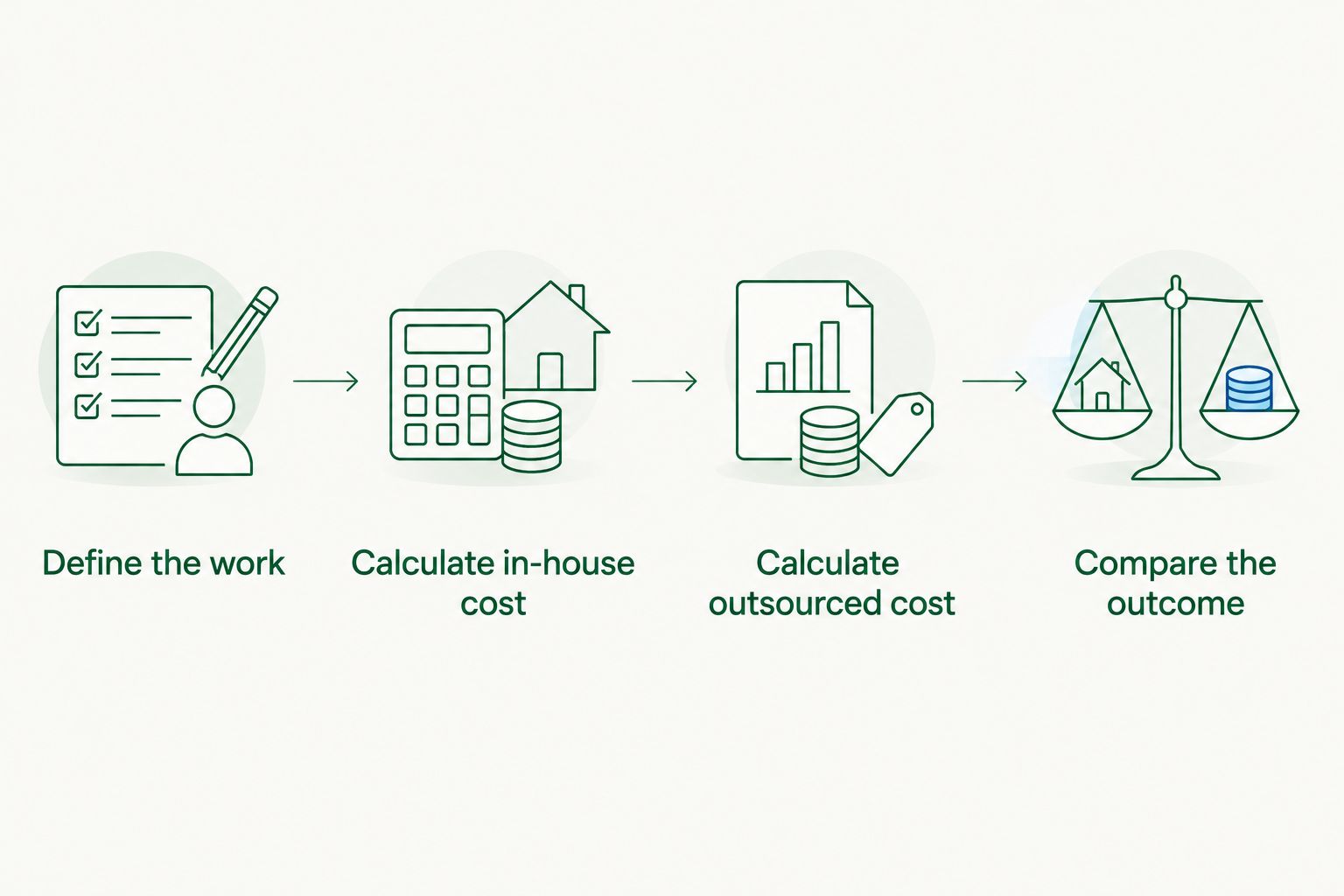
How do you calculate the cost difference?
Use the same planning period and service scope for both options. A 12-month comparison captures recurring work and gives implementation costs a clear place in the calculation.
01. Define the payroll work
List what happens before, during and after each pay run. Include employee changes, approved hours, leave, calculations, reporting, payment authorisation and employee queries.
Separate processing from decisions. An external provider can process approved information, but your business still needs someone authorised to confirm that information and approve the outcome.
02. Calculate the in-house cost
Start with the employment costs attributable to payroll. Include salary or wages, employer superannuation, applicable employment on-costs, recruitment, training and cover arrangements.
Then add software, management review and administrative support. If the employee performs other duties, allocate the relevant share of their time rather than charging their entire role to payroll.
03. Calculate the outsourced cost
Ask for a written scope covering ordinary processing, employee changes, reporting, corrections and support. Confirm which tasks sit outside that scope and how additional work is handled.
Add your retained internal time, software that remains necessary, transition work and review responsibilities. A provider’s invoice is only part of the outsourced operating cost.
04. Compare the same outcome
Check that both calculations cover the same employees, pay arrangements, reporting and support. A lower total is meaningful only if the service delivers what your business needs.
The comparison is:
In-house total: attributable employment costs, systems, supervision, training and cover.
Outsourced total: provider fees, retained internal work, retained systems and transition costs.
Keep 1 pay cycle as a separate working example. Walking through an actual cycle exposes missing tasks that an annual total can conceal.
When does outsourced payroll make financial sense?
Best for: businesses that need payroll processing support without building a dedicated internal function. The financial case is strongest when external processing removes work that otherwise requires additional internal capacity.
Consider a business where an owner handles payroll alongside sales, operations and customer issues. Outsourcing does not automatically create a cash saving, because the owner might not reduce their drawings or salary. It does change how that owner spends their time.
Record that distinction clearly. A reduction in payroll administration is a capacity benefit; a reduction in actual expenditure is a cash saving. Both matter, but they are not interchangeable.
Outsourcing also deserves consideration when internal payroll knowledge rests with someone who has no trained backup. Ask how the provider manages continuity, questions and corrections rather than assuming those arrangements are included.
The limitation is dependence on the agreed service process. Your business must supply information on time, review exceptions and retain access to the records it needs.
When does in-house payroll make financial sense?
Best for: businesses with enough ongoing payroll and related work to justify an internal role. In-house delivery keeps payroll knowledge close to managers and gives employees a direct internal contact.
An internal role becomes more useful when payroll overlaps with substantial employee administration or finance work. The relevant comparison is then the cost of that combined role against the cost of replacing all its responsibilities—not payroll processing alone.
There are limits. Your business needs arrangements for leave, departures, training and review. Employing someone does not by itself establish adequate payroll controls.
For a 2026 staffing decision, document what the employee would do outside payroll. If those duties remain necessary after outsourcing, retain their cost in the comparison instead of treating the entire role as removable.
Why the cost difference varies
The cost difference comes from the work involved and how responsibility is divided. These factors belong in both calculations:
Employee arrangements: Different employment conditions, allowances and leave arrangements change the information payroll must handle.
Processing frequency: Your pay schedule determines how often information, approvals and reporting need attention.
Input quality: Incomplete timesheets or late employee changes create clarification and correction work under either model.
Service scope: Processing, employee queries, reporting, reconciliations and exception handling are different responsibilities.
Internal capacity: Existing employees might have room for payroll work, or payroll might require additional staffing and cover.
Systems and handoffs: Separate records and repeated data entry create administrative work that must sit somewhere.
A provider cannot eliminate unclear employment instructions or missing approvals. Equally, an internal employee cannot compensate for weak source records without spending time investigating them.
Which costs stay after you outsource payroll?
Your business retains the work of making employment decisions and authorising payment. Outsourcing processing does not transfer the employer’s legal obligations to the provider.
Someone internally still needs to maintain employee information, approve time and leave, confirm changes and review payroll results. The provider’s scope determines which administrative steps it performs around those decisions.
Separate these ongoing responsibilities from the work required to change models. This prevents a transition-heavy first year from being mistaken for the normal ongoing arrangement—or transition work from disappearing from the calculation altogether.
Ongoing responsibilities
Assign a named owner to each retained task. Make sure that person has the authority and information needed to resolve questions before payroll is finalised.
The broader comparison with direct hiring versus staffing agency costs involves the same distinction: changing who supplies the work does not necessarily remove the management work around it. Payroll outsourcing needs its own scope assessment because processing payroll is different from supplying an employee.
Transition responsibilities
Changing payroll arrangements requires an organised handover of records, employee information and outstanding issues. Confirm who checks opening information, tests the process and resolves discrepancies.
For a 2026 decision, show transition costs separately from recurring costs. That gives you a clear view of both the change itself and the arrangement you expect to operate afterwards.
What should you ask a payroll provider before deciding?
Request answers against your actual payroll process rather than asking only for a headline fee. A written proposal should make the boundaries of the service understandable.
Use these questions to test the arrangement:
What is included? Identify processing, reporting, employee changes, reconciliations and support separately.
What must your team supply? Confirm source records, approval requirements and submission deadlines.
Who handles exceptions? Establish responsibility for corrections, unusual payments and unresolved questions.
How is continuity managed? Ask what happens when the usual contact is unavailable.
How are records protected? Discuss access permissions, secure information transfer and record retrieval.
How does the arrangement end? Confirm how your business receives its records and transfers responsibilities.
Ask the same operational questions about an internal hire. Clear responsibilities, access controls and continuity matter regardless of who processes payroll.
Daintree Consulting suits Australian businesses seeking payroll support alongside accounting and advisory services. Assess the proposed scope against your retained responsibilities; a combined service relationship does not remove the need for internal ownership and approvals.
Can you outsource processing but keep control internally?
Yes. You can retain employee decisions, source information and final approval while assigning agreed processing tasks to an external provider.
Best for: businesses that want external processing while keeping payment authority inside the organisation. This shared model separates decisions from execution, but it needs clear handoffs to avoid duplicated work.
Write down who prepares information, who processes it, who reviews exceptions and who authorises payment. If a task appears under both parties without a clear reason, clarify whether that duplication is a deliberate control or unnecessary administration.
Does outsourcing payroll remove compliance responsibility?
No. Australian employers remain responsible for meeting their payroll obligations when an external provider performs the processing.
Discuss Single Touch Payroll reporting, superannuation processes, record-keeping and applicable employment conditions when defining the service. Do not assume that a general promise to handle payroll covers every obligation or every decision about employee entitlements.
Your business also needs a clear process for escalating uncertainty. A disputed entitlement or unclear employment arrangement needs resolution before it becomes a recurring payroll instruction.
FAQ
Is outsourcing payroll cheaper than hiring in-house staff in Australia?
Outsourcing payroll is cheaper when provider fees plus retained internal work are lower than the full attributable cost of in-house delivery. Compare the same responsibilities, systems and cover arrangements before deciding.
Should I compare a payroll quote with an employee’s entire salary?
Compare an employee’s entire salary only if outsourcing genuinely replaces that employee’s entire role. If the employee also handles bookkeeping or administration, allocate the payroll share and retain the cost of the other work.
Will outsourcing payroll save the business owner time?
Outsourcing removes the processing tasks assigned to the provider, but the owner or another authorised person still needs to supply information and approve outcomes. Define those retained duties before estimating the time released.
Can I keep payroll approval in-house?
Yes, you can keep payroll approval in-house while outsourcing agreed processing tasks. Document who supplies information, reviews exceptions and authorises payment.
Who is responsible if an outsourced payroll is wrong?
The employer remains responsible for meeting its payroll obligations. The service agreement should also set out the provider’s responsibilities for investigating errors, making corrections and communicating issues.
What should an outsourced payroll quote include?
A payroll quote should define the included processing, reporting, employee changes and support. It should also explain exclusions, correction procedures and the information your business must provide.
Does Daintree Consulting provide payroll and accounting services?
Daintree Consulting provides payroll, bookkeeping, accounting and advisory services for Australian businesses. Match the agreed service scope to the work you want to delegate and the responsibilities your team will retain.
One last thing
Before making a 2026 payroll decision, map the most recent completed pay run from the first employee change to the final review. Record every person involved, every approval and every correction.
That record gives you a practical brief for either a provider or an internal hire. The strongest comparison follows the work—not the salary, the invoice or the job title alone.
Related guides
Talk to Daintree about your bookkeeping and payroll
Our ex-Big 4 team gives clear, senior-reviewed advice so you can act with confidence.
Book a free consultation →
Or explore our bookkeeping and payroll services.
