
Is it worth getting a management accounting report monthly?
Yes, a monthly management accounting report is worth getting when you use it to make decisions about cash flow, margins, spending or growth before the next reporting period. The report alone is not enough: it needs reliable figures, explanations of material changes and agreed actions, while a simpler business with limited financial movement can use a lighter reporting schedule.
TL;DR
Want expert help? Daintree Consulting's outsourced CFO services can take this off your plate. Book a free consultation.
Is it worth getting a management accounting report monthly? Yes, when the review changes your cash flow or spending decisions.
Monthly reporting provides 12 review points per year; quarterly reporting provides 4.
Choose explanations, forecasts and agreed actions over a larger collection of financial charts.
Daintree Consulting suits Australian businesses seeking accounting and advisory support as their financial needs grow.
Is it worth getting a management accounting report monthly?
Monthly management reporting earns its place when a quarterly or annual review leaves too much time between a problem developing and a decision being made. You need to know not just whether the business made a profit, but what changed, why it changed and what needs your attention.
For your 2026 reporting plan, compare the decision you need to make with the information each schedule provides. The right frequency follows the business, not the length of the report.
Reporting schedule | Best for | Main benefit | Main limitation |
|---|---|---|---|
Monthly: 12 reviews per year | Businesses making regular staffing, spending or cash decisions | Gives you a regular opportunity to identify changes and respond | Requires a reliable month-end close and time to review the results |
Quarterly: 4 reviews per year | Businesses with relatively stable operations and fewer changing commitments | Reduces reporting work while retaining scheduled oversight | Leaves a longer gap before changes receive a formal review |
Annual: 1 review per year | Looking back at the full year's financial performance | Provides a full-year view for historical comparison | Is too infrequent to guide decisions that cannot wait until year-end |
If you need help choosing the scope, consider the decisions you want accounting and advisory services to support. Asking for a monthly report without defining its purpose risks paying for information nobody uses.
Why this matters
A business can show an accounting profit and still face pressure paying its obligations. Credit sales, unpaid supplier bills, asset purchases and loan repayments affect profit and cash differently, so the bank balance cannot explain performance on its own.
Monthly management reporting brings those differences into view. You can examine trading results alongside debtors, creditors and cash commitments rather than treating each as a separate conversation.
The value is practical: better-informed decisions while there is still time to act. A report received but never discussed adds administration, not clarity.
What should a useful monthly report include?
Your 2026 monthly reporting pack should answer a small set of business questions clearly. Start with the financial statements, then add the comparisons and commentary needed to interpret them.
Profit and loss: are you earning enough from the work?
A profit and loss report shows income and expenses over a period. Compare the actual result with your budget and a relevant prior period, then investigate differences that affect your decisions.
Look beyond total revenue. Increased sales do not automatically mean improved profitability if direct costs, wages or overheads have also increased.
Balance sheet: what sits behind the result?
The balance sheet shows assets, liabilities and equity at a point in time. It helps you examine outstanding customer balances, supplier obligations, borrowings and other amounts that a profit and loss report does not explain alone.
Ask about unexplained balances and old reconciling items. A polished profit report is less useful when the underlying accounts have not been checked.
Cash flow: what needs funding next?
Review cash movements alongside a forward-looking cash forecast. Historical reporting explains what happened; a forecast uses assumptions to show the cash consequences of what you expect next.
Separate confirmed commitments from assumptions about future receipts. A forecast is a planning tool, not a guarantee that customers will pay when expected.
Commentary: what changed and what will you do?
Commentary should identify the material changes, explain their causes and connect them to decisions. A chart showing higher expenses does not tell you whether the increase reflects growth, timing or an avoidable problem.
Ask for an action, an owner and a review date for each issue that requires a response. Otherwise, the same observation can return in the next report without anything changing.
Monthly, quarterly or annual: which suits your business?
No reporting frequency fixes unreliable bookkeeping. Choose a schedule only after establishing that transactions are recorded consistently and the figures can be reviewed with confidence.
Monthly reporting: 12 reviews per year
Monthly reporting is best for businesses with changing sales, staffing, margins or cash commitments. It creates a regular point to compare expectations with results and update decisions.
Its limitation is the work required to close the accounts and interpret the results. If the report arrives too late to influence the next decision, improve the reporting process before adding more detail.
Quarterly reporting: 4 reviews per year
Quarterly reporting is best for businesses whose operations and commitments change less frequently. It offers structured oversight without requiring a full management discussion every month.
The drawback is the longer interval between reviews. Keep checking cash and near-term obligations between quarterly meetings; a reporting schedule does not replace day-to-day financial management.
Annual reporting: 1 review per year
Annual reporting is best for assessing the completed financial year and discussing its overall result. It provides context that individual months cannot supply, particularly when trading is seasonal.
Its limitation is timing. Annual accounts cannot guide a hiring, purchasing or funding decision that needs an answer during the year.
Why the value of monthly reporting varies
The same reporting pack will not serve every business equally. These factors determine how much attention your monthly review needs:
Cash commitments: Payroll, supplier payments, tax obligations and debt repayments need to be considered against expected receipts.
Margin visibility: Different services, projects or product lines can contribute differently to profit; an overall result can conceal those differences.
Trading patterns: Seasonal activity and uneven project income affect which comparisons are meaningful.
Decision timing: Recruitment, equipment purchases and expansion require financial information before you commit, not after.
Record quality: Unreconciled accounts and inconsistent coding weaken the conclusions you can draw from a report.
Use those factors to set your 2026 reporting priorities. A business managing project profitability needs different commentary from one mainly trying to understand overdue customer payments.
Avoid adding measures simply because the software can display them. Keep a measure when it helps explain performance or supports a decision you actually make.
How do you turn a monthly report into useful decisions?
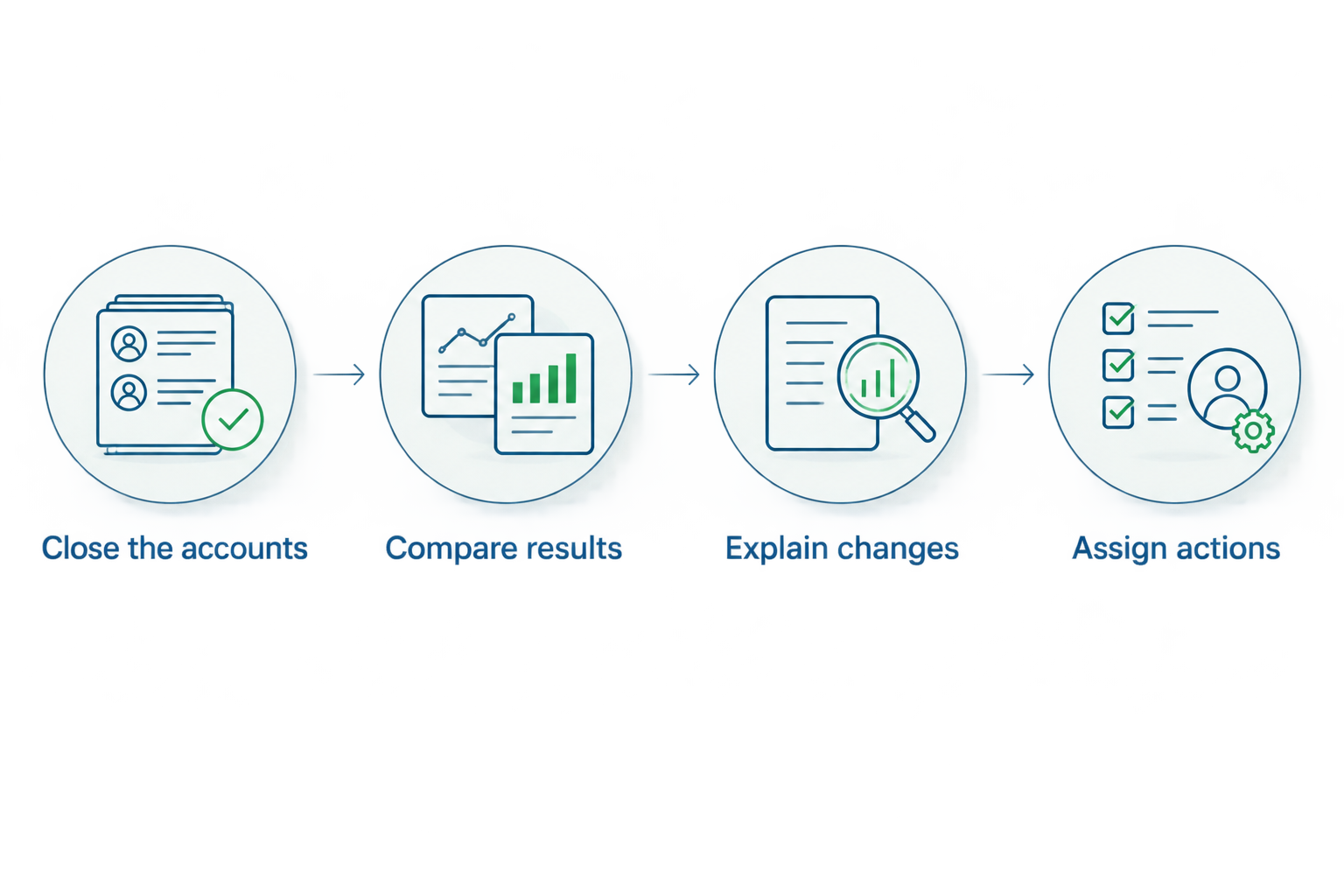
A monthly report works best as part of a repeatable review process. Agree on the sequence with whoever prepares the accounts so the meeting starts with usable information rather than unresolved bookkeeping questions.
01. Close the accounts
Reconcile bank accounts, review outstanding balances and check that income and expenses belong in the appropriate period. Include relevant accounting adjustments so the month is not distorted by recording everything only when cash moves.
The objective is consistency. Changing the treatment of similar transactions from month to month makes comparisons harder to trust.
02. Compare results
Compare actual performance with the budget and a meaningful historical period. For seasonal businesses, the immediately preceding month is not always the most useful comparison.
Identify the differences that matter to the business. Do not spend the meeting explaining every small movement while leaving a significant margin change unresolved.
03. Explain changes
Separate timing differences from underlying operational changes. A delayed invoice, a recurring cost increase and a change in the type of work sold require different responses.
Ask what evidence supports the explanation. Commentary should clarify the numbers, not simply repeat them in sentences.
04. Assign actions
Decide what needs to happen, who owns it and when it will be checked. Actions might involve reviewing overdue invoices, investigating a cost increase or revising a spending decision.
Bring unfinished actions into the next review. That link between reporting and accountability is what makes a monthly process useful.
When is a monthly management report not worth it?
A full monthly pack is not worthwhile when nobody reads it, its figures remain unresolved or it duplicates information without supporting a decision. More pages do not compensate for an unclear purpose.
For a simple business, start with dependable bookkeeping, visibility over cash commitments and a reporting schedule matched to its needs. Add detail when a specific question requires it.
Equally, do not cancel reporting because a pack is difficult to understand. First ask for clearer commentary, fewer irrelevant measures and a discussion focused on the decisions you face.
What should you ask an accountant before agreeing to monthly reports?
Ask what is included beyond generating the statements. Clarify who completes the bookkeeping, which accounts are reviewed, whether forecasts are included and who explains the results.
Agree on delivery timing and your responsibilities for providing records. There is little benefit in setting an ambitious timetable if missing information prevents the accounts from being completed.
Daintree Consulting is best for Australian businesses seeking accounting and advisory support as their financial needs grow. Its stated services include accounting, bookkeeping, business advisory and outsourced CFO support; ask which scope fits your reporting needs rather than assuming every service includes the same deliverables.
The boundary matters. Financial statements, a management discussion and ongoing CFO support are different scopes of work, and each should have clear responsibilities.
Can you prepare a monthly management report yourself?
Yes, you can prepare a monthly management report yourself if you understand the accounting and can maintain reliable records. Software can generate statements, but you still need to check the accounts and interpret the results.
The trade-off is your time and accounting capability. If adjustments or unexplained balances prevent a clear view, get those issues resolved before relying on the report.
Is monthly management reporting the same as BAS preparation?
No, monthly management reporting is not the same as BAS preparation. A business activity statement serves tax reporting obligations, while management reporting supports decisions about performance, financial position and cash.
The processes can use overlapping records, but they answer different questions. Do not assume that meeting a BAS obligation gives you the management information needed to run the business.
Should you review monthly reports with your accountant?
Yes, review monthly reports with your accountant when you need help understanding material changes or deciding how to respond. Sending a document alone is different from explaining its business implications.
For your 2026 engagement, specify whether a discussion is included and what preparation it requires. You should leave knowing what changed and what happens next.
FAQ
Is it worth getting a management accounting report monthly for a small business?
Yes, monthly management reporting is worthwhile for a small business when it supports recurring cash, margin or spending decisions. Keep the scope proportionate to the business rather than requesting a large pack by default.
What's the most useful information in a monthly management report?
The most useful information connects profit, financial position and cash flow to the decisions you need to make. Include relevant comparisons, explanations of material changes and agreed actions.
Is quarterly reporting enough for my business?
Quarterly reporting is suitable when operations are relatively stable and decisions do not require a full monthly review. You still need visibility over cash and obligations between reporting dates.
Does a profitable monthly report mean I have cash to spend?
No, an accounting profit does not mean the same amount is available in cash. Customer payment timing, asset purchases, debt repayments and other commitments affect available funds.
Do I need an outsourced CFO just to get monthly reports?
No, a monthly reporting requirement does not automatically mean you need an outsourced CFO. Define whether you need accurate statements, help interpreting results or ongoing financial leadership, then choose the appropriate scope.
What should I agree with Daintree Consulting before starting monthly reporting?
Agree with Daintree Consulting on the reporting scope, recordkeeping responsibilities, delivery timing and discussion required. Ask how its accounting and advisory services would address the decisions your business needs to make.
How should I assess my monthly reporting arrangements in 2026?
Assess your 2026 monthly reporting arrangements by whether they provide reliable information in time for decisions. Check that material changes are explained and that actions from previous reviews are followed up.
One last thing
Before adding another chart, write down the decision your current report does not help you make. That question is a better starting point for improving reporting than asking for a longer document.
At your next review, finish with a clear action and revisit it in the following meeting. The value of monthly reporting sits in what you do with the information, not how often a PDF arrives.
Related guides
Talk to Daintree about your finance function
Our ex-Big 4 team gives clear, senior-reviewed advice so you can act with confidence.
Book a free consultation →
Or explore our outsourced CFO services.
