
Is business advisory worth it for a small business?
Yes—business advisory is worth it for a small business when it helps you make a specific decision, put it into action and measure the result. In 2026, that means linking the advice to cash flow, profitability, funding or business capacity—not simply receiving another report. It is harder to justify when your records are unreliable, the brief is vague or nobody has time to act.
TL;DR
Want expert help? Daintree Consulting's business advisory services can take this off your plate. Book a free consultation.
Is business advisory worth it for a small business? Yes, when advice addresses a clear decision and leads to action.
Daintree Consulting combines business advisory with accounting support for Australian businesses.
Agree on the decision, deliverable and success measure before committing to ongoing support.
Fix unreliable bookkeeping first; forecasts need dependable financial records.
Is business advisory worth it for a small business?
Business advisory earns its place when it closes the gap between knowing your numbers and deciding what to do next. A profitable business can still struggle to pay suppliers; a growing business can still take on work that weakens its margins.
Daintree Consulting provides accounting and business advisory services to Australian businesses. The useful starting point is the decision you need to make, rather than a broad request to improve the business.
Use this comparison to separate a worthwhile engagement from advice that adds little practical value.
Test | Worthwhile advisory | Weak advisory brief |
|---|---|---|
Purpose | Resolve a defined business decision | Discuss performance without a decision |
Evidence | Use reconciled records and explicit assumptions | Rely on unexplained figures |
Output | Produce options, a recommendation and actions | Deliver commentary without next steps |
Responsibility | Name who will carry out each action | Leave implementation unassigned |
Review | Compare the outcome with an agreed measure | Hold meetings without checking progress |
Buy help with a decision, not a meeting schedule. Regular meetings can support accountability, but frequency alone does not make the advice useful.
Why this matters
Small business owners often carry financial decisions alongside sales, staffing and daily operations. That makes it easy to postpone a difficult choice or judge it from the bank balance alone.
A bank balance does not show every unpaid obligation, upcoming commitment or customer invoice still awaiting payment. Advisory brings those pieces into the decision before you commit to hiring, equipment, borrowing or expansion.
For a 2026 advisory brief, start with the question that is hardest to answer internally. A narrow, important question gives both you and the advisor a clear standard for judging the work.
When business advisory is worth considering
Cash flow decisions
Best for: owners who need to understand whether the business can meet its commitments. A cash-flow forecast connects expected customer receipts with supplier payments, payroll, tax obligations and other planned outgoings.
The benefit is visibility over timing, not just totals. Its limitation is equally important: a forecast is only useful when payment assumptions are realistic and someone updates it as circumstances change.
Ask the advisor to explain which assumptions create the greatest pressure. You need to understand the difference between a temporary timing gap and a recurring operating problem.
Pricing and profitability decisions
Best for: owners who are busy but cannot see which work produces an adequate return. Advisory can examine how pricing, direct costs, overheads and the mix of work affect profitability.
The benefit is a clearer basis for deciding what to charge, continue or change. The limitation is that incomplete job, product or service records restrict how precisely you can assess individual margins.
Do not treat an overall profit figure as proof that every activity is worthwhile. Ask which parts of the business contribute to the result and which costs the analysis includes.
Hiring and growth decisions
Best for: owners considering a new employee, location, major contract or equipment commitment. Advisory can compare the financial effect of proceeding, delaying or changing the proposal.
The benefit is seeing the commitment before it becomes difficult to reverse. The limitation is uncertainty: future sales, collection timing and operating demands remain assumptions, even in a carefully prepared model.
Request a downside case as well as the expected case. You need to know what happens if the additional revenue arrives later than planned.
Reporting and financial oversight
Best for: owners whose business has become harder to manage from day-to-day observations. Advisory can connect financial reporting with decisions about cash, margins and resources.
The benefit is a consistent basis for discussion. The limitation is the work required to maintain useful records and follow through; a dashboard does not replace management responsibility.
Choose measures tied to decisions you actually make. A report full of figures you never use adds administration without improving your view of the business.
Why the value of business advisory varies
The same service can be useful to one business and premature for another. These factors determine whether the work addresses a genuine need:
Decision significance: Advice has a clearer purpose when a decision affects ongoing commitments, financial exposure or business direction.
Record quality: Reconciled accounts support analysis; missing transactions and incorrect classifications weaken it.
Scope: A defined question makes it easier to agree on deliverables and assess whether they answer it.
Implementation capacity: Recommendations need an owner who has the authority and time to act.
Business complexity: Staffing, funding, reporting and operational demands determine the depth of support required.
Review discipline: Comparing actual results with assumptions shows whether the plan needs to change.
None of these factors requires you to buy ongoing support automatically. A focused engagement is a reasonable starting point when you have a contained question and the capacity to implement the answer.
Which type of financial support do you need?
Bookkeeping, accounting, business advisory and outsourced CFO support have different purposes, although providers can combine them. Choose the work you need before choosing the service label.
Support | Best for | Main contribution | Limitation to understand |
|---|---|---|---|
Bookkeeping | Owners needing dependable transaction records | Recording and reconciling financial activity | Accurate records alone do not answer strategic questions |
Accounting and tax | Owners needing financial accounts and tax compliance | Reporting and meeting relevant obligations | A compliance engagement does not automatically include decision support |
Business advisory | Owners facing a defined commercial decision | Analysing options and setting practical actions | Advice still needs implementation and review |
Outsourced CFO | Owners needing ongoing financial leadership | Connecting forecasting, reporting and financial decisions | The scope must fit the business's complexity and internal responsibilities |
Daintree Consulting business advisory is best suited to owners seeking accounting and advisory support together. Its stated services also include bookkeeping, payroll and outsourced CFO support, allowing the discussion to start with the business's actual needs.
The boundary to clarify is scope. A provider offering several services does not mean every service is included in your engagement; confirm the deliverables, responsibilities and exclusions before you proceed.
How do you test whether advisory will be worthwhile?
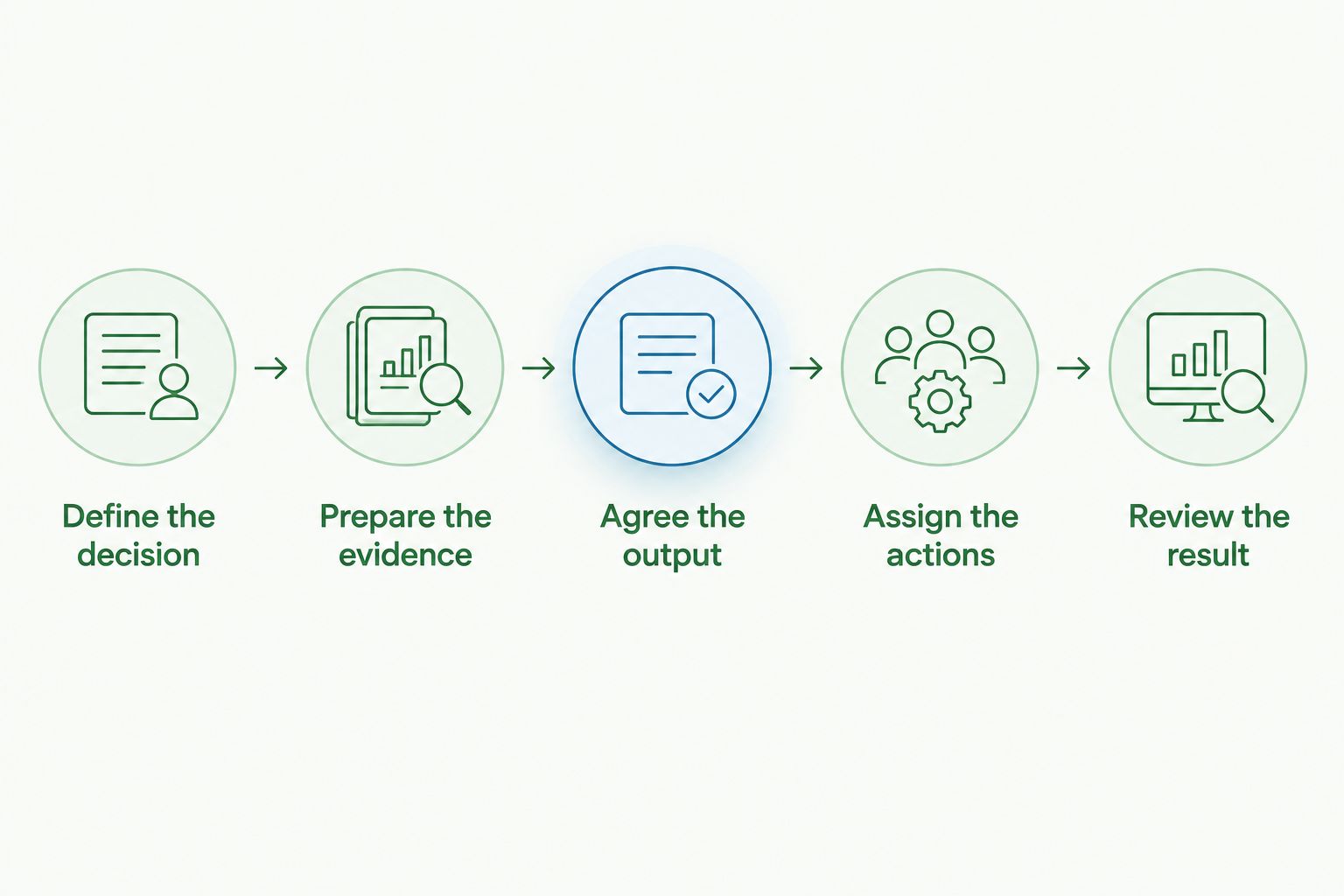
Use a short sequence to turn a general concern into an engagement you can assess. The aim is not to predict every outcome, but to make the purpose and responsibilities clear.
01. Define the decision
Write the decision in one sentence. For example: decide whether the business can support another employee without placing existing payment commitments under pressure.
Avoid a brief such as improving performance. That describes an ambition, not a decision the advisor can analyse and you can make.
02. Prepare the evidence
Bring current financial reports, bank reconciliations, amounts owed by customers, amounts owed to suppliers and relevant commitments. Include operational information that explains the decision, such as expected workload or proposed contract terms.
If the records need correction, separate that work from the advisory task. You should know whether the first stage is cleaning up the evidence or analysing a business choice.
03. Agree the output
Specify what you need to receive: a cash-flow forecast, a comparison of scenarios, a margin analysis or a written action plan. Agree which assumptions the advisor will explain and which inputs you must provide.
For a 2026 engagement, keep the brief tied to the decision in front of you. A large reporting pack is not a substitute for a clear answer.
04. Assign the actions
Name who will implement each agreed action and when it needs to happen. The advisor can analyse collection practices, for example, but someone inside the business still needs to change how overdue invoices are followed up.
Do not approve an action plan without assigning responsibility. Unassigned recommendations are difficult to distinguish from unfinished discussion.
05. Review the result
Choose a review date and a measure connected to the original problem. For cash flow, that can mean comparing forecast receipts and payments with what actually occurred.
Separate changes caused by your actions from changes in trading conditions. A better result does not prove every recommendation worked, just as an unexpected setback does not automatically invalidate the analysis.
When should you wait before engaging a business advisor?
Wait when the business cannot yet provide reliable records or act on the recommendations. That does not mean ignoring the problem; it means addressing the immediate obstacle first.
If transactions are missing or accounts are unreconciled, start with bookkeeping and accounting support. Otherwise, advisory time risks being spent investigating figures rather than answering your question.
If you already know the required action but have not assigned it, start with responsibility and follow-through. More analysis does not resolve an implementation gap by itself.
Also distinguish commercial advice from matters requiring a particular professional qualification or registration. Ask what sits within the engagement and when separate legal, tax, credit or financial advice is required.
Can a small business use advisory without ongoing support?
Yes—a small business can engage an advisor for a defined project rather than an ongoing arrangement. A specific hiring decision, cash-flow question or profitability review gives the project a natural boundary.
The advantage is focus. The limitation is that circumstances can change after the work ends, so agree who will update the analysis and identify when another review is needed.
Ongoing support makes more sense when decisions recur and the business needs regular financial oversight. Choose it because the work continues, not because a recurring meeting has become routine.
How do you measure whether business advisory worked?
Measure advisory against the decision and actions agreed at the start. Useful evidence includes a completed decision, implemented changes and a comparison between expected and actual results.
For your 2026 review, record the starting position before making changes. Without that reference point, it is harder to assess whether cash collection, margins or reporting quality improved.
Do not judge success only by whether the advisor supported your preferred option. Advice that identifies a weak assumption or an unaffordable commitment can be useful even when the recommendation is to wait.
FAQ
Is business advisory worth it for a small business in 2026?
Business advisory is worth it for a small business in 2026 when it addresses a defined decision and leads to action you can assess. Start with a clear question, reliable records and an agreed review measure.
What's the difference between an accountant and a business advisor?
Accounting commonly covers financial records, reporting and tax obligations, while business advisory focuses on decisions and actions. An accountant can also provide advisory services, but the engagement must explicitly include that work.
Do I need business advisory if my business is profitable?
Profitability alone does not determine whether you need business advisory. Advice can still help when you face cash-flow pressure, a major commitment or uncertainty about which activities produce the profit.
Can a sole trader benefit from business advisory?
A sole trader can benefit from business advisory when a specific financial or commercial decision needs analysis. Business size matters less than the decision, the available evidence and the ability to act.
What should I prepare before meeting a business advisor?
Prepare current financial reports, reconciled records, customer and supplier balances, relevant commitments and the decision you need to make. Ask the advisor which additional information the particular engagement requires.
Does business advisory replace bookkeeping?
Business advisory does not replace bookkeeping. Advisory uses financial information to assess decisions, while bookkeeping maintains the transaction records that support that information.
Does Daintree Consulting offer both accounting and business advisory?
Daintree Consulting provides accounting and business advisory services to Australian businesses. Its stated services also include bookkeeping, payroll, tax and BAS compliance, audit and assurance, SMSF accounting and outsourced CFO support.
One last thing
Before engaging an advisor in 2026, finish this sentence: The decision I need to make is… If you cannot complete it, ask for help defining the problem before commissioning a wider engagement.
The most useful starting point is not a longer list of services. It is a clear question, dependable evidence and someone responsible for the next action.
Related guides
Talk to Daintree about your next business decision
Our ex-Big 4 team gives clear, senior-reviewed advice so you can act with confidence.
Book a free consultation →
Or explore our business advisory services.
