
Is an SMSF worth it in 2026?
An SMSF is worth considering in 2026 when you need investment control that your existing super fund does not provide, and you can manage the trustee responsibilities and ongoing administration. It is not automatically better because your balance is large or you want to buy property. The decision rests on whether the additional control solves a genuine retirement need without creating disproportionate costs, concentration or compliance risk.
TL;DR
Want expert help? Daintree Consulting's SMSF accounting services can take this off your plate. Book a free consultation.
Is an SMSF worth it? Only when investment control justifies trustee duties, administration and retirement risks.
Daintree Consulting provides SMSF accounting alongside business tax and advisory services for Australian business owners.
An SMSF can have up to 6 members, but shared membership requires coordinated decisions.
Compare your existing super fund, insurance and investment options before transferring retirement savings.
Is an SMSF worth it in 2026?
An SMSF makes sense when you have a specific investment strategy, understand your legal responsibilities and can maintain the fund properly. It does not make sense simply because managing your own super sounds more flexible.
Daintree Consulting is best suited to Australian business owners seeking SMSF accounting alongside business tax and advisory support. Accounting support addresses administration and compliance; the investment decision needs its own assessment.
Decision point | Self-managed super fund | APRA-regulated super fund |
|---|---|---|
Best for | Members who need direct control and accept trustee duties | Members who prefer a fund trustee to handle governance |
Investment decisions | Trustees select investments within superannuation rules | Members select from the options their fund offers |
Main advantage | Greater control over the investment strategy and assets | Less direct responsibility for fund administration |
Main drawback | Trustees remain accountable even when specialists help | Available investments depend on the fund's offering |
Administration | Trustees arrange accounting, reporting and an independent annual audit | The fund trustee manages fund-level compliance |
Insurance | Members must assess and arrange suitable cover | Cover depends on the fund and membership arrangements |
Neither structure guarantees stronger returns. Compare the investment approach and the responsibilities, not just the label on the account.
Why this matters
Your super is retirement money, not spare business capital. Establishing an SMSF changes who controls that money and who must keep the fund compliant.
In 2026, the useful question is not whether SMSFs are good or bad. It is whether an SMSF improves your particular retirement arrangements after allowing for administration, professional support, insurance and the time you must contribute.
An SMSF can have up to 6 members. That creates scope for shared planning, but members need compatible investment objectives and a workable decision-making process. Combining balances does not remove individual retirement needs.
Keep business and retirement decisions distinct. A transaction that helps your business is not automatically suitable or permitted for your super fund.
When an SMSF is worth considering
You need a specific investment arrangement
Start with the investment requirement, not the fund structure. Identify what you want to hold, why it supports your retirement strategy and whether your current fund already offers an acceptable alternative.
Direct control is useful only when you have a clear reason to exercise it. A preference for choosing investments does not establish that the proposed portfolio is diversified, liquid or suitable.
Write down the investment problem an SMSF would solve before arranging a rollover. If you cannot describe that problem clearly, compare the options within your existing super first.
You accept the trustee role
An SMSF is not simply a super account with more investment choices. Its trustees must keep records, follow the fund's governing rules, arrange reporting and ensure the fund meets its obligations.
Appointing an accountant or administrator helps with the work. It does not transfer the trustee's legal responsibility to that provider.
You need enough understanding to question recommendations, review documents and recognise transactions that require advice. Willingness to sign paperwork is not the same as readiness to govern a retirement fund.
The fund remains practical as circumstances change
Assess the proposed arrangement beyond its first investment. Consider retirement, pension payments, a member leaving, incapacity and the eventual sale of assets.
A structure that works while all members contribute can become harder to manage when members need regular payments. The investment strategy must account for those changing demands, rather than assume assets can always remain untouched.
When keeping your existing super is the better choice
Keep the simpler arrangement when an SMSF adds responsibility without solving a defined problem. Your existing fund deserves a fair comparison before you replace it.
An SMSF is a poor fit when you do not want to review financial records, coordinate advisers or make decisions with other trustees. Outsourcing tasks reduces the workload but does not make the fund self-running.
It also deserves caution when the proposed portfolio depends heavily on one asset. A property or private investment can dominate the fund's risk while leaving limited cash for expenses and benefit payments.
Existing insurance is another reason to pause. Closing or transferring an account can affect cover, and replacement insurance is not automatically equivalent. Check the terms and whether replacement cover is accepted before cancelling anything.
Finally, do not establish an SMSF because someone promises early access to super. An SMSF must follow the same legal conditions of release that apply to super generally; changing structures does not remove those restrictions.
Why SMSF suitability varies in 2026
The same structure can suit one household and burden another. Assess these factors together:
Investment purpose: Direct control needs a retirement objective, not simply a desire to own a particular asset.
Fund balance: Compare the full administration burden against the assets available to support it. A balance alone does not prove suitability.
Member alignment: Different retirement dates, risk preferences and cash needs require a shared plan.
Liquidity: The fund needs accessible money for expenses, tax and benefits when they become payable.
Trustee capacity: Time, financial understanding and willingness to supervise professional work affect whether the arrangement is manageable.
Exit planning: Selling investments, moving benefits and winding up the fund need consideration before establishment.
No single factor settles the decision. Strong investment interest does not compensate for an inability to meet trustee obligations, and a substantial balance does not make a concentrated portfolio safe.
Does an SMSF give you a better tax outcome?
An SMSF does not receive a special tax advantage simply because you manage it yourself. A complying super fund generally pays 15% tax on taxable income in accumulation phase, subject to the applicable rules and exceptions.
That rate does not mean every receipt is taxed identically. Contributions, capital gains, retirement-phase income and non-arm's-length arrangements require separate treatment.
For a 2026 assessment, ask a registered tax agent to explain how the rules apply to your proposed investments and transactions. Compare like with like: the same investment strategy, member circumstances and retirement phase.
Tax treatment should support the investment decision, not replace it. An investment with an attractive tax outcome can still expose your retirement savings to poor diversification, difficult valuation or insufficient cash.
Daintree Consulting provides SMSF accounting and tax services. Keep that compliance assessment separate from a recommendation about whether an SMSF or a particular investment suits you.
Is buying property a good reason to establish an SMSF?
Buying property is a reason to investigate an SMSF, not a reason to approve one. The property must fit the fund's investment strategy and the superannuation rules.
Residential property held in an SMSF generally cannot be occupied by you or related parties. It is not a way to buy a home for personal use with retirement savings, even if you intend to pay rent.
Property also requires a cash-flow plan. Allow for outgoings, vacancies, maintenance and benefits payable to members without assuming rent will cover every obligation.
Borrowing adds legal and administrative complexity. SMSF borrowing is restricted, and permitted arrangements have specific requirements. Obtain advice before signing contracts or committing the fund to a transaction.
Assess the entire fund after the purchase, not just the property. A property can look attractive on its own while leaving the retirement portfolio concentrated and short of accessible cash.
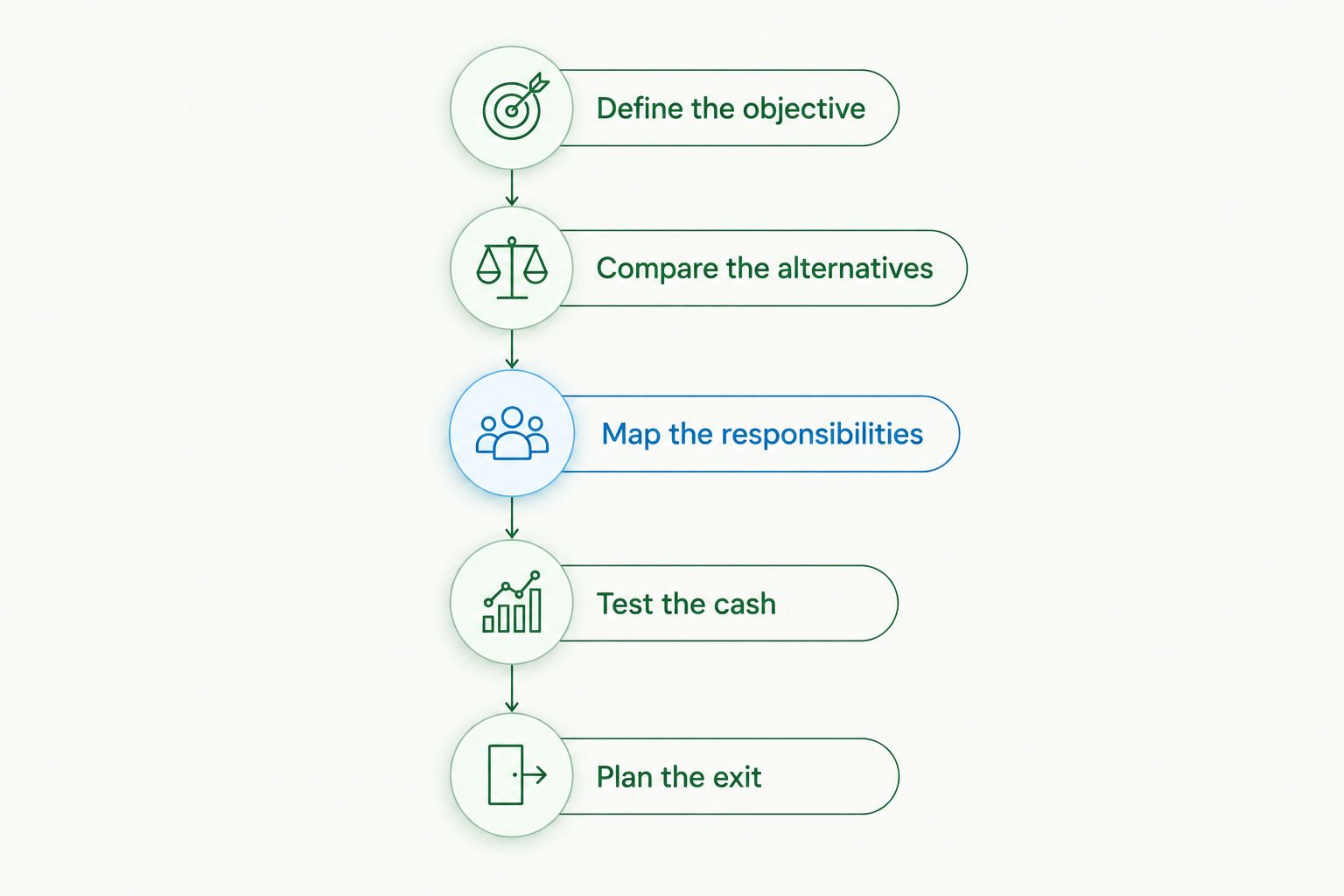
How should you assess an SMSF before setting one up?
01. Define the objective
Write a short explanation of what the SMSF must achieve. Separate investment preferences from essential requirements, and identify what your current fund cannot provide.
A clear objective gives each adviser the same problem to assess. It also helps you reject complexity that does not improve the result.
02. Compare the alternatives
Review your existing fund's investment options, administration, insurance and retirement arrangements. Ask whether changing investments within that fund would address the problem without establishing a new structure.
Compare services on the same scope. A basic administration proposal is not equivalent to ongoing accounting, tax, investment advice and trustee support.
03. Map the responsibilities
List who will manage records, organise reporting, arrange the audit and monitor the investment strategy. A regulated SMSF requires 1 independent audit each financial year, even when an accountant prepares its accounts.
Confirm what each provider handles and what remains with you. Daintree Consulting's SMSF accounting support can form part of that arrangement, but trustee oversight remains your responsibility.
04. Test the cash flow
Prepare a forward-looking cash-flow budget covering contributions, investment income, administration, tax and expected benefit payments. Test what happens if income stops or an asset cannot be sold promptly.
Do not treat an asset valuation as available cash. A fund can hold valuable investments and still struggle to meet payments.
05. Plan the exit
Document what happens if a member dies, loses capacity, wants to leave or no longer wants the trustee role. Include the practical process for transferring benefits and winding up the fund.
The exit plan belongs in the establishment decision. It is harder to make calmly after members' circumstances have changed.
Can I outsource everything and avoid trustee responsibility?
You remain responsible as an SMSF trustee even when professionals perform the administration. Accountants, administrators, auditors and advisers have different roles; appointing them does not remove your duty to supervise the fund and comply with the rules.
Is an SMSF better than an industry or retail super fund?
An SMSF is better only when its additional control serves your needs and justifies its responsibilities. An industry or retail fund is the stronger fit when you prefer professionally managed governance and the available investment options meet your requirements.
Should I establish an SMSF before getting advice?
Get advice before establishing an SMSF or transferring super. A licensed financial adviser can assess suitability, while accounting, tax and legal advice address the proposed structure and transactions within each professional's scope.
FAQ
Is an SMSF worth it in 2026?
An SMSF is worth considering in 2026 when direct investment control serves a clear retirement objective and you accept the trustee responsibilities. Compare administration, insurance, liquidity and alternatives before transferring super.
How much super do I need before an SMSF makes sense?
A balance alone does not establish whether an SMSF makes sense. Assess the full administration burden, investment strategy, member needs and trustee capacity against your existing super arrangements.
How many members can an SMSF have?
An SMSF can have up to 6 members. Shared membership requires coordinated investment decisions and planning for different retirement dates and cash needs.
Does an SMSF need an audit every year?
A regulated SMSF needs 1 independent audit each financial year. Preparing accounts and arranging an independent audit are separate compliance tasks.
Can my accountant take over my SMSF responsibilities?
Your accountant cannot remove your legal responsibilities as an SMSF trustee. Professional support helps with administration and compliance, but you remain responsible for overseeing the fund.
Can I live in a property owned by my SMSF?
You generally cannot live in residential property owned by your SMSF, and related parties generally cannot occupy it either. Obtain advice before entering any property transaction involving the fund.
Does an SMSF pay less tax than other super funds?
An SMSF does not receive a separate tax advantage simply because it is self-managed. A complying super fund generally pays 15% tax on taxable income in accumulation phase, with specific rules and exceptions applying.
Can I access my super early by setting up an SMSF?
Establishing an SMSF does not give you unrestricted early access to super. You must meet a lawful condition of release before withdrawing benefits.
One last thing
A good SMSF decision includes a reason not to proceed. Before committing in 2026, write down the circumstances that would make you keep your existing fund: unsuitable insurance changes, insufficient liquidity, disagreement between members or more administration than you want to manage.
Then test the proposal against those limits. This turns a broad preference for control into a decision you can explain and review.
If the SMSF still meets your objectives after that assessment, you have a clearer basis for the next discussion. If it does not, staying with an existing fund is a deliberate retirement decision, not a missed opportunity.
This article provides general information, not personal financial advice. Obtain advice specific to your circumstances before establishing an SMSF or transferring super.
Related guides
Talk to Daintree about your SMSF accounts
Our ex-Big 4 team gives clear, senior-reviewed advice so you can act with confidence.
Book a free consultation →
Or explore our SMSF accounting services.
