
Is an outsourced CFO better than a part-time finance manager?
An outsourced CFO is better when you need financial strategy, forecasts and support for major decisions; a part-time finance manager is better when you need reliable reporting and day-to-day financial control. In 2026, choose by the work your business needs done—not the title—and confirm who will maintain the records behind the advice.
TL;DR
Want expert help? Daintree Consulting's outsourced CFO services can take this off your plate. Book a free consultation.
Is an outsourced CFO better than a part time finance manager? Yes for strategic decisions; not for every finance workload.
Choose a part-time finance manager when reconciliations, reporting and financial controls need consistent ownership.
Choose an outsourced CFO when cash flow forecasting, funding decisions and business planning need senior financial judgement.
Daintree Consulting provides accounting and advisory services for Australian businesses as their financial complexity grows.
Why this matters
A late management report and an unclear expansion decision are different problems. Hiring strategic support will not automatically fix unfinished reconciliations, and hiring operational support will not automatically give you a funding strategy.
Before comparing titles, separate the work needed to produce accurate numbers from the decisions those numbers must support. Daintree Consulting's accounting and advisory services cover accounting, bookkeeping and outsourced CFO support, allowing the discussion to start with the work rather than a job title.
Is an outsourced CFO better than a part-time finance manager?
Neither role is better in every business. The better choice owns the financial problem you actually need solved. Use the distinction below as a starting point, then check the proposed responsibilities: providers and employers define these roles differently.
Question | Outsourced CFO | Part-time finance manager |
|---|---|---|
Best for | Strategic decisions and forward-looking financial planning | Consistent financial operations and management reporting |
Main focus | Interpreting financial performance and evaluating future choices | Maintaining financial processes and producing dependable reports |
Typical work to specify | Forecasting, scenario analysis, funding preparation and decision support | Month-end close, reconciliations, reporting and financial controls |
Main advantage | Senior financial judgement without creating a full-time CFO position | Regular ownership of the work that keeps financial information usable |
Main limitation | Does not automatically include bookkeeping or daily finance administration | Strategic planning and funding support depend on experience and scope |
Key dependency | Accurate records and access to business decision-makers | Sufficient time, clear processes and access to source information |
These are scope distinctions, not guarantees attached to a title. An experienced finance manager can contribute to strategy, while an outsourced CFO engagement can include operational oversight. Ask what each person will deliver and what remains your responsibility.
Outsourced CFO: best for decisions about the business
An outsourced CFO is the stronger fit when your financial records are usable but you need help deciding what comes next. Examples include assessing expansion, understanding cash requirements, reviewing margins or preparing financial information for a funding discussion.
The value sits in connecting financial information to a decision. A forecast should explain the consequences of hiring, investing or changing payment terms—not simply extend last month's figures into another spreadsheet.
Ask an outsourced CFO to specify:
Which business decisions the engagement will support.
Which forecasts and scenarios you will receive.
How assumptions will be checked with operational managers.
Who will explain results and agree actions with you.
What information your team must supply.
The limitation is operational coverage. Unless the agreement includes it, do not assume an outsourced CFO will process invoices, reconcile accounts, run payroll or chase missing receipts. Those tasks still need an owner.
Part-time finance manager: best for dependable financial operations
A part-time finance manager is the stronger fit when the business needs someone to organise financial workflows and produce reliable management information. Think unfinished reconciliations, inconsistent reporting, unclear payment processes or a month-end close that depends on the owner chasing everyone.
The advantage is direct ownership of recurring work. You can specify what must be completed, when it must be reviewed and how exceptions will reach you.
Ask a part-time finance manager to define:
Responsibility for month-end reporting and reconciliations.
Oversight of receivables, payables and payment approvals.
Coordination with bookkeeping, payroll and tax advisers.
The reporting timetable and escalation process.
Coverage when workload exceeds the agreed hours.
The limitation is capacity and scope. Part-time hours do not make an unlimited workload manageable, and responsibility for reporting does not automatically include complex funding analysis or strategic advice. Check the individual's relevant experience rather than assuming either capability or its absence.
Why the right choice varies
Your choice should reflect the work, the information available and the decisions ahead. In a 2026 engagement brief, make these factors explicit rather than relying on the words CFO or finance manager.
Record quality: Unreconciled accounts need operational attention before you rely on detailed forecasts.
Decision pressure: Expansion, borrowing and changes to your business model require analysis of future consequences.
Recurring workload: Payroll coordination, reporting and transaction oversight need enough ongoing capacity.
Internal capability: Existing bookkeeping and accounting support determines what the new role must add.
Access and authority: Financial support needs access to records and a clear path for decisions and approvals.
Scope boundaries: Specify responsibility for compliance, reporting, analysis and implementation separately.
Business size alone does not settle the question. Start with the tasks and decisions that are currently unowned, then identify the experience and time needed to take responsibility for them.
How do you choose between the roles?
Use this sequence to turn a broad hiring question into a clear brief. The aim is to identify the missing responsibility before you compare people or proposals.
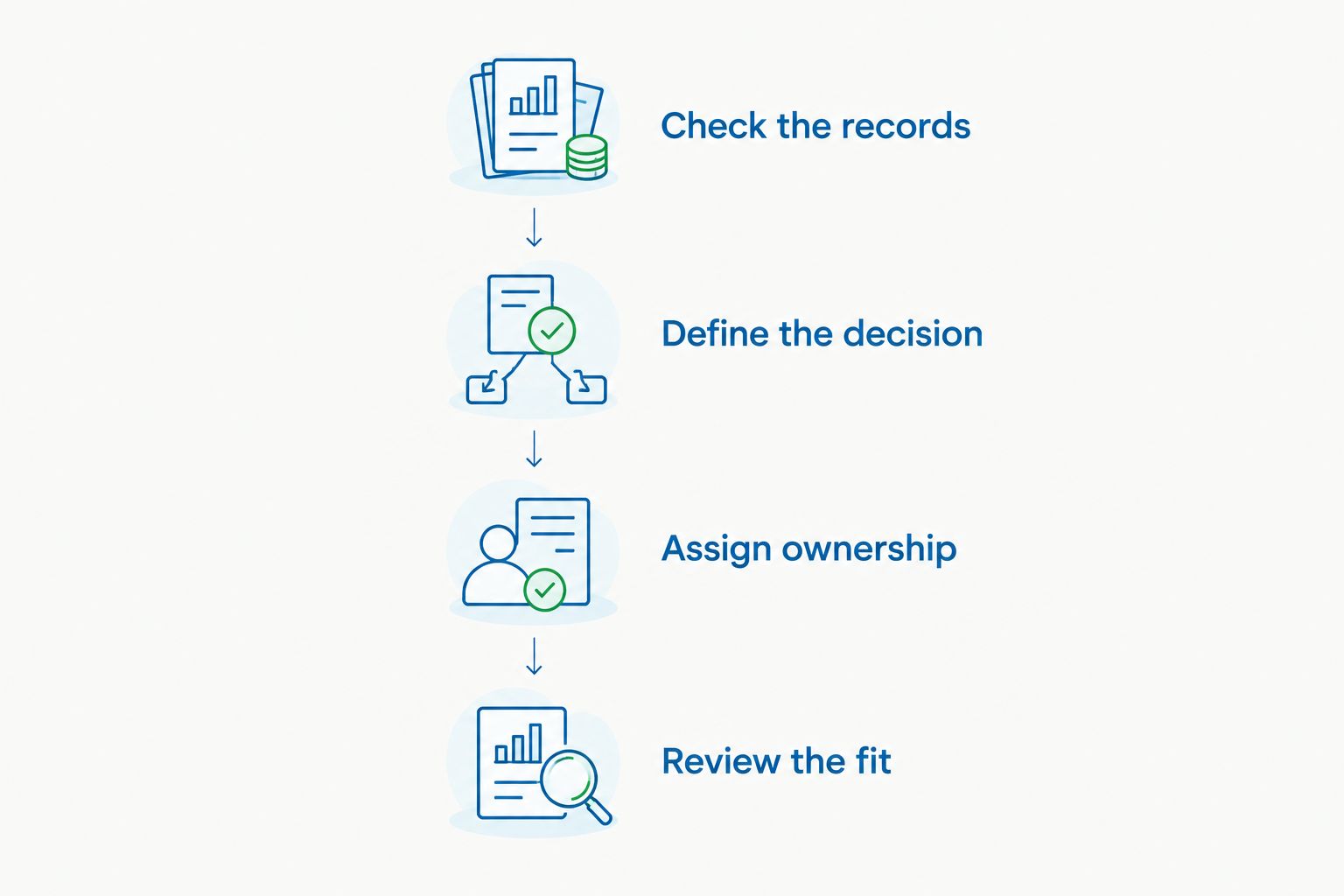
1. Check the records
Can you rely on your bank reconciliations, receivables, payables and payroll information? If not, identify who will correct the records and maintain them afterwards.
Do not treat a new forecast as a substitute for this work. A detailed model built on incomplete information still starts from an unreliable position.
2. Define the decision
Write down the decision you cannot currently make with confidence. Be specific: whether to recruit, how to fund equipment, which service line needs attention or how to manage a cash shortfall.
If there is no strategic decision but recurring financial work is slipping, operational finance ownership deserves priority. If reporting is dependable but decisions remain unclear, senior advisory support is the more direct fit.
3. Assign ownership
List who prepares information, who checks it and who acts on it. Include your existing bookkeeper, accountant and internal team so responsibilities do not overlap or disappear between providers.
Keep approval authority separate from preparation. Outsourcing financial work does not remove the need for you to decide who can authorise payments or commit the business.
4. Review the fit
Agree how you will assess the arrangement before work begins. Review completed outputs, unresolved issues and whether the support has helped you make the decision named in your brief.
For example, set a 30-day review to check access, responsibilities and initial deliverables. This is a suggested review point, not a promise that a financial clean-up or strategic project will be complete within that period.
Can a business need both roles?
Yes. A business can need a part-time finance manager to maintain reporting and an outsourced CFO to interpret results and support major decisions.
That arrangement only works when the handover is clear. Specify when reports become available, which assumptions need checking and who resolves discrepancies before forecasts reach the owner or board.
Avoid paying different people to recreate the same report. Agree one reporting pack, named owners and a shared definition of each measure, particularly where operational systems and accounting records describe revenue or margins differently.
For a business without dependable bookkeeping, adding both senior roles is not the first task. Establish how transactions will be recorded and reconciled, then build reporting and advice on that foundation.
What should you compare in a 2026 proposal?
Compare deliverables and accountability before comparing job titles. A proposal that promises strategic support still needs to explain what you receive, what information it depends on and who will implement the resulting actions.
The same discipline applies when you compare fractional CFO services: separate recurring reporting, forecasting, decision support and implementation so that differences in scope remain visible. Treat fractional and outsourced as descriptions to clarify, not evidence that two proposals include identical work.
Ask each candidate to respond to the same brief:
Starting position: What records and processes will you review before relying on the numbers?
Deliverables: Which reports, forecasts and written recommendations are included?
Working relationship: Who attends meetings and answers questions between them?
Responsibilities: What stays with the owner, bookkeeper, accountant or internal team?
Boundaries: What work requires a separate agreement?
Continuity: How will records, assumptions and outstanding actions remain accessible?
Ask for examples of the format of proposed outputs, with confidential information removed. You need to understand how the work supports your decisions, not just recognise the headings in a service description.
What should the first reporting cycle include?
For a new arrangement in 2026, agree a reporting cycle that connects the current financial position to your next decision. Keep the pack focused enough that you can explain what changed and what action follows.
Consider requesting a 13-week cash flow forecast for near-term cash planning and a 12-month forecast for the broader business plan. These are suggested planning horizons, not requirements for every business; select the horizon that matches the decision.
A cash forecast and a profit forecast answer different questions. Cash planning tracks when money moves, while profit reporting follows the accounting treatment of income and expenses. Neither replaces the other.
Ask the person responsible to explain:
The opening position and whether it reconciles to the records.
Expected customer receipts and significant payments.
Assumptions about sales, staffing and operating commitments.
Differences between actual results and the previous forecast.
Decisions required, with a named owner for each action.
A report without an explanation leaves you to do the interpretation yourself. A recommendation without an accountable action owner leaves implementation unresolved.
Where does Daintree Consulting fit?
Daintree Consulting is best suited to Australian businesses seeking accounting and advisory support that scales with their financial complexity. Its stated services include bookkeeping and payroll, tax and BAS compliance, business advisory and outsourced CFO support.
That service range makes it relevant when your question crosses operational accounting and senior financial advice. It does not replace the need to agree which responsibilities your business is engaging the firm to perform.
When speaking with Daintree Consulting, bring your current reporting pack and the decision you need help making. Ask for a clear division between keeping the numbers dependable, interpreting them and acting on the advice.
FAQ
Is an outsourced CFO better than a part time finance manager?
An outsourced CFO is better for strategic financial decisions; a part-time finance manager is better for recurring financial operations. Choose according to the responsibilities you need covered, then confirm the individual's experience and agreed scope.
Can a part-time finance manager help with business strategy?
Yes, a part-time finance manager can help with strategy when their experience and scope support that work. Ask for specific responsibility for forecasts, scenario analysis and decision support rather than relying on the title.
Will an outsourced CFO handle my bookkeeping and payroll?
Bookkeeping and payroll are not automatically included in outsourced CFO support. Confirm who processes transactions, reconciles accounts and manages payroll before the engagement starts.
Do I need accurate accounts before hiring an outsourced CFO?
You need dependable financial information before relying on detailed analysis and forecasts. An outsourced CFO can help identify information problems, but responsibility for correcting and maintaining the records must be agreed.
Can I use a finance manager and an outsourced CFO together?
Yes, a finance manager and an outsourced CFO can cover different responsibilities within the same business. Define the reporting handover and decision-making responsibilities so work is not duplicated.
What should I ask before signing a financial support agreement?
Ask for named deliverables, responsibilities, access requirements and exclusions. Also agree how you will review the work and who owns the actions arising from reports and advice.
One last thing
Before signing a 2026 engagement, ask one question: Who turns the agreed recommendation into completed work? Financial advice, approval and implementation are separate responsibilities; naming an owner for each makes the arrangement clearer from the start.
Related guides
Talk to Daintree about your finance function
Our ex-Big 4 team gives clear, senior-reviewed advice so you can act with confidence.
Book a free consultation →
Or explore our outsourced CFO services.
