
Is a trust structure better than a company for small business tax?
A trust structure is not automatically better than a company for small business tax in Australia. A discretionary trust can offer flexibility when distributing income to eligible beneficiaries, while a company can suit a business retaining profits for growth. Your result depends on who receives the income, how much stays in the business, and which tax rules apply—not simply the structure’s name.
TL;DR
Want expert help? Daintree Consulting's tax and BAS services can take this off your plate. Book a free consultation.
Is a trust structure better than a company for small business tax? Neither structure wins in every situation.
Discretionary trusts offer distribution flexibility, subject to the trust deed, beneficiary circumstances and anti-avoidance rules.
Companies can retain profits, but company tax is not necessarily the final tax paid by shareholders.
Daintree Consulting provides tax and business advisory services for Australian businesses assessing their structure.
Is a trust structure better than a company for small business tax?
A discretionary trust deserves consideration when lawful distributions and eventual asset sales matter; a company deserves consideration when retaining business profits matters. Neither advantage guarantees a lower overall tax bill.
Before choosing, compare the outcomes across the business and its owners. Daintree Consulting provides accounting and advisory support for Australian businesses making these decisions.
Issue | Discretionary trust | Company |
|---|---|---|
Best for | Owners needing flexibility over eligible income recipients | Owners wanting to retain profits in a separate entity |
Income tax | Beneficiaries are generally assessed on their share; trustee tax can apply | Company pays tax on its taxable income |
Retaining profits | Undistributed income generally attracts tax at the highest individual marginal rate | Profits can remain after company tax |
Paying owners | Distributions require valid entitlements and correct administration | Salary, dividends and loans have different tax consequences |
Capital gains | Eligible gains can qualify for the CGT discount | Companies cannot use the general CGT discount |
Main limitation | Distribution flexibility comes with rules and administration | Extracting profits can create further personal tax |
This comparison concerns an ordinary Australian private company and a discretionary trust. A unit trust has different ownership and entitlement arrangements, so do not apply discretionary-trust assumptions to every trust.
Why this matters
A structure that produces a lower tax payment inside the business can still leave its owners worse off after withdrawals. Compare the combined result, including personal tax, rather than stopping at the entity’s tax return.
For a 2026 structure review, separate your operating needs from your household spending needs. If you withdraw the business’s earnings to live on, retaining profits at company tax rates offers a different benefit from leaving those earnings invested in the business.
Also distinguish tax efficiency from legal protection. A tax comparison does not establish whether your contracts, guarantees, insurance or asset ownership arrangements protect you adequately.
Discretionary trust: distribution flexibility with conditions
A discretionary trust allows its trustee to decide which eligible beneficiaries receive income, within the trust deed and tax law. That can help when beneficiaries have different financial circumstances, but it is not permission to allocate income on paper without considering who benefits.
Adult beneficiaries generally include their share of taxable trust income in their own tax returns. Their other income, deductions and residency affect the result. Distributions to minors are subject to special rules, so children are not a simple route to lower family tax.
Best for: owners whose eligible beneficiaries have genuinely different income needs and whose arrangements support valid distributions.
The limitation is administration. The trustee must follow the deed, make effective distribution decisions within the applicable deadlines and maintain records that support those decisions. A distribution can also create a tax liability for a beneficiary before that person receives cash.
Ask your adviser to distinguish trust accounting income, taxable income and cash. These amounts are not always identical. A bank balance alone does not tell you what can be distributed or who must pay tax.
For 2026 planning, review the Australian Taxation Office’s guidance on trust distributions and section 100A reimbursement agreements. An arrangement involving one beneficiary’s entitlement and someone else enjoying the benefit needs careful assessment.
Company: retained profits and separate ownership
An eligible base rate entity pays 25% company tax; other companies generally pay 30%. The Australian Taxation Office’s company tax rates guidance sets out the eligibility tests, including aggregated turnover below $50 million and no more than 80% base rate entity passive income.
Do not assume every small company qualifies for the lower rate. Connected entities, affiliates and the nature of the company’s income can affect eligibility.
Best for: owners who expect to leave profits in the business to fund operations or expansion.
The benefit is that after-tax profits can remain in the company. The limitation appears when owners need that money personally: a company’s bank account is not the shareholder’s personal account.
Salary and wages bring payroll and reporting obligations. Dividends have their own tax treatment, and franking credits can recognise company tax already paid. A shareholder’s final position depends on personal circumstances; company tax is not automatically the final tax on business earnings.
Loans and payments to shareholders or their associates also require attention. Division 7A can treat certain private company payments, loans or forgiven debts as dividends unless an exception or compliant arrangement applies.
Why the tax outcome varies
The strongest comparison uses the same business assumptions for both structures. Change the assumptions midway and the apparent winner tells you little.
Profit withdrawals: Money required for household spending needs a different analysis from money retained for business use.
Beneficiary circumstances: Other income, residency and eligibility under the deed affect the outcome of trust distributions.
Income type: Trading income, capital gains and personal services income do not necessarily follow the same rules.
Future ownership: Bringing in investors or selling part of the business changes the questions a structure must answer.
Administration: Distribution decisions, payroll, company records and tax compliance create different responsibilities.
Existing assets: Moving an established business can trigger tax, duty and contractual consequences that a fresh-start comparison misses.
These factors also explain why another owner’s structure is a poor template. Similar turnover does not mean similar taxable income, cash requirements or exit plans.
How do you compare a trust and a company properly?
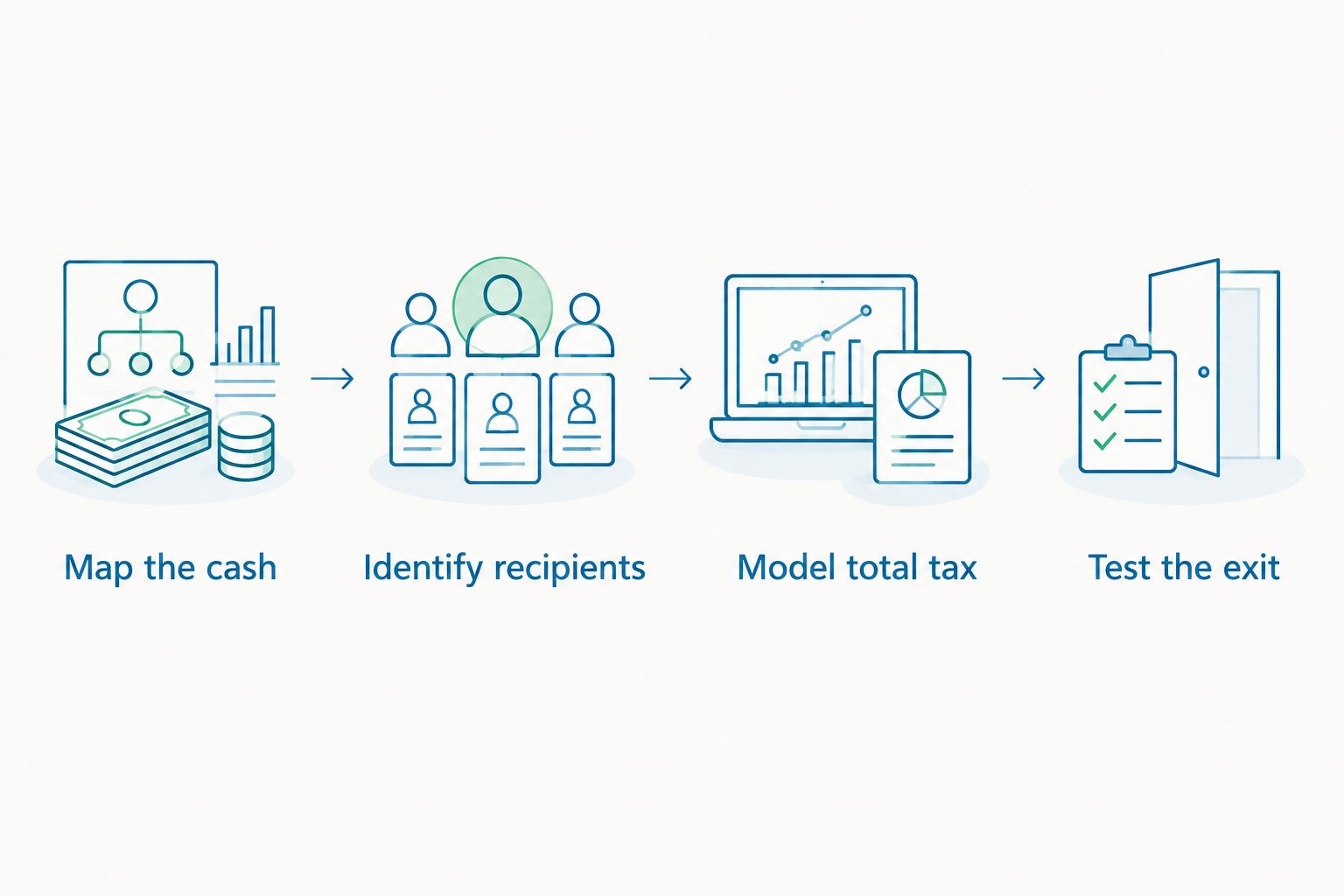
Use a written comparison rather than a recommendation based only on a headline tax rate. The useful output is a clear picture of where the money goes, who pays tax and what remains available to spend.
01. Map the cash
Separate expected business earnings from the amount you need personally. Identify working capital requirements, planned investment and obligations that need funding before owners withdraw money.
Keep profit and cash flow separate. A profitable business can still have cash tied up in debtors, stock or equipment.
02. Identify recipients
For a trust, identify eligible beneficiaries and their circumstances. For a company, identify shareholders and how owners expect to receive remuneration or distributions.
Do not assume an owner can redirect income freely after the event. Legal entitlements and the character of each payment matter.
03. Model total tax
Compare entity tax and recipient tax together. Include the treatment of retained earnings, dividends, trust distributions and relevant offsets rather than comparing only the first tax payment.
For a 2026 decision, use the tax rules and personal circumstances applicable to the relevant income year. Reusing an old calculation without updating those inputs undermines the comparison.
04. Test the exit
Consider an eventual business sale, asset sale, succession or change in ownership. A structure that fits current cash flow can produce a different result when you sell.
Ask for the assumptions in writing. You should be able to see why the recommended structure fits your plans and what would make that recommendation change.
Does a trust get a capital gains tax advantage?
A 50% CGT discount can apply to eligible trust capital gains where the relevant asset has been held for at least 12 months, subject to the applicable conditions. Companies cannot claim the general CGT discount.
That difference matters, but it does not make a trust the automatic choice for every trading business. The asset being sold, the beneficiary receiving the gain, residency and the trust’s records all affect the outcome.
An asset sale and a share sale are not interchangeable. In a company structure, a shareholder selling shares faces a different analysis from the company selling its business assets.
The small business CGT concessions are separate from the general discount and have their own eligibility tests. For a 2026 exit review, assess both rather than assuming either structure automatically qualifies.
Can you use a trust to split personal services income?
A trust does not switch off the personal services income rules. These rules can attribute income mainly generated by an individual’s personal efforts or skills back to that individual, depending on the circumstances.
This is particularly relevant when the business earns income from an owner’s expertise rather than a broader business operation. Using a company instead does not, by itself, remove the issue.
Ask for a personal services income assessment before relying on income splitting or retained company profits in your comparison. The Australian Taxation Office’s personal services income guidance explains the tests; your contracts and actual working arrangements determine how they apply.
Is a company trustee the same as trading through a company?
A corporate trustee is a company acting as trustee of a trust. That does not turn the trust’s business income into ordinary company trading income taxed at the company rate.
Keep the roles separate: the trustee administers the trust, while the trust arrangement determines beneficial entitlements. The company also has its own registration and record-keeping obligations.
Do not accept a structure recommendation until you can identify which entity signs contracts, owns assets and earns income. This distinction prevents a common misunderstanding in trust-versus-company discussions.
When should you keep your existing structure?
Keep the existing structure under consideration when it still fits your ownership, cash flow and risk arrangements. A theoretical tax improvement is not enough to justify a change.
Transferring assets or a business can have CGT, GST, duty, finance and contract consequences. Restructure concessions or rollovers can apply in qualifying circumstances, but eligibility needs checking before implementation.
Daintree Consulting’s accounting and advisory services include tax, compliance and business advice. That combination is relevant when a structure decision affects both your tax position and the way your business operates.
For a 2026 review, ask for a written explanation of the change, its consequences and the ongoing obligations. The recommendation should address your business, not just a tax rate.
FAQ
Is a trust always more tax effective than a company?
No. A trust can provide distribution flexibility, while a company can suit retained profits. Compare total tax across the business and its owners, including how money is withdrawn.
Does every small business company pay 25% tax?
No. The 25% rate applies to eligible base rate entities; other companies generally pay 30%. Aggregated turnover and the proportion of base rate entity passive income form part of the eligibility tests.
Can I leave profits in a discretionary trust?
A discretionary trust can retain income, but undistributed income generally attracts trustee tax at the highest individual marginal rate. Retention therefore needs a different analysis from leaving after-tax earnings in a company.
Can a trust distribute business income to my children?
A trust can distribute to children if the deed permits it, but special tax rules apply to minors. Do not assume a child's ordinary individual tax thresholds apply to a trust distribution.
Does a company trustee mean the trust pays company tax?
No. A company acting as trustee does not make the trust's income ordinary company trading income. Tax depends on the trust arrangements, beneficiary entitlements and applicable trustee assessment rules.
Can I change from a company to a trust later?
A business can change its structure, but transferring operations or assets can trigger tax, duty and contractual consequences. Check any available concessions and obtain advice before making transfers.
One last thing
A tax distribution and a cash payment are not necessarily the same event. Before approving trust distributions, establish who will owe tax and where the cash to pay it will come from.
Daintree Consulting provides tax and business advisory support for Australian businesses that need these decisions considered together. Bring your forecast, ownership details and personal cash requirements to the discussion—not just last year’s tax return.
This article provides general Australian tax information, not advice tailored to your circumstances. Confirm the applicable rules before establishing or changing a structure.
Related guides
Talk to Daintree about your tax and BAS
Our ex-Big 4 team gives clear, senior-reviewed advice so you can act with confidence.
Book a free consultation →
Or explore our tax and BAS services.
