
Is a company structure better than a sole trader for tax?
A company structure is not automatically better than a sole trader for tax in Australia in 2026: the result depends on your taxable profit, how much you withdraw and whether you can retain earnings in the business. A company’s tax rate does not necessarily represent your final tax bill, because salary and dividends can create personal tax obligations and company losses generally stay within the company.
TL;DR
Want expert help? Daintree Consulting's tax and BAS services can take this off your plate. Book a free consultation.
Is a company structure better than a sole trader for tax? Not automatically; retained profits and personal withdrawals matter.
Eligible base rate entity companies pay 25% tax; other companies generally pay 30%.
Sole traders pay individual income tax on business profit, including profit left in the business.
Daintree Consulting provides accounting, tax and advisory services for Australian businesses considering their structure.
Why this matters
Compare the total tax outcome, not just the company tax rate. Money retained by a company and money available for your household spending are different things. A structure that helps fund business growth does not necessarily reduce tax when you withdraw all the earnings.
Daintree Consulting’s accounting and advisory services cover tax compliance and business advice. The useful starting point is a comparison of your current structure against a company using the same profit, drawings and reinvestment assumptions.
For a 2026 decision, separate three questions: what the business earns, what you need personally and what the business needs to keep.
Is a company structure better than a sole trader for tax?
A company can provide a tax-timing advantage when it retains eligible business profits for reinvestment. A sole trader can be more suitable when profits are modest, simplicity matters or the owner needs most earnings for personal spending.
Neither structure wins in every situation. The comparison below separates the potential benefit from the limitation.
Question | Sole trader | Company |
|---|---|---|
Who pays tax on business profit? | You pay individual income tax on net business income. | The company pays tax on its taxable income. |
What happens to retained profit? | Leaving money in the business does not defer your income tax. | Profit can remain in the company after company tax, subject to applicable rules. |
How do personal withdrawals work? | Drawings are not a separate tax deduction or salary. | Salary, dividends and loans have different tax consequences. |
What is the main benefit? | A simpler structure, with access to individual tax thresholds. | Separation of company earnings from the timing of some personal distributions. |
What is the main limitation? | Business profit adds to your other taxable income. | Company tax is not necessarily the final tax on money distributed to you. |
Best for | Owners prioritising simplicity and direct access to earnings. | Owners retaining profits who can manage additional obligations. |
The deciding question is often whether you can leave profits in the business—not whether you can register a company. Incorporating without changing how you use the earnings does not establish a tax benefit.
Sole trader: individual tax rates apply
As a sole trader, you report net business income in your individual tax return. You pay tax on profit, not on the amount you transfer from the business bank account to your personal account.
Australian resident individuals generally have an $18,200 tax-free threshold. For the income year ending 30 June 2026, the resident marginal rate is 30% on taxable income from $45,001 to $135,000, before the Medicare levy and other adjustments.
A marginal rate applies only to income within that bracket. It is not the rate applied to every dollar you earn, so comparing your highest marginal rate directly with a company’s flat rate can mislead you.
Other income matters too. Employment income, investment income and net business income generally contribute to your individual taxable income, subject to the relevant rules.
Advantage: you use the individual tax thresholds and avoid a separate company income tax return.
Limitation: keeping cash for business expansion does not remove the underlying profit from your individual tax calculation.
Best for: owners whose financial needs and business complexity support a straightforward structure.
Drawings do not reduce taxable profit. Paying yourself less from the business account does not, by itself, reduce sole trader income tax.
Company: 25% for eligible base rate entities
An eligible base rate entity company pays a 25% company tax rate. Under Australian Taxation Office rules, eligibility generally requires aggregated turnover below $50 million and no more than 80% of assessable income to be base rate entity passive income.
Aggregated turnover includes relevant connected entities and affiliates; it is not always the turnover shown in one company’s accounts. Passive-income rules also require attention where a company receives investment income.
The 25% rate applies to the company’s taxable income. It is not a personal tax rate available simply because you invoice through a company.
Advantage: eligible profits retained after company tax can remain available for business purposes.
Limitation: taking those profits out can create additional personal tax consequences.
Best for: owners with genuine capacity to retain earnings and a business reason for using a company.
For a 2026 structure review, confirm eligibility before applying the lower company rate to a forecast. Do not assume every small company qualifies.
Company: 30% where the lower rate does not apply
Companies that do not qualify for the lower rate generally pay 30% company tax. That difference changes the retained-profit comparison and must be included before deciding to incorporate.
A company’s activities and income mix matter, not just its size. A business with substantial passive income needs a different assessment from a company earning predominantly active trading income.
Advantage: the company remains a separate taxpayer, with its own income and obligations.
Limitation: the general company rate provides less retained-profit tax deferral than the lower rate.
Best for: businesses with commercial reasons for a company structure, even where the lower rate is unavailable.
Choose the structure first for the full business position, then confirm the applicable tax treatment. A company is not a tax-saving product with a guaranteed outcome.
Why the tax outcome varies
The Australian Taxation Office’s company-rate and individual-rate rules provide the framework. Your circumstances determine how those rules interact.
Taxable profit: turnover alone does not show the income available after deductible business expenses.
Personal withdrawals: needing most earnings for household spending reduces the relevance of retaining company profits.
Other income: employment and investment income can change a sole trader’s marginal tax position.
Company eligibility: aggregated turnover and passive income determine access to the lower company rate.
Income attribution: personal services income rules can limit the expected benefit of earning through a company.
Losses and obligations: loss restrictions, reporting requirements and the work involved in maintaining the structure affect the overall decision.
These factors belong in the same assessment. Looking only at taxable profit leaves out how you access the money and what obligations the structure creates.
How do you compare the structures properly?
Use a written comparison rather than a turnover rule of thumb. Follow this sequence so the company and sole trader calculations answer the same question.
Business profit: estimate taxable business income after allowable deductions, keeping personal drawings separate.
Personal needs: identify the cash you need for household spending and other personal commitments.
Retained earnings: identify what can genuinely remain in the business for working capital or investment.
Tax treatment: assess individual tax, company tax, distributions, personal services income and relevant loss rules.
Structure review: consider administration, asset transfers, contracts and commercial risks before making a change.
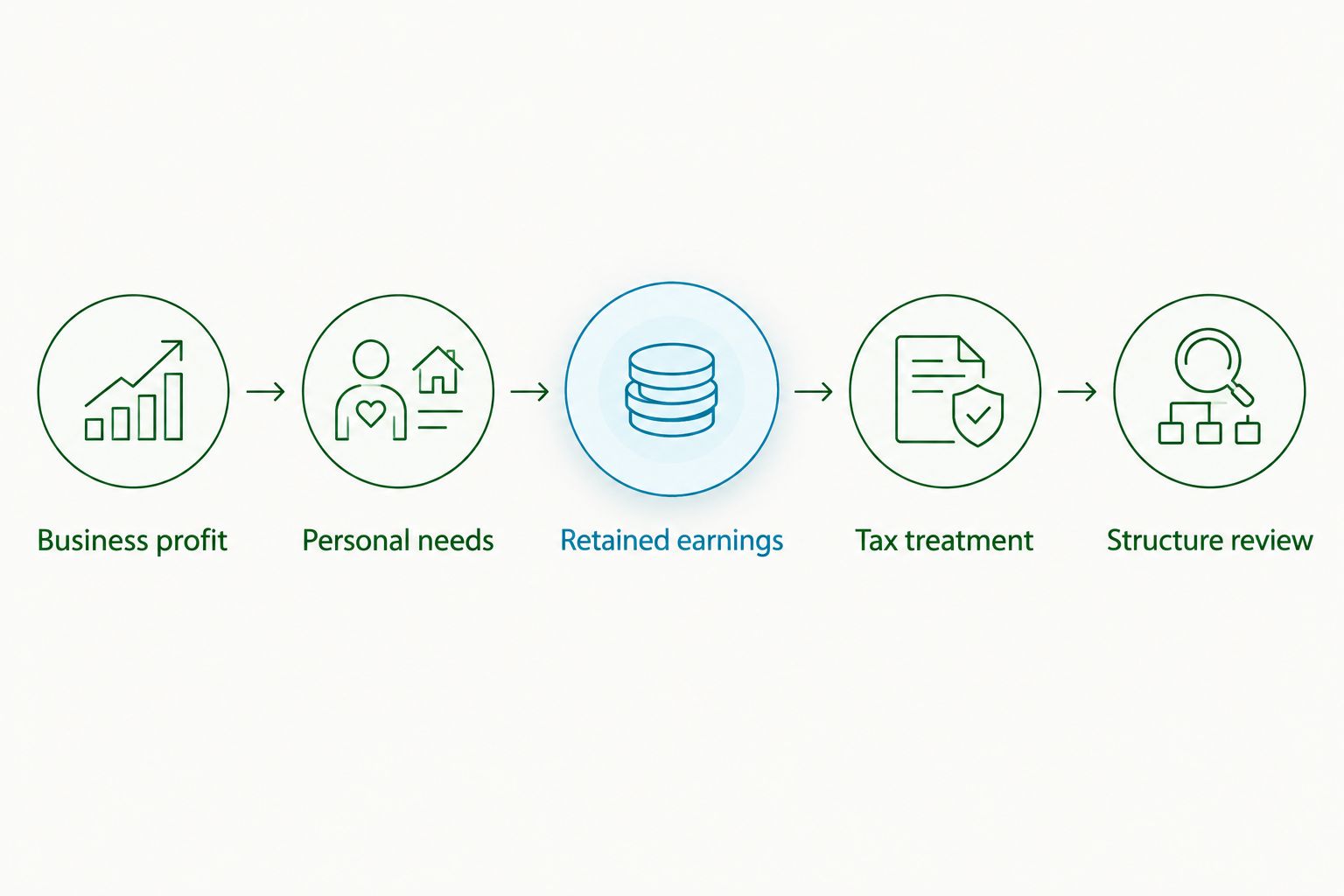
For your 2026 comparison, ask for the position both while profits remain in the company and when those profits reach you personally. This distinguishes a timing benefit from a permanent reduction in tax.
Daintree Consulting suits Australian business owners who need tax advice alongside accounting and business advisory. Ask for a structure assessment that connects the tax calculation to cash flow and your plans for the business.
Review your business structure
Compare tax treatment, personal cash needs and retained earnings before changing your structure.
Do you pay tax twice when a company pays dividends?
Company tax and personal tax are connected through Australia’s dividend imputation system. A franked dividend generally includes a credit for eligible company tax already paid, which the shareholder accounts for in their individual tax return.
Depending on the shareholder’s circumstances, additional tax can be payable, or an eligible excess franking credit can produce a refund. Unfranked dividends do not carry that company-tax credit.
The practical lesson is simple: include the shareholder’s outcome in the comparison. The company tax payment alone does not tell you the total tax on distributed earnings.
Can you take company money as drawings?
A company’s money is not automatically your personal money, even when you are its only shareholder and director. Transfers need an appropriate treatment, such as salary, dividends, expense reimbursement or a properly documented loan.
Division 7A can treat certain payments, loans or forgiven debts involving private companies and shareholders or their associates as unfranked dividends. Informal transfers therefore need attention before they become a tax problem.
Sole trader drawings work differently: transferring your own business funds does not create a deductible wage expense. Keeping that distinction clear prevents a misleading comparison between the structures.
Does incorporating protect personal services income from individual tax?
Incorporating does not, by itself, prevent personal services income from being attributed to the individual who earns it. The personal services income rules examine income mainly generated by an individual’s personal efforts or skills and include tests and exceptions.
This matters for consultants and other owner-operated service businesses. Check the rules before assuming that invoicing through a company allows you to retain income at the company tax rate.
A company can still have commercial purposes. Those purposes should be assessed separately from any tax treatment that the personal services income rules restrict.
FAQ
Is a company structure better than a sole trader for tax in 2026?
A company structure is not automatically better than a sole trader for tax in 2026. Compare taxable profit, personal withdrawals, retained earnings and any rules that attribute company income to you.
What tax rate does a small Australian company pay?
An eligible base rate entity company pays 25% company tax; other companies generally pay 30%. Eligibility depends on aggregated turnover and the proportion of base rate entity passive income, not simply whether the business calls itself small.
Do sole traders pay tax on money left in the business?
Sole traders pay individual income tax on net business income, including profit left in the business. Moving less money to a personal account does not reduce taxable profit.
Does a sole trader get a tax-free threshold?
Australian resident sole traders generally have an $18,200 individual tax-free threshold. That threshold applies to total taxable income, not separately to business income and other earnings.
Does the Medicare levy affect this comparison?
The Medicare levy is generally 2% of an individual’s taxable income, subject to applicable reductions and exemptions. Include it where relevant rather than comparing company tax with individual income tax alone.
Can company losses reduce my salary income?
Company losses generally remain in the company rather than reducing the shareholder’s salary income. Sole trader business losses also face restrictions, including the non-commercial loss rules, so immediate personal deductions are not automatic.
Can Daintree Consulting help me compare business structures?
Daintree Consulting provides tax, accounting and business advisory services for Australian businesses. A useful structure assessment considers personal cash needs, retained profits and compliance obligations together.
One last thing
Paying yourself less is not the same as earning less taxable income. For a sole trader, drawings do not determine taxable profit; for a company owner, leaving earnings in the company does not make those earnings available for unrestricted personal spending.
Before changing structure in 2026, write down what you intend to do with the profit. That single distinction—retain it for the business or use it personally—makes the tax comparison much clearer.
Related guides
Talk to Daintree about your tax and BAS
Our ex-Big 4 team gives clear, senior-reviewed advice so you can act with confidence.
Book a free consultation →
Or explore our tax and BAS services.
