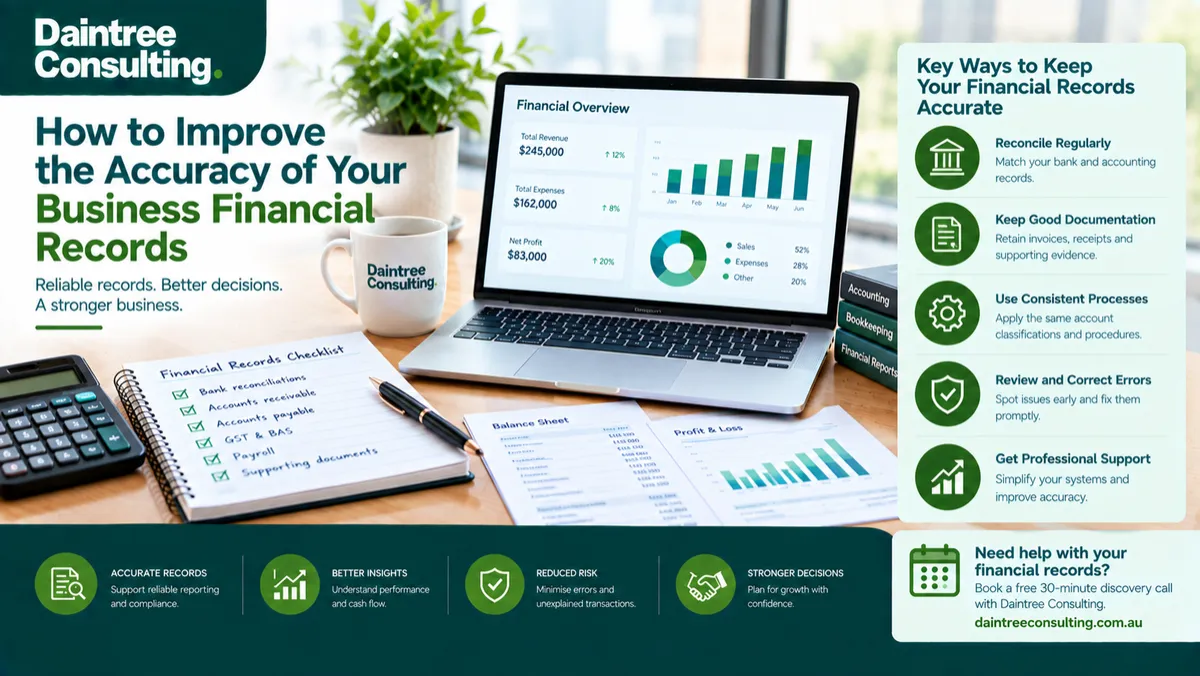
How to Improve the Accuracy of Your Business Financial Records
Accurate financial records are the foundation of good business management.
If your accounting records contain missing transactions, unreconciled balances, duplicated entries or incorrectly classified expenses, it becomes much harder to understand how your business is actually performing.
Want expert help? Daintree Consulting's accounting services can take this off your plate. Book a free consultation.
You may still be able to produce a profit and loss statement or balance sheet, but the numbers may not provide the level of confidence you need to make important decisions.
This is why maintaining accurate financial records should be an ongoing business priority rather than something that only receives attention at tax time.
Reliable records can support better financial reporting, clearer cash-flow visibility, easier compliance and more informed decisions about growth, hiring, investment and spending.
In this guide, we look at practical ways Australian businesses can improve the accuracy of their financial records and identify problems before they become more difficult to fix.
Quick Answer: How Do You Improve Financial Record Accuracy?
Businesses can improve the accuracy of their financial records by:
Reconciling bank and credit-card accounts regularly
Keeping bookkeeping up to date
Recording transactions promptly
Using consistent account classifications
Reviewing accounts receivable and payable
Checking payroll-related balances
Keeping supporting documentation
Reviewing unusual transactions
Correcting errors promptly
Restricting inappropriate accounting-system access
Performing regular month-end reviews
Separating personal and business transactions
Keeping financial records organised
Reviewing financial reports for unexpected movements
Establishing clear ownership of finance processes
The right process depends on the size and complexity of the business, but the principle is straightforward: financial information is only useful when the underlying records are reliable.
Why Accurate Financial Records Matter
Business owners often focus on revenue, profit and cash in the bank.
Those figures matter, but they are only as reliable as the records behind them.
Accurate financial records can help you understand:
How much the business is earning
What the business is spending
Which areas are profitable
What customers owe
What the business owes suppliers
How much cash is available
Whether expenses are increasing
Whether margins are changing
Whether the business is tracking against its budget
Whether financial obligations are being recorded appropriately
Reliable records can also make it easier for your accountant or adviser to provide useful support.
When records are incomplete or inconsistent, more time can be spent correcting historical information instead of analysing what the numbers mean.
1. Keep Your Bookkeeping Up to Date
One of the simplest ways to improve financial accuracy is to avoid letting bookkeeping fall behind.
When transactions are recorded weeks or months after they occur, several problems can develop.
You may:
Forget why a transaction occurred
Lose supporting documents
Miss an invoice
Record a transaction twice
Misclassify an expense
Carry errors into later reporting periods
Keeping records current makes it easier to identify problems while the information is still fresh.
The appropriate bookkeeping frequency depends on the business.
Some businesses may benefit from weekly processing, while others may use a different schedule.
The important point is that the process should be consistent and frequent enough to provide useful financial information.
2. Reconcile Bank Accounts Regularly
Bank reconciliation is one of the most important checks for financial record accuracy.
The accounting records should be compared with the relevant bank statements to identify differences.
A reconciliation can help uncover:
Missing transactions
Duplicate entries
Incorrect amounts
Unrecorded fees
Incorrect dates
Unusual transactions
Unexplained differences
Do not simply make an adjustment to force the balances to agree.
The purpose of reconciliation is to understand why the difference exists.
Regular reconciliations also make month-end reporting more reliable.
3. Reconcile Credit Cards and Other Financial Accounts
Bank accounts are not the only accounts that need attention.
Depending on your business, you may also need to reconcile:
Business credit cards
Loan accounts
Payment platforms
Merchant accounts
Clearing accounts
Investment accounts
Other financial accounts
If these accounts are not reconciled, errors can remain hidden in the financial records.
A business can therefore have an apparently accurate bank balance while other parts of the accounting system remain incorrect.
4. Separate Business and Personal Transactions
Mixing personal and business spending can make financial records significantly harder to maintain.
Ideally, business expenses should be paid from appropriate business accounts and personal expenses should remain separate.
When transactions are mixed together, it becomes more difficult to determine:
What is a business expense
What is a personal transaction
What should be recorded in the accounts
What supporting evidence relates to each transaction
Separate accounts and clear transaction practices can make reconciliation and reporting easier.
5. Use Consistent Account Classifications
A transaction can be recorded correctly in terms of amount but still be classified incorrectly.
For example, an expense may be posted to the wrong account or a capital purchase may be treated as an ordinary operating expense.
Over time, inconsistent classifications can distort financial reports.
Establish clear accounting practices for common transactions and apply them consistently.
If you are unsure how a transaction should be treated, obtain appropriate accounting advice rather than repeatedly guessing.
6. Keep Supporting Documentation
Financial records should be supported by appropriate evidence.
Depending on the transaction, this could include:
Supplier invoices
Customer invoices
Receipts
Contracts
Bank statements
Payroll records
Expense claims
Loan documentation
Asset purchase records
Other relevant correspondence
Good documentation makes it easier to understand why a transaction was recorded and provides an audit trail when information needs to be reviewed later.
It also reduces the need to reconstruct financial history from memory.
7. Review Accounts Receivable
Accounts receivable represents money owed to the business.
It is important to make sure the receivables ledger reflects what customers actually owe.
Regularly review:
Outstanding invoices
Overdue accounts
Credit notes
Customer payments
Bad or doubtful debts where relevant
Unusual balances
If an invoice has already been paid but remains outstanding in the accounting system, your financial reports may overstate receivables.
Regular review can help identify these discrepancies.
8. Review Accounts Payable
The same principle applies to money the business owes suppliers.
Review:
Outstanding supplier invoices
Payments made
Duplicate invoices
Credit notes
Unusual balances
Old outstanding amounts
Accurate accounts payable records help provide a clearer picture of the business's obligations.
They can also support better cash-flow planning.
9. Review Payroll Records
Payroll can create a range of accounting balances that need to be recorded accurately.
Depending on your business, these may include:
Wages
Superannuation
PAYG withholding
Leave balances
Payroll-related liabilities
Other employee-related costs
Payroll records should be appropriately reconciled with the accounting system.
Errors can become more difficult to resolve when they accumulate over several pay periods.
10. Review GST and BAS-Related Records
For GST-registered businesses, the accounting records need to support the relevant activity statement reporting.
This means businesses should pay attention to:
GST on sales
GST on eligible purchases
BAS-related accounts
Tax invoices and supporting records
Reconciliations
Adjustments
The appropriate GST treatment depends on the transaction and the business's circumstances.
If records are incomplete, correcting the issue later can take considerably more time.
Maintaining accurate records throughout the reporting period creates a stronger foundation for BAS preparation.
11. Perform a Regular Month-End Review
A month-end review is an opportunity to check whether the financial records make sense before management relies on them.
Depending on the business, the review may include:
Bank reconciliations
Accounts receivable
Accounts payable
Payroll
GST-related balances
Loan accounts
Fixed assets
Accruals
Prepayments
Revenue
Major expenses
The objective is not necessarily to perform a full financial audit every month.
It is to identify obvious errors, unusual movements and unresolved items while they are still relatively easy to investigate.
12. Investigate Unusual Movements
Financial reports can sometimes reveal problems that are not obvious from individual transactions.
For example:
Rent suddenly increases
Gross margin falls
Payroll costs jump
Accounts receivable grows quickly
A supplier balance becomes unusually large
A particular expense category changes significantly
Do not automatically assume the number is wrong.
Instead, investigate the movement.
It may have a legitimate explanation.
But reviewing unusual movements is a useful way to identify errors that ordinary transaction processing may not reveal.
13. Review Your Chart of Accounts
As a business grows, its chart of accounts can become cluttered.
You may end up with:
Duplicate expense categories
Old accounts that are no longer used
Inconsistent naming
Too many unnecessary categories
Transactions being posted to different accounts for similar purposes
A periodic review can help simplify financial reporting.
The objective should be to have enough detail to make useful decisions without creating unnecessary complexity.
14. Establish Clear Responsibilities
Financial record accuracy should not depend on one person simply remembering to do everything.
Establish clear responsibility for:
Recording transactions
Reconciling accounts
Reviewing reports
Approving payments
Maintaining documentation
Following up outstanding balances
Preparing information for the accountant
In larger businesses, appropriate separation of responsibilities can also help strengthen financial controls.
In smaller businesses, owner or management review can provide an additional layer of oversight.
15. Limit Accounting-System Access
Not everyone in the organisation needs unrestricted access to financial systems.
Review user permissions periodically.
Ask:
Who can create or edit transactions?
Who can approve payments?
Who can change supplier information?
Who can access payroll information?
Who has administrator privileges?
Do former employees still have access?
Appropriate system permissions can reduce the risk of unauthorised changes and make accountability clearer.
16. Record Transactions Promptly
Timing matters.
The longer a transaction sits unrecorded, the greater the chance that it will be forgotten or incorrectly entered later.
Prompt processing is particularly important for:
Sales invoices
Supplier invoices
Customer payments
Supplier payments
Payroll
Asset purchases
Loan transactions
Investment transactions
A consistent process for capturing transactions can significantly improve the quality of financial reporting.
17. Keep an Eye on Suspense and Clearing Accounts
Suspense and clearing accounts can be useful in certain accounting processes.
The problem arises when balances remain there indefinitely without explanation.
If an account is designed to temporarily hold transactions, establish a process for reviewing and clearing it.
Old unexplained balances can indicate that transactions have not been correctly processed.
18. Review Fixed Asset Records
If your business owns equipment, vehicles, technology or other significant assets, maintain appropriate fixed asset records.
Review:
New asset purchases
Asset disposals
Depreciation
Asset locations where relevant
Supporting purchase documents
Financing arrangements
This can help ensure that the accounting records reflect the business's actual asset position.
19. Compare Actual Results With Your Budget
Financial accuracy is not just about checking whether transactions were entered correctly.
It is also about using financial reports to identify unexpected results.
Comparing actual results with your budget can highlight:
Unexpected expense increases
Revenue shortfalls
Margin changes
Higher staffing costs
Cash-flow pressure
Changes in business activity
A significant variance does not automatically indicate an accounting error.
However, it provides a reason to investigate.
20. Correct Errors Promptly
If you discover an error, deal with it rather than allowing it to roll into future periods.
The appropriate correction depends on the nature of the error and the accounting circumstances.
Keeping a record of significant corrections can also help identify recurring process problems.
For example, if the same expense is repeatedly classified incorrectly, the problem may not be the individual transaction.
The underlying process may need to be improved.
21. Review Your Financial Reports Regularly
Business owners should not wait until tax time to look at their financial reports.
Regular review can help identify problems earlier.
Useful reports may include:
Profit and loss
Balance sheet
Cash-flow reports
Accounts receivable ageing
Accounts payable ageing
Budget versus actual
Key performance indicators
The appropriate reporting frequency depends on the size and needs of the business.
The important point is that financial reports should be reviewed while there is still time to act on the information.
22. Use Accounting Software Properly
Modern accounting platforms can automate parts of the bookkeeping and reconciliation process.
However, automation does not eliminate the need for review.
Bank feeds, automated rules and integrations can reduce manual data entry, but transactions can still be incorrectly classified or duplicated.
Businesses should establish appropriate review procedures around their accounting software rather than assuming that an automated system is automatically accurate.
23. Perform a Periodic Financial Health Check
Even if your monthly bookkeeping appears to be working, a broader periodic review can be valuable.
Look at:
Revenue trends
Gross margins
Operating expenses
Working capital
Cash flow
Debt
Outstanding receivables
Supplier balances
Major asset balances
Key financial ratios
This can identify issues that may not be obvious from individual monthly transactions.
What Happens When Financial Records Are Inaccurate?
Inaccurate records can create problems well beyond bookkeeping.
Poor decision-making
If management is relying on incorrect numbers, decisions about hiring, pricing, investment and expansion may be based on the wrong information.
Weak cash-flow visibility
Incorrect receivables, payables or cash balances can make it harder to understand upcoming cash requirements.
Reporting problems
Management accounts and financial reports may not accurately reflect business performance.
More difficult tax and BAS preparation
Incomplete records can increase the work required to prepare and review tax-related reporting.
Difficulties during audits or due diligence
Investors, lenders, auditors or other external parties may require additional explanations and supporting documentation.
More expensive accounting work
When records need to be reconstructed or corrected later, professional accounting time can increase.
The cost of maintaining good records is often easier to manage than the cost of fixing significant historical problems.
Signs Your Financial Records May Need Attention
Your business may benefit from a financial-record review if:
Bank reconciliations are regularly behind
Financial reports contain unexplained movements
The balance sheet has old unresolved balances
Receivables do not match what customers actually owe
Supplier accounts contain unexplained amounts
Payroll balances do not reconcile
Personal and business transactions are mixed
Supporting documents are difficult to locate
The business owner does not trust the reports
The accountant regularly needs to make significant adjustments
Management reports are consistently produced late
These signs do not necessarily mean your accounting system is fundamentally broken.
They may simply indicate that the current process needs attention.
A Practical Financial Records Accuracy Checklist
Every week or regularly
Record new transactions
Process invoices
Capture receipts
Review customer payments
Review supplier invoices
Keep supporting documents organised
During reconciliation
Reconcile bank accounts
Reconcile credit cards
Review payment-platform balances
Investigate differences
Check for duplicate transactions
At month-end
Review the balance sheet
Review profit and loss
Check receivables
Check payables
Review payroll balances
Review GST-related accounts
Investigate unusual movements
Review outstanding items
Periodically
Review the chart of accounts
Review system access
Check fixed asset records
Review internal controls
Compare actual results with budget
Review financial reporting processes
When Should You Consider Professional Accounting Support?
Some businesses reach a point where maintaining accurate records becomes difficult alongside day-to-day operations.
This can happen when:
Transaction volumes increase
The business hires more employees
Multiple entities are involved
The business expands
Management needs monthly reporting
Cash-flow visibility becomes more important
The existing bookkeeping process is unreliable
Historical records need cleaning up
The owner is spending too much time on finance administration
Professional accounting support can help establish a more structured process and provide management with clearer financial information.
How Daintree Consulting Can Help
Daintree Consulting provides accounting support designed to give Australian businesses more reliable financial information and clearer visibility over performance.
Depending on your requirements, support can include:
Financial record review
Bank and balance-sheet reconciliations
Management accounts
Budget-to-actual reporting
Cash-flow reporting
Financial dashboards
Fixed-asset and ledger oversight
Coordination with bookkeeping
Historical financial clean-up
Accounting process improvements
Daintree can also work alongside an existing bookkeeper or internal finance team rather than requiring the business to replace everything.
The focus is on creating a connected finance function that gives business owners better information for decision-making.
Final Thoughts
Improving the accuracy of your financial records is not simply about making your accountant's job easier.
Reliable records give you a clearer view of how your business is performing.
They can help you understand cash flow, identify changes in profitability, monitor expenses, prepare financial reports and make decisions with greater confidence.
The most effective approach is consistent rather than reactive.
Keep bookkeeping up to date.
Reconcile accounts.
Keep supporting documents.
Review unusual movements.
Correct errors promptly.
Make responsibilities clear.
And regularly review whether your financial processes still suit the size and complexity of your business.
If you cannot confidently explain what your financial reports are telling you, it may be time to look more closely at the records behind them.
Want More Confidence in Your Business Financial Records?
Daintree Consulting can help review your accounting processes, improve financial reporting and establish more reliable records for your business.
Book a free 30-minute discovery call to discuss your current financial processes and where they could be improved.
Frequently Asked Questions
Why are accurate financial records important for a business?
Accurate financial records help businesses understand revenue, expenses, profit, cash flow, assets and liabilities. They also provide a stronger foundation for financial reporting, tax-related work and business decision-making.
How can I make my business financial records more accurate?
Start with consistent bookkeeping, regular reconciliations, organised supporting documentation, clear transaction classifications and regular financial reviews. It is also important to investigate and correct errors promptly.
How often should business accounts be reconciled?
The appropriate frequency depends on the business's transaction volume, size and financial processes. Regular reconciliation is important because it allows discrepancies to be identified while they are easier to investigate.
What causes inaccurate financial records?
Common causes include delayed bookkeeping, missing documentation, duplicate transactions, incorrect classifications, unreconciled accounts, mixed personal and business transactions and unclear responsibility for financial processes.
Should small businesses reconcile their bank accounts?
Yes. Bank reconciliation is a useful control for businesses of all sizes. The process can help identify missing, duplicated or incorrectly recorded transactions.
Can inaccurate financial records affect cash flow?
Yes. If receivables, payables, expenses or cash balances are inaccurate, management may have an incomplete or misleading view of the business's cash position.
How do accurate financial records help with business decisions?
Reliable financial information gives management a clearer view of profitability, expenses, margins, cash flow and financial obligations. This can support decisions about pricing, staffing, investment, growth and cost management.
When should a business consider professional accounting support?
Professional support may be useful when financial records are consistently behind, reports cannot be trusted, transaction volumes increase, the business needs better management reporting or the owner is spending too much time managing accounting tasks.
Can Daintree Consulting help improve financial record accuracy?
Daintree Consulting can support Australian businesses with reconciliations, management accounts, financial reporting, cash-flow reporting, ledger oversight, bookkeeping coordination and historical financial clean-up, depending on the agreed scope.
Talk to Daintree about your accounting
Our ex-Big 4 team gives clear, senior-reviewed advice so you can act with confidence.
Book a free consultation →
Or explore our accounting services.
