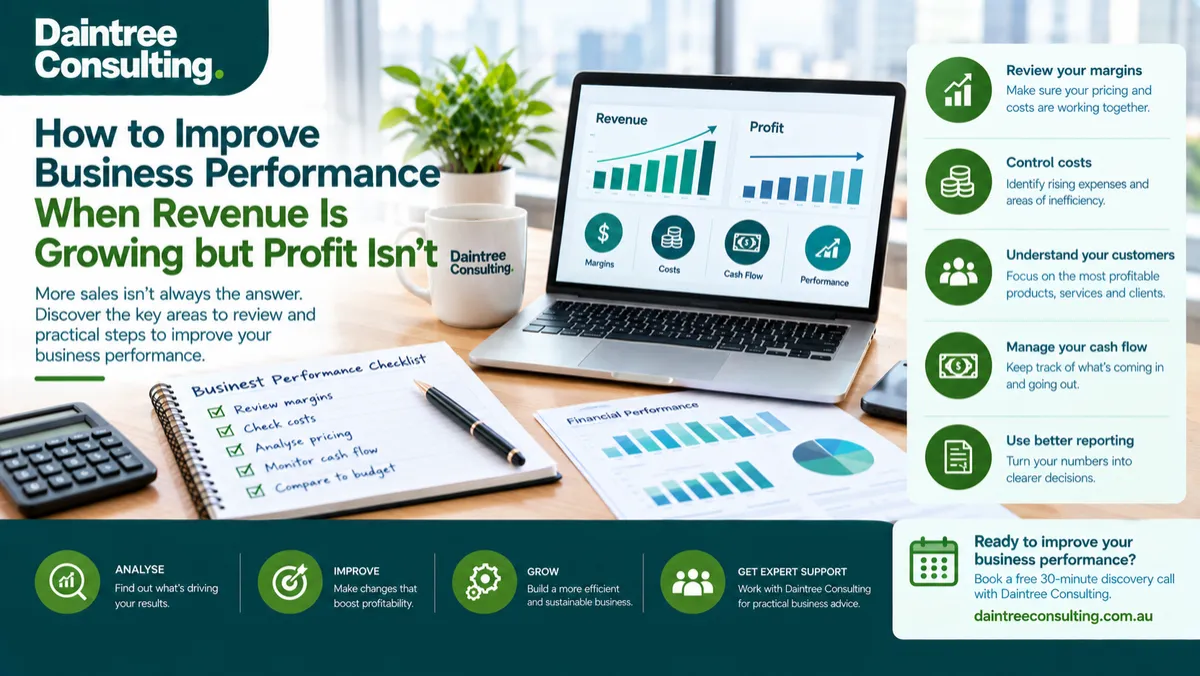
How to Improve Business Performance When Revenue Is Growing but Profit Isn’t
Growing revenue is usually a positive sign. More customers, more sales and a larger turnover can make a business look healthier from the outside.
But what happens when revenue keeps increasing and profit barely moves?
Want expert help? Daintree Consulting's business advisory services can take this off your plate. Book a free consultation.
This is a situation many Australian business owners eventually face. The business is busier, the team is working harder, sales are up, and yet there is not enough additional profit left at the end of the month.
When that happens, the answer is rarely as simple as “sell more”.
The real issue may be rising costs, shrinking margins, inefficient operations, pricing problems, poor cash-flow visibility, unprofitable customers or a lack of reliable financial reporting.
Improving business performance means looking beyond revenue and understanding what is actually driving profitability.
In this guide, we explain why revenue can grow without profit improving, what financial indicators to review and practical steps you can take to improve business performance.
Quick Answer: Why Is Revenue Growing but Profit Isn’t?
If revenue is increasing but profit is not, your business may be experiencing one or more of the following:
Costs are increasing faster than revenue
Gross profit margins are declining
Prices have not kept pace with rising costs
Some products or services are less profitable than others
Customer acquisition or delivery costs are too high
Payroll and overheads have increased
The business is taking on more low-margin work
Operational inefficiencies are reducing profitability
Discounts or pricing concessions are reducing margins
Financial reports are not being reviewed frequently enough
Cash-flow problems are limiting business decisions
Revenue growth is creating additional working-capital requirements
The first step is not necessarily to increase sales.
It is to understand where the additional revenue is going.
That is where a structured approach to business performance improvement becomes important.
Revenue Growth Does Not Automatically Mean Better Performance
Revenue tells you how much your business has sold.
Profit tells you what remains after the costs involved in generating that revenue are taken into account.
Those are very different measures.
Imagine a business increases annual revenue from $2 million to $2.5 million.
On the surface, that looks like strong growth.
But if the business had to increase staffing, subcontractor costs, marketing, rent, software, freight and other operating expenses significantly to generate the extra $500,000, the additional revenue may have produced very little additional profit.
This creates a common business trap:
More sales → more activity → more costs → little improvement in profit.
The business may be growing in size without becoming more financially efficient.
That is why business performance should be assessed using more than revenue alone.
1. Start by Looking at Gross Profit Margin
One of the first numbers to investigate is your gross profit margin.
Gross profit generally represents revenue less the direct costs associated with delivering the products or services.
For example, if your business generates $1 million in revenue and has $600,000 in direct costs, the gross profit is $400,000.
That gives you a gross profit margin of 40%.
If revenue increases but the gross margin falls, the business may need significantly more sales to generate the same level of profit.
For example:
Revenue increases by 20%
Direct costs increase by 30%
Gross profit increases only slightly
That is a warning sign.
It can indicate that the business is growing through lower-margin sales or that the cost of delivering the work has increased.
What can cause margins to fall?
Common causes include:
Supplier price increases
Higher wages or contractor costs
Increased freight or delivery costs
Excessive discounting
Pricing that has not been reviewed
Increased production costs
More complex customer requirements
More time required to deliver each job
Changes in product or service mix
A business performance improvement strategy should identify which of these factors is affecting your margins.
2. Review Profitability by Product or Service
Not every sale contributes equally to your bottom line.
A business may have several products, services or customer segments, but revenue reports can make them all look equally attractive.
They are not.
One service might generate strong revenue with a healthy margin, while another requires significantly more labour and resources for relatively little profit.
If you only look at total revenue, you may continue investing in the least profitable part of the business.
Instead, consider asking:
Which products generate the strongest margins?
Which services require the most staff time?
Which customers are most profitable?
Which jobs regularly exceed budget?
Which services generate frequent rework?
Which products have the highest direct costs?
Where are discounts reducing profitability?
Which customers require disproportionate support?
This type of analysis can reveal opportunities to improve performance without necessarily increasing total sales.
3. Check Whether Your Pricing Still Makes Sense
Pricing is one of the most important levers for profitability.
Yet many businesses review pricing less frequently than they should.
Costs change.
Wages change.
Supplier prices change.
Software subscriptions increase.
Insurance, rent, transport and other overheads can rise.
If your prices remain unchanged while your costs increase, your margin can gradually disappear.
This is particularly important for service businesses that price work based on historical rates or fixed fees.
A price that was profitable two years ago may no longer provide the same return today.
Questions to ask about pricing
Consider:
When did you last review your prices?
Have your direct costs changed?
Are you charging for the actual time required to deliver the work?
Are discounts being applied consistently?
Are customers accepting your current pricing?
Are some services underpriced compared with the value and resources involved?
Are price increases being communicated clearly?
Improving business performance does not always mean cutting costs.
Sometimes the better solution is to ensure the business is properly pricing the work it already performs.
4. Look Closely at Payroll and Staffing Costs
Payroll is often one of the largest expenses for a growing business.
Hiring additional employees can be necessary as revenue grows, but increased headcount should ultimately support the business's ability to deliver work, serve customers and generate sustainable profit.
Problems can occur when staffing increases ahead of profitable demand.
For example, a business may hire additional employees because revenue is increasing, but the additional revenue may not be sufficient to cover the full cost of those employees.
This does not automatically mean the employees are unnecessary.
Instead, examine:
Revenue per employee
Labour cost as a percentage of revenue
Utilisation
Overtime
Contractor costs
Rework
Unproductive time
Administrative workload
Capacity versus actual demand
The objective is not simply to reduce payroll.
It is to understand whether your people, time and resources are being used effectively.
5. Separate Growth Costs From Waste
Not every increase in expenses is a problem.
Some expenses are investments in future growth.
Marketing, technology, additional staff, equipment and systems may all increase costs while helping the business expand.
The important question is whether the additional spending is producing an appropriate commercial return.
This is where business owners need to distinguish between:
Growth investment and avoidable inefficiency.
For example, investing in a new system that reduces manual administration may increase costs initially but improve efficiency over time.
On the other hand, paying for unused software subscriptions, carrying excess inventory or repeatedly correcting avoidable errors may represent unnecessary costs.
Rather than cutting expenses across the board, review the reason behind each major cost.
Ask:
What is this expense helping the business achieve?
If the answer is unclear, it may deserve closer attention.
6. Improve Your Financial Reporting
Business performance improvement becomes difficult when financial information arrives too late.
If you only review your financial position at tax time, you may discover profitability problems months after they started.
Business owners need timely information that helps answer questions such as:
Are we on track against budget?
Are margins improving or declining?
Which costs are increasing?
How is cash flow tracking?
Are sales converting into profit?
Which areas are underperforming?
Are we generating enough cash to support growth?
Regular management reporting can turn accounting information into something much more useful for decision-making.
Depending on the business, useful reporting may include:
Profit and loss reports
Balance sheet reports
Cash-flow reporting
Budget-to-actual comparisons
Gross margin analysis
Key performance indicators
Revenue by product or service
Debtor and creditor analysis
The exact reporting structure should reflect the size, complexity and needs of the business.
7. Compare Actual Results With the Budget
A budget is more useful when it becomes a management tool rather than a document prepared once a year.
Comparing actual results with your budget can help identify where performance is moving away from expectations.
For example, you may discover:
Revenue is above budget
Gross margin is below budget
Payroll is above budget
Marketing costs are above budget
Debtor days have increased
Operating expenses are rising faster than expected
The most important part is not identifying the variance.
It is understanding why it happened.
A $50,000 unfavourable expense variance might be concerning.
But if the additional expense supported a profitable expansion, the management response may be different from a $50,000 overspend caused by poor cost control.
Budget-to-actual reporting gives business owners a way to investigate these differences before they become larger problems.
8. Pay Attention to Cash Flow, Not Just Profit
A profitable business can still experience cash-flow pressure.
This can happen when money is tied up in:
Unpaid customer invoices
Inventory
Work in progress
Equipment purchases
Loan repayments
Tax obligations
Rapid expansion
This is particularly important when revenue is growing quickly.
Growth can require additional working capital before the business receives the cash from its customers.
For example, a business may win a significant new contract but need to hire staff, purchase materials and incur other costs before receiving payment.
Revenue has increased.
Profit may eventually increase.
But cash can still become tight in the meantime.
That is why business performance should be assessed across profitability, cash flow and balance-sheet position rather than revenue alone.
9. Identify the KPIs That Actually Matter
Not every business needs to track dozens of KPIs.
The goal is to identify a small number of measures that help management understand what is driving performance.
Depending on the business, useful KPIs might include:
Revenue growth
Gross profit margin
Net profit margin
Labour cost percentage
Average transaction value
Customer acquisition cost
Customer retention
Debtor days
Inventory turnover
Utilisation
Revenue per employee
Cash conversion
Recurring revenue
The right KPIs depend on your industry and business model.
A professional services firm will not necessarily use the same measures as a wholesaler, construction business or e-commerce company.
The key is to connect your KPIs to the decisions you actually need to make.
10. Find Out Where Profit Is Being Lost
When revenue is growing but profit is not, it can be useful to work backwards.
Start with revenue.
Then ask:
Where does the money go?
Look at the major stages of the business:
Revenue
↓
Direct costs
↓
Gross profit
↓
Operating expenses
↓
Operating profit
↓
Finance and other costs
↓
Net profit
This creates a clearer picture of where performance is being diluted.
For example, if revenue is growing but gross profit is falling, pricing or direct costs may be the issue.
If gross profit is healthy but net profit is falling, operating expenses may deserve closer attention.
If profit looks healthy but cash is consistently tight, working capital may be the bigger concern.
The objective is to identify the specific part of the financial model that needs attention.
11. Focus on Profitable Growth, Not Growth at Any Cost
Growth is valuable when it strengthens the business.
But pursuing revenue at any cost can create problems.
A business may accept every customer, every project and every opportunity because the sales numbers look attractive.
Over time, this can lead to:
Lower margins
Overworked employees
Poor customer service
Increased rework
Cash-flow pressure
Higher overheads
Operational complexity
Sometimes the best business performance improvement decision is to become more selective.
That could mean focusing on higher-margin services, reviewing pricing, improving customer selection or reducing work that consistently produces poor returns.
The objective is not simply to become bigger.
It is to become more commercially sustainable.
12. Improve the Connection Between Accounting and Decision-Making
Accounting information is most valuable when it helps management make better decisions.
If your accounting system produces reports but nobody uses them to manage the business, there is a missed opportunity.
Business owners should be able to look at their financial information and understand:
What happened?
Why did it happen?
What is likely to happen next?
What needs attention?
What decision should we make?
That requires more than historical bookkeeping.
It requires reliable records, useful reporting and regular review.
For some businesses, this may mean improving management accounts.
For others, it may mean introducing better dashboards, cash-flow reporting, forecasting or KPI tracking.
The appropriate approach depends on the business.
A Practical Business Performance Improvement Process
If your revenue is increasing but profit is not, you do not necessarily need to overhaul the entire business.
A structured review can help identify the biggest opportunities.
Step 1: Confirm the numbers
Make sure your accounting records are reconciled and up to date.
You cannot make good decisions from unreliable financial information.
Step 2: Review gross margins
Look at overall margins and, where practical, margins by product, service or customer segment.
Step 3: Analyse major expenses
Identify which costs have increased and why.
Step 4: Review pricing
Compare current prices with current delivery costs and required margins.
Step 5: Examine cash flow
Look at receivables, inventory, payment terms, tax obligations and other working-capital requirements.
Step 6: Compare actual results with expectations
Use budgets, forecasts and previous periods to identify meaningful variances.
Step 7: Select the right KPIs
Choose a manageable set of measures that directly support management decisions.
Step 8: Create an action plan
Prioritise the changes that are most likely to improve profitability or financial control.
Step 9: Review progress regularly
Business performance improvement is not a one-off exercise.
The business environment changes, so financial performance should be monitored continuously.
When Should You Get Help With Business Performance?
You may benefit from professional support if:
Revenue has grown but profit has remained flat
You are unsure which products or services are actually profitable
Your margins are declining
Costs are increasing faster than expected
Cash flow is becoming harder to manage
Financial reports arrive too late to be useful
You do not have reliable management accounts
You are making major decisions without clear financial information
Your business has become more complex as it has grown
You need a clearer budget or forecast
You want someone independent to challenge your assumptions
The value of an external adviser is not simply producing another report.
It is helping management understand what the numbers mean and what actions may be worth considering.
How Daintree Consulting Can Help Improve Business Performance
Daintree Consulting works with Australian businesses that need clearer financial information and more commercially useful decision-making support.
Business performance improvement may involve looking at profitability, cash flow, reporting, KPIs, budgeting and the financial drivers behind growth.
Depending on your needs, support can include:
Financial performance analysis
Profitability and margin review
Management reporting
Budget-to-actual analysis
Cash-flow review
KPI and dashboard development
Financial forecasting
Working-capital analysis
Strategic business planning
Ongoing business advisory support
The starting point is understanding where the business is today, what is driving its results and where management needs greater visibility.
Final Thoughts
Growing revenue is encouraging, but revenue alone does not tell you whether your business is becoming more profitable, efficient or financially sustainable.
If sales are increasing while profit is not, take a closer look at the numbers.
Review your margins.
Analyse your costs.
Check your pricing.
Understand which customers, products and services are contributing to profit.
Review cash flow.
Compare actual performance with your budget and forecasts.
Most importantly, make sure your financial reporting gives you information early enough to act.
Effective business performance improvement is not about chasing a single number. It is about understanding how revenue, margins, costs, cash flow and operational decisions work together.
When those pieces are connected, business owners have a much clearer basis for deciding where to invest, what to change and how to pursue sustainable growth.
Ready to Get a Clearer View of Your Business Performance?
If revenue is growing but your profit is not keeping pace, Daintree Consulting can help you examine the financial drivers behind your results and identify areas that may need attention.
Book a free 30-minute discovery call to discuss your business, current reporting and where you want to improve performance.
Frequently Asked Questions
Why is my business revenue increasing but profit decreasing?
Revenue can increase while profit decreases when direct costs, payroll, overheads or other expenses increase faster than sales. Declining margins, discounting and operational inefficiencies can also reduce profitability.
How can I improve business performance without increasing sales?
Improvement does not always require more revenue. Reviewing pricing, margins, customer profitability, costs, productivity, cash flow and operational efficiency can create opportunities to improve financial performance from existing revenue.
What financial reports should I review to improve business performance?
Depending on the business, useful reports can include profit and loss statements, balance sheets, cash-flow reports, budget-to-actual reports, KPI dashboards and profitability analysis.
How often should I review business performance?
There is no single frequency that suits every business, but growing businesses generally benefit from reviewing meaningful financial and operational indicators regularly rather than waiting until year-end. Monthly management reporting can provide a useful basis for many businesses.
Should I focus on revenue or profit?
Both matter, but they answer different questions. Revenue shows the sales generated by the business, while profit provides a clearer indication of what remains after costs. Sustainable growth generally requires attention to both.
What is business performance improvement?
Business performance improvement is the process of identifying and addressing the financial and operational factors affecting a business's results. It can involve profitability, pricing, costs, cash flow, reporting, KPIs, forecasting and business processes.
Can an accountant help improve business performance?
An accountant can provide financial information, reporting and analysis that supports better decision-making. Depending on the business's needs, a business adviser or outsourced CFO may also provide broader commercial analysis, forecasting and strategic financial support.
Talk to Daintree about your next business decision
Our ex-Big 4 team gives clear, senior-reviewed advice so you can act with confidence.
Book a free consultation →
Or explore our business advisory services.
