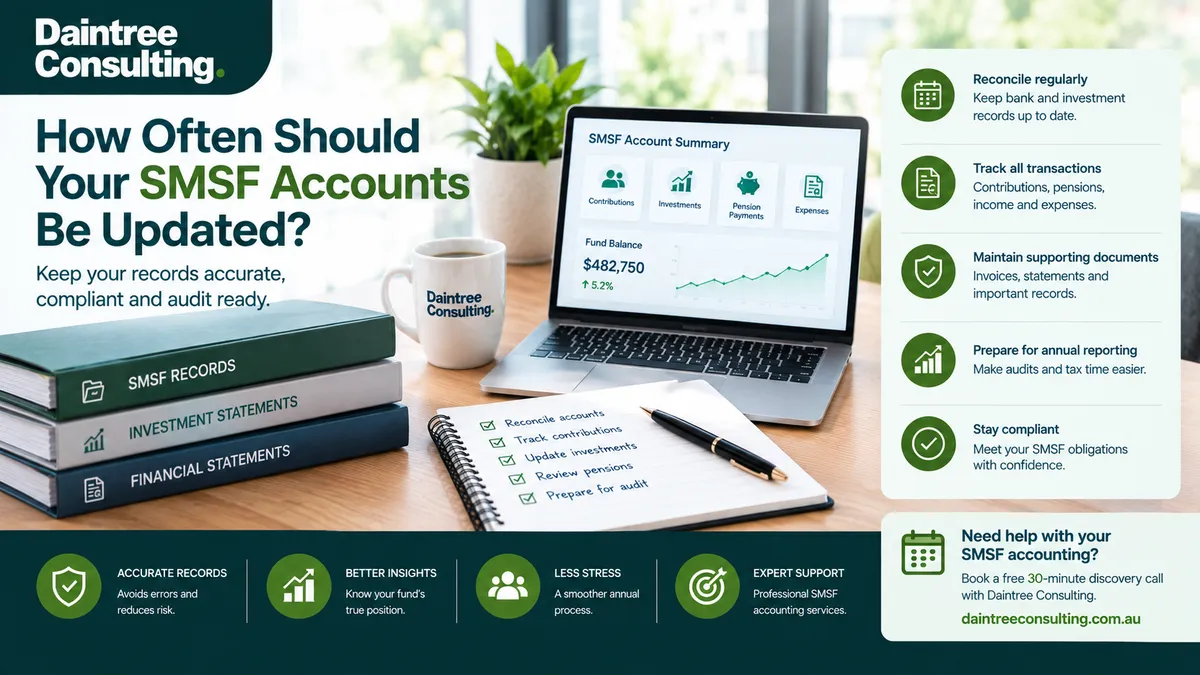
How Often Should Your SMSF Accounts Be Updated?
Managing a self-managed super fund is not simply a matter of checking the balance once a year and handing everything to an accountant at tax time.
For trustees, one of the more practical questions is: how often should SMSF accounts be updated?
Want expert help? Daintree Consulting's SMSF accounting services can take this off your plate. Book a free consultation.
The short answer is that there is no single rule requiring every SMSF to have its accounting records updated monthly or quarterly. However, your fund's records should be kept accurate, complete and accessible, and updated often enough to properly reflect transactions, contributions, investments, pension payments and other activity.
For some SMSFs, that may mean keeping records up to date throughout the year. For others, a structured periodic process may be appropriate, provided the fund's records and compliance obligations are properly managed.
The important point is that annual accounting should not mean annual record keeping.
Good SMSF accounting creates a much smoother path to annual financial statements, independent audit and annual return preparation.
Quick Answer: How Often Should SMSF Accounts Be Updated?
SMSF accounts should generally be updated regularly throughout the financial year, rather than leaving all transactions until year end.
The appropriate frequency depends on the fund's activity and complexity.
A relatively simple SMSF with limited transactions may be managed effectively through periodic updates, while a fund with frequent investment transactions, pension payments, property activity or other complex transactions may benefit from more frequent reconciliation and review.
The ATO requires SMSFs to maintain accurate and accessible accounting records that explain the fund's transactions and financial position. Certain records must be retained for at least five years, while other SMSF records have longer retention requirements.
Daintree Consulting's SMSF accounting service is structured around the fund's annual cycle, including transaction coding, investment reconciliation, contribution and pension tracking, financial statements and audit-file preparation.
Why Does the Frequency of SMSF Accounting Matter?
It can be tempting to think of SMSF accounting as an annual exercise:
Wait until 30 June → collect documents → prepare accounts → complete the audit → lodge the annual return.
That approach can create unnecessary problems.
An SMSF may have dozens or hundreds of transactions during a financial year. These could include:
Employer or personal contributions
Rollovers
Pension payments
Investment purchases
Investment sales
Dividends
Interest
Brokerage
Investment expenses
Property income
Property expenses
Related-party transactions
Insurance premiums
Tax payments
Administrative expenses
If these transactions are not captured and reconciled regularly, small discrepancies can accumulate.
By the time year end arrives, trustees may have forgotten why a transaction occurred, where supporting documents are located or how a particular payment should be classified.
That is when SMSF accounting becomes much more difficult.
Regular updates help create a cleaner audit trail and make the annual compliance process more predictable.
Is Monthly SMSF Accounting Required?
Not necessarily.
There is an important distinction between what is legally required and what is good accounting practice.
The ATO requires SMSF trustees to keep accurate and accessible accounting records that explain the fund's transactions and financial position. The ATO does not simply impose a universal rule saying every SMSF must have its accounts formally prepared every month.
That means monthly accounting is not automatically necessary for every fund.
However, monthly reconciliation can be useful where the SMSF has:
Frequent investment transactions
Multiple bank or investment accounts
Pension-phase members
SMSF property
Regular contributions
Complex investment structures
Multiple members
Significant transaction activity
Related-party transactions
A need for more frequent visibility over the fund
The more activity your fund has, the less practical it becomes to leave everything until the end of the financial year.
What Does Regular SMSF Accounting Actually Involve?
Updating SMSF accounts is more than entering transactions into accounting software.
A proper accounting process may involve several connected activities.
1. Bank reconciliation
The SMSF's bank transactions should be reconciled against the accounting records.
This helps identify:
Missing transactions
Duplicate entries
Unpresented items
Incorrect amounts
Unexplained payments
Unrecorded income
A reconciliation is particularly useful because the bank statement provides an independent record against which the accounting ledger can be checked.
2. Investment reconciliation
Investment records should also be kept current.
Depending on the fund's investments, this may involve checking:
Purchases
Sales
Dividends
Interest
Distributions
Brokerage
Investment expenses
Corporate actions
Investment balances
Ownership documentation
Daintree's SMSF accounting service specifically includes transaction coding and investment reconciliation as part of its service scope.
3. Contribution tracking
Contributions need to be correctly recorded and allocated to the relevant member.
This can become particularly important where there are multiple contribution types or different members making contributions during the year.
A regular accounting process allows trustees and their advisers to identify discrepancies earlier rather than discovering them when annual accounts are being prepared.
4. Pension payment tracking
For SMSFs paying pensions, keeping payment records organised is particularly important.
The fund needs appropriate documentation supporting benefit payments and the account from which the payment was made. The ATO identifies documentation relating to benefit payment types as part of the SMSF records that must be retained.
Regularly updating pension-related records can therefore help avoid a year-end scramble to reconstruct payments.
5. Expense recording
SMSFs incur administration, investment and other operating expenses.
These may include:
Accounting fees
Audit fees
Investment-related costs
Bank fees
Legal costs
Property expenses
Insurance
ASIC fees where applicable
The ATO recognises various SMSF operating, audit and tax-related expenses and explains that the treatment of expenses depends on the circumstances.
Keeping supporting invoices and other evidence organised as expenses arise makes the year-end accounting process considerably easier.
What Happens If You Only Update Your SMSF Accounts Once a Year?
For a very simple SMSF, periodic accounting may be manageable.
But leaving all accounting work until year end can create several problems.
1. Missing documents
You may struggle to locate an invoice, investment contract, contribution record or other supporting document months after the transaction occurred.
2. Unexplained transactions
A payment that was obvious six months ago may be difficult to identify later.
3. Reconciliation problems
Small errors can accumulate throughout the year and take considerably longer to investigate.
4. Delays to annual accounts
If the accounting records are incomplete, financial statements cannot simply be finalised immediately.
5. Audit questions
The independent SMSF auditor may require additional evidence or explanations if transactions are not properly supported.
6. Greater trustee workload
Instead of dealing with small accounting tasks periodically, trustees may face a large administrative exercise at year end.
7. Less visibility
You may not have a clear picture of the fund's accounting position until the annual accounts are prepared.
This is one reason Daintree's SMSF accounting process focuses on organised records, reconciliations and audit-file preparation rather than simply producing an annual set of accounts.
How Often Should You Reconcile an SMSF?
There is no one-size-fits-all answer.
A practical approach is to consider the fund's transaction volume and complexity.
Simple SMSF
A fund with relatively few investments and limited transactions may be suitable for periodic reconciliation, provided records remain accurate and complete.
Moderately active SMSF
A fund with regular contributions, investment income and transactions may benefit from monthly or similarly regular reconciliation.
Complex or highly active SMSF
A fund involving property, frequent investments, pension payments, multiple members or more complicated transactions may benefit from more frequent accounting and review.
The right frequency is ultimately about maintaining reliable records and meeting the fund's obligations—not following an arbitrary calendar.
What Should Be Updated During the Year?
A useful SMSF accounting process should capture more than the bank account.
Consider keeping the following information current.
Financial transactions
Record and reconcile:
Bank transactions
Investment income
Contributions
Rollovers
Pension payments
Expenses
Tax payments
Investments
Maintain appropriate records for:
Purchases
Sales
Dividends
Distributions
Interest
Brokerage
Investment balances
Supporting contracts and statements
Member accounts
Track relevant:
Contributions
Allocations
Benefit payments
Pension transactions
Member balances
Trustee documentation
Keep records of important trustee decisions and other required documentation.
The ATO's SMSF guidance notes that trustees have record-keeping responsibilities covering matters such as transactions, financial position, trustee decisions and other fund records.
What About SMSF Property?
SMSFs holding property generally require more attention than a fund with a small number of listed investments.
Property-related records may include:
Rental income
Property management fees
Repairs
Insurance
Council rates
Interest
Legal costs
Purchase documentation
Sale documentation
Loan records where applicable
Property valuation information
These transactions can create additional accounting and compliance considerations.
For that reason, an SMSF holding property may benefit from a more structured accounting process throughout the year rather than attempting to reconstruct everything at year end.
What About SMSFs Paying Pensions?
Pension-phase SMSFs can also require more careful tracking.
The accounting records need to properly reflect pension payments and member accounts, while trustees also need to meet their broader obligations.
The ATO emphasises that SMSF trustees must keep documentation showing decisions about benefit payment types and the account from which benefits were paid.
Regular accounting updates can make it easier to identify missing information before the annual reporting process begins.
Does Updating Accounts More Often Make an SMSF More Compliant?
Not automatically.
This is an important distinction.
Having monthly accounting records does not by itself guarantee that an SMSF is compliant.
Compliance depends on the fund's circumstances and whether trustees are meeting their obligations.
Regular accounting can, however, make it easier to identify and address problems earlier.
For example, regular reconciliation could reveal:
An incorrectly recorded contribution
An unexplained payment
Missing investment documentation
An incorrect member allocation
A transaction requiring further review
Missing supporting evidence
The earlier an issue is identified, the more opportunity there generally is to investigate it properly.
SMSF Accounting and the Annual Audit
Every SMSF generally needs an annual audit by an approved SMSF auditor. The ATO also states that the auditor must be appointed for each income year.
This is where well-maintained accounting records become particularly valuable.
A typical annual process may involve:
Transactions → Reconciliations → Financial statements → Audit file → Independent audit → Annual return
If the first two stages are incomplete, the later stages can become slower and more complicated.
Daintree's SMSF accounting service includes preparation of annual financial statements, organised records for the independent audit, contribution and pension tracking, year-end document preparation and coordination with the independent SMSF auditor and appropriately licensed advisers.
Importantly, accounting and audit are not necessarily the same role. Independence requirements apply, so the accounting and audit arrangements need to be structured appropriately.
How Long Do You Need to Keep SMSF Records?
Keeping records and updating records are two different responsibilities.
The ATO states that SMSFs must retain certain accounting and other records for specified periods.
For example, accurate and accessible accounting records explaining the fund's transactions and financial position must generally be kept for at least five years. Some other SMSF records have a 10-year retention requirement.
This is another reason not to treat record keeping as something that only matters at tax time.
Your SMSF should have an organised system for storing records throughout the fund's life.
A Practical SMSF Accounting Routine
If you're a trustee wondering how to keep your fund organised, consider a routine like this:
Throughout the year
Keep bank, investment, contribution, pension and expense documentation organised as transactions occur.
Regularly
Reconcile the fund's bank and investment records according to the fund's activity level.
When significant transactions occur
Document the transaction and retain the relevant supporting evidence rather than waiting until year end.
Before financial year end
Check that major accounts, investments, contributions, pensions and expenses have been captured.
After year end
Finalise the financial records and supporting documentation required for the annual accounts and audit.
Before the annual return
Resolve outstanding accounting or audit questions so the return can be prepared from complete information.
This approach is generally much more manageable than trying to reconstruct an entire year's activity in one exercise.
Signs Your SMSF Accounts May Not Be Updated Often Enough
You may want to review your current process if:
You cannot explain some transactions without searching through old emails.
Bank reconciliations are several months behind.
Investment records are incomplete.
Contribution information is difficult to locate.
Pension payments are not clearly documented.
Your accountant regularly has to chase missing records.
The annual audit repeatedly raises avoidable questions.
You spend weeks preparing information for year-end accounting.
You are unsure whether all investments are correctly reflected in the accounts.
Your fund's records depend heavily on one trustee remembering what happened.
These are not necessarily signs that something is wrong with the SMSF itself.
They may simply indicate that the accounting process needs better structure.
Should You Use an SMSF Accountant?
The answer depends on the complexity of your fund, your own knowledge and the amount of administration you are prepared to manage.
Some trustees are comfortable maintaining records themselves and engaging professionals for annual accounting and compliance.
Others prefer ongoing accounting and administration support so that records, reconciliations and documentation are kept organised throughout the year.
Professional SMSF accounting support can be particularly useful where:
The fund has become more active.
Investments have become more complex.
The fund has pension-phase members.
The SMSF owns property.
Trustees have limited time.
Records have fallen behind.
The annual audit process is becoming difficult.
Trustees want a clearer annual timetable.
Daintree Consulting provides SMSF accounting and administration support across the fund's annual cycle, including financial statements, transaction coding, investment reconciliation, contribution and pension tracking, year-end audit-file preparation and coordination with the independent auditor.
The Bottom Line
How often should your SMSF accounts be updated?
There is no universal requirement that every SMSF must have its accounts formally updated every month or quarter.
But your records should be accurate, complete, accessible and maintained throughout the year.
For a simple SMSF, periodic accounting may be sufficient. For a more active or complex fund, monthly or more frequent reconciliation may make sense.
The key is not simply frequency.
It is whether your accounting process allows you to:
Track transactions accurately
Reconcile bank and investment records
Monitor contributions and pensions
Retain supporting documentation
Prepare reliable annual financial statements
Respond efficiently to audit requirements
Meet annual reporting obligations
Good SMSF accounting should make the annual process easier—not create a once-a-year scramble.
Frequently Asked Questions
Do SMSF accounts need to be updated monthly?
Not necessarily. There is no universal requirement that every SMSF have its accounts formally updated monthly. The appropriate frequency depends on the fund's activity, complexity and record-keeping needs.
Can I do my SMSF accounting once a year?
Some trustees may use a periodic or annual accounting process, particularly where the fund has limited activity. However, waiting until year end can make reconciliations, document collection and transaction explanations more difficult.
How often should SMSF bank accounts be reconciled?
The appropriate frequency depends on the fund's transaction volume. More active SMSFs may benefit from monthly or more frequent reconciliation, while simpler funds may require less frequent processing.
Does an SMSF need an annual audit?
SMSFs generally need an annual audit by an approved SMSF auditor. The audit is an important part of the fund's annual compliance process.
How long do SMSF accounting records need to be kept?
Different records have different retention periods. Certain accounting records generally need to be kept for at least five years, while some SMSF records have 10-year retention requirements.
Can an SMSF accountant also perform the audit?
Not necessarily. Independence requirements apply to SMSF audits, so accounting and audit roles need to be structured appropriately. An independent approved SMSF auditor may be required.
What records should SMSF trustees keep?
Common records include bank and investment statements, contribution evidence, pension documentation, expense records, trustee decisions and other documents supporting the fund's transactions and financial position.
Need Help Keeping Your SMSF Accounts Organised?
SMSF accounting becomes much easier when the records, reconciliations and annual compliance process are structured from the beginning.
Daintree Consulting provides SMSF accounting and administration support for trustees who need organised records, annual financial statements, investment reconciliation, contribution and pension tracking and audit-file preparation.
If you're unsure whether your current SMSF accounting process is keeping up with the fund, book a free 30-minute discovery call with Daintree Consulting to discuss your records, annual timetable and accounting requirements.
Daintree Consulting – SMSF Accounting
Talk to Daintree about your SMSF accounts
Our ex-Big 4 team gives clear, senior-reviewed advice so you can act with confidence.
Book a free consultation →
Or explore our SMSF accounting services.
