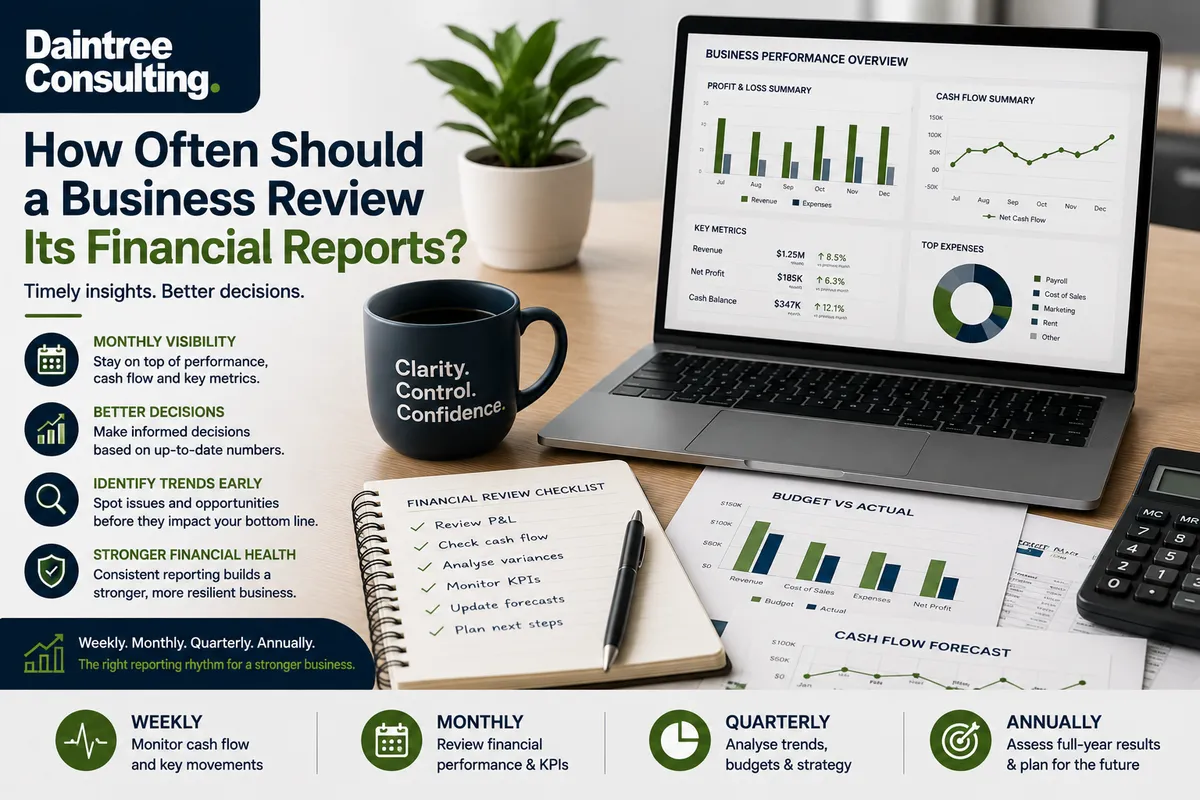
How Often Should a Business Review Its Financial Reports?
Many business owners receive financial reports regularly but do not always know how often they should actually review them.
Some businesses only look at their numbers when the accountant prepares the annual accounts. Others review financial reports every month, compare actual results against the budget and monitor cash flow throughout the year.
Want expert help? Daintree Consulting's accounting services can take this off your plate. Book a free consultation.
For most businesses, waiting until year-end is too late.
Financial reports are most valuable when they help you make decisions before a problem becomes expensive—or before an opportunity passes.
So, how often should a business review its financial reports?
The practical answer is:
Most businesses should review their key financial reports at least monthly, with more frequent monitoring for cash flow, payroll, sales or other areas that can change quickly.
The right frequency depends on the size, complexity and financial pressures of the business.
A small, stable business may be comfortable with monthly or quarterly management reporting. A growing business with tight cash flow, significant borrowing, multiple locations or rapid changes may need weekly cash-flow visibility and a more detailed monthly financial review.
This guide explains how often to review financial reports for business, which reports deserve the most attention and how to turn financial reporting into a practical management tool.
Quick Answer: How Often Should a Business Review Its Financial Reports?
For most businesses:
Monthly: Review core financial reports and business performance.
Quarterly: Conduct a deeper review of trends, budgets, KPIs and strategy.
Weekly: Monitor cash flow and other fast-moving indicators when necessary.
Annually: Review the full financial year, tax position, budgets and longer-term strategy.
The important point is that not every report needs to be reviewed at the same frequency.
For example, your annual financial statements are unlikely to need weekly review.
Your cash position might.
A useful reporting rhythm could look like this:
Weekly → Cash and immediate financial pressures
Monthly → Profitability, balance sheet, cash flow and performance
Quarterly → Trends, budgets, KPIs and strategic decisions
Annually → Full-year performance, tax, planning and future budgets
The objective is not to create more reports.
It is to make sure the right information reaches the right people at the right time.
Why Reviewing Financial Reports Regularly Matters
Financial reports tell you what is happening inside the business.
But their real value comes from what you do with the information.
A monthly report can help you identify:
Revenue changes
Rising expenses
Declining margins
Cash-flow pressure
Outstanding receivables
Increasing debt
Budget variances
Underperforming areas
Unexpected costs
Changes in working capital
Opportunities for investment or growth
Without regular reviews, these issues can remain hidden.
Imagine revenue has increased by 15% over six months.
At first glance, that sounds positive.
But suppose your gross margin has fallen, customers are taking longer to pay and operating expenses have increased faster than revenue.
The business may be growing—but becoming financially weaker.
A regular financial review helps you see the difference between growth on paper and sustainable performance.
Daintree Consulting describes timely management accounts and reporting as part of building clearer cash-flow and budget visibility and more confident business decisions.
Monthly Financial Reporting: The Best Starting Point for Most Businesses
For many Australian businesses, monthly financial reporting provides a useful balance between detail and practicality.
A monthly review gives management enough information to identify trends without creating an unnecessarily heavy reporting process.
At a minimum, consider reviewing:
1. Profit and Loss Statement
The profit and loss statement helps you understand how much the business earned and spent during a particular period.
Review:
Revenue
Cost of sales
Gross profit
Operating expenses
Net profit
Major changes from the previous period
Do not simply look at the bottom-line profit figure.
Ask:
Why did profit change?
If revenue increased but profit decreased, investigate the reason.
It could be:
Higher supplier costs
Increased wages
Discounting
Lower-margin sales
Higher marketing costs
New overheads
Pricing problems
The number tells you what happened.
The review should help you understand why.
2. Balance Sheet
The balance sheet is often overlooked by business owners who focus primarily on sales and profit.
That can be a mistake.
The balance sheet provides information about the business's financial position, including assets, liabilities and equity.
A monthly review can help identify changes in:
Cash
Accounts receivable
Inventory
Loans
Accounts payable
Fixed assets
Other liabilities
Owner or shareholder balances
A business can report a profit while experiencing significant cash pressure.
The balance sheet can help explain why.
For example, if sales are increasing but accounts receivable are also increasing rapidly, customers may not be paying quickly enough to support the growth.
3. Cash-Flow Report
For many business owners, cash flow deserves more frequent attention than the other financial reports.
Profit does not automatically mean cash is available.
Cash can be affected by:
Customer payment timing
Supplier payment terms
Inventory purchases
Loan repayments
Tax obligations
Capital expenditure
Payroll
Owner drawings
Business growth
If cash is tight, reviewing it only once a month may not be enough.
Some businesses benefit from a weekly cash-flow review, particularly when they have significant payment obligations or unpredictable cash movements.
The question is not simply:
"How much cash do we have today?"
It is:
"Will we have enough cash to meet our obligations over the coming weeks?"
4. Budget vs Actual Performance
A financial report becomes much more useful when you compare actual results with what you expected to happen.
This is where budget vs actual reporting becomes valuable.
For example:
You budgeted for $100,000 in monthly revenue.
Actual revenue is $90,000.
That is a $10,000 shortfall.
But the next question is more important:
Why?
Maybe:
Sales volume was lower than expected.
One major customer delayed an order.
Pricing changed.
A product line underperformed.
Seasonal demand was different.
The budget assumptions were unrealistic.
The same principle applies to expenses.
If wages were budgeted at $40,000 but actual wages were $48,000, you need to understand what caused the variance.
Regular variance analysis helps management identify issues while there is still time to respond.
Daintree's accounting service includes budget-to-actual and variance reporting as part of its management reporting support.
How Often Should a Small Business Review Its Financial Reports?
A small business may not need the same reporting frequency as a large or highly complex organisation.
However, small does not mean financial reporting is unimportant.
For many small businesses, a practical approach is:
Weekly
Monitor:
Bank balance
Upcoming payments
Major customer receipts
Payroll requirements
Tax obligations
Immediate cash-flow pressures
Monthly
Review:
Profit and loss
Balance sheet
Cash flow
Revenue
Gross margin
Major expenses
Accounts receivable
Accounts payable
Quarterly
Step back and review:
Business trends
Budget performance
KPIs
Pricing
Profitability
Working capital
Strategic priorities
This gives the owner a regular view of both short-term financial health and longer-term performance.
How Often Should a Growing Business Review Financial Reports?
Growth often increases the need for more frequent and better-quality reporting.
A business might start with simple bookkeeping and annual financial statements.
As it grows, that may no longer be enough.
You may need more regular reporting when:
Revenue is increasing quickly
Employee numbers are growing
You are opening new locations
You are taking on debt
You are investing heavily
Cash flow is becoming harder to predict
Multiple people are making financial decisions
You are considering outside investment
Management needs reliable forecasts
The owner can no longer keep track of everything personally
Daintree notes that management reporting can become particularly useful when reports arrive late, leaders spend too much time assembling financial information or growth has made the existing finance process fragile.
This is an important transition.
The reporting process that worked when the business had five employees may not work when it has fifty.
Should You Review Financial Reports Weekly?
Not necessarily.
Weekly reporting can be useful, but reviewing every financial statement every week may create unnecessary administration.
Instead, focus weekly attention on fast-moving information.
This may include:
Cash balance
Cash inflows
Cash outflows
Customer receipts
Large supplier payments
Payroll
Debt repayments
Major upcoming expenses
You may also monitor a small number of operational KPIs.
For example:
Weekly sales
Number of new customers
Average transaction value
Gross margin
Outstanding invoices
Project profitability
The purpose of weekly monitoring is not to replace monthly financial reporting.
It is to provide an early warning system.
When Should Financial Reports Be Reviewed Quarterly?
A quarterly review is useful for stepping away from individual transactions and looking at the bigger picture.
Ask:
Is the business moving in the right direction?
Look at revenue, profit, margins and cash flow over several months rather than focusing on one reporting period.
Are the original assumptions still realistic?
Your annual budget was based on assumptions.
Those assumptions can change.
Are costs increasing faster than revenue?
A growing cost base may eventually put pressure on profitability.
Is working capital under control?
Growth can consume cash if receivables and inventory increase faster than the business can fund them.
Are the current KPIs still useful?
As the business changes, the metrics that mattered six months ago may no longer provide enough insight.
Do you need to change the strategy?
Financial reporting should ultimately support business decisions.
A quarterly review can provide the opportunity to adjust pricing, staffing, investment, financing or growth plans.
What Should Be Included in a Monthly Financial Review?
A useful monthly financial review does not need to contain dozens of pages.
The reporting pack should reflect the decisions management needs to make.
A practical monthly review may include:
Financial performance
Revenue
Gross profit
Gross margin
Operating expenses
Net profit
Budget vs actual
Financial position
Cash
Receivables
Payables
Debt
Working capital
Major balance-sheet movements
Cash flow
Cash received
Cash spent
Expected receipts
Upcoming commitments
Short-term cash requirements
Business performance
Key operational KPIs
Customer or project performance
Product or service profitability
Major variances
Emerging risks
The exact reporting pack should be customised to the business.
Daintree's current accounting service includes monthly or periodic management accounts, balance-sheet and control-account reconciliations, budget-to-actual reporting, cash-flow reporting and financial dashboards.
How Long Should a Financial Report Review Take?
There is no universal answer.
A straightforward small business may be able to review its key numbers in under an hour.
A larger business may require a structured management meeting involving finance, operations and leadership.
The important thing is not the number of minutes.
It is whether the review answers useful questions.
A good financial review should answer:
What happened?
Why did it happen?
Is it different from what we expected?
Does it matter?
What should we do next?
If the meeting only involves reading numbers aloud, it is probably not providing enough value.
Don't Just Review the Numbers—Investigate the Variances
One of the most valuable habits a business can develop is asking why.
Suppose your monthly report shows:
Revenue down 8%
Marketing costs up 12%
Gross margin down 4%
Receivables up 20%
Those numbers are signals.
The review should investigate the underlying causes.
For example:
Revenue may have fallen because of seasonality.
Marketing may have increased because of a planned campaign.
Gross margin may have fallen because supplier prices increased.
Receivables may have increased because several large customers have not yet paid.
Once you understand the causes, you can decide whether action is required.
This is the difference between financial reporting and financial management.
How Often Should Business Owners Review KPIs?
KPIs can often be reviewed more frequently than formal financial reports.
The right frequency depends on the KPI.
For example:
Weekly KPIs
Sales
Leads
New customers
Cash collections
Average transaction value
Monthly KPIs
Gross margin
Net profit margin
Customer retention
Labour costs
Overheads
Accounts receivable days
Quarterly KPIs
Return on investment
Customer profitability
Revenue growth
Business-unit performance
Strategic objectives
The goal is to avoid tracking KPIs simply because they are available.
Every KPI should answer a business question.
What Happens If You Only Review Financial Reports Once a Year?
Annual financial statements remain important.
But using them as your only source of financial insight creates a significant information gap.
By the time you discover that:
margins have been falling,
expenses have increased,
customers are paying slowly, or
cash flow is deteriorating,
the underlying problem may already be difficult to fix.
Annual accounts are valuable for understanding historical performance and meeting relevant obligations.
Management reporting is different.
It helps management understand what is happening while the business is operating.
That distinction is particularly important for growing businesses.
Signs Your Business Needs Better Financial Reporting
You may need to improve your reporting process if:
1. You don't know whether the business is actually profitable
Revenue is increasing, but you cannot clearly explain the profit position.
2. Your reports arrive too late
A report received weeks after the period ends may be less useful for making timely decisions.
3. You don't trust the numbers
If management constantly questions whether the reports are accurate, the underlying accounting process may need attention.
4. Cash flow keeps surprising you
Profit should not be the only financial metric you monitor.
5. You cannot explain major variances
If expenses or revenue move significantly and nobody knows why, reporting may not be giving management enough context.
6. You spend too much time preparing reports manually
Leaders should not have to spend hours assembling information from different systems every month.
7. Growth has made the finance process difficult to manage
More customers, employees, locations, suppliers and transactions usually create more reporting complexity.
8. You are making major decisions without reliable numbers
Hiring, borrowing, investing and expanding all become more difficult when management does not have a clear financial picture.
What Is the Right Financial Reporting Frequency for Your Business?
There is no universal rule saying every business should review every financial report at exactly the same interval.
The right approach depends on:
Business size
Industry
Transaction volume
Cash-flow requirements
Growth rate
Debt levels
Number of employees
Management structure
Financial complexity
Regulatory requirements
The decisions management needs to make
A simple business might need:
Monthly financial reporting + weekly cash monitoring.
A growing SME might need:
Monthly management accounts + weekly cash-flow reporting + quarterly strategic reviews.
A larger or more complex organisation may need:
Weekly operational reporting + monthly management accounts + quarterly strategic reviews + annual financial reporting.
The key is to build a reporting cadence around the decisions that need to be made.
How Daintree Consulting Can Help With Financial Reporting
Daintree Consulting provides accounting and management reporting support for Australian businesses that need more reliable numbers and clearer financial visibility.
Its current accounting service includes:
Monthly or periodic management accounts
Balance-sheet and control-account reconciliations
Budget-to-actual and variance reporting
Cash-flow reporting
Financial dashboards
Fixed-asset and ledger oversight
Coordination with bookkeeping, tax and advisory work
This can be particularly useful when financial reports are arriving late, management is spending too much time assembling information or business growth has made the existing finance process difficult to manage.
Daintree can also work alongside an existing bookkeeper, accountant or internal finance team rather than requiring every business to replace its existing providers.
The objective is straightforward:
Accurate records → Clear reporting → Better decisions → More confident growth.
If you are unsure whether your current reporting frequency is giving you enough visibility, a focused review of your finance process can help identify what is missing.
Explore Daintree Consulting Accounting Services
Final Thoughts: Financial Reports Are Most Valuable When You Use Them Early
The purpose of financial reports for business is not simply to document what happened.
They should help you decide what to do next.
For most businesses, a monthly financial review provides a strong foundation. Weekly monitoring can be added for cash flow and other fast-moving areas, while quarterly reviews can provide a broader view of performance and strategy.
The important thing is consistency.
A business that reviews its numbers regularly is more likely to identify problems while they are manageable, understand the reasons behind performance changes and make decisions based on evidence rather than assumptions.
You do not need more reports for the sake of having more reports.
You need the right financial information, at the right time, presented in a way that helps you act.
If your financial reports are late, difficult to understand or disconnected from the decisions you are making, it may be time to rethink your reporting process.
Need clearer financial reporting for your business?
Daintree Consulting offers a focused 30-minute discovery call to understand where your finance process is creating pressure, identify the reporting gap and discuss a practical next step.
Book a free 30-minute discovery call with Daintree Consulting
Frequently Asked Questions
How often should a business review its financial reports?
For most businesses, monthly is a practical starting point. Cash flow and other fast-moving financial information may need weekly monitoring, while broader financial and strategic reviews can be performed quarterly.
Is monthly financial reporting enough for a small business?
For many small businesses, monthly reporting combined with regular cash-flow monitoring can provide useful visibility. However, the appropriate frequency depends on the business's size, complexity and financial circumstances.
What financial reports should a business review every month?
A typical monthly review may include the profit and loss statement, balance sheet, cash-flow information, budget vs actual results, accounts receivable, accounts payable and relevant business KPIs.
Should I review cash flow more often than profit?
Often, yes. Cash can change quickly because of customer payments, supplier obligations, payroll, tax, debt repayments and other commitments. Businesses experiencing cash-flow pressure may benefit from weekly cash monitoring.
What is management reporting?
Management reporting provides financial and operational information to help business leaders understand performance and make decisions. It can include management accounts, cash-flow reports, budget-to-actual analysis, KPIs and financial dashboards.
What is the difference between management accounts and annual financial statements?
Management accounts are generally prepared for internal decision-making and can be produced monthly or quarterly. Annual financial statements serve a different purpose and may be prepared for statutory, taxation, financing or other reporting requirements depending on the business.
When should a growing business increase its reporting frequency?
Consider increasing reporting frequency when revenue, staff numbers, transactions, debt, investment or operational complexity increases—or when management finds it increasingly difficult to understand cash flow and profitability.
Can an accountant help review my financial reports?
Yes. An accountant or finance professional can help review financial information, identify variances, improve reporting processes and provide context around what the numbers mean for the business. The appropriate scope depends on the business and engagement.
Important Note
Financial reporting requirements and the appropriate reporting process can vary depending on the business structure, industry, size and circumstances. This article is intended as general business information rather than accounting, taxation, legal or financial advice. The appropriate reporting frequency should be determined based on the business's specific needs, obligations and decision-making requirements.
Talk to Daintree about your accounting
Our ex-Big 4 team gives clear, senior-reviewed advice so you can act with confidence.
Book a free consultation →
Or explore our accounting services.
