
How much working capital does a growing SME need?
A growing SME needs enough working capital to cover the cash tied up between paying its operating costs and collecting from customers, plus a buffer for delays and disruption. Calculate that funding requirement from your largest forecast cash shortfall, rather than applying a fixed percentage of revenue. Keep planned equipment purchases, tax payments and debt repayments visible in the forecast: a positive working capital balance does not mean you have enough cash to pay them.
TL;DR
Want expert help? Daintree Consulting's outsourced CFO services can take this off your plate. Book a free consultation.
How much working capital does a growing SME need? Fund the forecast cash shortfall, with a separate contingency buffer.
Working capital measures current assets minus current liabilities; cash flow forecasting shows when money runs short.
Growth can absorb cash before additional sales turn into customer receipts.
Daintree Consulting suits Australian SMEs seeking accounting and advisory support as their financial complexity grows.
How much working capital does a growing SME need?
Your working capital requirement depends on the timing of your payments and receipts, not just your sales or profit. Start with a cash flow forecast that includes your growth plans, identify its lowest cash balance, and calculate the funding needed to keep that balance above your chosen minimum.
For a 2026 growth plan, use current payment behaviour and committed spending rather than assuming last year's trading pattern will continue. If you need help connecting the accounts to those decisions, Daintree Consulting's accounting and advisory services cover financial reporting and business planning needs.
Keep these measures separate:
Measure | What it tells you | Best for | Limitation |
|---|---|---|---|
Net working capital | Current assets minus current liabilities | Assessing your short-term balance sheet position | Does not show exactly when receipts and payments occur |
Operating working capital | Cash tied up in receivables and inventory, less supplier funding | Understanding the cash absorbed by trading | Excludes other demands on your bank balance |
Forecast funding gap | The amount needed to prevent cash falling below your minimum | Planning funding before a shortfall | Depends on realistic timing assumptions |
A business can report positive net working capital while struggling to meet payroll. Its current assets might include unpaid invoices or stock that cannot be converted into cash before wages fall due.
Why this matters
Growth creates commitments before it necessarily creates usable cash. You might buy materials, recruit employees or pay contractors before completing the work and issuing an invoice.
The risk is making a permanent commitment based on a temporary bank balance. A strong balance immediately after customer receipts can conceal a shortage when supplier payments, wages and tax obligations fall together.
Your 2026 working capital plan should therefore answer a practical question: can the business pay its obligations on time while delivering the growth already promised? Revenue targets alone cannot answer it.
Calculate your working capital requirement
Build the calculation around actual dates and the cash you can access. A monthly profit report provides context, but a cash forecast needs enough detail to reveal payment pressure within the month.
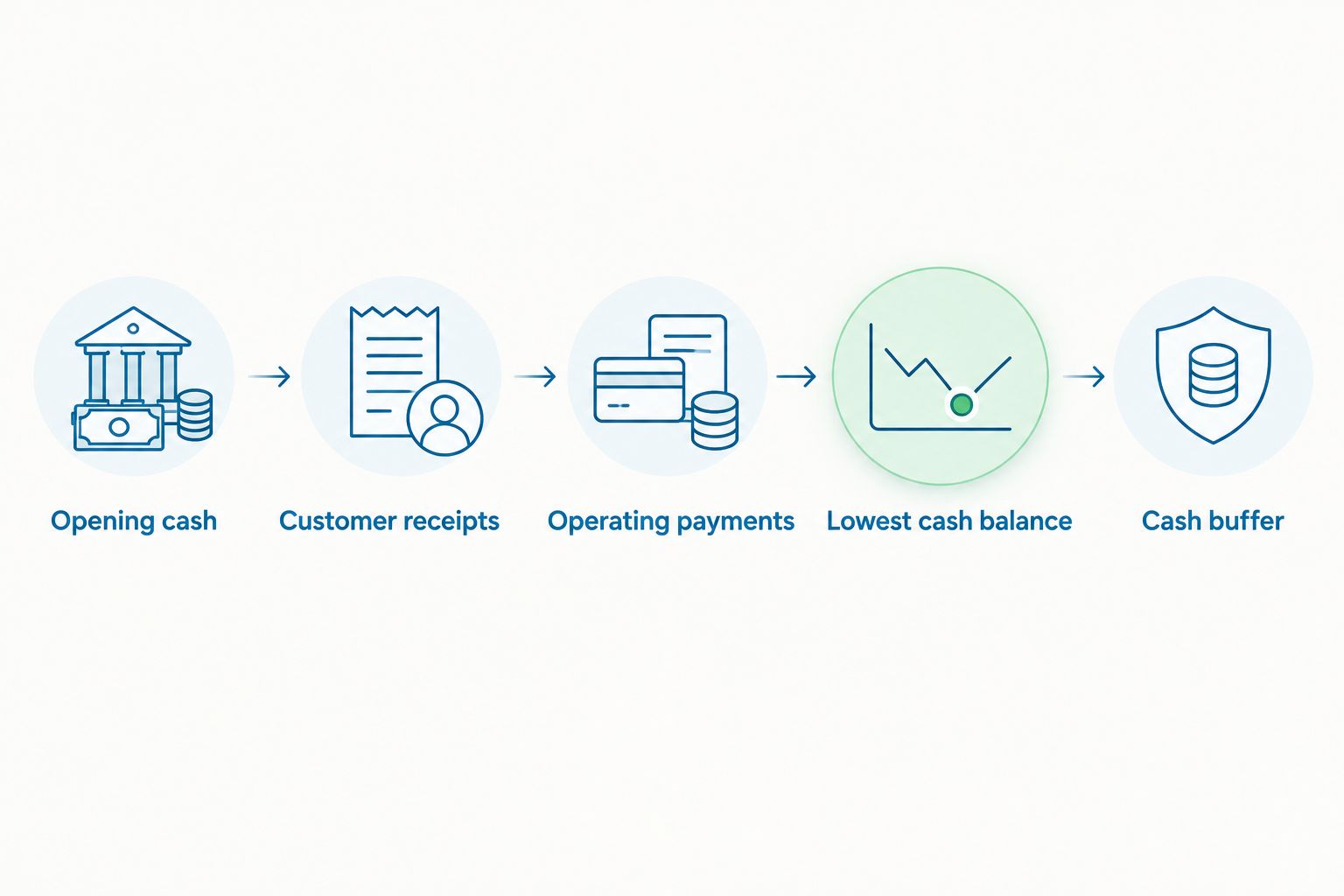
1. Establish your opening cash
Start with cleared cash that the business can use. Identify restricted money and amounts already committed to payments so you do not treat them as spare capacity.
Show an undrawn finance facility separately from cash. Check its conditions before relying on it, including whether access depends on eligible invoices, lender approval or other requirements.
2. Schedule customer receipts
List expected customer receipts by their likely collection date, not simply their invoice date. Use actual customer payment behaviour alongside contractual terms.
Separate confirmed orders from sales opportunities. A forecast that uses uncertain revenue to cover committed wages gives you a misleading picture of available cash.
3. Schedule operating payments
Include supplier payments, wages, superannuation, rent and other operating commitments on their expected payment dates. Add tax payments, debt repayments and planned capital expenditure as distinct lines.
Keeping those categories separate matters. It lets you distinguish cash absorbed by everyday trading from a shortfall caused by equipment investment or financing commitments.
4. Find the lowest cash balance
Calculate the closing cash balance for each forecast period before adding proposed new funding. The lowest balance identifies when pressure is greatest and how large the uncovered shortfall becomes.
Do not add each period's negative balance together. A rolling forecast already carries the previous balance forward; adding the deficits again would overstate the funding requirement.
5. Set a minimum cash buffer
Choose a minimum cash balance that reflects your unavoidable commitments and exposure to delayed receipts. Test the forecast against that minimum, rather than treating a bank balance just above zero as sufficient.
Additional funding required equals the amount needed to lift the lowest forecast cash balance to your chosen minimum. If the forecast already stays above that minimum, the model shows no additional funding gap under those assumptions.
Review the assumptions behind that result before acting. A precise spreadsheet answer is only useful when the customer receipts, payment dates and growth commitments are credible.
Why working capital needs vary
Two businesses with similar revenue can need very different amounts of working capital. The difference lies in how they trade and when cash moves.
Customer payment timing: Longer collection periods leave the business funding work after it has been delivered. Late payments extend that gap further.
Inventory commitments: Stock absorbs cash before sale. Slow-moving items tie up funds without helping you meet immediate obligations.
Supplier terms: Payment terms can fund part of the trading cycle, but only within the arrangements suppliers have agreed.
Payroll timing: Employees need to be paid regardless of when customers settle invoices. Recruitment can increase that commitment before new capacity earns revenue.
Seasonality and concentration: Uneven demand or reliance on a small customer base makes the timing of individual receipts more significant.
Growth delivery costs: Materials, subcontractors and other upfront costs can increase before the related customer payments arrive.
Use these drivers to challenge your 2026 forecast. If the sales plan changes but collection dates, staffing and supplier payments remain unchanged, check whether the model reflects how the extra work will actually be delivered.
Match the response to the cause
A working capital shortfall does not automatically mean borrowing is the right answer. First identify whether the gap comes from timing, avoidable cash being tied up, or trading that does not generate enough cash.
Response | Best for | Benefit | Trade-off |
|---|---|---|---|
Improve collections | Overdue invoices and inconsistent follow-up | Converts earned revenue into usable cash | Cannot fix inadequate margins |
Reduce excess inventory | Cash tied up in unnecessary stock | Releases cash from stock holdings | Cutting too far can disrupt fulfilment |
Agree payment terms | A mismatch between supplier and customer timing | Better aligns cash outflows and inflows | Depends on supplier agreement |
Arrange finance | A defined funding gap with a credible repayment source | Provides funding before receipts arrive | Adds repayment obligations and financing costs |
Stage growth spending | Expansion commitments that precede cash generation | Limits exposure while demand develops | Can slow the expansion timetable |
Best for overdue receivables: fix invoicing and collection discipline first. Confirm purchase requirements, invoice promptly and resolve disputes early rather than allowing administrative problems to become funding problems.
Best for a recurring trading deficit: review margins and operating costs. Finance can bridge timing, but it does not make an unprofitable transaction profitable.
Best for a defined timing gap: assess funding against the repayment source. Explain which receipts will repay the facility and what happens if those receipts arrive late.
Stress-test the plan before committing
A base forecast describes what you expect. A stress test shows whether the business can continue meeting obligations when the timing changes.
For your 2026 plan, test specific events rather than making an unexplained adjustment to every line. Move a significant customer receipt, delay an expected sale or bring forward a committed supplier payment, then recalculate the lowest balance.
Use a short sequence:
Choose the exposure. Identify a receipt, cost or commitment that materially affects cash.
Change its timing or amount. Use a plausible scenario grounded in your contracts and trading experience.
Recalculate the gap. Compare the revised low point with your minimum cash buffer.
Choose a response. Decide what you would defer, collect, renegotiate or fund before the problem occurs.
Avoid counting the same protection twice. If a delayed receipt is already included in a stress case, distinguish that scenario's funding requirement from any additional contingency you choose to retain.
A useful output is a decision, not just another forecast tab. Set out which commitment you can approve now and which depends on collections or funding being confirmed.
How much cash should you keep aside?
Keep enough accessible cash to meet your chosen minimum balance under the conditions you have decided to plan for. There is no universal cash reserve that fits every growing SME.
Base the reserve on unavoidable payments, receipt uncertainty and the time required to arrange a response. A business with concentrated customer receipts needs to examine different risks from one collecting smaller payments throughout its trading cycle.
Document what the buffer protects against. Otherwise, cash reserved for a collection delay can quietly become funding for expansion, leaving the original risk uncovered.
Does higher revenue mean you need more working capital?
Higher revenue increases working capital needs when the business must spend more before it collects. The effect depends on payment terms, delivery costs and how quickly customers pay.
Growth funded by customer payments received before delivery has a different cash profile from growth requiring materials and labour upfront. Model the actual trading arrangement rather than multiplying revenue by an assumed percentage.
Can you grow with negative working capital?
Negative working capital can occur where businesses collect from customers before paying suppliers, but it can also signal financial pressure. The balance alone does not establish whether growth is sustainable.
Check payment obligations, access to cash and the reliability of future receipts. If the business cannot pay debts when they fall due, seek professional advice promptly rather than treating the issue as a routine forecasting exercise.
Turn the forecast into a management routine
A working capital calculation becomes less useful when it is disconnected from current trading. Compare forecast receipts and payments with actual results, then update the remaining periods.
For 2026 management reporting, keep a short explanation of what changed: collections, inventory, supplier timing, staffing or growth spending. This makes it easier to distinguish an isolated timing movement from a persistent cash problem.
Give each action an owner. Someone should be responsible for disputed invoices, purchasing commitments and forecast updates, rather than assuming the accounting software will resolve them.
Daintree Consulting suits Australian SMEs seeking accounting and advisory support as their financial complexity grows. Its service scope includes bookkeeping, tax compliance, business advisory and outsourced CFO support; agree the work required rather than assuming every service is part of the same engagement.
External support does not remove the need for timely information from your team. Customer disputes, hiring decisions and purchase commitments must reach the forecast before they affect the bank account.
Review your working capital plan
Discuss cash flow forecasting, reporting and the support your growing business needs.
FAQ
How do I calculate how much working capital my SME needs?
Forecast customer receipts and all cash payments, find the lowest projected cash balance, and calculate the funding needed to keep it above your chosen minimum. Use realistic payment dates and include the costs of planned growth.
Is working capital the same as cash in the bank?
Working capital is not the same as cash in the bank. Net working capital includes current assets such as receivables and inventory, minus current liabilities, so a positive balance does not guarantee cash is available when payments fall due.
Should I use a percentage of revenue to set my working capital target?
Use a cash flow forecast to set your funding requirement rather than relying on a revenue percentage. Revenue does not show when customers pay or when wages, suppliers and other obligations fall due.
Why does my profitable business keep running short of cash?
A profitable business can run short of cash because profit and cash movements happen at different times. Unpaid invoices, inventory purchases, equipment spending and debt repayments can all put pressure on the bank balance.
Should I borrow to cover a working capital gap?
Consider borrowing only after identifying the cause of the gap and a credible repayment source. Compare funding with improving collections, reducing excess inventory, agreeing payment terms or staging growth spending.
How often should I review my cash flow forecast?
Review your cash flow forecast frequently enough to act before a shortfall occurs, and update it when material assumptions change. Tight cash positions and changing commitments require closer attention than stable trading.
Can an accountant help me plan working capital?
An accountant can help connect your financial records, cash forecast and funding decisions. Daintree Consulting provides accounting and advisory services for Australian businesses, including outsourced CFO support.
One last thing
Your busiest trading period can create your greatest cash pressure if you pay for delivery before collecting from customers. Check the lowest forecast bank balance before approving the next growth commitment, not after the sales target is reached.
Treat working capital as a timing decision, not a revenue target. Keep the calculation tied to how your business gets paid and what it must pay first.
Related guides
Talk to Daintree about your finance function
Our ex-Big 4 team gives clear, senior-reviewed advice so you can act with confidence.
Book a free consultation →
Or explore our outsourced CFO services.
