
How much super guarantee do you need to pay employees?
You must generally pay eligible employees super guarantee equal to 12% of their ordinary time earnings in 2026, subject to the statutory earnings cap. Super is usually additional to ordinary wages unless the employment agreement specifies an inclusive remuneration package; eligibility, earnings classifications and payment deadlines still need separate checks.
TL;DR
Want expert help? Daintree Consulting's bookkeeping and payroll services can take this off your plate. Book a free consultation.
How much super guarantee do you need to pay employees? Generally, 12% of ordinary time earnings in 2026.
Overtime, salary sacrifice and inclusive salary packages need different payroll treatment.
Daintree Consulting provides accounting and payroll support for Australian businesses.
From July 2026, payday super changes contribution deadlines; calculating the right amount is only part of compliance.
How much super guarantee do you need to pay employees?
The Australian Taxation Office sets the super guarantee rate at 12% in 2026. Apply that rate to the employee’s ordinary time earnings, rather than automatically applying it to every amount appearing on a payslip.
Super guarantee = ordinary time earnings × 12%.
Ordinary time earnings generally means earnings for ordinary hours of work. It commonly includes ordinary wages, commissions, shift loadings and paid leave taken during employment. Genuine overtime payments generally sit outside that calculation.
Payment or arrangement | General super treatment | What you need to check |
|---|---|---|
Ordinary wages | Included in ordinary time earnings | Which hours count as ordinary hours |
Genuine overtime | Generally excluded | Whether the payment actually relates to overtime |
Commissions and bonuses | Generally included when connected with ordinary work | What the payment rewards |
Paid annual or personal leave | Generally included during employment | Whether leave is taken or paid out on termination |
Salary sacrifice to super | Does not replace the compulsory employer contribution | The earnings base before the sacrifice |
Expense reimbursements | Generally excluded | Whether the payment reimburses an expense or is an allowance |
The table is a starting point, not a substitute for checking the applicable award, agreement and ATO earnings definitions. An allowance’s name alone does not settle its treatment.
For support connecting these calculations with your accounting records, Daintree Consulting’s accounting and payroll services cover the relevant business functions.
Why this matters
A correct percentage applied to the wrong earnings base still produces the wrong contribution. The same problem occurs when payroll calculates super correctly but the fund receives it late.
Your payroll process therefore needs separate checks for eligibility, calculation and payment. An employee’s payslip records what you calculated; it does not establish that the fund received the contribution on time.
In 2026, payment timing deserves particular attention because the move to payday super changes the relationship between wages and super contributions. Keep the calculation rules and payment deadlines visible in your payroll procedure rather than treating super as a quarter-end task.
Ordinary earnings: 12% super guarantee
For an eligible employee, the standard minimum is 12% of ordinary time earnings, subject to the statutory earnings cap. Full-time, part-time and casual employment do not carry different statutory percentage rates.
A casual loading generally forms part of ordinary time earnings when it relates to ordinary hours. Do not remove it from the calculation simply because it appears as a separate payroll item.
Which hours are ordinary hours?
Start with the employee’s award or employment agreement. Those documents help establish ordinary hours and distinguish them from overtime.
A higher hourly payment does not automatically mean overtime. A shift loading for ordinary hours can attract super even where a genuine overtime payment does not.
Best for checking an uncertain payment: examine what the payment relates to, then compare it with the ATO’s ordinary time earnings guidance. Relying only on the payroll category name leaves the underlying classification unchecked.
Do bonuses and allowances attract super?
Bonuses connected with ordinary work generally attract super. A payment relating solely to overtime requires different treatment.
Allowances also need individual review. An allowance paid as remuneration for ordinary work is different from reimbursement of an employee’s actual business expense.
Record the reason for each classification. That gives your payroll team a consistent answer when the same payment appears again.
Salary packages: 12% of the ordinary earnings component
An inclusive salary package is not the same as wages plus super. If the agreement includes employer super within total remuneration, separate the cash earnings component before calculating the contribution.
Where a package consists only of ordinary cash earnings and compulsory super, the package contains 100 parts earnings and 12 parts super. The employer contribution is therefore not calculated by taking 12% of the entire inclusive package.
Remuneration arrangement | How the calculation works | Benefit | Limitation |
|---|---|---|---|
Wages plus super | Apply 12% to ordinary time earnings | Makes the employer contribution separate and visible | Total employer cost exceeds the stated wages |
Package including super | Separate ordinary earnings from the inclusive total | States an overall remuneration amount | An unclear agreement can create confusion about cash wages |
Package with other benefits | Identify each component before calculating super | Can accommodate different remuneration components | A simple wages-and-super calculation is insufficient |
Best for a straightforward payroll calculation: clearly documented wages plus super. An inclusive package can also work, but the agreement must explain what the total contains.
Do not assume an inclusive package permits a reduction in cash wages whenever super obligations change. Check the contract, award and minimum employment entitlements before changing an employee’s pay.
Salary sacrifice: the 12% employer minimum still applies
An employee’s salary-sacrificed super does not replace your compulsory employer contribution. Calculate the employer minimum without reducing the relevant earnings base by the sacrificed amount.
Keep the employer contribution and the employee’s salary-sacrifice amount separate in payroll. Combining them into a single total can conceal an employer shortfall even when the employee’s fund receives a larger overall contribution.
Best for employees making additional contributions: a documented salary-sacrifice arrangement with separate payroll categories. Its limitation is that it adds another reconciliation requirement; the employee’s extra contribution does not simplify the employer’s obligation.
Personal contribution limits are a separate issue from the employer’s super guarantee calculation. An employee’s request to contribute more does not remove your responsibility to calculate the compulsory amount correctly.
Why the super amount varies between employees
The statutory percentage can remain the same while the contribution changes. These factors explain the difference:
Ordinary earnings: Different ordinary hours, wages and commissions produce different contribution amounts.
Payment classification: Genuine overtime, ordinary-hours loadings, allowances and reimbursements do not all receive the same treatment.
Eligibility: Employees under 18 generally need to work more than 30 hours in a week to qualify for that week.
Remuneration structure: An inclusive package must be separated into its components before calculating super.
Earnings limits: The statutory earnings cap can affect the compulsory minimum for higher-paid employees.
Additional obligations: An award, agreement or employment contract can require contributions above the statutory minimum.
Do not use low earnings alone as a reason to exclude an employee. The former minimum monthly earnings threshold no longer applies.
Also check contractors separately. A contractor engaged under a contract principally for their labour can qualify for super purposes, even when they quote an ABN and submit invoices.
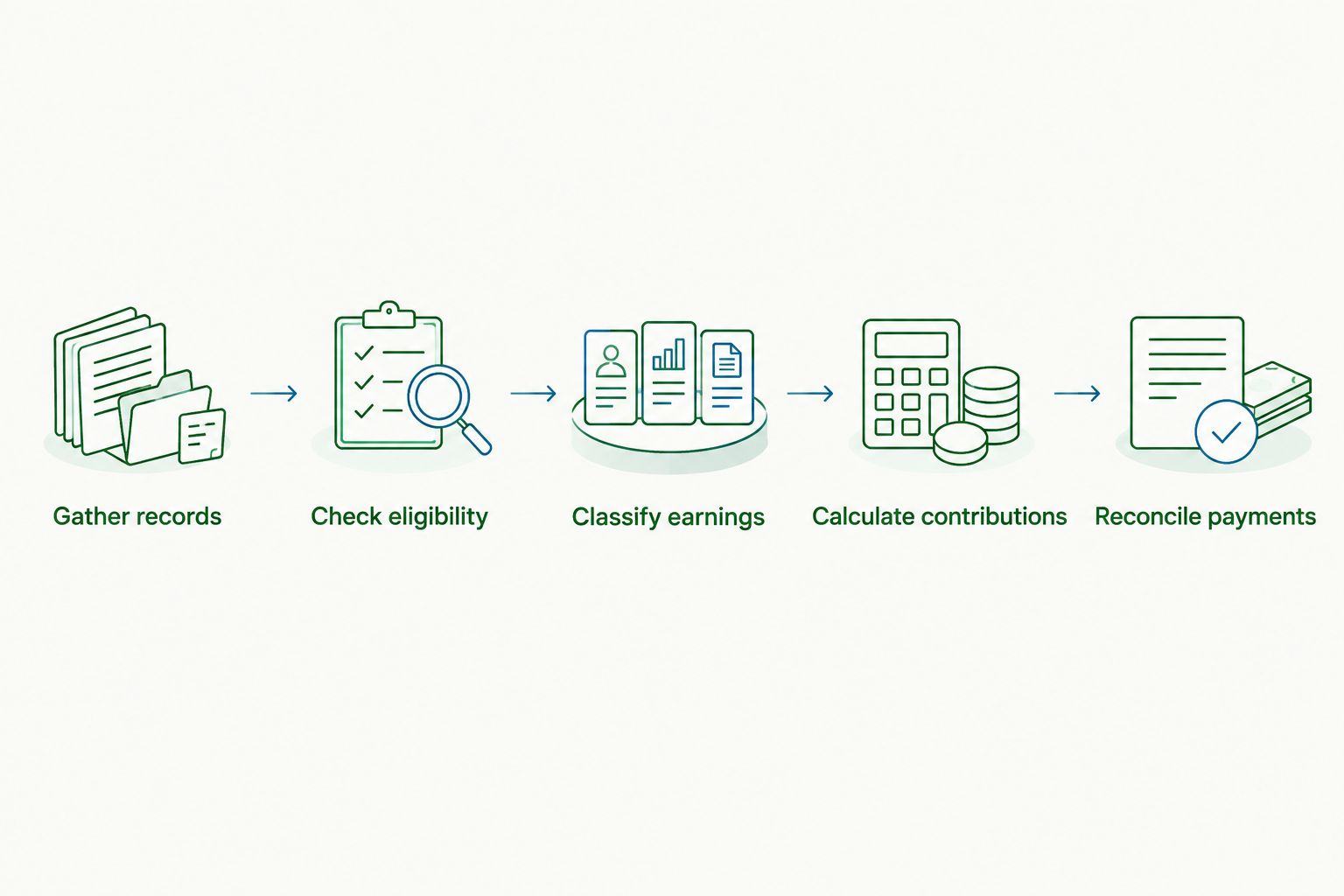
How do you calculate super correctly each pay run?
Use a repeatable process that connects the employee’s agreement, payroll records and fund payment. The calculation should be explainable from the records, not just accepted because payroll software produced it.
Gather records. Use the current employment agreement, applicable award, timesheets and payment details. Check changes before processing pay.
Check eligibility. Review the worker’s circumstances, including age-related rules and any contractor arrangements requiring separate assessment.
Classify earnings. Separate ordinary earnings from genuine overtime, reimbursements and other payments requiring different treatment.
Calculate contributions. Apply the statutory rate to the correct earnings base, then check any additional contractual obligations and relevant earnings cap.
Reconcile payments. Match the payroll liability with contributions received by the fund, including rejected or returned payments.
Keep evidence of corrections as well as the original calculation. If a contribution is rejected because employee details are incorrect, fixing the details does not by itself establish that the original payment deadline was met.
Daintree Consulting is suited to Australian businesses seeking accounting and payroll support. That support can sit alongside your internal payroll process; responsibility for meeting employer obligations remains with the business.
When do you need to pay employee super in 2026?
The contribution rate and the payment deadline are separate rules. Before the payday super changes commence, the quarterly system generally requires contributions to reach the employee’s fund by the applicable quarterly due date.
For example, the January–March 2026 quarter has a due date of 28 April 2026. The April–June 2026 quarter has a due date of 28 July 2026.
From 1 July 2026, payday super generally requires contributions to reach the employee’s fund within 7 business days of payday, subject to statutory exceptions. Check the ATO’s payday super guidance for the relevant payment and any transitional requirements.
Do not treat the date you submit a payment file as proof that the fund received the money. Your payment method and processing arrangements need to leave enough time for receipt.
Best for managing the transition: document the final quarterly reconciliation separately from the new payday process. This helps prevent an outstanding quarterly liability from disappearing behind more frequent contributions.
Do you pay super on overtime?
12% generally applies to ordinary time earnings, not genuine overtime payments. The important distinction is what the payment relates to, rather than whether the hourly rate is higher than usual.
Check ordinary-hours definitions in the applicable award or agreement. A payroll item labelled overtime does not settle the issue if the underlying hours are ordinary hours.
Do casual employees receive the same super rate?
12% is the standard super guarantee rate for eligible casual employees, just as it is for eligible full-time and part-time employees. Casual status does not create a lower rate.
Check eligibility separately, including the more-than-30-hours weekly rule for employees under 18. A short shift or low pay amount does not, by itself, remove the obligation.
Can an employee ask you not to pay super?
12% remains the statutory minimum for an eligible employee’s ordinary time earnings, subject to the relevant earnings cap. An employee cannot waive the employer’s legal obligation by asking to receive the contribution as extra wages instead.
Treat fund selection and salary sacrifice as separate decisions. Neither changes whether the compulsory employer contribution is payable.
FAQ
How much super guarantee do I need to pay employees in 2026?
You generally need to pay 12% of an eligible employee’s ordinary time earnings in 2026, subject to the statutory earnings cap. Check whether an award, agreement or contract requires additional contributions.
Is super calculated on gross pay or ordinary time earnings?
Super guarantee is generally calculated on ordinary time earnings, not automatically on every item in gross pay. Genuine overtime and expense reimbursements generally receive different treatment from ordinary wages.
Do I pay super for an employee who only works a few hours?
A small number of hours does not generally remove an eligible adult employee’s entitlement. Employees under 18 generally need to work more than 30 hours in a week to qualify for that week.
Does salary sacrifice count towards my employer super contribution?
No, an employee’s salary-sacrificed super does not replace your compulsory employer contribution. Keep the two amounts separate and calculate the employer minimum without reducing the earnings base by the sacrifice.
Do I have to pay super for contractors with an ABN?
An ABN does not automatically exclude a contractor from super entitlement. A contract principally for the individual’s labour can create a super obligation, so assess the arrangement separately.
When does payday super start?
Payday super starts on 1 July 2026. Contributions generally need to reach the employee’s fund within 7 business days of payday, subject to statutory exceptions.
What happens if I calculate super correctly but pay it late?
A correct calculation does not prevent a super guarantee shortfall if payment is late. Check the ATO’s super guarantee charge requirements rather than assuming a later contribution resolves every obligation.
One last thing
Check the payroll category that looks least significant. A recurring allowance or loading classified incorrectly can affect every pay run, while the headline super rate remains correct.
Choose one recent pay run and trace its ordinary earnings through to the fund receipt. Before changing your 2026 process, make sure you can explain both the amount calculated and the date received.
Related guides
Talk to Daintree about your bookkeeping and payroll
Our ex-Big 4 team gives clear, senior-reviewed advice so you can act with confidence.
Book a free consultation →
Or explore our bookkeeping and payroll services.
