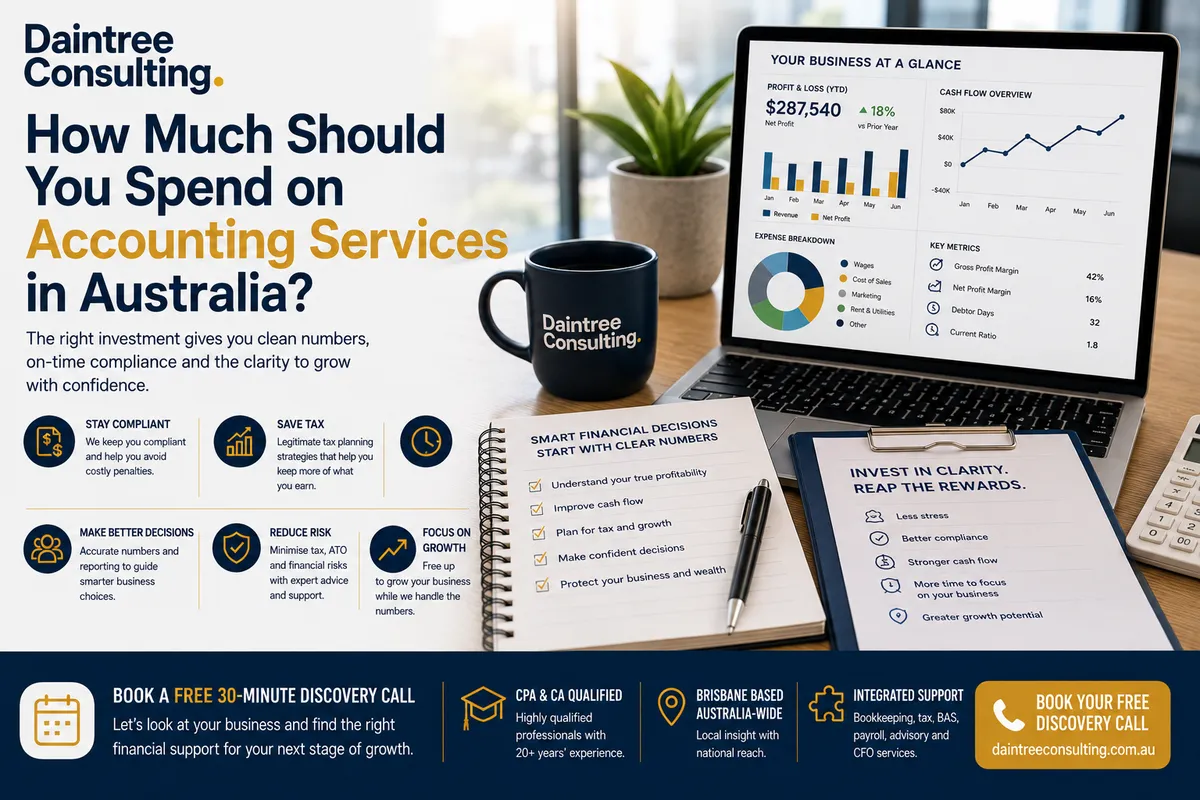
How Much Should You Spend on Accounting Services in Australia?
Most Australian business owners ask the same question once the business starts growing: “How much should I actually be spending on accounting services?”
The short answer is that the right spend is not the cheapest quote. It is the level of support that gives you clean numbers, on-time compliance, and enough clarity to make decisions without second-guessing cash flow or tax risk. For most SMEs in 2026, that sits somewhere between a few thousand dollars a year for simple compliance and several thousand dollars a month once you need reliable management reporting or senior financial guidance.
Want expert help? Daintree Consulting's accounting services can take this off your plate. Book a free consultation.
This guide breaks down realistic Australian fee ranges by business size and service level, shows what drives cost up or down, and helps you decide whether your current setup is under-powered, over-priced, or about right.
Quick Answer: What Should You Budget?
Business StageTypical Annual Accounting SpendWhat You Usually GetSole trader / micro (under ~$300k)$1,500 – $5,000Tax return + BAS + light bookkeepingSmall company (1–5 staff, under $2m)$6,000 – $18,000Full compliance + monthly bookkeeping + payrollGrowing SME ($2m–$10m)$24,000 – $60,000+Integrated finance function + management reportingVirtual / Outsourced CFO layer$18,000 – $72,000+Forecasting, cash-flow leadership, board packs
These figures are market observations drawn from Australian firm pricing in 2026. Your actual number depends on transaction volume, payroll complexity, number of entities, and how much forward-looking support you need.
Why Most Business Owners Get the Number Wrong
Many owners treat accounting as a pure compliance cost — something to minimise. That approach works when the business is simple. It starts to fail once you have staff, inventory, multiple revenue streams, or decisions that carry real money at stake.
Common pain points we see:
Books that are only cleaned up at year-end, so monthly decisions are made on incomplete data
BAS lodged late or with errors because the bookkeeping is inconsistent
Cash-flow surprises that force last-minute borrowing or delayed supplier payments
Owners still answering basic finance questions because no one else owns the numbers
Paying for a “cheap” service that creates more work and higher risk later
The real cost of under-investing is rarely the fee itself. It is the lost time, missed opportunities, and avoidable tax or compliance issues.
What Actually Drives Accounting Fees in Australia
Several factors move the price more than most people expect:
Transaction volume and complexity – High volumes of invoices, inventory, or multi-currency activity require more time.
Payroll and awards – Complex awards, multiple pay cycles, or superannuation guarantee compliance add cost.
Structure – Sole traders are simpler and cheaper than companies, trusts, or multi-entity groups.
Record quality – Clean, cloud-based books (Xero or MYOB) cost less to maintain than messy spreadsheets or catch-up work.
Level of insight required – Pure compliance is cheaper. Monthly management reporting, forecasting, and decision support sit at a higher tier.
Location and delivery model – Brisbane, Sydney and Melbourne rates tend to sit higher than regional or purely offshore models, but senior onshore oversight usually reduces risk.
Hourly rates in 2026 typically run:
Bookkeepers / BAS agents: $50 – $120 per hour
Accountants: $150 – $350+ per hour
Senior advisors / virtual CFO: $250 – $500+ per hour
Most growing businesses move away from pure hourly billing toward fixed monthly packages for predictability.
Realistic Fee Ranges by Service Level (2026)
Sole traders and micro businesses
Annual tax return only: $250 – $800
Tax + quarterly BAS: $1,200 – $2,500 per year
Full bookkeeping + BAS + tax: $300 – $700 per month
Small companies (1–5 employees, turnover under $2m)
Year-end financials + tax return: $1,800 – $4,500
Monthly bookkeeping + BAS + payroll: $400 – $1,500 per month
Bundled compliance package: $600 – $1,800 per month all-in
Mid-sized SMEs (5–25 employees, $2m–$10m turnover)
Full compliance (bookkeeping, payroll, BAS, tax): $2,000 – $5,000 per month
Plus management reporting: add $800 – $2,000 per month
Virtual CFO / senior advisory layer: $1,500 – $4,000+ per month
Virtual / Outsourced CFO
Typical retainers sit between $3,000 and $8,000 per month depending on scope, hours, and complexity. This is still a fraction of a full-time CFO package (often $180,000 – $300,000+ fully loaded).
A useful rule of thumb used by many Australian firms is roughly 0.8% – 2% of turnover for solid bookkeeping, BAS and compliance, with additional investment for genuine advisory or CFO-level support.
In-House vs Outsourced: The Real Cost Comparison
Hiring in-house looks cheaper on a salary line until you add the full cost:
Bookkeeper loaded cost: often $75,000 – $110,000 per year
Finance manager / controller: $140,000 – $220,000+ loaded
Full-time CFO: $200,000 – $320,000+
Outsourced or hybrid models frequently deliver equivalent capability for 40–70% less once recruitment, leave, super, management time and turnover risk are factored in. The trade-off is that an outsourced team is not sitting in your office every day — but for most SMEs under $10–15m revenue, the flexibility and senior access usually outweigh the presence of a single full-time hire.
How to Decide the Right Level of Spend for Your Business
Ask yourself three practical questions:
Are your numbers accurate and available early enough to influence decisions, or do you only see the real picture months later?
Is the owner (or a senior team member) still the bottleneck for finance questions and cash-flow visibility?
Do you need someone who can help you plan the next hire, investment, or growth step — or just keep the ATO happy?
If the answer to the first two is “no” and the third is “yes”, you have likely outgrown pure compliance support. Moving to an integrated package that includes management reporting and some senior oversight is usually the highest-ROI step.
Why Daintree Approaches Cost Differently
At Daintree Consulting we do not sell the cheapest possible compliance. We build the right level of financial support for the stage your business is actually in.
We are Brisbane-based, Australia-wide, CPA and CA qualified, with more than 20 years of experience across complex commercial and regulated environments. Our model is senior-led and relationship-based rather than production-line. Clients typically start with accurate bookkeeping, payroll and compliance, then add management reporting and outsourced CFO support as complexity or decision pressure increases.
The goal is simple: financial clarity that lets you make confident decisions without carrying the full cost of an in-house finance team before you need one.
Ready to See What the Right Spend Looks Like for Your Business?
Every business is different. The only way to know whether you are underspending, overspending, or sitting in the right range is to look at your actual numbers, systems and decision needs.
Book a free 30-minute discovery call. We will look at where clarity is breaking down and identify a practical next step — with no pressure and no obligation.
Frequently Asked Questions
How much should a small business spend on accounting services in Australia?
Most small companies with a few staff and under $2m turnover spend between $6,000 and $18,000 per year for solid compliance and bookkeeping. Growing businesses that need monthly reporting and advisory typically move into the $2,000 – $5,000+ per month range.
Is it cheaper to hire an in-house accountant or outsource?
For the majority of SMEs under $10–15m revenue, a well-structured outsourced or hybrid model is significantly cheaper once full employment costs are included. In-house becomes more competitive when you genuinely need full-time presence and can absorb the fixed overhead.
What is a realistic monthly fee for bookkeeping and BAS?
Clean small-business packages commonly sit between $400 and $1,500 per month depending on transaction volume, payroll and GST complexity. Very simple sole traders can be lower; multi-entity or high-volume operations sit higher.
How much does a virtual or outsourced CFO cost in Australia?
Typical retainers range from $1,500 – $4,000 per month for lighter support up to $3,000 – $8,000+ for more intensive forecasting, board reporting and strategic involvement. This remains far below the fully loaded cost of a full-time CFO.
When should I move beyond basic compliance accounting?
When monthly numbers arrive too late to influence decisions, cash flow still feels unpredictable, or major choices (hiring, investment, funding, expansion) lack a clear financial picture. That is usually the signal that management reporting or outsourced CFO support will deliver more value than pure compliance.
Does Daintree offer fixed-fee packages?
Yes. We structure engagements around clear scope and predictable fees wherever possible, so you know what you are paying and what you are receiving. Scope can start with foundation compliance and expand as the business grows.
Talk to Daintree about your accounting
Our ex-Big 4 team gives clear, senior-reviewed advice so you can act with confidence.
Book a free consultation →
Or explore our accounting services.
