
How much does SMSF compliance cost each year?
SMSF compliance has no single annual cost: your total depends on the accounting, administration, independent audit and statutory charges your fund requires. For 2026, assess the full annual scope rather than the headline accounting fee, because audit fees, corporate trustee charges and work outside the agreed scope can sit separately.
TL;DR
Want expert help? Daintree Consulting's SMSF accounting services can take this off your plate. Book a free consultation.
How much does SMSF compliance cost each year? Compare accounting, independent audit, statutory charges and separately billed work.
Daintree Consulting provides SMSF accounting; assess the proposed scope against your fund’s actual requirements.
An SMSF needs an annual independent audit, even when the fund has little activity.
Request a written breakdown covering routine compliance, exclusions and responsibility for each task.
How much does SMSF compliance cost each year?
Your annual SMSF compliance budget should cover the whole fund, not just preparation of the tax return. Start with the following components and establish which are bundled together.
Cost component | What it covers | Best for checking | Limitation to watch |
|---|---|---|---|
Accounting and administration | Financial statements, member records, reconciliations and annual return preparation, according to scope | Routine annual compliance work | A package does not necessarily include every transaction or correction |
Independent audit | The annual financial and compliance audit by an approved SMSF auditor | Meeting the fund’s audit obligation | Audit work is distinct from preparing the accounts |
Statutory charges | The ATO supervisory levy and applicable corporate trustee charges | Obligations outside professional service fees | These charges are not necessarily included in an accountant’s quote |
Additional work | Work such as pension establishment, property transactions or resolving historical errors | Identifying costs triggered by particular events | Scope and charging arrangements need separate confirmation |
Daintree Consulting’s accounting and advisory services include SMSF accounting. The useful starting point is a clear description of your fund’s investments, member activity and outstanding work—not a request for an unexplained annual figure.
Why this matters
A narrow quote and a broader quote are not directly comparable. One might cover the annual accounts and return, while another also includes routine administration and audit coordination.
That difference matters when you budget for 2026. A low headline fee does not establish a lower total annual cost, and a broader package does not automatically represent better value.
Choose the scope your fund needs, then compare fees for that same scope. Keep investment advice, investment management and insurance separate when assessing compliance costs; they serve different purposes, even if they appear in the same household retirement budget.
Accounting and administration: define the routine work
Annual accounting turns the fund’s transactions and supporting documents into financial statements, member information and its annual return. Administration includes maintaining the records needed to support that work, depending on the arrangement you choose.
Ask whether the engagement includes:
Reconciling bank and investment accounts.
Recording contributions, rollovers, income and expenses.
Maintaining member balances and relevant supporting schedules.
Preparing annual financial statements and the SMSF annual return.
Responding to routine questions from the independent auditor.
Lodging the return after the required preparation, audit and approvals.
The advantage of a clearly defined annual service is that you know who owns each task. The limitation is that an annual package still has boundaries: missing records, unusual transactions and prior-period corrections need explicit treatment.
For your 2026 engagement, ask what you must supply, when you must supply it and what happens if the records need substantial reconstruction. Those responsibilities affect whether the quoted scope matches the work required.
Independent audit: confirm the separate obligation
An SMSF must undergo an independent audit each year. The audit examines the fund’s financial statements and compliance with relevant superannuation requirements; it is not replaced by having an accountant prepare the return.
An accountant or administrator can coordinate the audit, but the approved SMSF auditor must meet independence requirements. Audit coordination and audit performance are different responsibilities.
Confirm whether the proposal includes the auditor’s fee, merely arranges the auditor, or leaves appointment and payment to you. Also ask how additional audit queries are handled when documents are missing or a compliance issue needs investigation.
A bundled arrangement gives you a single point of coordination. Its limitation is visibility unless the proposal clearly identifies the audit component and the process for additional work.
Statutory charges: separate them from professional fees
The ATO supervisory levy is a statutory SMSF charge, not payment for your accountant’s work. If your fund has a corporate trustee, applicable ASIC annual review obligations and charges also need attention.
Do not assume a corporate trustee automatically qualifies for special-purpose company treatment. Confirm the company’s status and the requirements that apply to it.
For your 2026 budget, ask whether statutory charges are included, collected separately or paid directly by the fund or company as appropriate. Keep the distinction visible even when a provider helps administer the payment.
This separation makes proposals easier to compare. It also prevents you from treating a government charge as evidence that one accountant is charging more for the same service.
Additional work: identify events outside the annual scope
Routine annual compliance is different from changing the fund’s arrangements or fixing an existing problem. A standard engagement should say how those events are treated.
Examples to discuss include establishing or changing a pension, admitting or removing a member, purchasing or selling property, reviewing borrowing records, changing trustees, correcting earlier accounts and winding up the fund. These are examples of work to clarify—not a statement that every provider bills each item separately.
The benefit of separate project work is a defined task and approval process. The limitation is that an annual compliance quote alone does not show the total cost of a year containing those events.
Ask for written approval arrangements before additional work starts. You need to know what triggers a revised scope, who authorises it and how the expected work will be explained.
Why SMSF compliance costs vary
The work required to support the fund’s accounts and audit drives differences between engagements. These factors deserve attention:
Investment structure. Bank accounts and listed investments require different records from direct property, unlisted investments and borrowing arrangements.
Transaction activity. Contributions, rollovers, investment trades, distributions and benefit payments all need correct recording and supporting evidence.
Pension activity. Pension commencement, payments and changes introduce requirements that differ from an accumulation-only fund.
Record quality. Missing statements, unreconciled balances and incomplete transaction documents create work beyond processing a complete record set.
Fund changes. Member changes, trustee changes and wind-up work need attention beyond an unchanged annual position.
Historical issues. Unresolved audit findings, overdue returns and earlier accounting errors need assessment rather than being treated as routine current-year processing.
A fund’s balance alone does not describe its compliance workload. Before comparing proposals, give each provider the same information about the fund and any known issues.
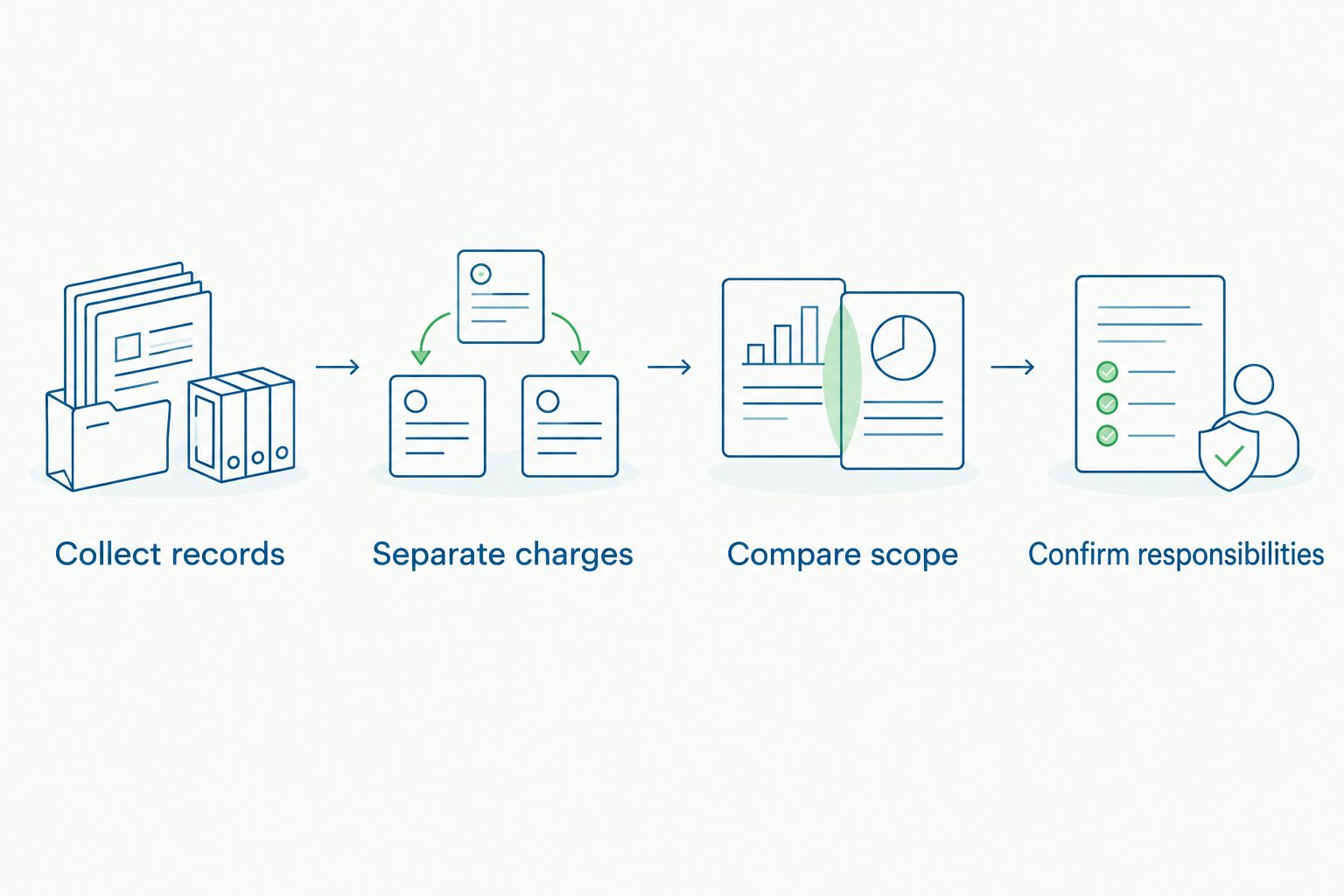
How to compare SMSF compliance quotes
Use this sequence to compare the same work across proposals. It gives you one clear picture of the annual service without treating every possible extra as inevitable.
01. Collect records
Prepare a summary of investments, members, pension arrangements, transaction activity and the status of the latest accounts and audit. Include known gaps, overdue work and planned changes.
You do not need to diagnose every issue yourself. You do need to disclose the circumstances that affect the requested service.
02. Separate charges
Ask each provider to distinguish accounting and administration, independent audit, statutory charges and event-based work. Confirm whether GST is included in the professional fees being quoted.
This is a comparison exercise, not a demand that every provider use the same package structure. Different structures are workable when their boundaries are clear.
03. Compare scope
Place the proposals side by side and mark which tasks are included, excluded or unclear. Ask about record maintenance, auditor queries, trustee documents, pension-related work and lodgement responsibilities where relevant to your fund.
Do not interpret silence as inclusion. Get an answer in writing before making the decision.
04. Confirm responsibilities
Agree who supplies records, appoints the auditor, responds to queries, approves documents and monitors lodgement requirements. Confirm how you will be told about work outside scope.
For an engagement covering 12 months, distinguish recurring annual work from any initial catch-up or transition work. Otherwise, the first engagement and the ongoing service are not being compared on equal terms.
Which service arrangement fits your fund?
The right arrangement depends on how much administration you will handle and how clearly responsibilities are divided. Neither approach removes trustee responsibility.
Arrangement | Best for | Advantage | Trade-off |
|---|---|---|---|
Annual compliance with trustee-managed records | Trustees who maintain complete records and want defined year-end support | A clear division between recordkeeping and annual preparation | You retain the agreed recordkeeping workload |
Ongoing administration with annual compliance | Trustees who want continuing record maintenance included in the engagement | Administration and year-end work sit within a connected scope | You need to check exactly what ongoing support includes |
These are service arrangements to discuss, not named packages. Ask the provider to explain which arrangement the proposal represents and what you would still need to do.
Daintree Consulting is best suited to trustees seeking SMSF accounting alongside broader accounting and advisory support. Confirm the fund-specific engagement separately: access to broader services does not mean every advisory task belongs in the annual SMSF compliance scope.
Is a fixed annual fee better than separate charges?
A fixed annual fee is useful when the included work matches your fund’s needs and the exclusions are clear. Separate charges can also be transparent when each responsibility and approval process is documented.
Choose clarity over the billing label. Neither structure establishes value without a matching scope.
Does outsourcing SMSF compliance remove trustee responsibility?
Outsourcing SMSF compliance does not remove trustee responsibility. You still need to understand the fund’s obligations, provide reliable information and review the documents requiring your approval.
Professional support helps with the work. It does not turn trusteeship into a passive arrangement.
FAQ
How much does SMSF compliance cost each year in Australia?
SMSF compliance has no single annual cost: the total depends on accounting, administration, independent audit, statutory charges and any additional work. Request a fund-specific written quote that separates these components and states the exclusions.
Does an SMSF accounting fee include the annual audit?
An SMSF accounting fee includes the annual audit only when the engagement explicitly says so. Confirm whether the provider includes the auditor’s fee, coordinates the audit separately or leaves the arrangement to you.
Does my SMSF need an audit if it has no contributions?
An SMSF still needs an annual independent audit when it receives no contributions. Low activity does not remove the audit obligation.
Are investment advice fees part of SMSF compliance?
Investment advice fees are separate from the work of preparing accounts, lodging the annual return and completing the independent audit. Keep advice and investment management distinct when comparing compliance proposals.
Will a corporate trustee affect my annual SMSF budget?
A corporate trustee brings company administration obligations and applicable ASIC charges into the budget. Confirm the company’s status and whether administration support is included in your engagement.
Can I do the SMSF recordkeeping myself?
You can maintain your SMSF’s records yourself, but the records must support the fund’s reporting and compliance obligations. Agree the required documents and format with the accountant and independent auditor.
Can Daintree Consulting help with SMSF accounting?
Daintree Consulting provides SMSF accounting alongside accounting and advisory services. Ask for a scope based on your fund’s investments, member activity, pension arrangements and any outstanding compliance work.
One last thing
Before accepting a 2026 proposal, ask one question: What circumstances would make the final annual bill different from this quote?
The answer should identify exclusions, the approval process and your own responsibilities. That is more useful than a headline figure that leaves you guessing about the rest.
Related guides
Talk to Daintree about your SMSF accounts
Our ex-Big 4 team gives clear, senior-reviewed advice so you can act with confidence.
Book a free consultation →
Or explore our SMSF accounting services.
