
How much does payroll processing cost per employee in Australia?
Payroll processing in Australia has no single standard cost per employee: your effective rate depends on the provider’s charging basis, pay frequency and included work. For a useful comparison in 2026, divide the full quoted fee by the employees covered over the same period, then account for setup, corrections and compliance tasks outside that fee.
TL;DR
Want expert help? Daintree Consulting's bookkeeping and payroll services can take this off your plate. Book a free consultation.
How much does payroll processing cost per employee in Australia? Compare total fees, billing periods and included responsibilities.
A per-pay-run fee and a monthly fee are not directly comparable without adjusting for payroll frequency.
Daintree Consulting suits Australian businesses seeking payroll support alongside bookkeeping, accounting and business advisory.
Check who handles employee changes, payroll approvals, reporting and corrections before accepting a quote.
How much does payroll processing cost per employee in Australia?
The useful figure is the total cost for an agreed scope, not the advertised employee rate alone. A quote needs to identify its billing period, employee definition and included tasks before you can use it to budget.
For your 2026 comparison, ask every provider to price the same payroll brief. Otherwise, a quote covering calculations alone sits beside another covering employee changes, reporting and payroll queries, without making that difference obvious.
Charging basis | Best for comparing | What it helps you see | What you still need to check |
|---|---|---|---|
Per employee, per pay run | Quotes for the same payroll frequency | How charges relate to each processed payroll | Minimum charges, employee definitions and extra runs |
Per employee, per month | Quotes using the same monthly scope | The recurring fee allocated to each employee | Included pay runs and treatment of starters or leavers |
Fixed recurring fee | A defined package of payroll work | The fee for an agreed service scope | Headcount limits, exclusions and scope changes |
Time-based billing | Separately scoped support or corrective work | How chargeable work is measured | Estimates, approval controls and reporting of time |
These are comparison categories, not a statement that every provider offers every model. Ask which basis applies to your proposal and get the answer in writing.
Why this matters
Payroll sits between employee records, bookkeeping, cash flow and compliance. Comparing fees without comparing responsibilities leaves you exposed to work that nobody has clearly agreed to own.
Daintree Consulting provides payroll alongside bookkeeping, accounting and advisory services. That combination is relevant when you want payroll information connected to your wider financial reporting; it does not replace the need to agree on exactly which payroll tasks the engagement covers.
A sensible buying decision separates two questions: what will the provider do, and what will your business still need to do? Answer both before choosing on cost.
How do you calculate the effective cost per employee?
Use the same period and scope throughout the calculation. A monthly employee rate should not be compared directly with a fee charged every pay run.
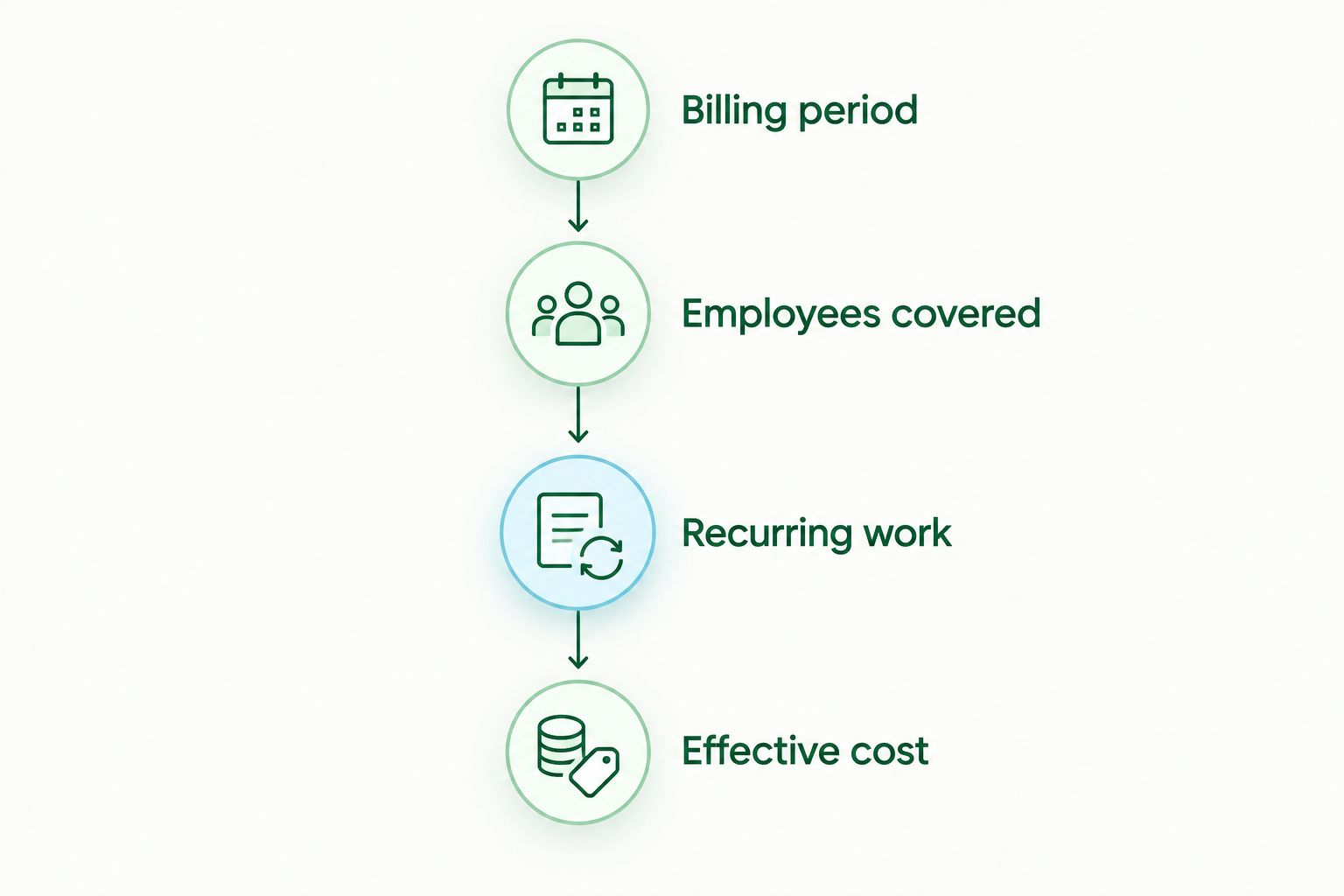
1. Establish the billing period
Record whether the quote applies per pay run, month or another agreed period. Then identify how many scheduled payroll runs fall within your comparison period.
Ask how the provider treats an additional run, an off-cycle payment or a payroll processed again after approval. Do not assume those events sit within the recurring fee.
2. Define the employees covered
Confirm what counts as a billable employee. Your comparison needs to distinguish people paid during the period from everyone held in the payroll system.
Ask how employees on unpaid leave, new starters, departing employees and inactive records are treated. Use the same headcount definition across every quote.
3. Separate recurring work from other work
Keep ongoing processing separate from implementation, historical corrections and any work quoted independently. This shows you the continuing commitment without hiding the work needed to begin.
For a first-year budget in 2026, retain both views: the recurring operating cost and the total including separately quoted work. Neither tells the whole story alone.
4. Calculate and label the result
Effective recurring cost per employee = total recurring payroll fees for the period ÷ employees covered during that period. Label the result with its period and scope.
If you also calculate a first-year figure, identify the setup and other separately quoted work included. Do not present that result as the ongoing rate.
Payroll software: compare the work your team retains
Payroll software is best for businesses with someone able to operate and review payroll internally. It provides a system for the work, rather than automatically transferring responsibility for the work.
The advantage is direct control over payroll inputs and processing. The limitation is that your team still needs to maintain records, check calculations, approve payments and resolve questions within the arrangement you choose.
When budgeting in 2026, separate the software subscription from internal payroll effort. A subscription quote alone does not describe the whole operating process.
Ask who will cover payroll when the usual operator is away. Documenting that responsibility helps you assess the arrangement beyond its recurring invoice.
Outsourced payroll: compare the responsibility transferred
Outsourced payroll is best for businesses seeking external help with an agreed processing workload. Its value depends on which tasks the provider takes on and the quality of the information your business supplies.
The advantage is access to external processing support. The limitation is the continuing need for your business to provide accurate changes, approve payroll and meet agreed cut-offs.
Ask whether employee queries, corrections, reporting and payroll-related bookkeeping are included. A processing-only engagement and a broader support engagement are different services, even when both are described as payroll outsourcing.
Do not treat outsourcing as a transfer of every employer obligation. Your engagement should make the division of responsibilities explicit.
What makes payroll processing costs vary?
Payroll workload depends on more than headcount. Use these factors to explain your requirements, then ask each provider how they affect the proposed scope and fee.
Pay frequency: More frequent payroll means more scheduled processing events. Confirm whether the quote changes with the number of runs.
Pay arrangements: Salaries, variable hours, overtime, allowances and deductions create different calculation and checking requirements.
Employee changes: Starters, departures, leave changes and updated employee details require accurate inputs and review.
Record quality: Incomplete records or unresolved payroll balances create work separate from routine processing.
Service boundaries: Processing, employee support, reporting, bookkeeping and specialist advice are distinct responsibilities unless the agreement combines them.
Systems and data transfer: Confirm who moves approved time and employee information into payroll, checks it and resolves errors.
These factors give you a better brief than headcount alone. Describe the work as it actually happens, including exceptions, rather than only describing a normal pay run.
What should a payroll processing quote include?
A useful quote lets you identify the deliverables, the exclusions and the point at which additional work needs approval. Ask for a responsibility schedule alongside the fee proposal.
Payroll preparation and approval
Specify who supplies approved hours, leave and employee changes. Identify who reviews the draft payroll and who authorises it.
Agree on cut-offs and the handling of late changes. The written process should tell you what happens when an input arrives after payroll preparation has started.
Reporting and payment responsibilities
Confirm who handles Single Touch Payroll reporting and how reporting errors are addressed. Ask separately about superannuation-related tasks, payment files, payslips and payroll reports.
Do not use a broad phrase such as payroll compliance as a substitute for named responsibilities. Each task needs an owner, including any approval your business must provide.
Reconciliation and employee support
Ask whether the service includes reconciling payroll figures with the accounting records. Processing a pay run and explaining differences in payroll accounts are not necessarily the same assignment.
Also identify who answers employee questions. A provider handling calculations does not automatically mean employees receive direct support from that provider.
Exceptions and scope changes
Request the process for corrections, termination payments and work outside the normal cycle. Ask how additional work is authorised before it proceeds.
A clear variation process helps you control spending without expecting every unusual event to fit inside a routine processing fee.
Is payroll software cheaper than outsourcing?
There is no reliable comparison until you include the work your business retains. Software and outsourced payroll do not transfer the same responsibilities.
Approach | Best for | Main advantage | Main limitation |
|---|---|---|---|
Internally operated payroll software | Businesses with internal payroll capability | Direct control of processing and records | Internal staff retain operation, checking and cover responsibilities |
Outsourced payroll processing | Businesses wanting external processing support | An agreed workload moves to a provider | Inputs, approvals and excluded work remain with the business |
Payroll with bookkeeping support | Businesses wanting payroll connected to accounting records | Scope can connect processing and reconciliation | Integration and advisory responsibilities still need explicit agreement |
For your 2026 decision, map the tasks before comparing the invoices. If an option leaves reconciliation or employee queries with your team, record that retained work beside the quoted fee.
Does outsourcing payroll remove your compliance responsibilities?
Outsourcing payroll does not remove every employer responsibility. Your business still needs clear approval controls, accurate employee information and a process for checking that agreed tasks are completed.
Ask how the provider handles questions about pay conditions and when specialist advice is required. Do not assume routine payroll processing includes interpreting every award, agreement or employment issue.
Payroll tax also needs its own scope discussion. It is a state and territory matter, distinct from simply calculating employee pay, and should not be assumed to sit inside a processing fee.
How do you choose the right payroll arrangement?
Start with the problem you need to solve: processing capacity, unreliable records, unclear reporting or an internal dependency on one person. Then match the engagement to that problem.
Daintree Consulting’s payroll and bookkeeping services suit Australian businesses seeking connected accounting support rather than treating payroll as an isolated task. Confirm the proposed scope against your requirements, particularly where you also need reporting or advisory support.
Before accepting any proposal, request a written answer to these questions:
Who owns employee data, payroll preparation and final approval?
Which reports and reconciliations are included?
How are errors, late changes and additional runs handled?
What remains with your business, and who provides internal cover?
How does the engagement change when your workforce or payroll requirements change?
Choose the arrangement you can operate clearly, not simply the shortest fee schedule.
FAQ
What is the average payroll processing cost per employee in Australia?
There is no single standard rate that answers the question for every Australian business. Compare written quotes using the same billing period, employee definition and service scope.
Is payroll charged per employee or per pay run?
The charging basis depends on the provider and engagement. Confirm whether an employee rate applies to each pay run or to a defined billing period, and ask about minimum charges.
Does payroll processing include superannuation?
Superannuation-related responsibilities need to be confirmed in the engagement. Ask separately about calculations, contribution processing, approvals and checking that payments have been completed.
Will a payroll provider handle Single Touch Payroll reporting?
Single Touch Payroll reporting should be expressly included if you expect the provider to handle it. Confirm who submits reports, reviews outcomes and corrects errors.
Can my bookkeeper also process payroll?
A bookkeeper can provide payroll processing when it forms part of the agreed service and the work is within their capability. Check the scope, approval process and arrangements for questions requiring specialist advice.
Can Daintree Consulting help with payroll and bookkeeping together?
Daintree Consulting provides payroll and bookkeeping alongside accounting and advisory services. Discuss which processing, reconciliation and reporting responsibilities your business needs included.
What should I compare when reviewing payroll quotes in 2026?
Compare total fees, included work, retained responsibilities and exception handling in 2026. Keep setup and corrective work separate from the recurring fee so the ongoing commitment remains clear.
One last thing
Ask each provider to explain what happens when an approved payroll turns out to contain an error. That answer exposes the practical boundaries of the service: who investigates, who authorises the correction and how additional work is agreed.
A useful payroll quote explains the exception as clearly as the routine pay run. Keep that explanation with your engagement documents so your team knows what to do when the normal process breaks.
Related guides
Talk to Daintree about your bookkeeping and payroll
Our ex-Big 4 team gives clear, senior-reviewed advice so you can act with confidence.
Book a free consultation →
Or explore our bookkeeping and payroll services.
