
How much does a tax accountant cost for a small business in Australia?
Your tax accountant cost in Australia depends on the work included, your business structure and the condition of your records; there is no single standard small-business fee for 2026. An annual tax-return quote does not automatically include bookkeeping, BAS, payroll or advice during the year. Compare written scopes before comparing fees, so you know whether you are buying a completed return or ongoing financial support.
TL;DR
Want expert help? Daintree Consulting's tax and BAS services can take this off your plate. Book a free consultation.
Compare tax accountant cost by scope: annual returns, BAS, bookkeeping and advisory are different services.
Daintree Consulting suits Australian businesses seeking tax compliance alongside bookkeeping and advisory support.
Ask whether record corrections, extra entities and advice sit outside the quoted scope.
Choose return-only support for a defined annual task; assess ongoing support when compliance and reporting recur.
Why this matters
A low-looking quote and a broader accounting proposal are not necessarily competing offers. One might cover preparing a return from reconciled accounts; another might include maintaining those accounts, preparing activity statements and discussing business decisions throughout the year.
The distinction matters because someone must complete the underlying work. If bookkeeping is excluded, responsibility stays with you or your bookkeeper rather than disappearing from the process.
Daintree Consulting’s accounting and advisory services include tax and BAS compliance, bookkeeping, payroll and business advisory. Treat those as separate scope decisions, not automatic inclusions in every tax engagement.
How much does a tax accountant cost for a small business in Australia?
The meaningful comparison is the fee for the same deliverables, entities and period. A sole trader’s annual return, a company’s accounts and tax return, and ongoing compliance support are different assignments.
Use this scope comparison when assessing a small-business tax proposal in 2026:
Support option | Best for | What to confirm | Main limitation |
|---|---|---|---|
Annual tax preparation | Businesses with reliable records needing a defined annual task | Which returns, accounts and schedules are included | Does not maintain your records during the year |
Ongoing compliance | Businesses needing recurring tax and BAS support | Lodgements covered, record checks and responsibility for deadlines | Advice and bookkeeping still need explicit inclusion |
Broader accounting support | Businesses needing bookkeeping, payroll, reporting or advisory alongside tax | Tasks, reporting frequency and access to advice | A wider engagement needs clear boundaries to avoid overlap |
Ask each accountant to quote against the same brief. Otherwise, the headline amounts tell you little about which proposal actually meets your needs.
Annual tax preparation: a defined year-end task
Best for: a business whose records are already complete and reconciled, with a clear owner for ongoing bookkeeping.
An annual engagement centres on preparing the agreed accounts and returns from the information you provide. Confirm whether the proposal covers your business return, your individual return, or both; they are not interchangeable deliverables.
The advantage is a contained assignment with an identifiable finish. The limitation is timing: year-end preparation does not provide ongoing cash-flow reporting or advice before you make a business decision.
Choose this scope when the annual task is genuinely what you need. Do not expect it to replace financial support throughout the year.
Ongoing compliance: recurring obligations
Best for: a business that wants recurring compliance tasks assigned rather than organised separately each time.
This scope can combine annual tax preparation with BAS and other agreed compliance work. Spell out each obligation, who supplies the records and who approves the figures before lodgement.
For a business lodging quarterly throughout the year, that means identifying responsibility for 4 quarterly BAS statements, rather than assuming an annual tax engagement covers them.
The benefit is clear ownership of recurring work. The limitation is that compliance alone does not answer every question about margins, cash flow or expansion; those conversations need their own agreed scope.
Broader accounting support: records, compliance and decisions
Best for: a business that needs help producing reliable financial information as well as meeting tax obligations.
Broader support brings selected bookkeeping, payroll, management reporting or advisory tasks into the engagement. The correct combination depends on what your team already handles and which decisions require better information.
The advantage is continuity between the records, the returns and the discussion about business performance. The trade-off is a broader scope to manage, particularly if you retain an internal bookkeeper or another adviser.
Specify responsibilities rather than buying an undefined package. A clear handover between people matters more than the package label.
Why tax accountant cost varies
The work changes when the underlying business or the starting records change. These are the main scope drivers to discuss:
Business structure: identify whether the engagement concerns a sole trader, company, trust or several entities. Confirm each return and set of accounts separately.
Record condition: reconciled transactions provide a different starting point from incomplete records, unexplained balances or missing documents.
Services included: tax preparation, BAS, bookkeeping, payroll and advisory are distinct tasks. Combining them changes the assignment.
Payroll responsibilities: specify whether the accountant prepares payroll, reviews work completed elsewhere or only uses payroll figures in the annual accounts.
Advice required: preparing a return is different from assessing a proposed purchase, restructuring question or expansion decision.
Reporting expectations: management reports and forecasts require defined outputs and review arrangements, not simply access to accounting software.
Do not use turnover as your only shortcut. Describe the transactions, entities and responsibilities so the accountant can assess the actual work.
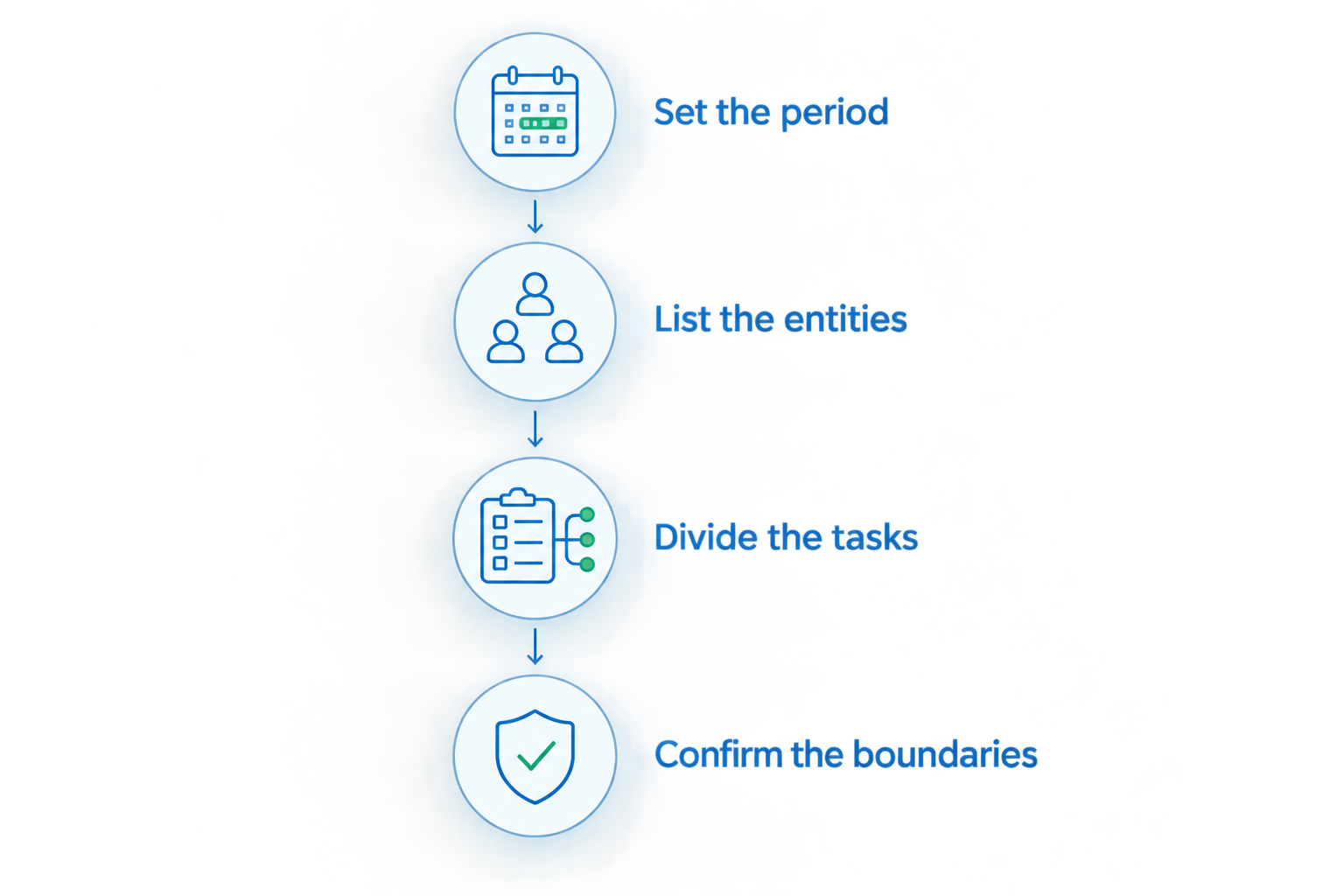
How do you get a quote you can compare?
Give every accountant the same information and ask for the same written breakdown. This keeps the conversation focused on what your business needs rather than on differently named packages.
01. Set the period
State which financial year the work covers and whether you need ongoing support after that period. For a 2026 engagement, distinguish outstanding work from future recurring tasks.
Prepare 12 months of records for an annual engagement, along with an explanation of any missing periods. Tell the accountant about incomplete reconciliations before asking for a final scope.
02. List the entities
Identify every business entity involved and whether you also want personal tax work included. Include related entities that require separate attention rather than assuming they sit within a business-wide quote.
An entity list is more useful than describing the engagement as simply small-business tax. It gives both sides something specific to check.
03. Divide the tasks
List bookkeeping, BAS, payroll, annual accounts, tax returns and advice separately. Against each task, name the person responsible: you, an employee, your bookkeeper or the accountant.
This step exposes both gaps and duplication. It also prevents an outsourced task from being counted again in another provider’s engagement.
04. Confirm the boundaries
Ask what triggers additional work, how that work is authorised and whether you receive an updated scope before it starts. Also confirm how routine questions are handled.
If you collect 3 written quotes, compare the same task list across all 3. The number of proposals matters less than making their inclusions genuinely comparable.
When should you move beyond annual tax help?
Move beyond annual tax preparation when the unresolved work happens during the year. Recurring bookkeeping problems, unclear payroll ownership or financial reports you cannot use are scope issues, not simply year-end tax questions.
The decision about hiring a small business accountant should identify which responsibilities need an owner before comparing proposals. If your immediate problem is incomplete records, define the bookkeeping work; if it is a decision about expansion, define the advisory question.
Keep those needs separate even when one firm handles them. That makes it easier to understand what you receive and to assess whether the engagement is working.
Do not add services because they appear in a proposal. Add them because a named task, obligation or decision needs support, then confirm who will deliver it and what you must provide.
Is a fixed fee better than hourly billing?
Neither billing method replaces a clear scope. A fixed fee defines an amount for agreed work; hourly billing charges for time spent under the agreed terms.
For your 2026 comparison, examine the boundaries before choosing the billing method:
Billing option | Best for | Advantage | Limitation to check |
|---|---|---|---|
Fixed fee | Work that can be clearly defined upfront | Makes the agreed commitment clear | Additional tasks require an agreed variation process |
Hourly billing | Work whose extent is difficult to establish initially | Connects billing to time spent | The final commitment depends on the work required |
With a fixed-fee proposal, ask what assumptions underpin it. With hourly billing, ask how progress and time spent will be communicated and when further authorisation is required.
A monthly payment arrangement is a separate question. Confirm whether it pays for ongoing monthly services or spreads payment for a defined annual engagement; the payment schedule alone does not describe the service.
Does the quoted fee include BAS and bookkeeping?
BAS and bookkeeping are included only when the engagement names them. An annual tax return uses accounting records, but preparing that return is not the same task as maintaining the records.
Ask who reconciles bank accounts, resolves unexplained transactions and prepares the information for BAS. If you handle those tasks internally, clarify what checks the accountant performs before relying on the figures.
This division also matters when records need correction. Agree whether corrections belong to the existing bookkeeping scope or require separately authorised work, rather than discovering the boundary after preparation has started.
Can you reduce the work without removing useful support?
Yes. Start by removing duplicated tasks and giving the accountant complete, organised records rather than cutting every service from the proposal.
Keep supporting documents accessible, answer queries together where practical and nominate someone who can resolve questions about business transactions. Ask the accountant which recurring record problems need attention, then assign responsibility for fixing them.
The objective is not to do accounting work you are unequipped to handle. It is to stop paying attention to the same unresolved issue repeatedly while preserving the compliance and advice your business actually needs.
What should you confirm before accepting?
Before signing, read the proposal as a division of responsibilities. You should be able to explain what the accountant does, what remains with you and how either side requests a change.
Check these points:
The entities and financial periods are named.
Each return, report and recurring task is listed.
Your record-keeping and approval responsibilities are clear.
Existing bookkeeping or payroll arrangements are recognised.
Extra work requires an agreed authorisation process.
Questions, review meetings and advice have defined boundaries.
Daintree Consulting suits Australian businesses seeking tax compliance alongside bookkeeping and advisory support. The relevant decision is which of those services belongs in your engagement, not whether every available service should be included.
Clarify your accounting scope
Discuss the tax, bookkeeping and advisory responsibilities your business needs covered.
FAQ
What's included in a small-business tax accountant fee?
A small-business tax accountant fee covers the work specified in the engagement. Confirm the entities, accounts and returns included, and whether bookkeeping, BAS, payroll and advice are separate.
Is a sole trader's tax return the same as a company tax return?
A sole trader's business income is reported through the individual's tax return, while a company lodges its own company tax return. Ask the accountant to identify the returns required for your structure.
Does paying monthly mean bookkeeping is included?
Monthly payment does not establish that bookkeeping is included. Check whether the arrangement covers recurring services or spreads payment for an annual engagement.
How many BAS statements should my accounting quote cover?
4 quarterly BAS statements should be addressed if your business lodges quarterly throughout the year. Confirm your actual lodgement frequency and who prepares, approves and lodges each statement.
Can I keep my bookkeeper and hire a separate tax accountant?
You can keep your bookkeeper and engage a separate tax accountant. Define who reconciles the records, resolves queries and makes year-end adjustments so responsibilities do not overlap.
Does Daintree Consulting provide more than tax services?
Daintree Consulting provides accounting, bookkeeping, payroll, tax and BAS compliance, audit and assurance, SMSF accounting, business advisory and outsourced CFO services. Confirm which services are included in your proposed engagement.
One last thing
Your payment frequency is not your service frequency. A monthly invoice does not, by itself, mean someone reviews your records or speaks with you every month.
Before accepting a 2026 proposal, ask what happens between tax returns. The answer should name the tasks, responsibilities and agreed contact arrangements—not merely describe how you pay.
Related guides
Talk to Daintree about your tax and BAS
Our ex-Big 4 team gives clear, senior-reviewed advice so you can act with confidence.
Book a free consultation →
Or explore our tax and BAS services.
