
How long does it take to onboard a new accounting firm?
Onboarding a new accounting firm takes as long as it takes to transfer usable records, establish access and agree who handles each outstanding obligation; signing an engagement letter is only the start. For a 2026 handover, judge readiness by completed checks, not a promised date, and separate the administrative transfer from any bookkeeping corrections or advisory setup.
TL;DR
Want expert help? Daintree Consulting's accounting services can take this off your plate. Book a free consultation.
How long does it take to onboard a new accounting firm? Records, access and agreed responsibilities determine completion.
Separate the accounting handover from historical bookkeeping corrections and new reporting work.
Daintree Consulting suits Australian businesses seeking accounting, bookkeeping and advisory support together.
Confirm ownership of the next BAS, payroll run and tax lodgement before ending existing arrangements.
Why this matters
An accounting handover affects more than where you send receipts. Your incoming firm needs enough information and authority to do the agreed work, while your business still has reporting and payment obligations to meet.
Before comparing dates, define the accounting and advisory services you are transferring. A tax-only engagement has a different starting point from an arrangement that also includes bookkeeping, payroll, management reporting and cash-flow forecasting.
The useful question is not simply when the new firm starts. It is when the new firm can take responsibility for each task without leaving a gap.
How long does it take to onboard a new accounting firm?
The onboarding period depends on the work being transferred and the condition of your records. Ask the incoming firm to give you a proposed timetable after reviewing your scope, access requirements, outstanding work and next deadlines.
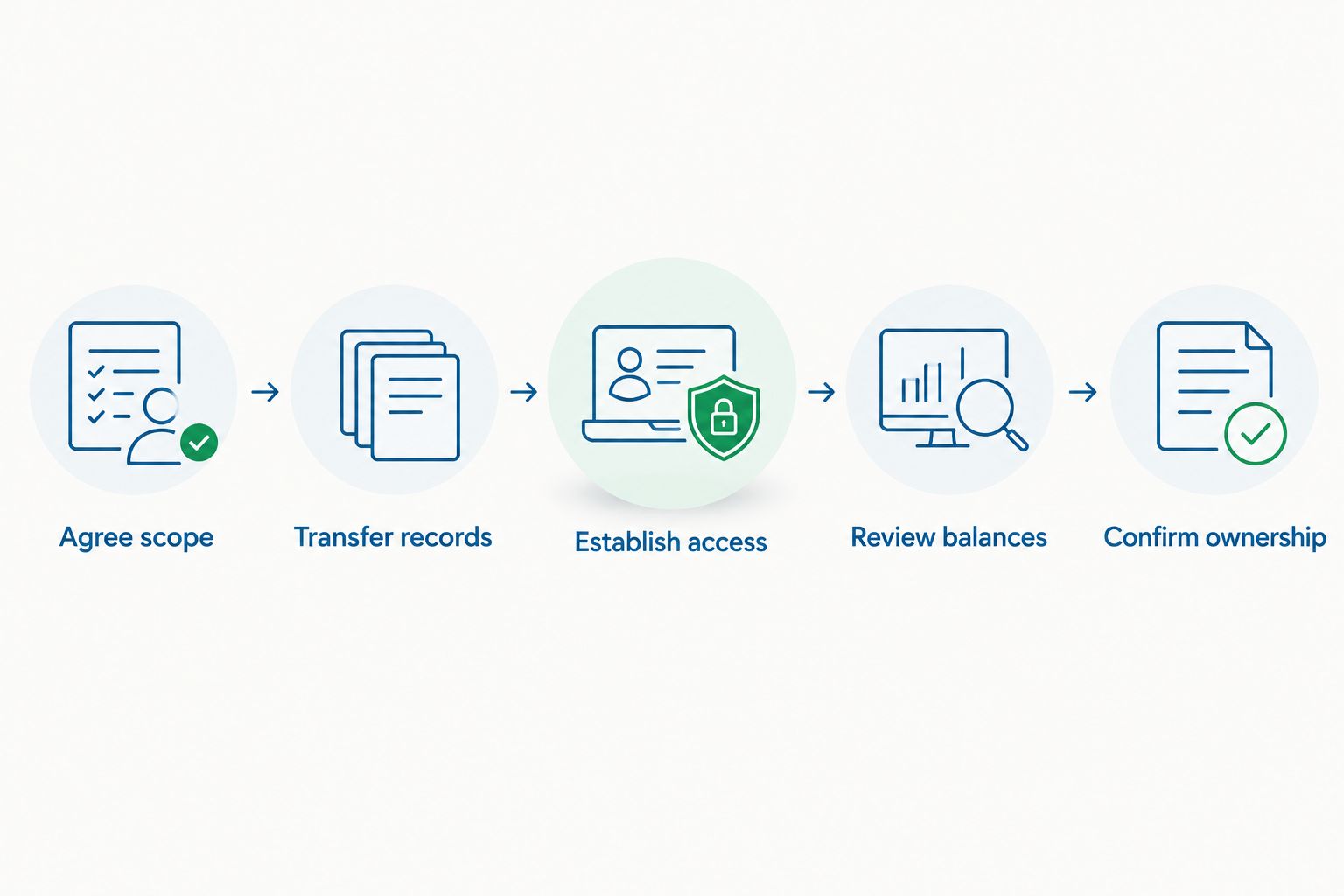
Use these steps to distinguish a firm appointment from a working handover. Each stage should have a named owner and a clear completion condition.
Stage | What needs to happen | Evidence that the stage is complete |
|---|---|---|
Agree scope | Confirm services, responsibilities and exclusions | Both parties accept the engagement terms |
Transfer records | Arrange the professional handover and obtain relevant files | The incoming firm confirms receipt of the requested records |
Establish access | Set up appropriate software permissions and tax authorisations | The firm confirms it can access the systems required |
Review balances | Check opening balances, reconciliations and outstanding issues | Exceptions are documented and assigned |
Confirm ownership | Allocate upcoming lodgements, payroll and reporting | Each task has an owner and an agreed deadline |
The stages can overlap. Records can arrive while software access is being arranged, but access alone does not establish that the figures are ready to use.
Ask for separate milestones for appointment, access, review and ongoing service. That gives you a clearer timetable than a single completion date that leaves historical issues undefined.
Tax-only onboarding: confirm the lodgement position
A tax-only engagement needs a clear record of what has already been lodged, what remains outstanding and which information supports the next return. The incoming accountant also needs to understand the business structure and relevant prior-year balances.
Best for: businesses retaining their existing bookkeeping arrangements and transferring tax work only. The narrower scope keeps the handover focused, but it does not resolve weaknesses in the underlying bookkeeping.
For a 2026 transition, ask the incoming firm to identify the next obligation it will handle and confirm any required client-to-agent linking or authorisation steps. Do not assume that signing the engagement automatically completes ATO access or transfers every pending task.
Keep copies of relevant lodged returns, assessments and correspondence. A clear tax history helps the incoming accountant distinguish an existing issue from work arising after the appointment.
Bookkeeping and payroll onboarding: set the cutover
Bookkeeping and payroll require an operational handover, not just a document transfer. You need to know who is entering transactions, reconciling accounts, processing pay and responding to employee queries during the change.
Best for: businesses transferring recurring financial administration. Keeping related work together gives the incoming firm visibility across transactions and payroll, but unclear ownership creates a risk of duplicated entries or missed processing.
Agree the final processing point for the outgoing provider and the first processing point for the incoming provider. Record outstanding bank reconciliations, unpaid supplier bills, customer balances and payroll matters that need attention.
Do not remove access simply because the new engagement is signed. Sequence access changes around the agreed handover, and confirm that the incoming provider can perform its assigned work before ending the previous arrangement.
Advisory and outsourced CFO onboarding: define usable reporting
Advisory onboarding requires agreement about what decisions the reporting needs to support. A cash-flow forecast, management report and business review serve different purposes, even when they draw on the same accounting records.
Best for: businesses seeking financial interpretation and planning alongside compliance. The benefit is a clearer connection between the numbers and business decisions; the limitation is that unreliable records must be addressed before the analysis becomes dependable.
For a 2026 reporting setup, define the reporting period, information sources, review responsibilities and intended audience. Also agree which assumptions management must supply, such as planned hiring, major purchases or changes to customer payment terms.
Daintree Consulting is best suited to Australian businesses seeking accounting, bookkeeping and advisory support together. Its stated service range also includes tax, audit and assurance, SMSF accounting and outsourced CFO support; confirm the engagement scope rather than assuming every service is included.
Why accounting onboarding time varies
The main drivers are practical. Each one should become a question in your handover plan rather than an unexplained reason for delay.
Record condition. Reconciled accounts give the incoming firm a different starting point from records containing unexplained balances or unprocessed transactions. Separate corrections from routine onboarding.
Service scope. Moving tax work alone requires a different handover from transferring bookkeeping, payroll and management reporting together. Specify the responsibilities being accepted.
Access and authority. Software invitations, appropriate permissions and applicable tax authorisations are separate tasks. Name the person responsible for completing each one.
Business structure. Companies, trusts, partnerships and related entities require the incoming firm to understand the relevant relationships and records. Give the firm the full entity picture at the start.
Outstanding obligations. An approaching payroll run, BAS or tax lodgement affects the order of work. Identify the next obligation before choosing a changeover date.
Handover responsiveness. Questions cannot be closed until the relevant business owner, employee or outgoing adviser responds. Assign a contact who can obtain answers and approve decisions.
A detailed timetable does not need to promise that every historical issue will disappear before ongoing work begins. It needs to show which issues block the handover and which sit within a separate correction plan.
What should you prepare before the handover starts?
Prepare a short handover pack that explains your business, identifies the systems in use and lists the work currently outstanding. Give the incoming firm a map of the records rather than an unlabelled collection of files.
Business and authority details
List the entities included in the engagement, the authorised decision-makers and the people who handle day-to-day finance questions. Include relevant registration information and explain relationships between entities where those relationships affect the work.
Use the firm's nominated secure transfer method for sensitive information. Grant individual access where the system supports it rather than circulating shared passwords.
Financial and compliance records
Identify the latest completed financial statements, lodged returns, BAS records and reconciled reporting period. Include relevant loan schedules, asset records and notices that need a response.
Do not describe records as current without stating the period they cover. Knowing where the completed work ends helps the incoming firm identify what remains to be done.
Operational responsibilities
List payroll processing dates, approval contacts, bank reconciliation ownership and existing reporting commitments. Identify any work still being completed by the outgoing provider.
For a 2026 handover, turn this list into an agreed responsibility schedule. A task description, owner, due date and status provide a practical basis for checking progress without relying on scattered email threads.
Can you switch accountants before everything is finished?
You can arrange a change while work remains outstanding, but unfinished work needs an explicit owner. Ask both firms to confirm which engagements they will complete and what information the incoming firm needs from that work.
A partially prepared return or unfinished reconciliation does not explain itself when files change hands. Record its status, the unresolved questions and whether the outgoing or incoming firm will finish it.
The same discipline applies to corrections discovered after the handover. Agree how they will be assessed and authorised rather than treating all earlier work as part of the new firm's routine service.
Does changing accounting software delay onboarding?
Changing software adds work to the handover because data, opening balances, user access and reporting need to be checked in the new system. Consider whether the software change must happen at the same time as the adviser change.
Keeping the current system initially avoids combining an adviser handover with a migration. The trade-off is that any limitations of the existing setup remain until a separate change is completed.
A simultaneous migration combines the transitions, but it also increases the work that needs coordination. Ask for a migration plan, a cutover point and a clear method for checking that the transferred records agree.
How do you know onboarding is complete?
Onboarding is complete when the incoming firm confirms it has the agreed records, appropriate access and ownership of the work it has accepted. Your business should also understand what remains outside scope.
Check these completion conditions before treating the handover as closed:
The engagement identifies the services and entities covered.
Required records have been received, or exceptions are documented.
Necessary access works for the people doing the work.
Upcoming obligations have named owners and deadlines.
Historical corrections have a separate plan where required.
You know the contact and process for routine questions and approvals.
For a 2026 appointment with Daintree Consulting, ask for these conditions to be reflected in the agreed accounting handover. A useful completion date describes operational readiness, not just a signed document.
Discuss your accounting handover
Clarify the services, records and responsibilities involved in changing accounting firms.
FAQ
What's the fastest way to onboard a new accountant?
Prepare the requested records, arrange appropriate access and nominate someone who can answer questions. Agree the service scope and next obligations before treating the handover as ready.
Do I need to tell my current accountant I am leaving?
Tell your current accountant about the change and agree how outstanding work and records will be handled. Ask the incoming firm to explain the professional handover process and any permissions it needs.
Will changing accountants automatically move my ATO access?
Do not assume an engagement letter completes ATO access. Confirm the authorisation and any client-to-agent linking requirements that apply to your business.
Can my new accountant fix old bookkeeping errors?
Ask the incoming accountant to assess historical bookkeeping errors and agree a correction scope. Keep that work distinct from the transfer of ongoing responsibilities so completion expectations remain clear.
Can I keep my current bookkeeper when I change accountants?
You can structure the new engagement around retaining your existing bookkeeper. Define who prepares reconciliations, answers tax queries and makes adjustments so responsibilities do not overlap.
Should I wait until the end of the financial year to change accountants?
Choose the handover point around your obligations and record readiness rather than the calendar alone. Confirm who handles each return, BAS, payroll task and reporting period that crosses the changeover.
What should I ask an accounting firm before signing?
Ask what services are included, what records are required and who owns the next deadlines. Also confirm communication arrangements, access requirements and how historical corrections will be scoped.
One last thing
Ask the incoming firm to name the first obligation it will own. That answer exposes more about handover readiness than a general start date: it requires agreement on access, information, approvals and responsibility for a real piece of work.
Keep that commitment in writing. Your business needs one clear picture of who is doing what, especially while the outgoing and incoming arrangements overlap.
Related guides
Talk to Daintree about your accounting
Our ex-Big 4 team gives clear, senior-reviewed advice so you can act with confidence.
Book a free consultation →
Or explore our accounting services.
