
How long does it take to get a tax refund from the ATO?
The ATO usually processes online tax returns within 2 weeks in 2026; paper returns can take up to 10 weeks. These are processing timeframes, not guaranteed bank-deposit dates: return reviews, identity checks, debt offsets and payment issues can delay or change your refund.
TL;DR
Want expert help? Daintree Consulting's tax and BAS services can take this off your plate. Book a free consultation.
How long does it take to get a tax refund from the ATO? Usually 2 weeks for online returns.
Paper tax returns can take up to 10 weeks to process; neither timeframe guarantees a bank-deposit date.
Check your notice of assessment, account transactions and bank details before treating an expected refund as available cash.
Daintree Consulting provides tax compliance support for Australian businesses; the ATO controls return processing and refund release.
Why this matters
An estimated tax refund is not money you can spend yet. Lodging a return starts the assessment process; it does not confirm that the ATO has accepted your calculation or released a payment.
For your 2026 cash-flow planning, keep an expected refund separate from cleared funds. If you need help checking the return itself, distinguish accounting and tax services from an ATO processing enquiry: your adviser can explain your lodgement and assessment, but cannot promise a payment date.
How long does it take to get a tax refund from the ATO?
Most online tax returns process within 2 weeks, while paper returns can take up to 10 weeks. The ATO’s published guidance on checking tax-return progress gives these standard processing timeframes; an individual return can take longer if it needs further attention.
Two weeks means 14 calendar days, not 14 business days. Count from when your return was lodged with the ATO, rather than when you uploaded documents, signed an authority or sent information to your accountant.
Lodgement method | Standard processing timeframe | Best for | Main benefit | Main limitation |
|---|---|---|---|---|
Online return, including electronic lodgement by a registered tax agent | Most process within 2 weeks | Taxpayers using an electronic lodgement method | Shorter standard processing timeframe | Reviews and checks can extend processing |
Paper return | Can take up to 10 weeks | Taxpayers lodging a paper form | Provides a paper lodgement route | Longer processing timeframe; postal delivery adds time before receipt |
These timeframes describe processing, not a guaranteed refund entitlement. You receive a refund only if your assessed position produces a credit that is available for payment after any applicable offsets or adjustments.
Start with the actual lodgement date
Before deciding a refund is late, confirm that your return was submitted successfully. A saved draft, an accountant’s completed working papers and a signed declaration are not the same as a lodged return.
If a tax agent lodged for you, ask for confirmation of the lodgement date. That gives you a clear starting point for checking progress without guessing from the date of your appointment.
Online tax returns: usually within 2 weeks
Online lodgement has the shorter standard processing timeframe. This includes returns lodged through myTax and returns lodged electronically by a registered tax agent.
A tax agent’s involvement does not create a guaranteed fast-track refund. The ATO still assesses the return, checks information and decides whether further action is required.
For a straightforward online return in 2026, the usual 2-week window is a useful planning reference. It is not a deadline the ATO guarantees for every taxpayer.
Check progress through ATO online services linked to myGov, or ask your tax agent to check the return’s status. Read any explanation attached to that status before assuming that a lack of payment means something has gone wrong.
Paper tax returns: up to 10 weeks
Paper returns have a longer processing window: up to 10 weeks. Allow for postal delivery as well, because posting a return and the ATO receiving it are different events.
If you lodge on paper, retain a copy of the return and evidence of posting. These records help establish what you sent and when if you later need to follow up.
The longer timeframe does not mean your refund is being disputed. It means the paper processing pathway takes longer, although the same identity, assessment and payment checks can still apply.
Avoid lodging another copy simply because the first return has not produced a payment. Check its status first; a duplicate return is not a way to move an existing lodgement ahead.
Why ATO tax refund timing varies
A correctly lodged return can still need additional attention. The useful question is not simply whether the refund is late, but which stage needs attention and whether you need to act.
Information checks: The ATO checks reported income and other information against records it holds. A discrepancy can require further review.
Identity checks: The ATO can ask you to verify your identity before completing processing or releasing a refund.
Return reviews: Claims or circumstances that need closer examination can extend processing beyond the usual timeframe.
Outstanding returns: Unlodged returns can affect whether a credit is available for refund. Check whether the ATO has requested another lodgement.
Debt offsets: A credit can be applied against eligible outstanding debts rather than paid entirely into your bank account.
Payment details: Incorrect or outdated financial institution details can prevent a refund reaching the intended account.
A delay alone does not establish that your deductions were rejected or that you are being audited. Read the actual correspondence and account information before drawing that conclusion.
Respond to a specific request, rather than repeatedly resubmitting the same information. If the ATO asks for supporting records, provide the requested material through the stated channel and retain a copy.
How do I check where my ATO refund is?
Use the following sequence to separate a lodgement problem from an assessment or payment issue. For a 2026 return, check the correct financial year and taxpayer account before interpreting any balance.
1. Confirm lodgement
Check that the return was lodged successfully and note the date. If an accountant prepared it, confirm that preparation has progressed to actual submission.
2. Check progress
Open ATO online services through your linked myGov account and check your tax-return progress. If a registered tax agent lodged the return, ask the agent to explain the current status and any outstanding action.
3. Read correspondence
Look for requests for information, identity verification or other action. Do not rely only on a refund estimate displayed when you prepared the return.
4. Review assessment
Read your notice of assessment when it becomes available. Compare the assessed result with your expected refund, then check your account transactions for credits, offsets or other adjustments.
5. Check bank details
Confirm that the ATO holds the correct BSB and account number for the refund. If a payment appears to have been issued but has not arrived, check the payment destination before treating it as a processing delay.
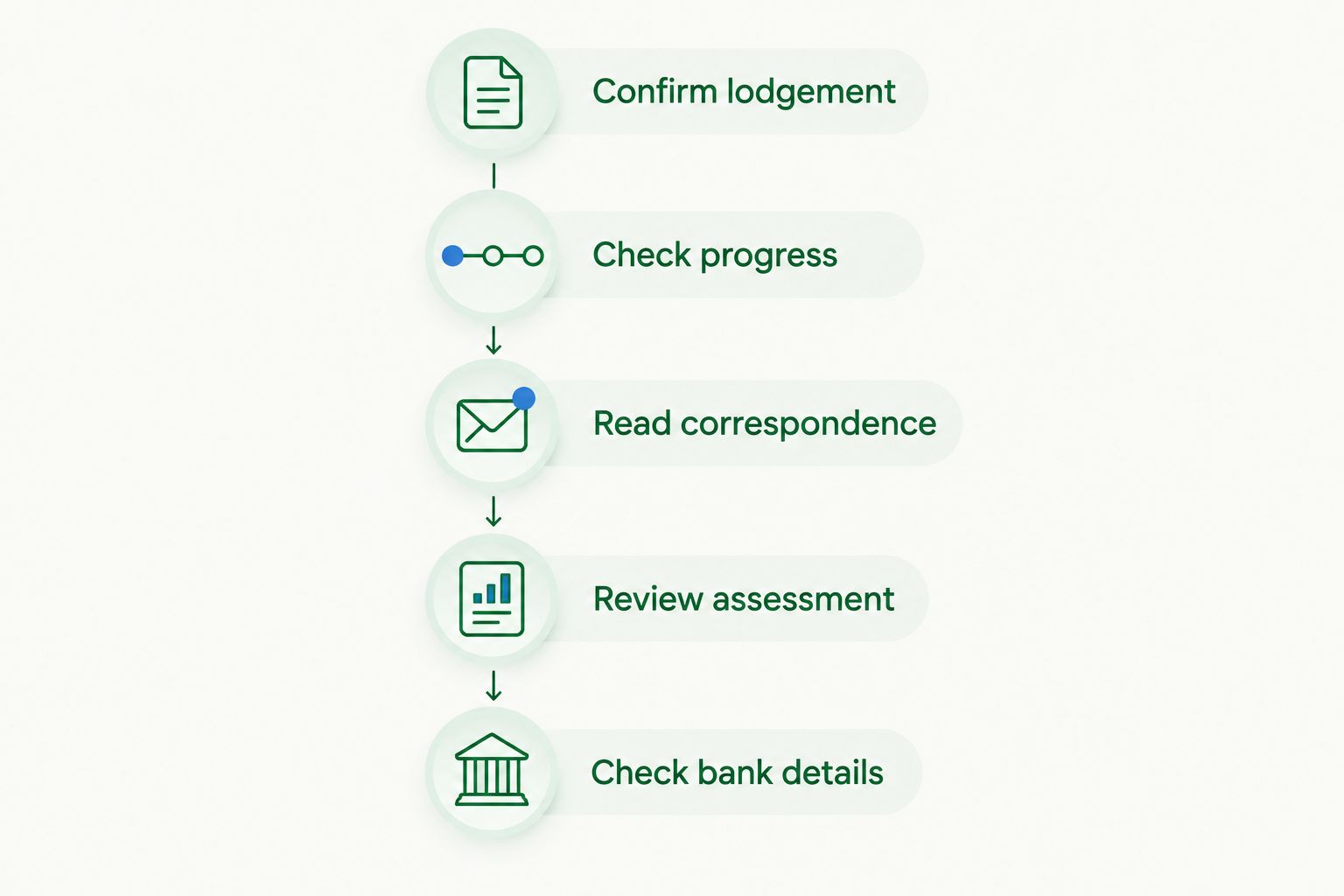
Keep the lodgement confirmation, relevant correspondence and assessment together. A clear record makes a follow-up more useful than a general enquiry about when the money will arrive.
Does processed mean the refund is in my bank account?
The usual 2-week online processing window is not a bank-deposit guarantee. A processed return and a cleared payment are separate events.
Check the notice of assessment to understand the tax outcome, then review account transactions to see what happened to the credit. A refund estimate, an assessed credit and an issued payment tell you different things.
If payment has been issued, confirm the destination account and allow for bank processing. Do not lodge an amendment merely because the deposit has not appeared; an amendment changes the return, not the bank’s payment handling.
When should I follow up on a delayed refund?
After the usual 2-week online or 10-week paper processing window, check progress before making an enquiry. A return that needs review can take longer, so first look for a status explanation or an unanswered request.
Have the lodgement date, relevant financial year, current status and any ATO correspondence ready. If the ATO has given you a specific timeframe or instruction, use that when deciding your next step.
Contact your tax agent if the agent lodged the return, or use the ATO’s official contact options. Do not use phone numbers or payment instructions supplied in an unexpected refund message without independently checking them.
Can a tax agent get my refund faster?
The usual 2-week online timeframe also applies to electronically lodged agent returns; using an agent does not guarantee faster processing. An agent’s practical role is to prepare the return correctly, explain the assessment and help respond to queries.
For a business owner, the more useful question is whether the tax return agrees with the underlying records. Unreconciled accounts, missing information or misunderstood adjustments need attention before lodgement, not a promise of faster payment afterwards.
Daintree Consulting suits Australian businesses seeking tax compliance and ongoing accounting support. Its accounting, bookkeeping and advisory services address the records and decisions behind a return; ATO review and refund timing remain outside the firm’s control.
Get clarity on your tax position
Explore tax compliance and accounting support for your Australian business.
FAQ
How long does an ATO refund take after online lodgement?
Most online tax returns process within 2 weeks. That is a processing timeframe, not a guarantee that the refund will be in your bank account by that date.
Are the ATO’s 2 weeks business days or calendar days?
Two weeks means 14 calendar days, not 14 business days. Count from actual lodgement with the ATO, rather than when you started preparing the return or sent documents to your accountant.
Why is my ATO refund smaller than the estimate?
Your final refund can differ because the assessment changes your tax position or a credit is applied against eligible outstanding debts. Read the notice of assessment and account transactions to identify the reason.
Should I lodge my tax return again if my refund is late?
No—check the existing return’s lodgement and processing status first. A duplicate lodgement does not fast-track processing; use an amendment only when information in the lodged return needs correcting.
Can the ATO keep my refund to pay a debt?
The ATO can apply a credit against eligible outstanding debts before paying any remaining refund. Check the account transactions rather than assuming the entire assessed credit will reach your bank account.
Does a delayed refund mean I am being audited?
A delayed refund does not, by itself, mean you are being audited. Check the return status and correspondence to establish whether the ATO needs information or is conducting a review.
Can Daintree Consulting help with my business tax return?
Daintree Consulting provides tax compliance and accounting services for Australian businesses. Advice can help you understand your return and assessment, but it cannot guarantee an ATO refund amount or release date.
One last thing
A larger refund is not automatically a better tax outcome. A refund reflects the relationship between your assessed liability and amounts already paid or credited; it is not a separate reward for lodging.
For your 2026 planning, understand both the refund and the payments that created it. If tax instalments repeatedly leave your business short of working capital, discuss the underlying forecast rather than making a late refund part of your normal cash-flow plan.
Related guides
Talk to Daintree about your tax and BAS
Our ex-Big 4 team gives clear, senior-reviewed advice so you can act with confidence.
Book a free consultation →
Or explore our tax and BAS services.
