
How long does an ASIC company registration take?
Allow 2 business days for ASIC company registration through the Australian Government’s Business Registration Service when your application is complete and the proposed name is available. That processing window does not include time spent preparing your application, resolving queries or arranging separate tax registrations. For a 2026 launch, treat company registration as a milestone—not confirmation that your banking, payroll and tax arrangements are ready.
TL;DR
Want expert help? Daintree Consulting's business advisory services can take this off your plate. Book a free consultation.
How long does an ASIC company registration take? Allow 2 business days for a complete Business Registration Service application.
Name reviews, incorrect details and missing consents can delay your company registration.
An ACN confirms company registration; an ABN and tax registrations serve different purposes.
Daintree Consulting suits Australian businesses seeking accounting and advisory support alongside company setup.
Why this matters
Your company’s registration date affects when it exists as a legal entity. It does not tell you when a bank will finish checking your application or when every tax registration will be confirmed.
Daintree Consulting provides accounting and advisory services for Australian businesses. The practical priority is to separate the registration deadline from the date you need the business ready to operate.
Plan backwards from your first business commitment, not just the application submission date. If you need to sign a lease, engage employees or invoice a customer, identify which registrations and approvals that activity requires before promising a start date.
How long does an ASIC company registration take?
The Australian Government’s Business Registration Service advises that applicants should receive confirmation within 2 business days when the company name is available and the application is completed correctly. That is a processing guide, not a guaranteed deadline for every application.
For your 2026 setup timetable, distinguish these stages:
Stage | Best for tracking | What completion means | Limitation |
|---|---|---|---|
Preparation | Checking readiness before submission | You have agreed the structure and collected the required information | ASIC processing has not started |
Application submitted | Tracking the lodgement | The registration request has been sent | Submission alone does not create the company |
Company registered | Confirming legal existence | ASIC has registered the company and issued its ACN | Separate tax and banking tasks remain |
Operational setup | Checking readiness to trade | You have addressed the registrations and arrangements your activities require | Requirements differ between businesses |
The registration certificate is the evidence to look for. A payment receipt or an application reference confirms a transaction or submission, not necessarily a successful registration.
Does the processing window include weekends?
A business-day estimate is not the same as an elapsed-hours promise. Do not count a weekend or relevant public holiday as ordinary processing time when setting your deadline.
An application lodged before a weekend therefore needs a different timetable from one lodged early in a working week. Check the acknowledgement for the status of your application and any instructions requiring a response.
Does a company exist as soon as you submit the form?
No. Under the Corporations Act, a company comes into existence when ASIC registers it, rather than when an applicant starts or submits the form.
Avoid representing an unregistered company as already registered. If you need to enter a contract before registration, get legal advice about pre-registration contracts and responsibility for those commitments.
What needs to happen before you lodge?
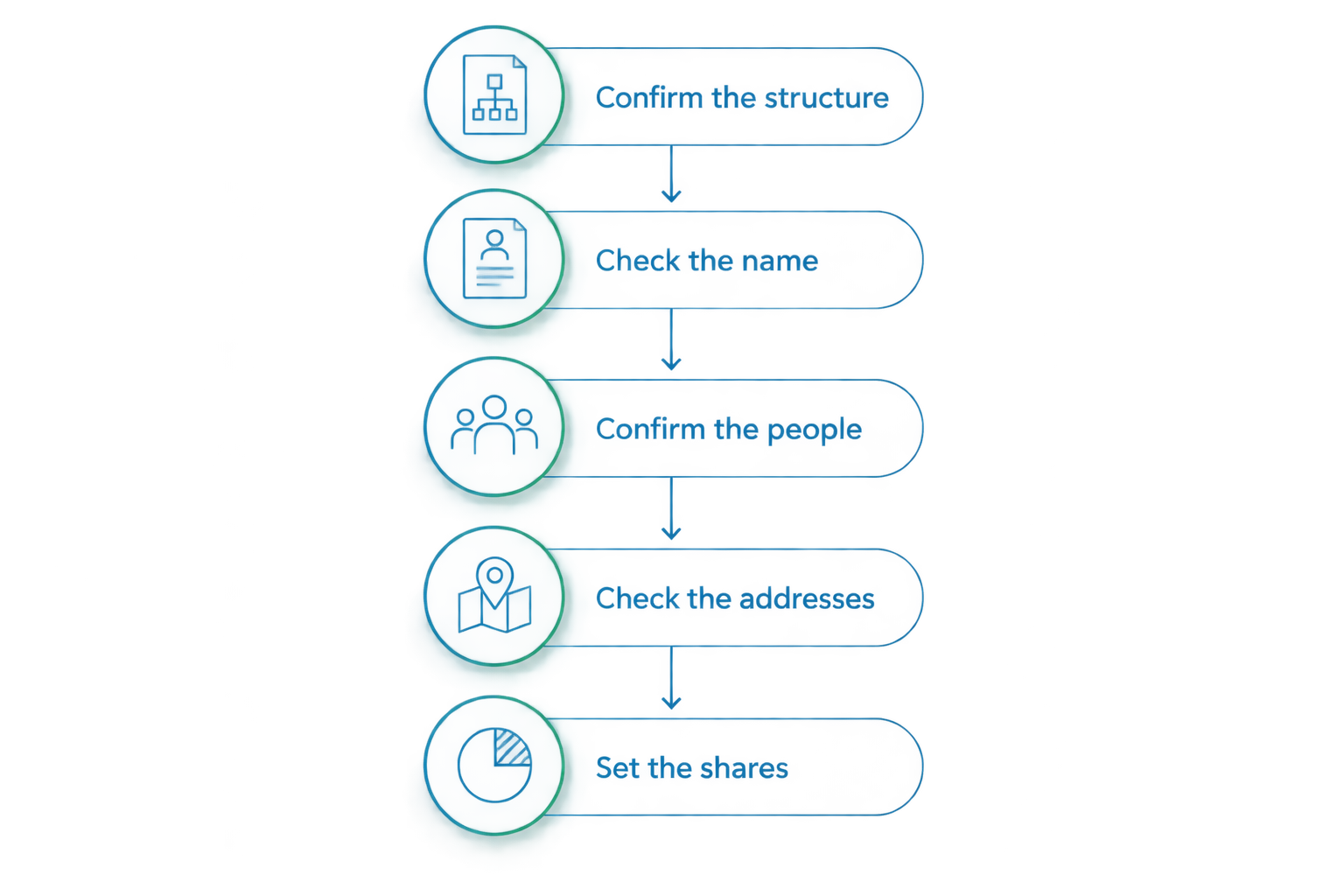
Preparation is the part of the timetable you can control most directly. For a 2026 application, settle the decisions below before opening the registration form rather than trying to resolve them while submitting it.
01. Confirm the structure
Decide whether a company is the appropriate structure for the business. Registration is an administrative process; choosing who owns and controls the business is a separate legal and financial decision.
A company creates obligations that differ from those of a sole trader. If the ownership arrangements are unclear, resolve them before lodging rather than treating registration as a way to decide later.
02. Check the name
Check the proposed company name against ASIC’s naming requirements. A name that appears available still needs to satisfy the registration rules, including restrictions on certain words and expressions.
You can also register a company using its Australian Company Number as its name. That does not remove the need to consider business-name registration if you intend to trade under another name.
03. Confirm the people
Collect accurate details for the directors, shareholders and any other required officeholders. Obtain the required written consents before registration and retain them with the company’s records.
Intending directors generally need their director identification number before appointment, subject to the applicable rules. Australian Business Registry Services administers director IDs separately from ASIC company registration.
04. Check the addresses
Confirm the registered office and principal place of business details. If the company does not occupy its proposed registered office, obtain the occupier’s written consent to use that address.
An address entered for convenience can create problems if important correspondence does not reach the right person. Choose arrangements that support reliable receipt and management of company notices.
05. Set the shares
Agree on the initial share structure and ownership details. Check the share classes, allocations and amounts against the intended ownership arrangements before submission.
Changing the structure afterwards involves additional decisions, records and potentially tax consequences. A quick registration is not a substitute for getting ownership right.
Why ASIC company registration time varies
A complete application and an application requiring a decision or correction do not follow the same path. The useful question is whether your application can proceed without further information.
Company name: A proposed name requiring assessment, consent or a different selection adds work before registration can proceed.
Restricted words: Certain words and expressions require approval. Check the naming rules before building your launch around a proposed name.
Application accuracy: Incorrect personal details, addresses or share information can require clarification or correction.
Application completeness: Missing information prevents the application from being assessed as a complete registration request.
Submission route: The time a service provider spends reviewing or preparing your application is separate from government processing.
Response time: If further information is requested, the application depends on you or your representative supplying it.
There is no useful universal deadline for resolving these issues. Read the specific request, confirm who must respond and supply a complete answer rather than repeatedly resubmitting the same details.
Can you register a company yourself or use an adviser?
You can apply through the Australian Government’s Business Registration Service or use a service provider. Choose the route according to the decisions you need help making, not an assumed difference in ASIC priority.
Route | Best for | Advantage | Limitation |
|---|---|---|---|
Apply yourself | Owners who have settled the structure and understand the requirements | You manage the application directly | You remain responsible for checking the details and requirements |
Use an adviser | Owners needing help with structure, ownership or accounting setup | Advice can connect registration with the wider business arrangements | Adviser preparation is a separate stage and does not guarantee ASIC approval |
Daintree Consulting’s accounting and advisory services are relevant when company setup raises questions about reporting, tax, bookkeeping or future growth. The firm is best suited to owners who want those financial arrangements considered together, rather than treating registration as an isolated form.
The boundary matters: accounting advice does not replace legal advice on shareholder rights or contractual arrangements, and appointing an adviser does not remove a director’s responsibilities. Confirm the engagement scope and who will lodge, monitor and respond to the application.
Does an ACN mean your ABN is ready?
No. An Australian Company Number and an Australian Business Number identify different registrations. ASIC issues the company’s ACN when registration is completed; the Australian Business Register administers ABNs.
An ACN has 9 digits. An ABN has 11 digits. Neither number, by itself, confirms that every tax registration your business needs has been completed.
For a 2026 launch, track these separately:
Company registration: Confirm the certificate, registered name and ACN.
ABN application: Check the application outcome rather than assuming company registration includes approval.
GST registration: Determine whether registration is required or appropriate, then confirm its effective date.
PAYG withholding: Address registration obligations before making payments that require withholding.
Banking: Complete the bank’s identity and company checks through its own process.
The Australian Business Register states that an ABN application requiring review can take up to 20 business days. That is a separate review timeframe, not an extension of ASIC’s company-registration estimate.
Keep each acknowledgement and outcome in the company records. A single checklist is useful, but each item needs its own evidence of completion.
What should you do if registration is taking longer?
Start with the application acknowledgement and the account or provider used to lodge it. Check whether the application is submitted, awaiting information, rejected or completed before taking another action.
Then work through the following steps:
Confirm the submission. Check that the application was actually lodged, rather than saved as a draft or left awaiting action.
Read the correspondence. Look for a request about the name, applicant details or another part of the form, including messages sent to your representative.
Assign responsibility. Decide who will respond so that the owner and adviser do not send conflicting instructions.
Follow up through the original channel. Use the application reference and ask what action is required.
Do not lodge a duplicate application simply because a confirmation email has not arrived. Establish the status of the existing application first.
For deadline-sensitive commitments in 2026, tell the other party that registration remains pending. A clear status update is more useful than a completion date you cannot confirm.
What documents should you keep after registration?
Keep the registration certificate and check its details against the approved application. Store the company’s governing documents, required consents and ownership records so they can be retrieved when needed.
Registration is also the start of ongoing administration. Allocate responsibility for ASIC correspondence, company records and accounting obligations instead of leaving those tasks with whoever happened to complete the application.
The handover is finished when someone owns the next deadline. Record who will monitor notices and maintain the company details when addresses, officeholders or ownership arrangements change.
FAQ
How long does an ASIC company registration take in Australia?
Allow 2 business days through the Australian Government’s Business Registration Service when the application is complete and the name is available. Applications requiring assessment or corrections take longer.
Can I register an Australian company on the same day?
Do not rely on same-day registration for a fixed business commitment. Use the published processing guidance and wait for confirmation that ASIC has registered the company.
Does ASIC process company registrations over the weekend?
Do not count weekends as business days when planning around a published processing window. Check your application acknowledgement for its status and any required action.
Will I receive my ABN when ASIC issues my ACN?
An ACN does not confirm ABN approval. ASIC company registration and Australian Business Register applications are separate processes, even when you apply through a combined service.
Do I need a director ID before registering a company?
An intending director generally needs a director ID before appointment, subject to the applicable rules. Check the Australian Business Registry Services requirements before lodging the company application.
Can an accountant guarantee faster ASIC registration?
An accountant cannot guarantee ASIC’s approval time. An adviser can help prepare accurate information and address setup questions, but government assessment remains separate.
What should I do if my company registration is delayed?
Check the original application status and correspondence before submitting anything again. Use the application reference to follow up through the service or representative that lodged it.
One last thing
An available company name is not trade mark clearance. Before investing in signage, packaging or a launch, check the name separately against relevant trade marks and obtain advice where necessary.
The fastest registration is not the best outcome if the ownership is wrong or the trading name creates a dispute. Settle those decisions first, then use the processing window to plan the remaining setup work.
Related guides
Talk to Daintree about your next business decision
Our ex-Big 4 team gives clear, senior-reviewed advice so you can act with confidence.
Book a free consultation →
Or explore our business advisory services.
