
How do you prepare financial statements for a bank loan?
To prepare financial statements for a bank loan in 2026, confirm the lender’s document requirements, reconcile your accounting records, and prepare consistent profit and loss, balance sheet and cash flow information. Separate historical results from forecasts, explain unusual transactions, and show how the proposed repayments fit your business’s cash flow; accurate statements alone do not establish borrowing capacity.
TL;DR
Want expert help? Daintree Consulting's business advisory services can take this off your plate. Book a free consultation.
How do you prepare financial statements for a bank loan? Reconcile records, prepare consistent reports and explain repayment capacity.
Keep historical financial statements, current management accounts and forecasts clearly labelled and separate.
Daintree Consulting suits Australian businesses seeking accounting and advisory support together.
Ask the lender which reporting periods, supporting documents and accountant involvement the application requires.
How do you prepare financial statements for a bank loan?
Start with the lender’s checklist, then build a financial pack that agrees with your underlying records. The objective is not to make the figures look stronger. It is to make your trading performance, financial position and repayment assumptions understandable.
If your records need attention before an application, Daintree Consulting provides accounting, bookkeeping and advisory services for Australian businesses.
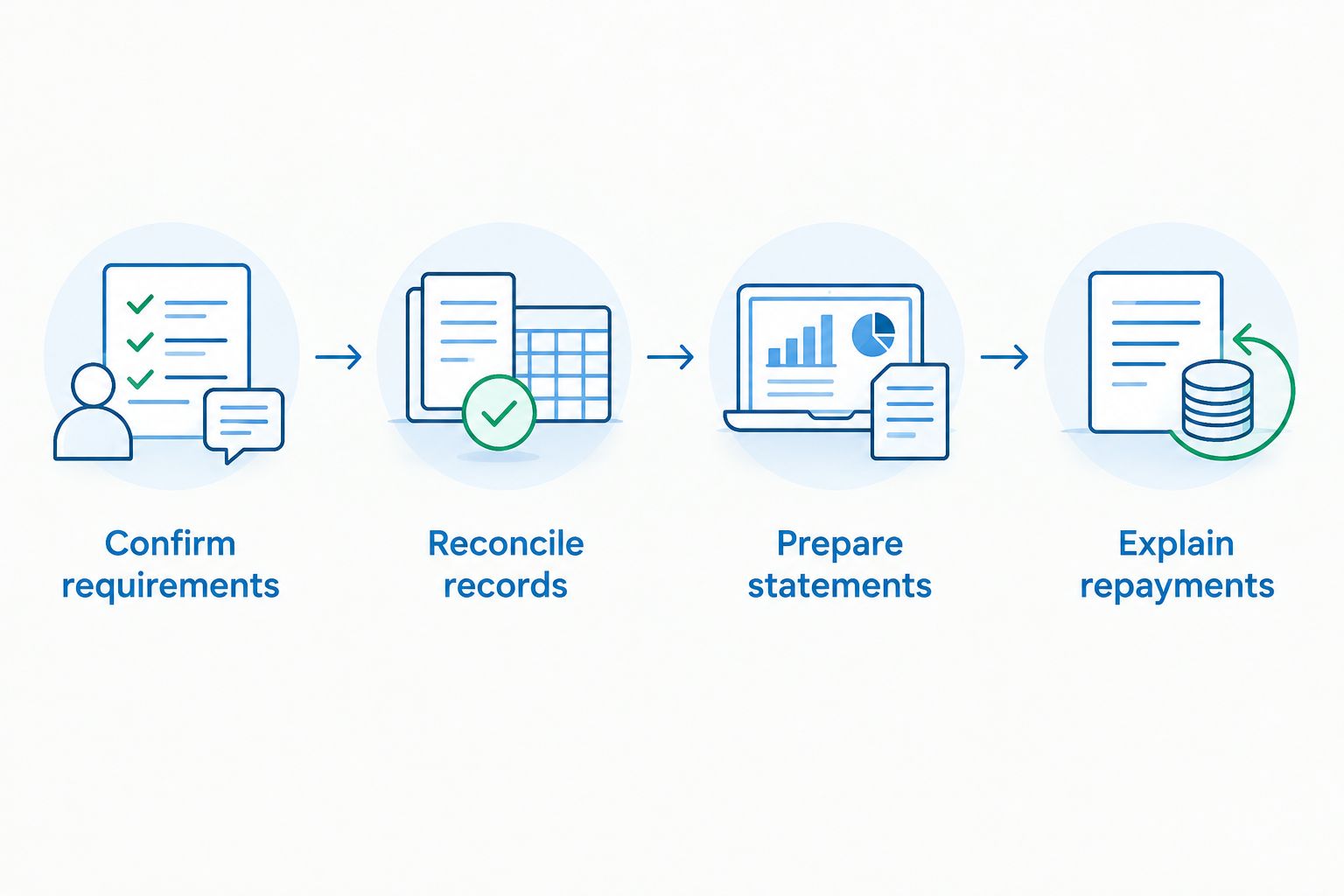
01. Confirm requirements
Ask the lender or your finance broker for the requirements for your specific application. Do this before commissioning reports: the documents needed depend on the borrower, lending product and assessment process.
Confirm:
Which legal entity is applying and whether related entities need to provide information.
Which completed financial periods and current reporting dates are required.
Whether the lender wants accountant-prepared statements, tax returns or other supporting documents.
Whether forecasts, existing debt schedules or security information are required.
How the documents should be submitted and who will answer follow-up questions.
Use the same legal entity name across the application and financial reports. A company’s accounts and its owner’s personal financial position are not interchangeable, even when the owner controls the company.
02. Reconcile records
Bring the bookkeeping up to date before generating reports. Reconcile bank accounts, credit cards and loan accounts to their statements, then check customer balances, supplier balances, payroll liabilities and tax accounts against supporting records.
Look beyond whether the bank balance agrees. A payment allocated to the wrong account can leave the bank reconciliation correct while distorting profit, liabilities or asset values.
Check for duplicate transactions, missing invoices, unreconciled transfers and private expenses recorded as business costs. Review inventory, fixed assets, depreciation and director or shareholder loan balances where relevant to your business.
Resolve errors in the accounting records rather than editing exported reports to conceal them. Keep explanations and supporting documents for any adjustments, especially where the updated figures differ from an earlier version supplied to the lender.
03. Prepare statements
Build the financial pack around 3 core statements: the profit and loss statement, balance sheet and cash flow statement. Confirm which statements the lender requires, rather than treating this list as a universal submission rule.
Profit and loss statement: shows income, expenses and profit over a reporting period. Check that revenue and costs belong to the stated period and that unusual items are identifiable.
Balance sheet: shows assets, liabilities and equity at a particular date. Check cash, receivables, inventory, borrowings and tax balances against their supporting schedules.
Cash flow statement: explains movements in cash through operating, investing and financing activities. It helps distinguish trading cash generation from borrowing or owner contributions.
A full financial year normally covers 12 months, but interim accounts cover a shorter period. Label the dates clearly so a reader does not compare a partial year with a full year as though they were equivalent.
For example, a profit and loss statement labelled ‘year ended 30 June 2026’ describes activity over a period. A balance sheet labelled ‘as at 30 June 2026’ describes the position on that date. Those labels are not interchangeable.
04. Explain repayments
Show how the proposed borrowing affects cash, debt and repayments. If the lender requests a forecast, connect its opening balances to the latest actual accounts and identify the assumptions behind sales, margins, payment timing and expenditure.
Include existing commitments as well as the proposed facility. Loan principal repayments reduce cash and the outstanding liability; they are not an operating expense in the profit and loss statement. Interest is treated separately.
Explain what the borrowed money will fund and when that spending occurs. An equipment purchase, for example, affects cash and assets differently from an ordinary operating expense.
A repayment forecast must explain timing, not just show an annual profit. Map customer receipts, supplier payments, wages, tax obligations and debt servicing to the periods when cash actually moves.
Why this matters
Profit and available cash answer different questions. Your business can report a profit while cash remains tied up in unpaid customer invoices, inventory or asset purchases.
For a 2026 loan application, the financial pack should let the lender trace reported performance to the balance sheet and understand the cash available for commitments. Clear explanations do not guarantee approval, but they give the lender a coherent basis for assessment.
Which financial reports belong in the application?
Historical accounts, management accounts and forecasts serve different purposes. Use each for the question it answers; do not present a forecast as evidence of completed trading. The lender’s checklist determines which documents belong in your application.
Report | Best for | What it contributes | Limitation |
|---|---|---|---|
Historical financial statements | Explaining completed reporting periods | Recorded performance and financial position | Do not show trading after their reporting date |
Current management accounts | Explaining recent trading | An updated view since the last completed period | Require reconciliations and appropriate adjustments |
Cash flow forecast | Explaining planned repayment capacity | Expected receipts, payments and funding needs | Depends on assumptions rather than completed transactions |
Historical financial statements
Use completed accounts to explain the business’s recorded results and position. Include comparative figures where required, and explain material changes rather than leaving the reader to infer their cause.
If a completed period includes an unusual expense or income item, identify it separately in an explanation. Do not remove genuine transactions from the accounts simply because they weaken the lending presentation.
Current management accounts
Use current accounts to bridge the gap between the last completed financial period and the application date. State the reporting cut-off and whether year-end-style adjustments, such as depreciation or accrued expenses, have been included.
For an application made during 2026, a completed financial year and the current year-to-date period describe different stretches of trading. Use comparable periods when explaining growth, margin changes or seasonality.
Cash flow forecast
Use a forecast to show how future receipts and payments interact with the proposed borrowing. Distinguish confirmed commitments from assumptions, and explain the basis for expected customer receipts or increased sales.
Test a less favourable trading outcome as well as your expected case. Slower collections or lower sales should change the forecast’s cash position; a forecast that ignores those effects does not explain repayment risk clearly.
Why financial statement requirements vary
There is no single financial pack that applies to every Australian business loan. The scope depends on the application and the information needed to assess it.
Borrowing entity: a sole trader, company or trust has different records and reporting considerations.
Loan purpose: funding equipment, working capital or another business purchase requires different explanations of how funds will be used.
Trading history: established results and startup forecasts provide different forms of evidence.
Business complexity: related entities, existing borrowing and multiple income streams need clear supporting schedules.
Reporting currency: the gap between completed accounts and the application date determines how much recent trading needs explanation.
Lender requirements: document formats, reporting periods and accountant involvement depend on the lender and facility.
Daintree Consulting’s accounting and advisory services suit businesses that need their records, reporting and planning considered together. That support helps prepare the financial information; the lender still makes the credit decision.
How do you check the financial pack before submission?
Read the application as a connected set of documents, not a collection of attachments. The same debt, cash balance or reporting period should not appear differently without an explanation.
Before submitting your 2026 application, check:
Entity and dates: names, reporting periods and balance dates are consistent.
Cash and debt: statement balances agree with the relevant bank and loan records.
Tax differences: explain differences between accounting reports, tax returns and BAS figures rather than assuming they must match exactly.
Forecast opening balances: cash and debt start from the latest relevant actual position.
Adjustments: unusual items and corrections have a documented basis.
Version control: the application contains the final reports, not conflicting drafts.
Keep a supporting schedule for existing loans that identifies the borrower, outstanding balance and repayment commitment. Reconcile the schedule to the accounts at the same reporting date, and explain any subsequent changes separately.
Can you use accounting software reports for a bank loan?
Accounting software reports are a starting point, not proof that the accounts are ready. Their usefulness depends on complete records, correct classifications and appropriate adjustments.
Ask whether the lender accepts those reports or requires accountant-prepared financial statements. Export a consistent set after reconciliation, and retain the underlying records needed to explain the balances.
Do you need an accountant to prepare bank loan statements?
Accountant involvement depends on the lender’s requirements and the condition of your records. Confirm the required preparation or assurance level before arranging work.
An accountant can address reporting issues and explain the financial position, but preparation does not automatically mean audit or assurance. Daintree Consulting provides accounting, advisory, audit and assurance services; confirm the specific scope needed for your application rather than treating those services as interchangeable.
Discuss your financial reporting needs
Clarify the accounting records, financial reports and forecast support your application needs.
FAQ
What financial statements do I need for a business bank loan?
Your lender’s checklist determines the required financial statements. Ask whether it needs profit and loss statements, balance sheets, cash flow information, current management accounts and supporting tax records.
How many years of financial statements does a bank need?
The required reporting history depends on the lender and loan application. Confirm the completed periods and current reporting dates before preparing the submission.
Can I apply for a business loan without completed annual accounts?
Ask the lender what alternative information it accepts if completed annual accounts are unavailable. Current records and forecasts are different forms of evidence and do not automatically replace historical financial statements.
Is a cash flow forecast the same as a cash flow statement?
A cash flow forecast estimates future receipts and payments, while a cash flow statement reports historical cash movements. Label them separately so planned performance is not confused with completed trading.
Will profitable financial statements guarantee loan approval?
Profitable financial statements do not guarantee loan approval. The lender assesses the application, including repayment capacity and any other requirements for the proposed facility.
Should my BAS match my profit and loss statement exactly?
BAS figures and a profit and loss statement do not necessarily match exactly. Reporting periods, accounting basis, GST treatment and transaction scope can differ, so reconcile and explain relevant differences.
Can I adjust one-off expenses when explaining business performance?
You can explain genuine one-off expenses separately, but the financial statements must still record the underlying transactions correctly. Keep supporting evidence and distinguish any adjusted analysis from the reported accounts.
One last thing
Check the lowest forecast cash balance, not just the closing balance. A forecast can finish with positive cash while showing an earlier shortfall when tax, supplier payments and loan commitments fall together.
Before submitting, identify how any shortfall is funded and whether that funding is confirmed or assumed. That check gives you a clearer view of the borrowing decision, not just a tidier application.
Related guides
Talk to Daintree about your next business decision
Our ex-Big 4 team gives clear, senior-reviewed advice so you can act with confidence.
Book a free consultation →
Or explore our business advisory services.
