
How do you know when your business has outgrown its accountant?
Your business has outgrown its accountant when the support you receive no longer matches the decisions, reporting needs and complexity of the business—not simply when revenue increases. The clearest sign is a persistent gap between accurate compliance work and the financial guidance you need; first establish whether that gap requires a broader engagement, specialist support or a different firm.
TL;DR
Want expert help? Daintree Consulting's accounting services can take this off your plate. Book a free consultation.
How do you know when your business has outgrown its accountant? Look for a persistent gap between support and decisions.
Accurate tax returns do not replace cash flow forecasts, management reporting or business advice.
Clarify the engagement before changing firms: missing advice and an unpurchased service are different problems.
Daintree Consulting suits Australian businesses seeking accounting and advisory support together.
How do you know when your business has outgrown its accountant?
You have outgrown the current arrangement when important financial decisions repeatedly fall outside its scope, capability or delivery. A business can have correctly lodged returns and still lack a clear view of profitability, cash commitments or the consequences of hiring.
Use these signs to structure your 2026 review. Look for recurring gaps rather than treating one slow reply or one difficult conversation as proof that the relationship has failed.
Sign | What it means | What to ask for |
|---|---|---|
You receive historical accounts but cannot assess current performance | Reporting does not answer your operating questions | Management reports with explanations and agreed delivery dates |
Hiring or investment decisions rely on your bank balance | You lack a forward view of cash commitments | A cash flow forecast with explicit assumptions |
Advice arrives after you have committed | Financial input comes too late to shape decisions | Reviews scheduled before material commitments |
New complexity sits outside the engagement | Responsibilities or technical needs have changed | A revised scope and named specialist responsibilities |
You repeatedly chase answers without resolution | Communication arrangements are not working | Clear ownership, response expectations and escalation arrangements |
Daintree Consulting provides accounting and advisory services for Australian businesses. The relevant question is whether your support covers the work you need now—not whether your accountant offers the longest service list.
Why this matters
A tax return answers a different question from a cash flow forecast. One records and reports relevant tax information; the other helps you assess whether expected receipts can cover planned payments.
Confusing those roles leaves business owners disappointed and accountants working to a scope that no longer fits. Your accountant might be delivering the agreed compliance service properly while your business needs additional reporting or advice.
For your 2026 review, separate service quality from service scope. Good work in the wrong-sized engagement is a scope problem; work that repeatedly misses the agreed standard is a delivery problem. The next move depends on which problem you actually have.
Five signs your accounting support needs to change
You cannot explain what is driving profit
You should be able to connect your financial reports to the decisions you make. If reported profit changes and you cannot identify whether sales, direct costs, staffing or overheads explain the movement, ask for analysis rather than another spreadsheet.
Useful reporting links the result to the business. It explains material changes, identifies questions that need investigation and distinguishes trading performance from accounting adjustments.
Before blaming the accountant, check whether management reporting forms part of the engagement. Also check whether your records are current enough to support it. A detailed report built on incomplete records will not give you a dependable picture.
Cash surprises keep interrupting decisions
A healthy-looking bank balance does not show every upcoming commitment. Supplier payments, payroll, tax obligations, loan repayments and customer collection timing all affect the cash available for your next decision.
If you repeatedly discover these commitments after agreeing to new spending, ask for a forecast rather than relying on historical accounts alone. The forecast should show its assumptions and be updated when those assumptions change.
The warning sign is not one unexpected expense. It is the absence of a repeatable way to see commitments before you make them, despite having asked for that support.
Advice follows decisions instead of informing them
An accountant cannot shape a decision that reaches them only after you have signed. Tell your adviser about material plans early enough to assess the financial and tax implications.
The engagement needs attention when you provide that notice but still receive only retrospective explanations. Ask what information the accountant needs, who will advise you and when the discussion should occur.
For decisions planned in 2026, build financial review into the approval process. Hiring, borrowing, changing ownership or committing to premises should not depend on an unanswered email sent immediately before signing.
Complexity has moved beyond the agreed service
A business that once needed straightforward bookkeeping and annual tax work can develop different needs. Employees, additional entities, inventory, financing arrangements or new reporting obligations can change the work required.
That does not automatically mean the original accountant is unsuitable. It means the engagement needs reassessment, including whether another specialist should handle a defined part of the work.
Ask the accountant to identify what remains within scope, what needs a separate engagement and what requires external expertise. An explicit boundary is more useful than an unclear promise to handle everything.
You cannot get clear ownership or usable answers
You need to know who is responsible for your work and how to raise a question that affects a business decision. A technically correct answer is not enough if it arrives after the decision or leaves you unable to act.
Look at the pattern: repeated unanswered requests, unclear handovers between staff, unresolved corrections or explanations that never address your question. Compare that pattern with the service expectations you actually agreed.
Ask for a named contact and a practical escalation process. If the firm cannot establish or meet those arrangements, changing the relationship becomes a delivery decision rather than a reaction to frustration.
Why your accounting needs vary
There is no single revenue milestone that proves you need a different accountant. Review these 5 factors against the decisions your business faces:
Business structure: Additional entities or ownership arrangements create questions that a simpler engagement did not cover.
Operating complexity: Payroll, inventory and different revenue streams affect the records and analysis you need.
Decision frequency: Regular hiring, purchasing or financing decisions require information before commitments are made.
Cash timing: A gap between customer receipts and business payments increases the importance of forecasting.
Internal capability: A business with an experienced finance team needs different external support from an owner managing the records alone.
Use the factors to define work, not to justify buying every service available. A broader engagement should solve identifiable problems and leave responsibilities clear.
Should you expand the engagement or change accountants?
Start with the smallest change that addresses the actual gap. Your existing accountant might be able to deliver the missing work, or the business might need a specialist alongside them.
Option | Best for | Strength | Limitation |
|---|---|---|---|
Expand the existing engagement | Businesses satisfied with quality but missing defined services | Preserves knowledge of the business and existing working relationships | Does not resolve capability or persistent delivery problems |
Add specialist support | Businesses with a specific need outside the accountant's scope | Adds expertise without replacing every service | Requires clear coordination and responsibility boundaries |
Change accounting firms | Businesses with unresolved capability, delivery or relationship gaps | Allows a fresh scope and service arrangement | Requires a managed transfer of information and responsibilities |
A move should have a clear purpose. If you cannot explain what the next arrangement must do differently, you risk recreating the same problem with a new firm.
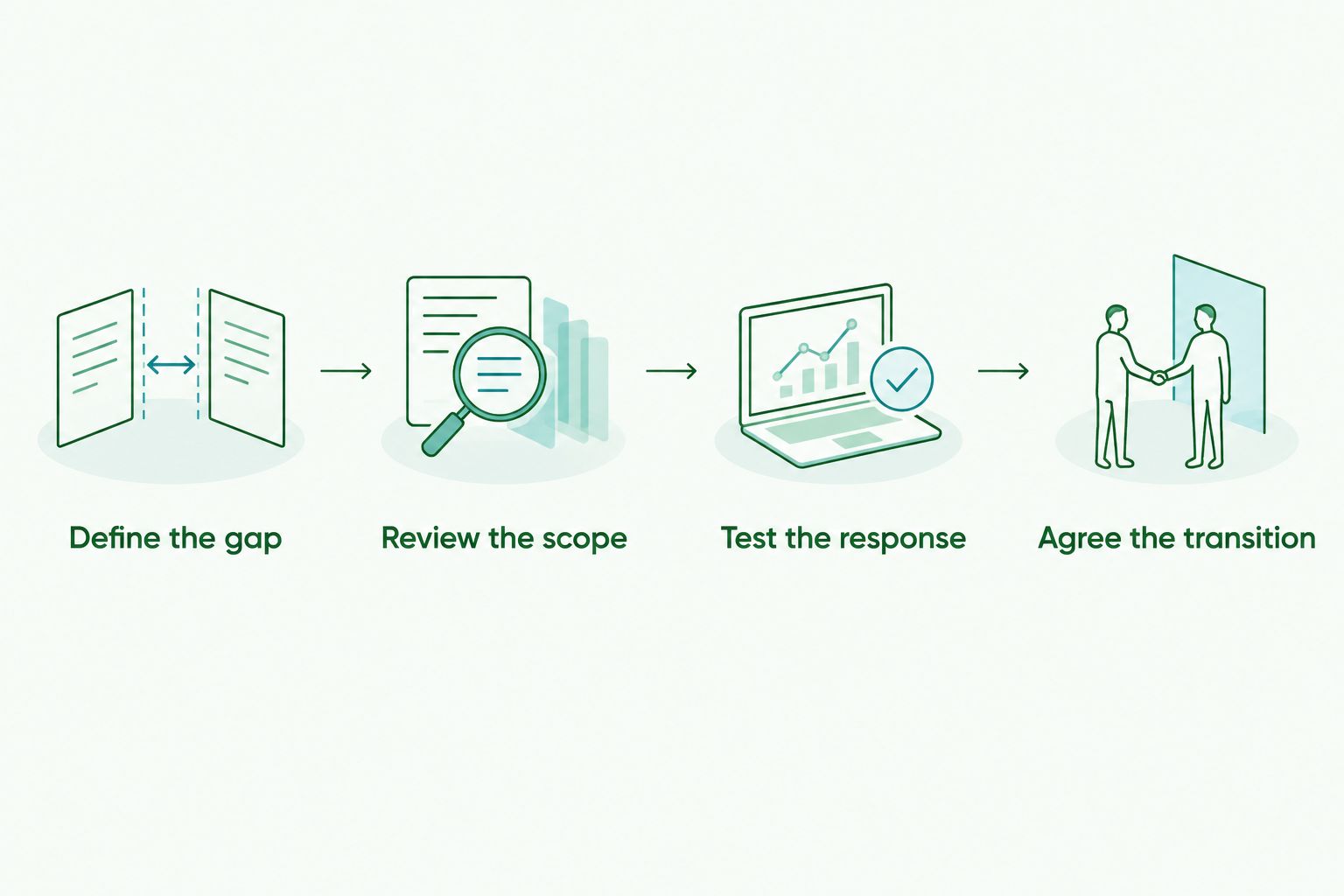
Four steps before you make a change
1. Define the gap
Write down the decisions you cannot make confidently and the information you lack. Replace broad complaints such as wanting more proactive advice with specific requests: an explanation of margin changes, a cash forecast or financial input before a planned hire.
Keep the list focused on business outcomes. This gives both your current accountant and any prospective adviser something concrete to respond to.
2. Review the scope
Read the engagement terms and compare them with the work you expect. Identify what is included, what is separately agreed and what has never been discussed.
For a 2026 engagement review, list the deliverables, responsible people and delivery expectations in one place. Do not assume that bookkeeping, tax compliance, management reporting and strategic advice are interchangeable services.
3. Test the response
Present the gaps to your accountant and ask for a proposed arrangement. A useful response identifies the work, the inputs required from you and how the advice will support decisions.
Judge the response by its clarity and fit. A longer service list is not a substitute for an explanation of how your specific problem will be addressed.
4. Agree the transition
If you decide to move, establish who handles outstanding work before the handover begins. Confirm responsibility for upcoming lodgements, unresolved queries, access permissions and the transfer of relevant records.
Do not leave an obligation without an owner during the changeover. Ask the incoming and outgoing advisers to confirm their respective responsibilities rather than assuming the transfer itself settles them.
What should you ask a prospective accountant?
Use the same 3 questions in each conversation so you can compare answers fairly:
What would you need to understand before recommending a scope? Look for questions about your records, obligations, current problems and planned decisions.
What will I receive, and how will it help me act? Ask for a plain explanation of reports, meetings and advice rather than accepting service labels alone.
Who owns the work when several services are involved? Establish who coordinates bookkeeping, compliance, reporting and specialist input.
Ask about your responsibilities too. An adviser needs timely records, access and notice of planned decisions; clarify what happens when those inputs are late or incomplete.
Daintree Consulting suits Australian businesses that need accounting and advisory support together. Its stated services include bookkeeping, payroll, tax and BAS compliance, audit and assurance, SMSF accounting, business advisory and outsourced CFO support; those services still need an agreed scope that matches your business.
Does business growth automatically mean you need a new accountant?
Business growth alone does not mean you need a new accountant. The stronger test is whether the existing firm can support the work your business now requires and deliver it to an agreed standard.
Higher revenue does not explain every reporting or advice need. Review complexity, decision-making and internal capability alongside size, then ask whether the current engagement can adapt.
Can you keep your accountant and add advisory support?
You can keep your accountant and add advisory support when responsibilities are clearly divided. This suits a business that values its existing compliance work but needs additional forecasting, reporting or financial decision support.
Agree which adviser maintains the underlying records, prepares reports, answers tax questions and coordinates changes. Without that division, adding support can leave you managing conflicting instructions instead of gaining clarity.
What should you prepare before changing accountants?
Prepare an agreed handover list before changing accountants. Include relevant financial records, prior accounts and returns, outstanding correspondence, upcoming obligations and a clear record of who will finish each open task.
For a handover in 2026, check system access and authorisations as part of the transfer. Arrange permissions through the relevant systems and confirm access works rather than sharing personal login credentials.
FAQ
How do I know if my business has outgrown its accountant?
Your business has outgrown its accounting arrangement when its reporting, advice or complexity needs persistently exceed the support provided. Check whether the issue is an outdated scope, missing specialist expertise or failure to deliver agreed work.
Should I change accountants just because my business is growing?
Growth alone is not a reason to change accountants. First ask whether your existing firm can provide the reporting, forecasting and advice your business now needs.
Is preparing my tax return enough support for my business?
Preparing your tax return is not a substitute for management reporting or cash flow forecasting. Whether you need those additional services depends on the decisions and obligations your business faces.
Can I keep my tax accountant and use an outsourced CFO?
You can retain your tax accountant and use outsourced CFO support for financial management and decision support. Agree who owns the records, reporting, tax advice and coordination between providers.
What should I do before moving to another accounting firm?
Clarify the missing work, review your current engagement and discuss whether the gap can be resolved. If you move, agree responsibility for outstanding work, upcoming obligations and records before the handover.
Can Daintree Consulting provide accounting and advisory support?
Daintree Consulting provides accounting and advisory services for Australian businesses, including bookkeeping, payroll, tax and BAS compliance, business advisory and outsourced CFO support. Confirm the scope, responsibilities and deliverables that fit your business.
One last thing
Before your next accountant meeting, finish this sentence: The decision I cannot make confidently is… Bring the supporting records and explain when you need to decide.
That question gives your 2026 review a practical test. The right accounting arrangement should help you understand what the numbers mean, identify the limits of the information and decide what to do next—not simply produce more paperwork.
Related guides
Talk to Daintree about your accounting
Our ex-Big 4 team gives clear, senior-reviewed advice so you can act with confidence.
Book a free consultation →
Or explore our accounting services.
