
How do you know if your business needs a CFO?
Your business needs CFO-level support when reliable accounts no longer give you enough information to manage cash, assess risk and make major decisions. The signal is a recurring gap between the financial information you have and the decisions you need to make—not a particular turnover, headcount or business age.
TL;DR
Want expert help? Daintree Consulting's outsourced CFO services can take this off your plate. Book a free consultation.
How do you know if your business needs a CFO? Look for recurring cash flow, forecasting and decision-making gaps.
Fix unreliable bookkeeping before expecting useful CFO advice; strategic decisions need dependable financial records.
Choose outsourced support for defined financial leadership needs; consider employment when the role requires continuous internal ownership.
Daintree Consulting provides outsourced CFO support for Australian businesses whose financial complexity is growing.
How do you know if your business needs a CFO?
You need CFO-level support when financial uncertainty repeatedly delays decisions or exposes the business to risks you cannot clearly assess. That includes deciding whether you can afford to hire, understanding why profit is not becoming cash, or evaluating expansion without a credible forecast.
For your 2026 assessment, start with the problem rather than the job title. The comparison below separates work that keeps your records dependable from work that helps you decide what happens next.
Support | Best for | Main contribution | Limitation to address |
|---|---|---|---|
Bookkeeping | Accurate transaction records | Reconciliations, transaction processing and dependable underlying data | Does not replace responsibility for financial strategy |
Accounting and tax support | Reporting and compliance | Financial statements, tax obligations and accounting advice | The agreed scope might not include ongoing forecasting or decision support |
Outsourced CFO support | Defined financial leadership needs | Forecasting, management reporting and commercial analysis | Requires clear responsibilities, access to information and internal follow-through |
Employed CFO | Continuous internal financial leadership | Day-to-day ownership of the finance function and strategic financial decisions | Creates an ongoing employment commitment and needs a clearly scoped role |
These responsibilities overlap. Check what your existing advisers actually deliver before adding another service, and make one person accountable for each output.
Why this matters
A business can meet its compliance obligations and still lack a clear picture of its financial position. Lodging correctly does not answer whether an expansion is affordable or whether a profitable customer is absorbing too much working capital.
Daintree Consulting’s outsourced CFO support is best suited to Australian businesses needing financial leadership as complexity grows. Daintree Consulting also provides accounting and bookkeeping services; the relevant starting point depends on whether your immediate gap is record accuracy, reporting or decision support.
The distinction matters because strategic advice cannot repair missing records by itself. Equally, accurate records do not automatically produce a forecast or a recommendation.
Cash flow: when profit does not explain your bank balance
CFO-level support becomes relevant when you cannot explain how trading activity will affect cash commitments. You might see a profit in your accounts but still struggle to plan wages, supplier payments and tax obligations.
Start by separating profit from cash timing. Customer payment terms, inventory purchases, loan repayments and capital expenditure affect available cash differently from the way they appear in profit reporting.
Ask for a 13-week cash flow forecast as a practical starting point, not as a test you must pass before seeking help. It should show expected receipts, committed payments and the assumptions behind uncertain amounts.
The useful output is not simply a spreadsheet. You need to know which payments need attention, which receipts require follow-up and which proposed commitments should wait.
Reporting: when the numbers arrive without an explanation
You need more than a reporting pack when nobody can explain why results changed or what action follows. A collection of charts is not financial leadership.
Useful management reporting connects performance with decisions. Depending on your business, that means explaining margin changes, overhead commitments, customer profitability or the gap between actual results and your plan.
For a 2026 reporting reset, request a short commentary alongside the financial statements. It should identify the material change, explain the cause and assign the next action to someone who can carry it out.
First check that the underlying accounts are reconciled and current. Fix unreliable records before treating a financial dashboard as evidence.
Growth: when a bigger business creates harder decisions
Growth creates a need for CFO-level analysis when new commitments become difficult to assess using current reports alone. Hiring, equipment purchases and expansion each change the business’s future cash requirements.
A 12-month financial plan is a useful starting recommendation for connecting those commitments with expected trading. Build the plan around explicit assumptions rather than treating sales growth as a complete strategy.
Test what happens if customer receipts arrive later, margins narrow or the proposed expansion takes longer to contribute. The purpose is to understand the effect of uncertainty before you commit.
CFO support does not remove commercial risk. It gives you a clearer basis for accepting, reducing or declining that risk.
Why the level of CFO support varies
The right arrangement depends on the work your business needs, not a universal revenue threshold. Assess these factors together:
Decision complexity: An expansion, acquisition or funding proposal requires different analysis from routine spending approvals.
Cash commitments: Payroll, stock, debt repayments and customer payment terms shape your forecasting requirements.
Reporting requirements: Owners, lenders and boards can need different explanations and reporting formats.
Data quality: Incomplete records create a foundation problem that needs attention before deeper analysis.
Internal capacity: Someone must maintain information, approve decisions and carry out agreed actions between advisory meetings.
Continuity of ownership: Occasional decision support differs from running a finance function every working day.
A narrow but urgent decision can justify specialist support without justifying a permanent executive appointment. Conversely, continuous financial leadership needs require more than an occasional report review.
How to assess your business before appointing a CFO
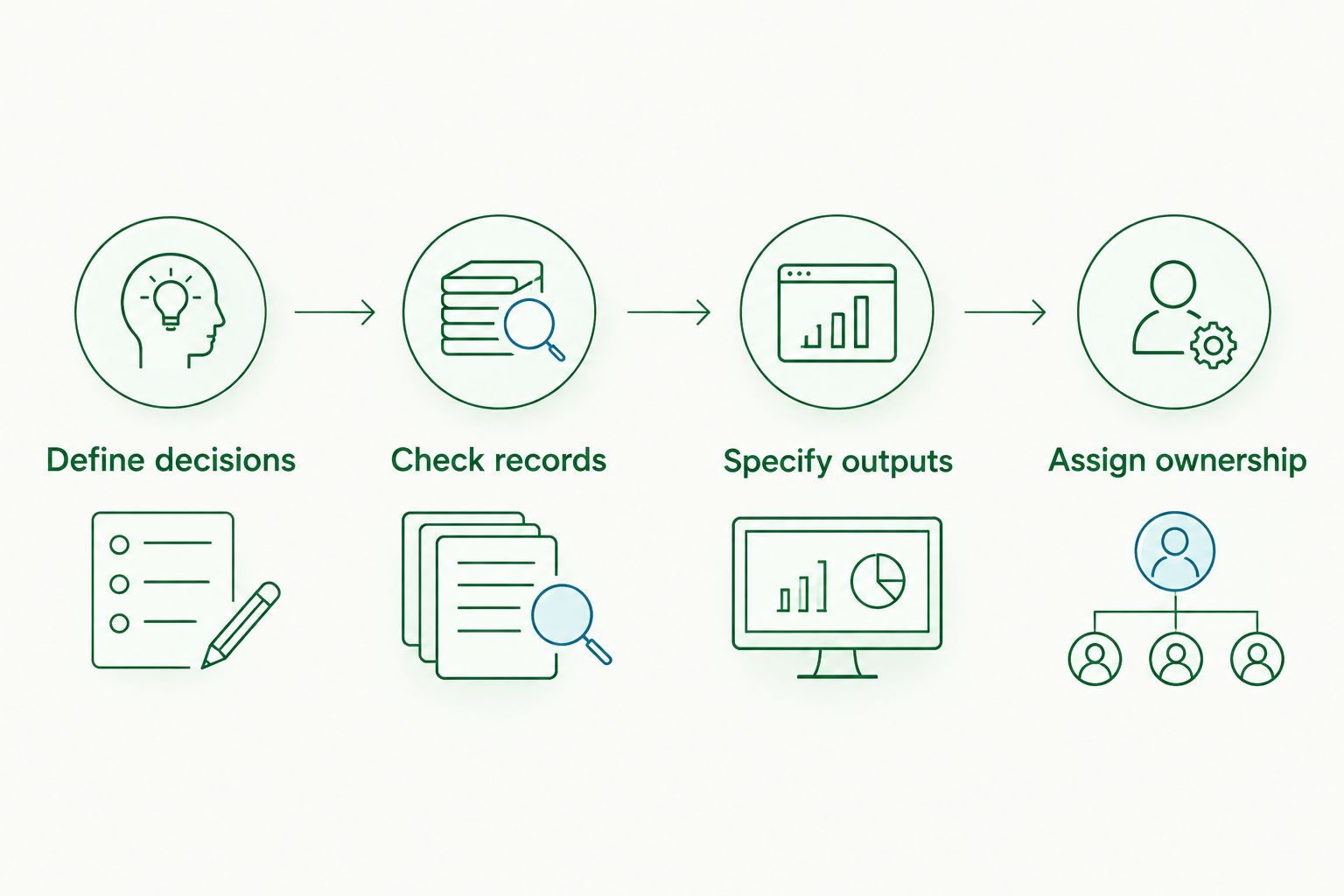
Use this sequence to turn a general feeling of uncertainty into a defined brief. You will make a better appointment when you can describe the decisions that need support.
01. Define decisions
List the financial decisions currently waiting on your desk. Replace broad concerns such as improving profitability with specific questions: which work produces an acceptable margin, or what conditions must be met before hiring?
Keep the list focused on decisions someone can actually make. A request for better visibility is too vague unless you explain what that visibility needs to change.
02. Check records
Confirm whether the accounts are current, reconciled and consistent enough to support analysis. Identify missing information, unresolved transactions and reporting delays.
If the foundation is weak, agree on a clean-up plan first. CFO input can help define the required information, but someone still needs to complete the bookkeeping and accounting work.
03. Specify outputs
Translate each decision into an output: a cash forecast, a margin analysis, a funding assessment or a financial plan. Name the person who will use it and the action it should inform.
For your 2026 brief, include reporting responsibilities and a review process. Avoid a scope that promises strategic advice without defining what you will receive.
04. Assign ownership
Decide who supplies information, who prepares analysis, who challenges assumptions and who approves action. These responsibilities should remain clear whether support is outsourced or employed.
Your business retains responsibility for commercial decisions. An adviser’s recommendation is useful only when someone has authority to act on it.
Do you need a full-time CFO or outsourced support?
Choose the arrangement around the frequency and ownership of the work. Outsourced CFO support fits a defined need for financial leadership without automatically creating a permanent internal role.
Its strength is a scope built around the decisions and reporting you need. Its constraint is that access, information sharing and follow-through must be deliberately organised; an external adviser is not automatically embedded in every operational discussion.
An employed CFO fits a role requiring continuous internal ownership, team leadership and participation in management decisions. The trade-off is an ongoing employment commitment, with responsibilities that must be substantial and clearly defined.
For a 2026 appointment, compare the same scope under each arrangement. Do not compare an advisory engagement covering forecasting with an employment role covering forecasting, finance operations and team management as though they are equivalent.
Can your accountant do the CFO work instead?
Your accountant can provide CFO-level support if the engagement includes that work and the adviser has the relevant capability. The title alone does not establish what is included.
Ask whether your current arrangement covers forward cash forecasting, management commentary, scenario analysis and support for major decisions. Then check who owns those outputs and how they connect with your operational team.
Keeping work together can simplify coordination, but it does not remove the need for a clear scope. Separating providers can also work when responsibilities and information sharing are explicit.
Buy the required output, not an additional title. If your existing adviser already supplies the analysis you need, adding another adviser without a distinct responsibility creates overlap.
What should you ask before engaging CFO support?
Ask questions that expose how the work will operate, rather than asking only whether the adviser understands your sector. Relevant experience matters, but you also need a workable relationship between analysis and action.
Which decisions will this engagement help us make?
What information must we provide, and who checks its quality?
Which reports and forecasts are included?
Who explains the findings and challenges the assumptions?
What remains with our bookkeeper, accountant and management team?
How will we judge whether the engagement is useful?
For an initial 30-day action plan, prioritise the most urgent decision, the information needed to resolve it and the person responsible for acting. This is a suggested planning period, not a promised turnaround or service commitment.
Judge progress through useful outputs: a forecast you can explain, a decision you can support and responsibilities that no longer fall between advisers.
FAQ
How do I know if my small business needs a CFO?
Your small business needs CFO-level support when recurring cash, reporting or commercial decisions require analysis your current finance arrangements do not provide. Start by identifying the decisions you cannot confidently make, rather than using business size as the test.
Is there a turnover level where I must hire a CFO?
There is no universal turnover threshold for appointing a CFO. Assess financial complexity, cash commitments, reporting requirements and the need for continuous internal leadership.
Can an outsourced CFO replace my bookkeeper?
Outsourced CFO support does not replace the need for accurate bookkeeping. Strategic analysis depends on current records, so define who maintains the accounts and who turns them into decision support.
What should a CFO help me understand about cash flow?
A CFO should help you understand expected cash movements, upcoming commitments and the assumptions that could change the forecast. A 13-week cash flow forecast is a practical starting recommendation for that discussion.
Is an outsourced CFO better than a full-time CFO?
Outsourced CFO support is better suited to defined advisory needs, while an employed CFO suits continuous internal ownership. Compare responsibilities and access requirements before choosing the arrangement.
What should I prepare before speaking with a CFO adviser?
Prepare current financial reports, information about cash commitments and a list of decisions needing support. Identify unresolved record issues so the engagement can separate financial clean-up from forward planning.
Does Daintree Consulting provide outsourced CFO services?
Daintree Consulting provides outsourced CFO and business advisory services to Australian businesses. It also provides accounting, bookkeeping and payroll, tax and BAS compliance, audit and assurance, and SMSF accounting services.
One last thing
The clearest sign you need CFO support is a decision you keep postponing because you cannot see its financial consequences. Start there, rather than commissioning a larger reporting pack by default.
Write that decision at the top of your 2026 finance brief. Then ask what information would change your answer, who will prepare it and who will act once the answer is clear.
Related guides
Talk to Daintree about your finance function
Our ex-Big 4 team gives clear, senior-reviewed advice so you can act with confidence.
Book a free consultation →
Or explore our outsourced CFO services.
