
How do you fix overdue BAS lodgements?
Fix overdue BAS lodgements by identifying every missing statement, reconciling the records for each period and lodging accurate statements with the Australian Taxation Office (ATO). If you cannot pay the resulting debt, address payment separately rather than delaying lodgement. For Australian businesses catching up in 2026, the priority is to establish what is outstanding, correct the records and agree on a manageable next step.
TL;DR
Want expert help? Daintree Consulting's tax and BAS services can take this off your plate. Book a free consultation.
How do you fix overdue BAS lodgements? Reconcile each outstanding period, lodge accurate statements and address payment separately.
Daintree Consulting suits businesses seeking bookkeeping and BAS compliance support together.
Lodging overdue BAS does not automatically remove penalties, interest or the underlying tax debt.
Check actual ATO obligations before assuming every missing statement covers the same reporting period.
Why this matters
An overdue BAS creates two separate problems: an outstanding reporting obligation and, where tax is payable, a debt. Paying an estimated amount does not replace lodgement, and lodging does not settle the debt.
Resolve reporting and payment as separate tasks. If your bookkeeping is behind as well, Daintree Consulting’s accounting and BAS services cover the underlying records and compliance work. Start with an accurate position, not a rushed figure designed simply to clear a reminder.
How do you fix overdue BAS lodgements?
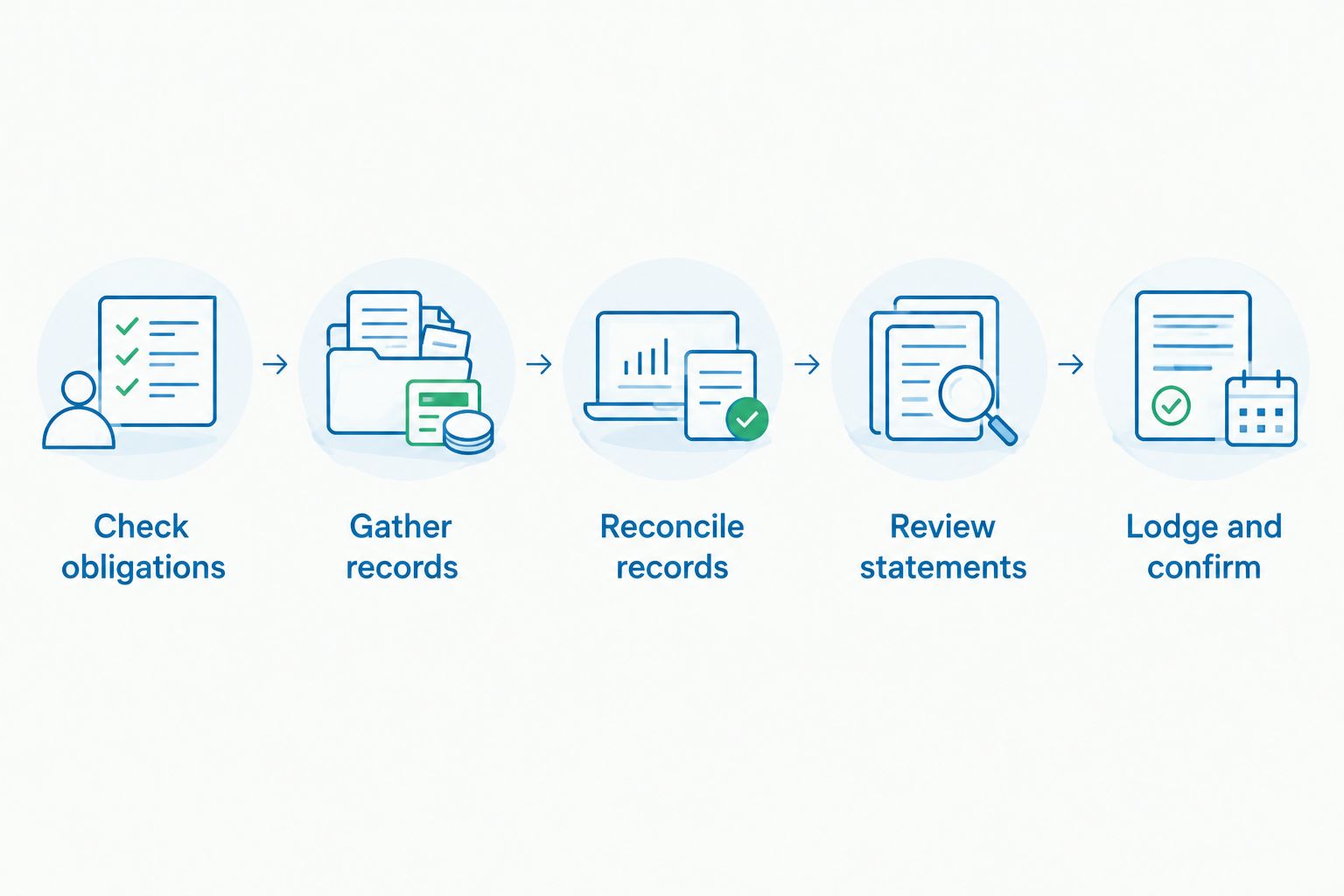
Use the following sequence to bring overdue BAS up to date in 2026. The ATO account establishes what must be lodged; your reconciled business records establish what belongs in each statement.
01. Check obligations
Open your business’s ATO account through the appropriate online service, or ask your registered tax or BAS agent to confirm the outstanding activity statements. Record each reporting period, its due date and whether the statement is unlodged or already lodged with an unpaid balance.
Do not rely only on reminder emails or your accounting software’s dashboard. A prepared BAS sitting in accounting software is not necessarily a lodged BAS, and an unpaid statement is not necessarily an unlodged one.
Check for:
Missing activity statements and their reporting periods.
Statements already lodged but not paid.
ATO notices requiring a response.
Changes to GST registration or reporting arrangements.
Lodgement receipts for statements you believe were submitted.
02. Gather records
Collect sales records, supplier invoices, bank statements, credit card statements and relevant payroll reports for each outstanding period. Include transactions outside the main bank account, such as payment processor settlements and purchases paid personally on the business’s behalf.
Quarterly reporting covers 3 months per statement; monthly reporting covers 1 month per statement. Use the period shown on the actual BAS rather than assuming the business has always reported at the same frequency.
Build a separate working file for each period. This makes it easier to trace a figure back to its source and avoids mixing transactions from different statements.
03. Reconcile records
Match bank and credit card balances to the accounting records, investigate missing transactions and check for duplicates. Review GST coding against the underlying documents rather than accepting every bank-feed suggestion.
A bank deposit is not automatically a taxable sale. Loans, owner contributions and transfers between business accounts need different treatment from customer income, so coding every receipt as sales can distort the BAS.
Also check the GST accounting basis the business uses. Cash and non-cash accounting recognise transactions differently; do not switch the basis simply because the records are easier to assemble another way.
04. Review statements
Prepare each BAS using the obligations shown for that period. Depending on the business, the statement can include GST, PAYG withholding and PAYG instalments, so reviewing GST alone is not always enough.
Compare the proposed figures with sales, purchases and payroll reports. Investigate unexpected movements, negative amounts and unexplained differences before submitting. If an accountant or bookkeeper has prepared the statement, understand what remains unresolved rather than treating a software-generated total as final.
05. Lodge and confirm
Submit the completed statements through an authorised channel and retain the lodgement confirmations. Then check the updated ATO account so that the lodged periods, resulting balances and any remaining obligations are clear.
Do not wait until you can pay before addressing lodgement. If the debt is unaffordable, contact the ATO about payment arrangements and keep current obligations on your catch-up list as well.
What if you cannot pay the overdue BAS?
Lodge accurate outstanding statements and discuss the debt with the ATO. A payment arrangement addresses how a debt is paid; it does not replace lodgement or remove your obligation to keep submitting future statements.
Before requesting an arrangement, prepare a cash-flow forecast that includes wages, suppliers, operating expenses and upcoming tax obligations. An instalment that looks affordable only because the next BAS is missing from the forecast does not solve the underlying problem.
Approach | Best for | Benefit | Limitation |
|---|---|---|---|
Paying the assessed balance in full | Businesses with sufficient available cash | Clears that assessed balance once payment is processed | Must be considered alongside essential business commitments |
Requesting a payment arrangement | Businesses unable to pay the balance immediately | Provides a structured way to address the debt if agreed | Interest can continue, and ongoing obligations still need attention |
For a 2026 catch-up plan, assess the existing debt and the next reporting period together. If the business cannot meet debts as they fall due, seek qualified advice promptly rather than assuming an instalment request resolves the wider issue.
What if an overdue BAS contains mistakes?
An unlodged BAS and an incorrect lodged BAS need different treatment. Correct the working records before lodging an outstanding statement; for an already lodged statement, assess whether a revision or an eligible correction on a later BAS is appropriate.
The ATO has conditions governing when GST errors can be corrected on a later statement. Do not assume that placing an old discrepancy into the next BAS is acceptable, particularly when several periods are affected.
Keep a record of the original treatment, the reason it was wrong and the correction made. This creates an explanation for the change and helps prevent the same error appearing in another reporting period.
Why the BAS catch-up process varies
The work depends on the state of your records and obligations, not simply how many reminder letters have arrived. The following factors change what needs attention:
Missing periods: More outstanding statements create more period-specific reconciliation and review work.
Record quality: Missing invoices, incomplete statements and duplicate transactions require investigation before figures can be relied on.
Reporting obligations: GST-only work differs from statements that also require PAYG withholding or instalment information.
Accounting basis: Cash and non-cash GST reporting require transactions to be allocated correctly.
Earlier errors: Incorrect opening balances or previously lodged figures can affect the catch-up work.
ATO action: A notice with a response deadline needs attention alongside preparation of the statements.
Ask for a scope that distinguishes bookkeeping repairs, BAS preparation, lodgement and debt discussions. These are connected tasks, but completing one does not mean the others are finished.
How do you catch up when bank records are incomplete?
Start by requesting missing statements or transaction exports from the financial institution. Then compare the recovered records with the accounting ledger and supporting invoices, including the opening and closing balances for each affected period.
The purpose of reconciling incomplete bank records is to establish which transactions and balances are missing before relying on the accounts for a BAS. A closing balance that happens to match does not explain unidentified transactions or establish their GST treatment.
Use a practical exception list:
Identify each missing statement or transaction date range.
Separate unmatched transactions from transactions with uncertain GST treatment.
Request invoices, receipts or other supporting evidence.
Record the explanation and treatment of each resolved item.
Escalate unresolved items before finalising the affected statement.
Do not invent transactions to make a reconciliation balance. Where documents cannot be recovered, ask a registered agent what evidence is acceptable and how the relevant transaction should be treated. A missing invoice and a missing bank transaction are different problems; finding one does not automatically resolve the other.
Can the ATO remove late-lodgement penalties?
The ATO can consider remission of a failure-to-lodge penalty, but removal is not automatic. Explain the circumstances, provide supporting evidence and show what has been done to bring the obligations up to date.
A request should identify the affected statements and explain how the circumstances prevented timely lodgement. Keep the account factual: what happened, when it affected the business, what records support the explanation and what has changed.
Interest on an unpaid tax debt is separate from a late-lodgement penalty. If both apply, addressing one does not necessarily remove the other, and neither should be confused with the underlying BAS liability.
For overdue statements being resolved in 2026, check the actual notices and account entries rather than relying on an old penalty example. Ask your agent to distinguish the tax debt, interest and penalties when explaining the balance.
How do you stop BAS falling behind again?
Set a reporting routine that gives you time to resolve exceptions before the due date. Your process should identify who maintains the records, who reviews the BAS and who authorises lodgement and payment.
Use these controls:
Regular reconciliation: Keep bank, credit card and payment processor accounts matched to the ledger.
Document capture: Save invoices and receipts where the preparer can retrieve them.
An exception list: Track uncertain coding, missing evidence and unusual transactions until resolved.
A lodgement calendar: Use the business’s actual obligations and applicable due dates.
Cash-flow planning: Include tax payments and existing arrangements in the forecast.
For your 2026 reporting calendar, distinguish preparation deadlines from statutory lodgement deadlines. A date for sending records to the bookkeeper is an internal control, not a replacement for the ATO due date.
Daintree Consulting is best suited to Australian businesses seeking bookkeeping and BAS compliance support together. The firm provides both services, but you should still agree on responsibilities, outstanding periods and the work included before the catch-up begins.
Do you need to lodge BAS if there was no activity?
If the ATO has issued an activity statement and the obligation remains in place, having no business activity does not by itself remove the requirement to lodge. A nil BAS is appropriate only when the relevant labels genuinely have nothing to report.
Check expenses, payroll and other statement obligations before assuming the period was inactive. No sales does not necessarily mean no reportable transactions.
Can a bookkeeper fix overdue BAS?
A registered BAS agent can provide BAS services within their registration and competence. A bookkeeper who is not appropriately registered cannot simply provide regulated BAS services for a fee in their own right.
Ask who will reconcile the records, who will provide the BAS advice and who will lodge the statements. Where the backlog involves broader tax or solvency questions, confirm which qualified adviser will address those issues.
FAQ
How do you fix overdue BAS lodgements in Australia?
Identify every outstanding statement, reconcile the records for each period and lodge accurate BAS with the ATO. Address any unpaid balance separately, including requesting a payment arrangement where needed.
Can I lodge an overdue BAS if I cannot pay it?
Yes, you can lodge an overdue BAS even if you cannot pay the resulting debt immediately. Contact the ATO about payment options rather than delaying lodgement until cash becomes available.
Should I lodge a nil BAS just to stop reminders?
No, lodge a nil BAS only when there is genuinely nothing to report against the relevant obligations. An inaccurate nil statement creates a correction problem rather than resolving the backlog.
Will lodging overdue BAS automatically remove penalties?
No, lodging overdue BAS does not automatically remove penalties or interest. The ATO considers remission separately, and the underlying tax debt remains payable.
Can I put all my overdue BAS into the next statement?
No, each outstanding reporting obligation must be addressed for its own period. Correcting an earlier GST error on a later BAS is a separate process subject to ATO conditions.
How long must I keep records supporting my BAS?
Australian business tax records generally need to be kept for at least 5 years, with longer requirements applying in some circumstances. Keep the working papers and evidence supporting overdue BAS and any corrections.
Can Daintree Consulting help with overdue BAS?
Daintree Consulting provides bookkeeping, tax and BAS compliance services for Australian businesses. Agree on the outstanding periods, record-repair work and lodgement responsibilities when discussing support.
One last thing
The first overdue period is not always where the underlying error began. If its opening bank balance does not agree with the supporting records, investigate the earlier difference rather than carrying it through every catch-up statement.
Before closing the backlog, keep the lodgement receipts, reconciliations, correction explanations and any ATO payment correspondence together. You need both an up-to-date account and records that explain how the figures were reached.
Related guides
Talk to Daintree about your tax and BAS
Our ex-Big 4 team gives clear, senior-reviewed advice so you can act with confidence.
Book a free consultation →
Or explore our tax and BAS services.
