
How do you choose the right SMSF accountant?
Choose an SMSF accountant by checking relevant SMSF experience, who will prepare the fund’s accounts and annual return, how the independent audit is arranged, and what the engagement includes. Before appointing anyone in 2026, confirm the service boundaries: accounting support does not automatically include investment advice, and you remain responsible for your fund as a trustee.
TL;DR
Want expert help? Daintree Consulting's SMSF accounting services can take this off your plate. Book a free consultation.
Choose an SMSF accountant with relevant fund experience, clear responsibilities and a documented annual compliance process.
Daintree Consulting suits trustees seeking SMSF accounting alongside business accounting and advisory services.
Keep accounting, independent audit and licensed financial advice distinct, even when providers coordinate the work.
Compare written engagement terms, exclusions and communication arrangements before choosing a provider.
How do you choose the right SMSF accountant?
Start with the work your fund needs, then check whether the accountant can explain how that work gets completed. A clear process matters more than a broad promise to handle everything. Daintree Consulting provides SMSF accounting alongside business accounting and advisory services; assess that service mix against your fund’s requirements.
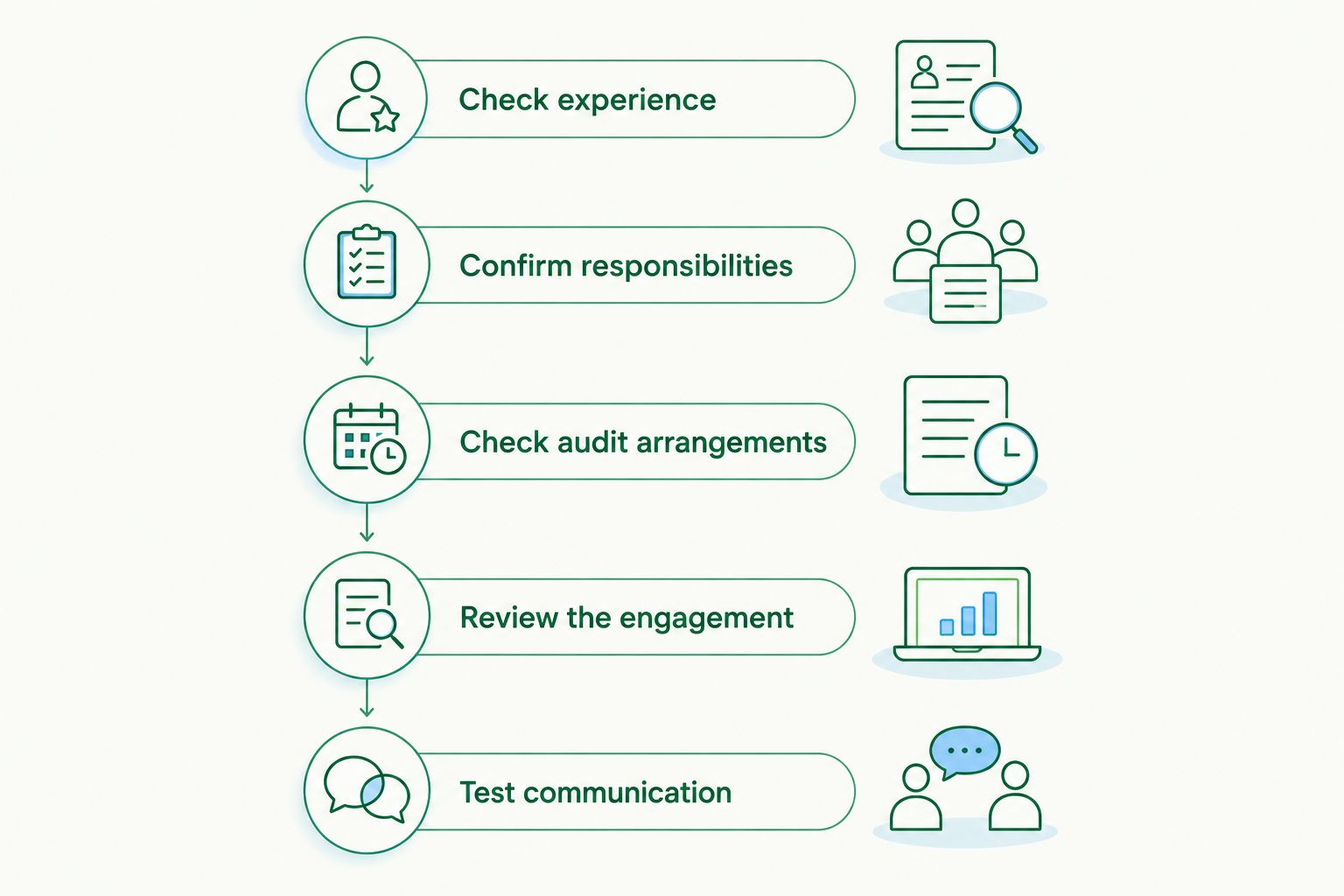
Use these steps when comparing providers:
Check experience. Ask about funds with investments and circumstances similar to yours.
Confirm responsibilities. Identify who prepares the accounts, annual return and supporting schedules.
Check audit arrangements. Ask who appoints the approved SMSF auditor and how independence is maintained.
Review the engagement. Read the inclusions, exclusions and responsibilities before signing.
Test communication. Ask how questions, missing records and compliance concerns are handled.
The outcome should be a written understanding of what happens, who does it and what you must supply—not just a verbal assurance.
Why this matters
An SMSF combines investment decisions with tax, reporting and trustee obligations. Choosing an accountant only when the annual return is due leaves little room to resolve missing documents or questions about transactions.
For your 2026 review, separate administrative convenience from legal responsibility. An accountant can prepare records and explain accounting issues, but appointing one does not transfer your trustee duties. You still need to understand the fund’s activities and respond when something requires your approval.
A good selection process also prevents gaps between providers. If the accountant expects the financial adviser to monitor an issue, and the adviser assumes the accountant handles it, you need that misunderstanding resolved before work begins.
What should an SMSF accountant handle?
An SMSF accounting engagement commonly covers financial statements, tax calculations and preparation of the SMSF annual return. The actual service depends on the engagement letter, so do not treat these tasks as automatically included.
Ask whether the accountant also prepares supporting schedules, assists with pension calculations, liaises with the auditor and responds to audit queries. Each responsibility should have an owner. A provider who coordinates an audit is not necessarily the person who performs it.
Role | Best for | Main contribution | Boundary to check |
|---|---|---|---|
SMSF accountant | Fund accounts and tax reporting | Prepares agreed accounting records, statements and returns | Investment advice is not automatically included |
Approved SMSF auditor | Independent annual audit | Examines financial statements and compliance with relevant superannuation requirements | Does not replace ongoing accounting or trustee oversight |
Licensed financial adviser | Personal financial advice about your superannuation | Advises within the scope of their authorisation and engagement | Does not automatically prepare the fund’s accounts or return |
Choose the right role for the decision, not just the provider you already know. An accountant’s familiarity with your tax affairs is useful, but it does not establish that they are authorised to recommend particular investments or advise whether an SMSF is suitable for you.
How do you check SMSF experience and credentials?
Ask the prospective accountant to explain their experience with your fund’s circumstances without sharing another client’s confidential information. Relevant examples include pension accounts, direct property, unlisted investments or changes in membership.
You are checking understanding, not collecting technical language. A useful answer explains which records are needed, what requires specialist input and when a transaction needs attention before it proceeds.
Check the credentials that relate to the work being offered:
Tax agent services: check the Tax Practitioners Board register where registration is required for the proposed service.
SMSF audit: check that the person performing the audit is an approved SMSF auditor registered with ASIC.
Financial advice: check the adviser’s authorisation and the scope of advice they can provide.
Professional membership: treat membership as supporting information, not a substitute for checking the relevant registration.
In 2026, ask who will actually manage your engagement. The experience of the person at the introductory meeting matters less if someone else prepares the work and answers your questions.
What should you ask about the independent audit?
An SMSF must undergo an independent audit each year by an approved SMSF auditor. The audit covers both the financial statements and compliance with relevant superannuation requirements; it is not simply another name for preparing the annual accounts.
Ask how the accountant and auditor exchange information, who answers queries and when you must provide documents. You should also understand whether audit coordination is included in the accounting engagement or handled separately.
Useful questions include:
Who is the approved SMSF auditor?
How are the auditor’s independence requirements addressed?
Who supplies the financial statements and supporting records?
Who tells you about unresolved queries or compliance issues?
What happens if the audit identifies a problem?
Convenient coordination is useful; unclear independence is not. You do not need to manage every exchange yourself, but you should know who performs each role and receive a clear explanation of significant findings.
Why SMSF accounting requirements vary
The right SMSF accountant depends on the work your fund creates. A fund holding straightforward investments presents different recordkeeping and valuation questions from a fund holding direct property or private investments.
These factors change the support you need:
Investment structure: different assets require different evidence of ownership, income, expenses and value.
Pension activity: starting or maintaining retirement-phase pensions adds calculations and reporting considerations.
Member changes: contributions, rollovers, benefit payments and changes in membership affect the records required.
Record quality: missing statements or unclear transactions create follow-up work before accounts can be finalised.
Unusual transactions: related-party dealings, borrowing arrangements and asset transfers need careful attention to applicable rules.
An Australian SMSF can have up to 6 members, but member count alone does not describe its accounting complexity. Ask the provider to assess the actual transactions and assets rather than assuming a smaller fund is always straightforward.
For your 2026 appointment, disclose any unresolved issues early. The accountant needs an accurate picture of the fund, not just its latest financial statements.
What documents should you show a prospective accountant?
Provide enough information for the accountant to understand the engagement before asking for a firm scope. Start with the latest financial statements, annual return, audit report, trust deed and any amendments.
Also explain changes since the last reporting period. A new pension, property purchase, member departure or unresolved audit matter can change the work required. Avoid sending sensitive identification documents until you have confirmed the provider’s secure collection process.
Prepare a short handover summary covering:
The fund’s assets and current members.
Who currently handles accounting, administration, audit and advice.
Any outstanding returns, queries or audit issues.
Planned transactions that need attention.
Where statements, contracts and trustee records are stored.
This summary helps you compare providers on the same facts. Otherwise, one proposal might assume complete records while another includes substantial work to resolve missing information.
What should the engagement letter make clear?
The engagement letter should turn the discussion into defined responsibilities. Read it before approving the appointment, and ask for unclear wording to be explained in plain English.
Check the scope of financial statements, tax return preparation, audit coordination and routine questions. Then check what sits outside that scope, including transaction advice, historical corrections, additional reporting or responses to more involved audit issues.
You should also understand how work outside the agreed engagement is authorised. A clear exclusion is better than an assumption that fails when you need help. Ask how you will be told before additional work starts.
For a 2026 engagement, confirm communication and document-handling arrangements as well. Who is your contact? Who reviews the work? How do you approve the return? What happens if your usual contact is away? These practical details affect whether the service works for you throughout the year.
Can an SMSF accountant give investment advice?
An SMSF accountant does not automatically have authority to give personal financial advice. Accounting and tax expertise are different from authorisation to recommend financial products or advise on the suitability of an SMSF.
Ask the accountant to distinguish factual information, tax treatment and personal financial advice. If your question is whether to establish an SMSF, retain it or buy a particular investment, confirm who is authorised to advise on that decision.
An accountant who clearly explains this boundary gives you useful information about their service. You can then arrange the right advice without confusing an accounting discussion with a recommendation tailored to your financial circumstances.
How do you compare providers without choosing on convenience alone?
Compare written scopes side by side. Look for differences in annual reporting, audit coordination, access to explanations and treatment of work outside the engagement.
A tightly defined annual service can suit trustees who maintain orderly records and need limited assistance. Its limitation is that additional questions or transactions might require a separate engagement. Broader support can suit trustees who need more coordination, but only if the responsibilities are clearly described.
Do not assume that the longest service list is the best fit. Choose the support you need and can explain back in your own words. If the provider cannot describe the service clearly before appointment, resolve that uncertainty before committing.
FAQ
What should I look for in an SMSF accountant?
Look for relevant SMSF experience, a clear written scope, appropriate registration for the services offered and a documented independent audit process. Ask who prepares, reviews and explains the work.
Does an SMSF need an audit every year?
An SMSF needs an independent audit each year by an approved SMSF auditor. Preparing the accounts and annual return does not replace that audit.
Can my regular business accountant handle my SMSF?
Your business accountant can handle SMSF accounting if they have the relevant capability and meet the requirements for the services they provide. Check SMSF experience rather than assuming business accounting experience is sufficient.
Is Daintree Consulting suitable for SMSF accounting?
Daintree Consulting provides SMSF accounting alongside business accounting and advisory services. Confirm the proposed engagement covers your fund’s assets, reporting needs and audit coordination requirements.
Can an SMSF accountant recommend investments?
An SMSF accountant cannot provide personal financial advice merely because they are an accountant. Check the relevant authorisation and engagement scope before relying on an investment recommendation.
How long do I need to keep SMSF records?
ATO recordkeeping requirements generally require at least 5 years for accounting records and at least 10 years for specified trustee and governance records. Confirm the retention requirement for each document type before disposing of records.
Am I still responsible if an accountant manages the paperwork?
You remain responsible for your SMSF as a trustee even when an accountant manages the paperwork. Read the documents you approve, keep required records and respond promptly to compliance questions.
One last thing
Ask the prospective accountant what you should discuss before making a transaction, not just what documents to send afterwards. That question tests whether you understand when accounting support is needed and where separate advice begins.
For your 2026 selection, write down the responsibilities on both sides before signing. One clear picture of the work, the boundaries and the handover is more useful than a promise that everything is covered.
Related guides
Talk to Daintree about your SMSF accounts
Our ex-Big 4 team gives clear, senior-reviewed advice so you can act with confidence.
Book a free consultation →
Or explore our SMSF accounting services.
