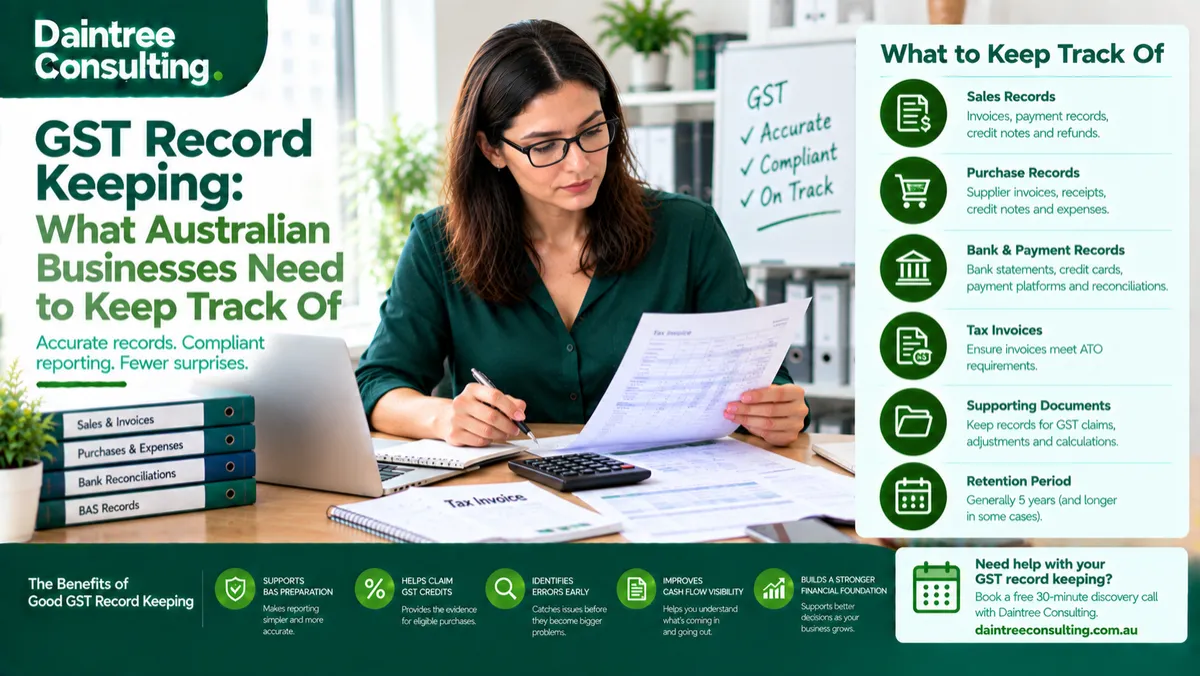
GST Record Keeping: What Australian Businesses Need to Keep Track Of
If your business is registered for GST, keeping accurate records is more than an administrative task.
Your GST records provide the evidence behind the amounts you report on your Business Activity Statement (BAS), including GST collected on sales and GST credits claimed on eligible business purchases.
Want expert help? Daintree Consulting's tax and BAS services can take this off your plate. Book a free consultation.
As your business grows, keeping track of GST can become more complicated. You may have more sales, supplier invoices, employees, business expenses, subscriptions, assets, refunds and payment channels to reconcile.
Without a consistent record-keeping process, it can become difficult to determine whether your GST figures are complete and correctly reported.
This guide explains GST record keeping for Australian businesses, what records you should keep, how tax invoices fit into the process, how long GST records generally need to be retained, and what to review before BAS lodgement.
Quick answer
GST record keeping means maintaining the business records and supporting documents needed to calculate, report and substantiate your GST obligations.
Depending on your business, this can include:
Sales records
Purchase records
Tax invoices
Receipts and other proof of purchase
Credit notes and adjustments
Bank and credit-card records
GST coding in your accounting system
Records supporting GST credits
Import documentation where relevant
Records of GST-related calculations or decisions
BAS records and supporting reconciliations
Records relating to private or business use where relevant
The ATO states that GST records generally need to be kept for five years, starting from when the records were prepared or obtained, or when the relevant transaction or act was completed, whichever is later. Some records may need to be retained for longer depending on the circumstances.
What is GST record keeping?
GST record keeping is the process of maintaining sufficient records to support the GST amounts your business reports and claims.
In practical terms, your records should allow you — or your accountant or BAS agent — to understand:
What your business sold
What GST was collected
What your business purchased
What GST was paid on eligible purchases
Which transactions were GST-free or otherwise treated differently
What adjustments were made
How reported BAS figures were calculated
What supporting documents exist for significant transactions
The ATO says businesses need records that show the income and expenses used to calculate and support amounts reported and GST credits claimed. This includes sales, tax invoices and other GST-related transactions, fees, expenses, wages and other business costs, as well as documents supporting GST adjustments, decisions or calculations.
Good GST record keeping therefore means more than simply keeping receipts.
It means maintaining a financial record trail that connects your transactions to the GST amounts ultimately reported.
Why does GST record keeping matter?
GST is reported through the BAS for businesses that have the relevant GST obligations.
If the underlying records are incomplete or inaccurate, the BAS figures may also be incorrect.
Good records can help your business:
Support BAS preparation
Your accounting records provide the information needed to determine the relevant GST amounts for your BAS.
Substantiate GST credits
Supporting documents help demonstrate the basis for GST credits claimed on eligible business purchases.
Identify errors earlier
Regularly reviewing transactions can help identify incorrect GST coding, duplicate entries, missing transactions and other issues before they become larger problems.
Make reconciliations easier
When transactions and supporting documents are organised, it is easier to compare accounting records against bank and other source information.
Respond to questions
Good records can provide evidence if the ATO requests information about a transaction or reported amount.
Improve financial visibility
GST records form part of the wider accounting information used to understand business income, expenses and cash flow.
Business.gov.au notes that good record keeping can help businesses track financial health, manage cash flow and meet tax and other obligations.
What GST records should an Australian business keep?
The exact records you need will depend on your business and transactions.
However, there are several important categories most GST-registered businesses should consider.
1. Sales records
You should maintain records of business sales that allow you to determine the relevant GST treatment.
Depending on how you operate, these could include:
Sales invoices
Tax invoices
Point-of-sale records
Online sales records
Payment-platform reports
Receipts
Customer credit notes
Refund records
Sales summaries
The records should provide enough information to understand what was sold, when it was sold and the relevant GST treatment.
For businesses with multiple sales channels, this becomes particularly important.
For example, an online business might receive payments through its website, a payment gateway, marketplace platforms and direct bank transfers.
Those sources may all need to be reconciled back to the accounting records.
2. Purchase and expense records
GST record keeping also involves maintaining evidence for business purchases and expenses.
These may include:
Supplier invoices
Tax invoices
Receipts
Credit-card records
Expense claims
Subscription invoices
Utility bills
Professional-service invoices
Advertising invoices
Equipment purchases
Business travel records where relevant
Do not assume that every business expense automatically has the same GST treatment.
The GST treatment depends on the nature of the transaction and the circumstances.
That is why accurate transaction coding and supporting documentation matter.
3. Tax invoices
Tax invoices are an important part of GST record keeping.
When purchasing taxable supplies, a valid tax invoice may be required to support a GST credit claim, subject to the applicable rules.
For sales, businesses registered for GST generally need to issue tax invoices when required.
A tax invoice generally contains information such as:
The words “tax invoice”
Supplier identity
ABN
Date of issue
Description of the goods or services
GST amount or information allowing it to be calculated
Other details depending on the value and circumstances of the transaction
The requirements can vary depending on the transaction amount and circumstances, so businesses should use current ATO guidance when checking whether an invoice is valid. Business.gov.au currently states that tax invoices have specific information requirements and that buyers may need a valid tax invoice to claim GST credits.
A missing or incomplete invoice can make it harder to substantiate a GST claim.
4. Bank and payment records
Bank statements are another important part of GST record keeping.
Your accounting records should be capable of being reconciled with the actual movement of money through your business accounts.
Depending on the business, this may include:
Business bank accounts
Credit cards
EFTPOS settlements
Online payment platforms
Payment gateways
Direct debit transactions
Merchant accounts
Reconciliation can help identify transactions that were:
Missed
Duplicated
Recorded for the wrong amount
Assigned to the wrong account
Assigned the wrong GST treatment
The ATO specifically recommends reconciling sales with bank statements as part of good record-keeping practices.
5. Credit notes, refunds and adjustments
GST records should not only capture normal sales and purchases.
You also need to retain records that explain changes to previously recorded transactions.
For example:
Customer refunds
Supplier refunds
Credit notes
Cancelled invoices
Discounts
Bad-debt adjustments where relevant
Other GST adjustments
These transactions can affect the GST amounts reported.
Without supporting documentation, it may be difficult to understand why a GST amount changed from the original transaction.
For this reason, adjustments should be recorded clearly rather than simply changing the original transaction without an audit trail.
6. Records for business assets
Assets can create additional GST record-keeping considerations.
Examples include:
Vehicles
Equipment
Computers
Machinery
Property-related transactions
Office fit-outs
Other significant business assets
Keep purchase documentation and records that establish the relevant transaction details.
If an asset is later sold, records relating to the sale should also be retained.
The ATO and business.gov.au identify records relating to business assets as part of the broader records businesses may need to retain.
Where an asset has both business and private use, additional records may be required to support the business-use portion.
7. Records for GST adjustments and calculations
Not every GST figure comes directly from a simple sales invoice or supplier bill.
A business may also need to make calculations or adjustments based on its particular circumstances.
The ATO states that businesses should retain documents that record adjustments, decisions or calculations made for GST purposes.
This is important because someone reviewing the accounts later should be able to understand:
What was calculated
Why the calculation was made
Which records supported it
How the resulting GST amount was determined
Keeping this information creates a clearer audit trail.
8. Import records where applicable
Businesses that import goods into Australia may have additional GST records to retain.
Import transactions can involve documentation from Australian Government agencies and other supporting records.
The GST treatment of imports differs from ordinary domestic purchases, so businesses involved in importing should ensure the relevant documentation is retained and correctly reflected in the accounting system.
The ATO notes that tax invoices are not required in the same way for taxable imports, but businesses need appropriate documents showing the GST paid on imports.
9. Records relating to private use
Some business purchases may have both business and private components.
For example:
Motor vehicles
Mobile phones
Home-office expenses
Certain equipment
Other mixed-use assets or expenses
Where private use affects the GST treatment, your records should support how the business portion was determined.
This is one reason simply keeping a receipt may not always be enough.
The business may also need records explaining how the relevant business-use percentage or calculation was established.
GST record keeping and your BAS
Your BAS is only as reliable as the information supporting it.
Before lodging a BAS, businesses should make sure the relevant accounting records have been reviewed and reconciled.
Business.gov.au recommends reconciling BAS figures with business records and checking that purchases and sales are reported in the correct period.
A practical pre-lodgement review might include checking:
Sales
Are all relevant sales recorded?
Are sales reconciled to available payment and bank information?
Are GST treatments correctly coded?
Have refunds and credit notes been included appropriately?
Purchases
Are relevant business purchases recorded?
Are GST codes correct?
Are supporting invoices available where required?
Have duplicate expenses been removed?
Reconciliations
Are bank accounts reconciled?
Are credit cards reconciled?
Are payment platforms reconciled?
Are unusual balances investigated?
Adjustments
Are refunds and credit notes accounted for?
Are relevant GST adjustments supported?
Can unusual GST movements be explained?
Reporting period
Are transactions being reported in the correct BAS period?
Are there transactions that have been entered late or allocated to the wrong period?
The objective is not simply to make the BAS balance.
It is to make sure the reported figures are supported by the underlying records.
Common GST record-keeping mistakes
Even businesses that keep their accounting records regularly can make GST record-keeping mistakes.
Mixing personal and business transactions
Using business accounts for personal purchases can make GST treatment and bookkeeping more complicated.
Where possible, keep business and personal transactions clearly separated.
Missing tax invoices
A payment appearing on a bank statement does not necessarily provide all the information required to support a GST claim.
Keep the appropriate supporting documentation.
Incorrect GST coding
A transaction can be recorded in the wrong GST category even when the amount itself is correct.
This can affect BAS reporting.
Failing to reconcile payment platforms
Businesses using online payment providers can sometimes record the sale without properly reconciling fees, settlements and related transactions.
Ignoring credit notes
Credit notes can change the GST position of previously recorded transactions. They should be captured and processed correctly.
Keeping only bank statements
Bank statements show money movements, but they do not necessarily explain the nature and GST treatment of every transaction.
Leaving record keeping until BAS time
Trying to reconstruct several months of transactions immediately before BAS lodgement increases the risk of missing information or discovering problems too late.
How long do you need to keep GST records?
For GST purposes, the ATO currently states that GST records generally need to be kept for five years.
The five-year period generally starts from when you prepared or obtained the record, or completed the relevant transaction or act, whichever is later.
There are circumstances where records need to be kept for longer, so businesses should not assume that every record can automatically be destroyed after five years.
Business.gov.au similarly states that most business records need to be kept for five years, while some records have longer retention requirements.
If you are unsure about a particular record, check the current ATO requirements before disposing of it.
Can GST records be stored electronically?
Yes.
Australian businesses can generally maintain records electronically or on paper, provided the records meet the applicable requirements.
Digital record keeping can make it easier to:
Search for invoices
Match transactions
Store supporting documents
Back up records
Share information with an accountant or BAS agent
Retrieve historical transactions
Maintain a consistent bookkeeping process
Business.gov.au notes that digital record keeping can reduce physical storage requirements and make records easier to manage, while businesses should also consider security and backups.
For many businesses, connecting accounting software with digital invoice and receipt storage can make GST record keeping more efficient.
However, automation does not remove the need to review the information being recorded.
How to build a better GST record-keeping process
A practical GST record-keeping system does not have to be complicated.
Start with a few consistent processes.
Step 1: Capture transactions promptly
Avoid allowing invoices, receipts and other records to accumulate.
Step 2: Apply consistent GST coding
Make sure transactions are categorised consistently according to their actual GST treatment.
Step 3: Keep supporting documents
Attach or store relevant invoices, receipts and other documentation with the accounting records where practical.
Step 4: Reconcile regularly
Compare accounting records with bank accounts, cards and payment platforms.
Step 5: Investigate unusual transactions
Do not simply accept unexplained balances or unexpected GST movements.
Step 6: Review before BAS lodgement
Make sure the records supporting the BAS have been checked and reconciled.
Step 7: Maintain an organised archive
Make it easy to locate historical GST records if they are needed later.
Step 8: Back up digital records
Your records should be protected against accidental loss, system failure and other risks.
What should you do if your GST records are incomplete?
If you discover that your GST records are incomplete, do not simply guess the missing amounts.
First, identify what is missing.
For example:
Supplier invoices
Sales records
Payment-platform reports
Bank transactions
Credit notes
Import documentation
Expense receipts
Then determine whether the missing information can be reconstructed from reliable source documents.
Depending on the issue and its impact, you may need assistance from your accountant or BAS agent to determine the appropriate treatment and whether any previously lodged BAS needs correction.
The sooner an issue is identified, the easier it may be to investigate.
Why growing businesses should review GST record keeping
A GST record-keeping process that worked when a business had a small number of transactions may become difficult to manage as the business grows.
Growth can introduce:
More customers
More suppliers
More employees
More payment methods
More bank accounts
More expenses
More assets
More transactions
More complex business structures
At that point, businesses may need stronger processes around bookkeeping, reconciliation and document management.
This is particularly important when the business owner is no longer personally reviewing every transaction.
A well-organised system should make it clear:
What happened → What was recorded → What GST treatment was applied → What evidence supports it → What was reported on the BAS
That chain is at the heart of effective GST record keeping.
When should you get professional help with GST record keeping?
Professional support can be useful when:
Your transaction volume has increased significantly
You are regularly behind with bookkeeping
BAS preparation takes too long
You are unsure about GST coding
Bank reconciliations are not up to date
You use multiple payment platforms
Your business has started importing goods
You have mixed business and private transactions
You have complex adjustments
Previous BAS figures may contain errors
You are spending too much time managing bookkeeping yourself
Professional bookkeeping and BAS support can help create a more consistent process and reduce the administrative burden on business owners.
However, the appropriate level of support depends on the business, its transactions and its broader accounting needs.
How Daintree Consulting can help
GST record keeping works best when it is part of a broader, organised bookkeeping and accounting process.
Daintree Consulting provides bookkeeping and payroll support for Australian businesses, including:
Bookkeeping
Bank and card reconciliations
Accounts payable
Accounts receivable
Payroll processing
Month-end processes
BAS-ready financial records
Coordination with accounting and reporting requirements
The aim is to help businesses keep their financial records accurate, organised and ready for the next reporting requirement.
If your GST records are becoming difficult to manage, or you are spending too much time trying to keep your bookkeeping up to date, it may be worth reviewing your current process.
Book a free 30-minute discovery call with Daintree Consulting to discuss your bookkeeping and GST record-keeping requirements.
Frequently Asked Questions
What is GST record keeping?
GST record keeping is the process of maintaining the records and supporting documents needed to calculate, report and substantiate your GST obligations.
What records do I need to keep for GST?
Depending on your circumstances, GST records can include sales records, purchase records, tax invoices, receipts, bank records, credit notes, adjustment documentation, import records and other documents supporting GST calculations and claims.
How long do I need to keep GST records in Australia?
The ATO generally requires GST records to be kept for five years, although some records or circumstances may require longer retention. Always check the current requirements for the particular records involved.
Do I need to keep paper receipts?
Not necessarily. Businesses can generally maintain records electronically, provided the electronic records meet the applicable requirements and can be retrieved when needed.
Can I claim GST without a tax invoice?
Whether a tax invoice is required depends on the transaction and the circumstances. For eligible business purchases, a valid tax invoice may be required to substantiate a GST credit. Check the current ATO requirements for the specific transaction.
Should I reconcile my GST records before lodging BAS?
Yes. Reconciling the relevant accounting records before BAS lodgement can help identify missing transactions, incorrect GST coding and other discrepancies.
What happens if my GST records are incomplete?
Start by identifying the missing records and reconstructing the transaction from reliable supporting information where possible. If the issue could affect a BAS already lodged, speak with your accountant or BAS agent about the appropriate next step.
Can accounting software help with GST record keeping?
Yes. Accounting software can help businesses record transactions, apply GST classifications, generate reports and store supporting information. However, software does not replace the need for accurate data entry, appropriate GST treatment and regular review.
Final takeaway
Good GST record keeping gives your BAS a reliable foundation.
For Australian businesses registered for GST, keeping track of sales, purchases, tax invoices, receipts, bank transactions, adjustments and other supporting records can make it easier to prepare accurate BAS reports and substantiate GST amounts.
The most effective approach is not to treat GST records as something that only needs attention at BAS time.
Instead, make record keeping part of your normal bookkeeping process.
Capture transactions promptly. Keep supporting documents. Apply consistent GST treatment. Reconcile regularly. Review unusual transactions. Keep records securely and retain them for the required period.
As your business grows, a structured GST record-keeping process can help keep your financial records organised and make the wider accounting process easier to manage.
Talk to Daintree about your tax and BAS
Our ex-Big 4 team gives clear, senior-reviewed advice so you can act with confidence.
Book a free consultation →
Or explore our tax and BAS services.
