What Is the Difference Between GST, BAS and Business Tax Returns?
If you run a business in Australia, you will probably come across three terms regularly: GST, BAS and tax return.
They are often mentioned together, but they mean different things.
Want expert help? Daintree Consulting's tax and BAS services can take this off your plate. Book a free consultation.
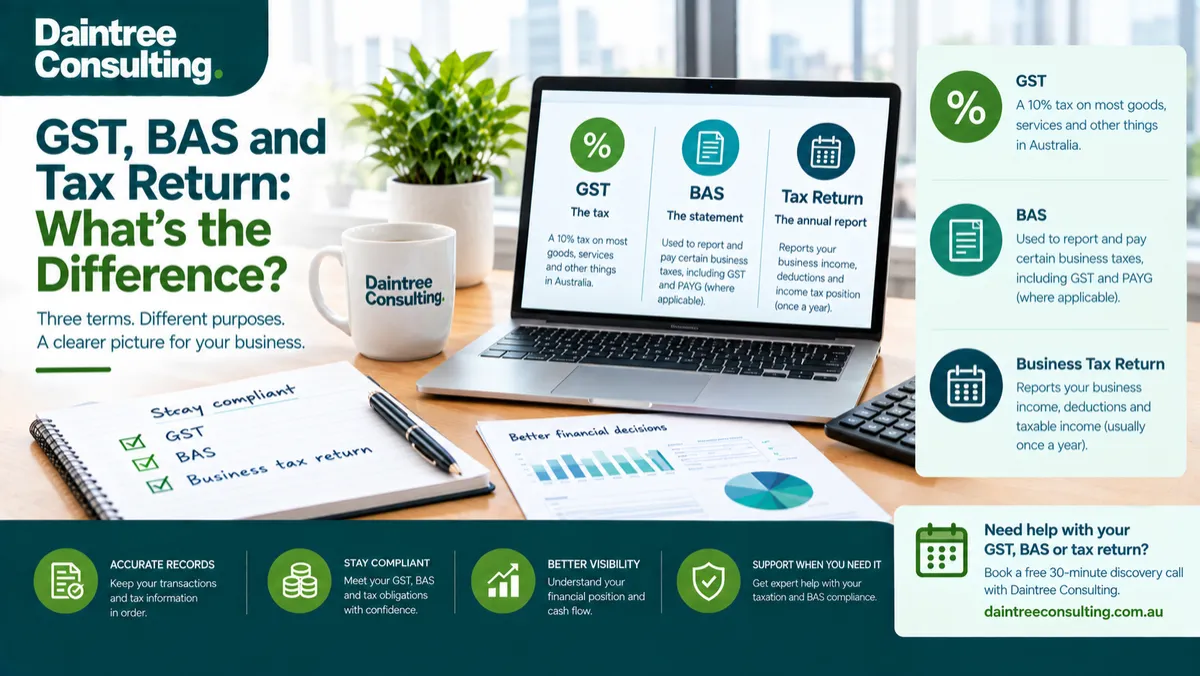
GST is a tax that applies to many goods and services. A BAS, or Business Activity Statement, is a reporting mechanism used to report and pay certain business taxes, including GST and, where applicable, PAYG amounts. A business tax return is generally used to report the business's annual income, deductions, taxable income and income tax position.
Understanding the difference matters because each obligation serves a different purpose.
It also helps explain why your business may need to deal with GST and BAS throughout the year and then complete an annual tax return.
So, what is the difference between GST, BAS and a business tax return?
The simplest way to think about it is:
GST = the tax
BAS = the statement used to report certain business taxes
Tax return = the annual income tax reporting process
The exact obligations depend on your business structure, registrations, activities and circumstances. The Australian Taxation Office (ATO) confirms that activity statements are different from tax returns: activity statements are used to report and pay taxes such as GST and PAYG, while the annual tax return reports business income and tax information.
Quick Answer: GST vs BAS vs Tax Return
What is GST?
GST, or Goods and Services Tax, is a 10% tax on most goods, services and other things sold or consumed in Australia.
Businesses registered for GST generally collect GST on taxable sales and may be entitled to claim GST credits for eligible business purchases.
What is a BAS?
A BAS, or Business Activity Statement, is a form used to report and pay certain business taxes to the ATO.
Depending on the business, a BAS can include GST, PAYG withholding, PAYG instalments and other amounts.
What is a business tax return?
A business tax return reports the business's annual income, deductions and taxable position so the appropriate income tax can be calculated.
The form and reporting process depend on the business structure. For example, a sole trader generally reports business income through their individual tax return, while a company generally lodges a separate company tax return.
1. What Is GST?
GST stands for Goods and Services Tax.
It is a broad-based consumption tax that applies to many goods, services and other transactions in Australia.
For a business that is registered for GST, GST can affect both sides of the accounting records.
You may:
Charge GST on taxable sales
Pay GST on eligible business purchases
Collect GST from customers
Claim eligible GST credits
Report GST amounts through your BAS
Pay the resulting net amount to the ATO or receive a refund, depending on the circumstances
This means GST is not simply another business expense.
For a GST-registered business, the GST collected from customers generally needs to be accounted for to the ATO, subject to the applicable rules and eligible GST credits.
For example, suppose a business sells a taxable service for $1,100 including GST.
The amount includes:
$1,000 for the underlying sale
$100 GST
That $100 is not simply additional business revenue.
It is GST collected as part of the transaction and may need to be reported through the business's activity statement.
2. What Is a BAS?
A Business Activity Statement, commonly called a BAS, is a reporting document.
This distinction is important.
GST is a tax. BAS is the reporting mechanism used to report GST and other applicable business tax obligations.
The ATO states that businesses use activity statements to report and pay taxes such as GST and PAYG.
Depending on the business, the BAS may include information relating to:
GST
PAYG withholding
PAYG instalments
Other applicable taxes or obligations
For example, if your business is registered for GST and has employees, your BAS may involve both GST reporting and PAYG withholding information.
PAYG withholding relates to amounts withheld from certain payments, such as employee wages. The ATO requires applicable PAYG withholding amounts to be reported through the BAS and paid to the ATO.
This is why a BAS can involve more than GST alone.
3. What Is a Business Tax Return?
A business tax return is different from a BAS.
Its primary purpose is to report the business's annual income tax position.
The tax return generally considers information such as:
Business income
Allowable deductions
Depreciation and other relevant adjustments
Taxable income
Tax payable
Other relevant tax information
The ATO describes income tax as the tax paid on money the business earns and explains that businesses report this information through their annual tax return.
The way business income is reported depends on the structure.
Sole trader
A sole trader generally reports business income and deductions in their individual tax return.
Partnership
A partnership generally has its own partnership tax reporting requirements, while partners report their share of partnership income in their own tax returns.
Company
A company generally lodges its own company tax return.
Trust
A trust has its own tax reporting requirements, with the tax treatment of trust income depending on the circumstances.
So when someone says "business tax return", it is important to understand what type of business structure they are talking about.
4. GST, BAS and Tax Returns Work Together
Although GST, BAS and tax returns are different, they are connected.
A simplified process looks like this:
Business transactions
↓
Bookkeeping and accounting records
↓
GST and other activity statement information
↓
BAS reporting
↓
Annual financial information
↓
Business tax return
The numbers don't operate in isolation.
Accurate bookkeeping helps support both BAS preparation and annual tax reporting.
For example, sales recorded during the year can affect:
GST reporting
Revenue in the accounting records
Accounts receivable
Profit and loss
Annual taxable income
Likewise, business expenses can have different accounting, GST and income tax treatments.
This is one reason accurate bookkeeping is so important.
5. Why GST and Income Tax Are Not the Same
One of the most common misconceptions is that GST and income tax are simply two versions of the same tax.
They aren't.
GST is generally associated with the consumption of goods and services.
Income tax is based on taxable income.
This means a business can have:
High sales but relatively low taxable profit
or
Lower sales but a relatively strong profit margin.
The GST position and income tax position can therefore be very different.
For example, a business might collect a significant amount of GST during a period because it has made substantial taxable sales.
At the same time, it may have significant eligible business expenses that reduce its taxable income for income tax purposes.
That does not mean the GST disappears.
The two tax systems operate according to different rules.
6. What Does a BAS Actually Tell the ATO?
A BAS provides information about the business's relevant activity for the reporting period.
For a GST-registered business, this can include information about:
Total sales
GST on sales
GST on purchases
Other applicable GST information
The ATO's Simpler BAS framework for eligible small businesses focuses on three GST reporting labels: total sales, GST on sales and GST on purchases.
Depending on the business and its circumstances, the BAS may also include PAYG withholding, PAYG instalments or other amounts.
This means the BAS can provide a snapshot of certain tax obligations for a particular reporting period.
It is not the same as an annual profit and loss statement.
7. Does the BAS Show Business Profit?
Not necessarily.
A BAS is not designed to be a complete measure of business profitability.
It may report information relevant to GST and other tax obligations, but that doesn't mean it provides the same information as a profit and loss statement or annual tax return.
For example, a business may have:
Strong sales
Significant GST collections
Large operating expenses
Payroll costs
Finance costs
Depreciation
Other deductions
The BAS may provide information about certain tax obligations, but it does not replace management accounts or the annual income tax reporting process.
This is an important distinction for business owners.
Your BAS is not your management report.
And it is not a substitute for understanding profitability.
8. Does the Tax Return Report GST?
GST and income tax are separate systems, although information from your accounting records can be relevant to both.
GST amounts are generally reported through activity statements where applicable.
The annual tax return focuses on the income tax position of the relevant taxpayer or entity.
The accounting treatment of GST can also depend on whether amounts are GST-inclusive or GST-exclusive and on the applicable accounting and tax rules.
This is another reason why GST coding needs to be handled correctly throughout the year rather than trying to reconstruct everything at tax time.
9. How Bookkeeping Connects GST, BAS and Tax Returns
Good bookkeeping is the link between the day-to-day transactions and the formal reporting obligations.
Consider a simple business transaction.
A business receives a supplier invoice for an eligible business purchase.
The transaction may need to be:
Entered into the accounting system
Correctly classified
Checked for GST treatment
Reconciled when payment is made
Included in relevant BAS reporting
Reflected appropriately in the accounting records
Considered when preparing the annual tax information
If the original transaction is entered incorrectly, the error can potentially flow through to multiple reports.
That is why keeping financial records current and reconciled is more effective than treating BAS and tax returns as completely separate exercises.
10. How Often Do You Lodge a BAS?
BAS reporting frequency depends on the business's circumstances.
Many businesses lodge BAS quarterly, while some businesses have monthly or annual reporting arrangements.
The ATO notes that most businesses registered for GST receive a BAS every three months, although reporting arrangements can vary.
The important point is not to assume that another business has the same reporting cycle as yours.
Your reporting frequency can depend on factors such as:
GST registration
Business circumstances
ATO reporting arrangements
Turnover
Elections or other applicable rules
Other tax obligations
Your BAS will generally provide the relevant reporting period and due-date information.
11. How Often Do You Lodge a Business Tax Return?
A business tax return is generally an annual reporting obligation.
It looks at the income tax position for the relevant income year rather than simply one BAS period.
The exact tax return and lodgement requirements depend on the structure.
For example:
A sole trader generally reports business income in their individual return.
A company generally lodges a company tax return.
A partnership has partnership reporting requirements and partner-level tax reporting.
A trust has separate trust reporting requirements.
This is why business owners should not assume that advice applying to one structure automatically applies to another.
12. What Happens If Your BAS Is Wrong?
Errors in BAS reporting should not simply be ignored.
If you discover an error, the appropriate correction method can depend on:
What the error was
When it occurred
The amount involved
Whether it relates to GST or another obligation
Whether it can be corrected on a later activity statement
Whether another correction process is required
The important lesson is to address errors rather than allowing them to accumulate.
A good bookkeeping and BAS process can also make discrepancies easier to identify.
If you're unsure how to correct a BAS error, getting advice from a registered tax or BAS agent can help determine the appropriate approach.
13. Common GST, BAS and Tax Return Mistakes
Understanding the differences between the three can help prevent common mistakes.
Treating GST as business income
GST collected from customers is not necessarily income available to spend freely.
It generally represents an amount that needs to be accounted for under the GST system.
Assuming the BAS is the same as the tax return
It isn't.
The BAS primarily deals with activity statement obligations such as GST and PAYG amounts, while the tax return deals with annual income tax reporting.
Using incorrect GST codes
Incorrect GST coding can affect BAS reporting.
Falling behind on bookkeeping
When transactions aren't recorded promptly, BAS preparation can become more difficult.
Forgetting PAYG obligations
A business with employees may have PAYG withholding obligations that need to be reported and paid.
The ATO confirms that PAYG withholding amounts are reported through the BAS for applicable businesses.
Assuming every business has the same reporting requirements
Business structure, registrations and circumstances can significantly affect obligations.
14. Why Accurate Records Matter
GST, BAS and tax return obligations all depend on reliable underlying information.
A business should maintain records that support its transactions and tax reporting.
This includes information such as:
Sales records
Purchase invoices
Expense records
Bank transactions
Payroll records
GST information
Asset purchases
Loan information
Relevant business documents
When records are incomplete, several problems can arise.
You may struggle to:
Prepare an accurate BAS
Identify GST errors
Calculate business performance
Prepare the annual tax return
Explain transactions
Respond to ATO queries
This is why bookkeeping should be treated as part of the business's financial infrastructure rather than simply an administrative task.
15. How GST, BAS and Tax Return Affect Cash Flow
These obligations can also affect cash flow.
A business may collect GST throughout the year but need to pay the net amount to the ATO when the relevant BAS is due.
Similarly, businesses may need to manage PAYG instalments or withholding obligations depending on their circumstances.
Then there is the annual income tax position.
This means business owners need to distinguish between:
Cash in the bank
and
Cash that is actually available to spend.
A business that does not set aside money for tax obligations can experience unnecessary cash-flow pressure when BAS or tax payments become due.
Regular financial reporting can help business owners plan for these commitments.
16. How to Keep GST, BAS and Tax Reporting Under Control
A good process doesn't have to be complicated.
Keep bookkeeping current
Don't wait until BAS time to reconstruct months of transactions.
Reconcile regularly
Bank accounts and other relevant accounts should be reconciled so the accounting records remain reliable.
Review GST coding
Incorrect GST treatment can create BAS errors.
Monitor tax obligations
Know what reporting and payment obligations apply to your business.
Keep supporting documents
Maintain records that support sales, purchases, expenses and other transactions.
Review before lodging
BAS information should be checked before submission.
Plan for annual tax
Don't treat income tax as a surprise bill that only appears after year end.
Get professional help when needed
A registered tax or BAS agent can help with obligations that are beyond the business owner's experience or capacity.
17. Do You Need an Accountant for GST and BAS?
Not every business needs the same level of professional support.
Some owners manage straightforward bookkeeping themselves and use an accountant or BAS agent for review and lodgement.
Others outsource most or all of their bookkeeping, BAS and tax work.
Professional support can become particularly useful when:
Transactions have become more complex
The business has employees
GST treatment is difficult
The business is growing
BAS errors are occurring
Bookkeeping is falling behind
The business has multiple entities
There are significant asset purchases
The owner doesn't understand the financial reports
ATO correspondence has become difficult to manage
The objective isn't simply to outsource compliance.
It is to create a process where financial records, BAS reporting and tax work connect properly.
How Daintree Consulting Can Help With GST, BAS and Tax Compliance
Daintree Consulting provides practical Taxation & BAS Compliance support for Australian businesses that want clearer responsibilities, accurate records and a more organised reporting process.
Support can include:
BAS preparation and lodgement
Business tax return support
GST and PAYG-related compliance
Tax planning discussions
ATO correspondence and review support
Coordination with bookkeeping and accounting
Reviewing overdue lodgements
Helping maintain clean supporting records
Daintree can also work with your existing bookkeeping or accounting team rather than requiring you to replace the entire finance function.
The goal is to make the process clearer:
Accurate records → Correct reporting → Better visibility → Fewer surprises
You can learn more about Daintree Consulting's Taxation & BAS Compliance Services or discuss your current requirements through a free discovery call.
Frequently Asked Questions
Is GST the same as BAS?
No. GST is a tax, while a BAS is a reporting statement. A business registered for GST generally reports its GST through its BAS, along with other applicable obligations.
Is a BAS the same as a business tax return?
No. A BAS is used to report and pay certain business taxes such as GST and PAYG amounts. A business tax return is used to report the annual income tax position.
Do all businesses need to register for GST?
No. GST registration depends on the business's circumstances and applicable rules. Businesses should check the current ATO requirements to determine whether registration is required or available.
Does every business need to lodge a BAS?
Not necessarily. BAS obligations depend on the business's registrations and circumstances. Businesses registered for GST generally have BAS obligations, while other businesses may receive different types of activity statements or notices.
Can a BAS show whether my business is profitable?
No. A BAS is not a complete profitability report. It primarily reports particular tax obligations for the relevant period.
Do I report business income on both the BAS and tax return?
Business information can feed into different reporting obligations, but the BAS and tax return serve different purposes. GST reporting and income tax reporting should not be treated as interchangeable.
How often is a BAS lodged?
The frequency depends on the business's circumstances. Many businesses lodge quarterly, while some lodge monthly or annually.
What is PAYG and how does it relate to BAS?
PAYG can refer to different tax arrangements. PAYG withholding involves amounts withheld from certain payments, such as employee wages, while PAYG instalments are prepayments towards an income tax liability. Applicable amounts can be reported through activity statements.
Can an accountant help with both BAS and tax returns?
Yes. Depending on their registration and scope of services, a suitably qualified and registered tax or BAS agent can assist with BAS and tax return preparation and lodgement.
Final Takeaway
GST, BAS and business tax returns are connected, but they are not the same thing.
The simplest way to remember the difference is:
GST is the tax.
BAS is the reporting statement used for GST and other applicable business tax obligations.
The tax return reports the annual income tax position.
For a business owner, understanding this distinction can make Australian tax obligations much easier to manage.
But the real foundation is accurate bookkeeping.
When your transactions are recorded correctly, accounts are reconciled and supporting records are organised, BAS preparation and annual tax reporting become much more manageable.
If you're unsure whether your business is handling GST, BAS and tax reporting correctly, it may be worth reviewing the entire process rather than looking at each obligation separately.
Daintree Consulting can help Australian businesses connect bookkeeping, BAS compliance and tax support into a clearer, more organised process.
Book a free discovery call to discuss your business's accounting and tax requirements.
Talk to Daintree about your tax and BAS
Our ex-Big 4 team gives clear, senior-reviewed advice so you can act with confidence.
Book a free consultation →
Or explore our tax and BAS services.
