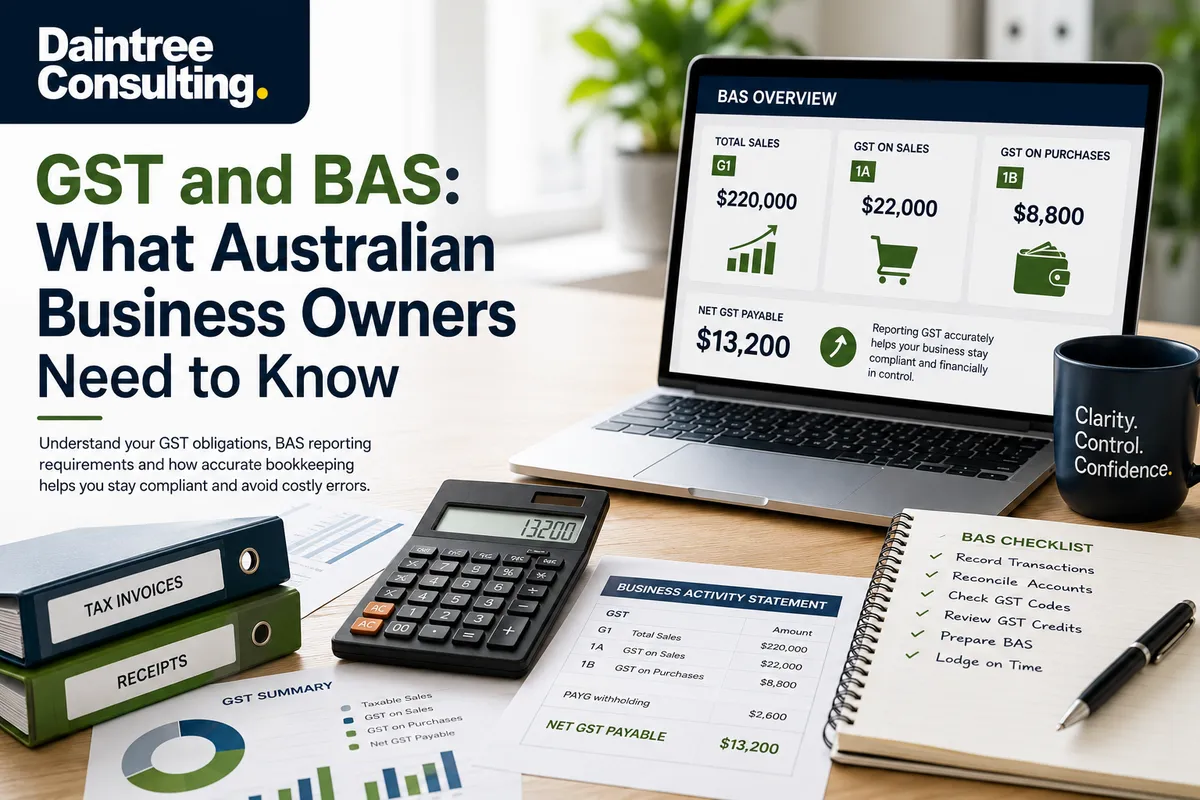
GST and BAS: What Australian Business Owners Need to Know
GST and BAS are two terms almost every Australian business owner encounters, but understanding how they work together is essential for getting your business reporting right.
GST (Goods and Services Tax) is a 10% tax that generally applies to most goods and services sold or consumed in Australia. A Business Activity Statement (BAS) is one of the ways a GST-registered business reports its GST obligations and other applicable tax information to the ATO.
Want expert help? Daintree Consulting's tax and BAS services can take this off your plate. Book a free consultation.
The important point is that GST and BAS are connected, but they are not the same thing.
GST is the tax obligation. Your BAS is the reporting mechanism used to report relevant amounts to the ATO.
For business owners, accurate bookkeeping is critical because the information recorded throughout the reporting period ultimately feeds into your BAS.
Quick Answer: What Is the Difference Between GST and BAS?
GST is a tax applied to most taxable sales and certain other transactions.
BAS is the statement a business uses to report certain business tax obligations to the Australian Taxation Office (ATO), including GST where applicable.
For a GST-registered business, the BAS may require information such as:
Total sales
GST collected on taxable sales
GST credits for eligible business purchases
Other applicable tax obligations
For many small businesses using the ATO's Simpler BAS system, the GST reporting requirements are streamlined. The ATO identifies G1 total sales, 1A GST on sales and 1B GST on purchases as the key labels for Simpler BAS reporting.
What Is GST?
GST is a broad-based consumption tax of 10% that generally applies to taxable supplies made in Australia.
If your business is registered for GST, you generally:
Charge GST on taxable sales.
Record GST paid on eligible business purchases.
Report the relevant amounts to the ATO.
Pay the net GST amount or receive a refund where applicable.
However, not every transaction is treated the same way.
Some supplies may be GST-free, while others may be input-taxed. This is why simply adding 10% to every transaction is not an appropriate way to manage GST.
The correct GST treatment depends on the nature of the transaction and the circumstances of the business.
When Does a Business Need to Register for GST?
Generally, a business must register for GST when its GST turnover reaches the applicable registration threshold.
The ATO currently identifies $75,000 as the general GST registration threshold, with a $150,000 threshold for not-for-profit organisations. Taxi and ride-sourcing drivers have different requirements and generally need to register regardless of turnover.
Businesses below the threshold may also choose to register voluntarily.
If you voluntarily register for GST, you generally take on the associated GST reporting obligations.
If you believe your business is approaching the registration threshold, it is worth reviewing the position early rather than waiting until the last minute.
How Does GST Appear on Your Sales?
When a GST-registered business makes a taxable sale, GST is generally included in the price charged to the customer.
For example, if a taxable service is priced at:
$1,000 + GST
the customer would generally pay:
$1,100 including GST
The business has collected $100 of GST that may need to be reported through its BAS.
The accounting treatment can become more complicated when a business has a mixture of taxable, GST-free and input-taxed transactions.
This is why accurate GST coding in your accounting software matters.
Can a Business Claim GST on Its Purchases?
A GST-registered business may be entitled to claim a GST credit for eligible purchases used in carrying on its business.
However, not every business expense automatically creates a GST credit.
The purchase must satisfy the relevant GST credit requirements.
For example, the ATO states that GST credits may generally be available for GST included in purchases or imports for a GST-registered business where the purchases relate to taxable or GST-free sales.
You should also retain the required supporting documentation.
For eligible purchases over the applicable tax-invoice threshold, a valid tax invoice is generally required to support a GST credit claim.
How GST and BAS Work Together
Think of the process this way:
Your business transactions → bookkeeping → GST classification → BAS preparation → ATO lodgement
Your accounting records provide the underlying information.
During the reporting period, your bookkeeping system records sales, purchases and other transactions and applies the appropriate tax treatment.
When the BAS is prepared, those records are used to determine the amounts that need to be reported.
The BAS then provides the ATO with the relevant information.
This is why BAS preparation should not be treated as simply completing a form at the end of the quarter.
The quality of your BAS depends heavily on the quality of your underlying bookkeeping.
What Do You Report on a BAS?
The exact BAS labels and reporting requirements depend on the business and its reporting method.
For many small businesses using Simpler BAS, the main GST fields include:
G1 — Total sales
1A — GST on sales
1B — GST on purchases
The ATO explains that Simpler BAS is the default GST reporting method for eligible small businesses and reduces the number of GST questions that need to be reported.
However, businesses with more complex GST circumstances may have additional reporting requirements.
That is why business owners should avoid assuming that another business's BAS treatment automatically applies to their own.
GST-Free vs Input-Taxed: Why the Difference Matters
One common source of confusion is the difference between GST-free and input-taxed transactions.
GST-free
GST is not charged to the customer, but eligible related business purchases may still allow GST credits.
Examples can include certain types of food, health services and exports, depending on the specific circumstances.
Input-taxed
GST is generally not charged on the supply, and GST credits related to making those supplies are generally restricted.
Residential rent is a common example of an input-taxed supply.
The distinction matters because the GST treatment of your sales and purchases affects what ultimately appears in your BAS.
Common GST and BAS Mistakes
Many BAS problems start well before the BAS is prepared.
1. Incorrect GST coding
A transaction can be incorrectly coded as GST-free, taxable or BAS-excluded.
If the coding is wrong, the BAS can also be wrong.
2. Claiming GST on ineligible expenses
Not every business expense includes GST, and not every GST amount can automatically be claimed.
3. Missing tax invoices
Supporting documentation should be maintained throughout the reporting period.
4. Mixing business and private expenses
Private-use portions may require different treatment from the business-use component.
5. Leaving bookkeeping until BAS time
Trying to reconcile an entire quarter immediately before lodgement increases the risk of errors.
6. Assuming every sale attracts GST
GST treatment depends on the transaction. Some supplies can be GST-free or input-taxed.
7. Treating BAS as a year-end task
BAS is an ongoing reporting responsibility, not something that should only be considered when the deadline arrives.
How to Make BAS Preparation Easier
The simplest way to make GST and BAS management easier is to build good processes throughout the reporting period.
Keep bookkeeping up to date
Don't wait until the BAS deadline to reconcile your accounts.
Use consistent GST codes
Your accounting software should be configured correctly and used consistently.
Reconcile bank accounts regularly
Bank reconciliation helps identify missing transactions, duplicates and incorrectly recorded payments.
Keep supporting documents
Maintain tax invoices and other records required to support your GST treatment.
Review unusual transactions
Large asset purchases, vehicle transactions, overseas transactions and unusual expenses may require additional attention.
Review the BAS before lodgement
The BAS should be checked for obvious errors and unusual movements before it is submitted.
What Happens If Your BAS Is Wrong?
If you discover an error in a BAS, the appropriate correction process depends on the nature and size of the error and the circumstances involved.
Don't simply ignore the problem because the BAS has already been lodged.
If you identify a potential error, discuss it with your accountant or registered BAS agent so the appropriate correction can be made.
Similarly, if you know you may have difficulty meeting a lodgement or payment obligation, deal with it early rather than waiting until after the deadline.
Why Accurate Bookkeeping Matters for GST and BAS
Good bookkeeping does more than make your accountant's job easier.
It gives you better visibility over:
GST collected
GST paid
Cash flow
Business expenses
Sales performance
Outstanding invoices
Upcoming tax obligations
This means your BAS becomes part of your broader financial management rather than an unexpected quarterly bill.
For example, if your records show that your business has accumulated a significant GST liability, you can identify that position before the BAS deadline and plan your cash flow accordingly.
How Daintree Consulting Can Help With GST and BAS
At Daintree Consulting, GST and BAS support can form part of an integrated bookkeeping, payroll and compliance function.
Rather than treating BAS as an isolated task, the goal is to maintain accurate financial records throughout the reporting period so that GST reporting is based on reliable information.
Support can include:
Bookkeeping and transaction recording
Bank and account reconciliations
GST coding and review
BAS preparation
BAS lodgement
Payroll support
Ongoing financial reporting
Tax and compliance support
Business advisory and financial guidance
For growing Australian businesses, having bookkeeping and BAS processes connected can reduce unnecessary handovers and give owners greater confidence in their numbers.
When Should You Get Professional BAS Support?
Professional support can be particularly useful when:
Your transaction volume is increasing
You have employees and payroll
Your business has multiple revenue streams
You have GST-free and taxable sales
You are dealing with larger purchases or assets
You operate through multiple entities
Your bookkeeping is behind
You are unsure whether GST has been coded correctly
You are spending too much time preparing your BAS
You want more confidence that your reporting is accurate
The objective isn't simply to lodge the BAS.
It is to create a reliable financial process that supports the business throughout the year.
Final Thoughts: GST and BAS Should Work Together
GST and BAS are fundamental parts of the financial administration of many Australian businesses.
GST determines the relevant tax treatment of transactions, while the BAS provides the mechanism for reporting applicable amounts to the ATO.
The best approach is to manage both proactively.
Keep your bookkeeping current, classify transactions correctly, retain appropriate records and review your BAS before lodgement.
Most importantly, don't wait until the BAS deadline to discover that your financial records need attention.
Ready to Make BAS Preparation Easier?
If you're unsure whether your GST and BAS processes are working properly, Daintree Consulting can help you review your current setup.
Book a free 30-minute discovery call to discuss your bookkeeping, BAS and compliance requirements and identify a practical next step.
Frequently Asked Questions
Is GST the same as BAS?
No. GST is a tax, while a BAS is a statement used to report GST and other applicable business tax obligations to the ATO.
Do all Australian businesses need to register for GST?
No. GST registration depends on factors including GST turnover and the type of business. The general registration threshold is currently $75,000, with different rules applying in some circumstances.
Can I claim GST on business expenses?
A GST-registered business may be able to claim GST credits on eligible business purchases, subject to the applicable requirements and documentation.
What is reported on a BAS?
The information required depends on the business and reporting method. For many eligible small businesses using Simpler BAS, key GST fields include G1 total sales, 1A GST on sales and 1B GST on purchases.
How can I avoid BAS mistakes?
Keep your bookkeeping current, use the correct GST codes, reconcile your accounts regularly, retain supporting documentation and review the BAS before lodgement.
Can an accountant or BAS agent prepare my BAS?
Yes. A registered BAS agent can provide BAS services for clients within the scope of their registration. Using professional support can be particularly helpful when your transactions or GST circumstances are becoming more complex.
Does Daintree Consulting help with BAS?
Yes. Daintree Consulting provides bookkeeping, payroll and compliance support for Australian businesses, including BAS-related services.
Important Publishing Note
GST rules, BAS reporting requirements, thresholds, lodgement dates and eligibility requirements can change and may depend on the business's circumstances. This article is intended as general information only and should not be treated as individual tax advice. Before relying on specific GST or BAS requirements, business owners should confirm the applicable rules for their circumstances with the ATO or a suitably qualified tax or BAS professional.
For current requirements, the ATO should be treated as the primary source.
