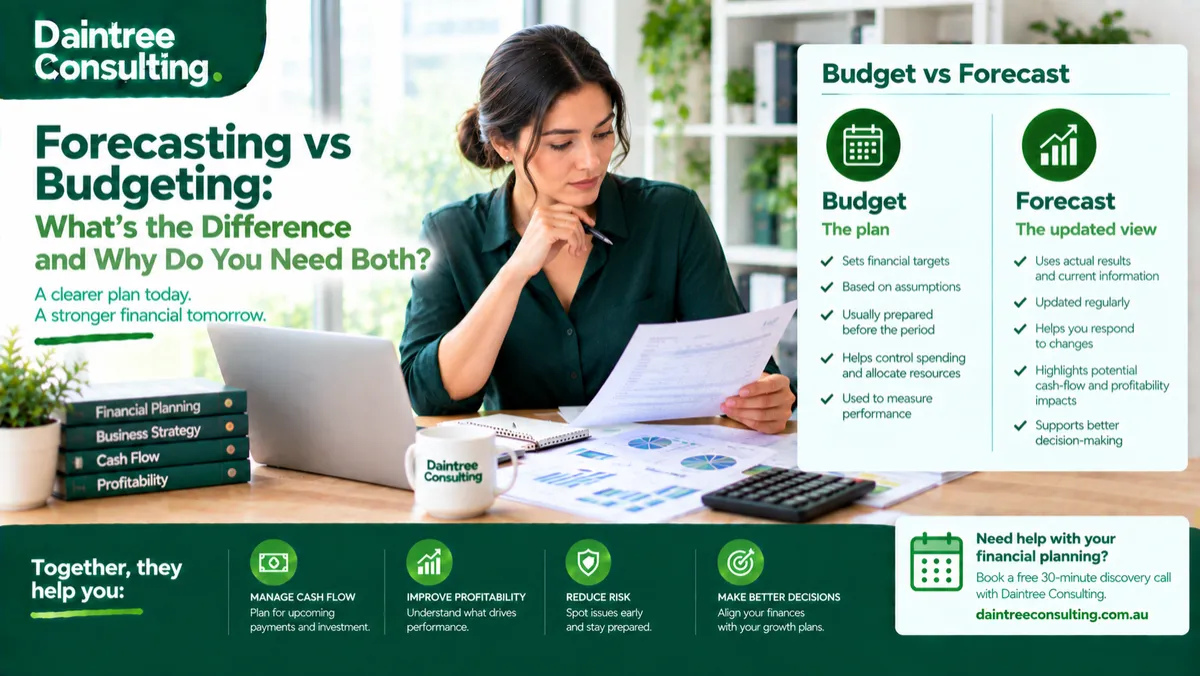
Business Forecasting vs Budgeting: What’s the Difference and Why Do You Need Both?
Business owners often use the terms budgeting and forecasting interchangeably.
They are related, but they serve different purposes.
Want expert help? Daintree Consulting's business advisory services can take this off your plate. Book a free consultation.
A budget sets out what the business expects or intends to achieve over a defined period. A forecast provides an updated view of what may happen based on current information, actual performance and changing assumptions.
Understanding forecasting vs budgeting matters because growing businesses need both.
A budget can help establish financial targets, control spending and allocate resources. A forecast can help management respond when actual results start moving away from those original expectations.
Neither replaces the other.
The budget gives you a financial plan to work towards. The forecast helps you understand whether that plan still reflects what is likely to happen.
When used together, they can give business owners and leadership teams a clearer view of performance, cash flow, profitability and upcoming financial decisions.
Quick answer: What is the difference between forecasting and budgeting?
The simplest distinction is:
A budget is a financial plan. A forecast is an updated financial outlook.
A budget is generally prepared before a financial period and establishes expected revenue, expenses, cash requirements and other financial targets.
A forecast is updated using actual results and current information to estimate what the business may achieve over the remainder of the period.
For example, a business might budget for $3 million in annual revenue.
Six months into the year, actual sales may be tracking below expectations because a major contract was delayed.
The original budget does not necessarily change. It remains the benchmark against which performance can be assessed.
The forecast, however, can be updated to reflect the latest information.
That might mean forecasting lower revenue for the year, adjusting expected expenses, revising cash requirements or considering different scenarios.
This is why businesses should not choose between budgeting and forecasting.
They answer different questions.
What is a business budget?
A business budget is a financial plan for a future period.
It usually sets out expected income and expenditure and may also include planned cash flow, capital expenditure, staffing costs, debt repayments and other financial commitments.
Depending on the business, a budget may be prepared annually and broken down into monthly or quarterly targets.
A useful budget can help answer questions such as:
How much revenue do we expect?
What will our major expenses be?
How much can we afford to spend?
What level of profit are we targeting?
How many employees can we support?
What investments are we planning?
How much cash might we need?
What financial resources will be required to support our strategy?
The budget becomes a financial reference point for management.
It can also be used to compare actual results against expectations.
For example:
Budget revenue: $250,000 per month
Actual revenue: $225,000 per month
Variance: $25,000 below budget
That variance is not necessarily a problem by itself.
The important question is why it occurred.
Perhaps sales were delayed.
Perhaps pricing changed.
Perhaps a major customer left.
Perhaps the business deliberately shifted its sales strategy.
The budget identifies the difference. Management reporting and forecasting help explain what it means for the future.
What is business forecasting?
Business forecasting is the process of estimating what is likely to happen in the future based on current information, historical performance, assumptions and known changes.
Unlike a budget, a forecast can be updated regularly.
For example, a business might start the financial year with a budget based on expected revenue of $5 million.
After four months, management may have better information about:
Actual sales
Customer demand
Pricing
Staffing
Supplier costs
Operating expenses
Cash collections
New contracts
Lost contracts
Capital expenditure
Economic or market conditions
That information can be incorporated into an updated forecast.
The forecast might now suggest that annual revenue could be $5.3 million rather than the original $5 million.
Or it might suggest that revenue could fall below budget.
The value of forecasting is not that it predicts the future perfectly.
It gives management a structured way to continually reassess what the latest information means for the months ahead.
Budgeting vs forecasting: the key differences
Although the two processes overlap, they have different roles.
Budgeting is about planning
A budget establishes financial expectations.
It may be linked to the company's:
Business strategy
Sales targets
Hiring plans
Marketing plans
Investment plans
Cost-control objectives
Profit targets
Cash requirements
It answers:
“What are we planning for?”
Forecasting is about updating expectations
A forecast considers what has happened and what is now expected to happen.
It answers:
“Based on what we know today, what is likely to happen next?”
A budget is usually more fixed
Once approved, the budget often remains relatively stable throughout the financial year.
This makes it useful as a benchmark.
If you continually change the budget every time circumstances change, it becomes much harder to determine whether the business actually performed above or below its original expectations.
A forecast is more flexible
Forecasts can be updated when new information becomes available.
For example:
A major customer signs a contract.
A project is delayed.
Supplier costs increase.
A new employee is hired.
A major expense is brought forward.
A business unit performs differently from expectations.
A funding requirement changes.
The forecast can incorporate those changes.
Why businesses need both
The most useful way to think about budgeting and forecasting is that they work together.
The budget establishes the destination.
The forecast helps you understand whether you are still on the right path.
Imagine a business budgets for:
$4 million revenue
$1.6 million gross profit
$1.1 million operating expenses
$500,000 net profit
After six months, actual performance might show:
Revenue is ahead of budget
Gross margin is below expectations
Labour costs are higher
Customer payments are slower
Cash reserves are lower than expected
Looking only at revenue could give management a false sense of security.
The business is growing, but the financial position may not be developing in the same way.
The budget provides the benchmark.
The forecast shows what these changes could mean for the remainder of the year.
Together, they provide a much more useful management perspective.
1. A budget gives you something to measure against
Without a budget, it can be difficult to determine whether financial performance is genuinely strong.
Suppose your business spends $100,000 on marketing during a quarter.
Is that too much?
The answer depends on the plan.
If the approved budget was $150,000 and the business generated the expected return, the expenditure may be consistent with the plan.
If the budget was $50,000, management may need to understand why spending doubled.
Budget-to-actual reporting can therefore highlight areas that deserve further investigation.
Useful comparisons can include:
Revenue
Gross profit
Operating expenses
Payroll
Marketing
Overheads
Capital expenditure
Cash flow
Other key financial metrics
The objective is not to make every actual result exactly match the budget.
Business conditions change.
The objective is to understand the difference and decide whether action is required.
2. A forecast helps you respond to change
A budget is based on assumptions made when it was created.
Those assumptions can become outdated.
For example, a business may budget based on:
Expected customer demand
Planned pricing
Supplier costs
Staffing levels
Expected project timing
Anticipated financing
Planned investment
Six months later, some of those assumptions may no longer apply.
A forecast gives management the opportunity to update its view.
If sales are below expectations, the forecast can show the potential full-year impact.
If sales are significantly stronger, the forecast can help determine whether the business has enough capacity and cash to support further growth.
This makes forecasting particularly valuable for businesses operating in changing conditions.
3. Budgeting supports financial discipline
Budgets can help businesses establish spending limits and financial priorities.
For example, management may decide that the business will:
Maintain a particular gross margin
Limit certain overhead increases
Invest in new equipment
Increase staffing gradually
Allocate a defined amount to marketing
Maintain a target cash reserve
Reduce particular operating costs
The budget translates some of these decisions into financial numbers.
That creates accountability.
Managers can then compare actual expenditure with the amount that was planned.
Without a budget, spending decisions can become more reactive.
4. Forecasting improves cash-flow visibility
A business can be profitable and still experience cash-flow pressure.
This is one reason forecasting should not focus solely on the profit and loss statement.
A useful cash-flow forecast considers the timing of money coming into and leaving the business.
For example, management may know that:
A large customer payment is expected next month
Payroll will increase next quarter
A major equipment purchase is planned
A tax payment is approaching
Supplier terms are changing
A project requires substantial upfront expenditure
These timing differences matter.
A forecast can help identify periods when cash may become tight, giving management more time to assess options.
This is particularly important during periods of rapid growth.
5. Forecasting can help identify potential problems earlier
Suppose a business is six months into the financial year.
Revenue is only slightly below budget, so management initially sees no major concern.
However, the updated forecast shows that:
Gross margins are continuing to fall
Labour costs are increasing
Debtor days are increasing
Cash reserves are declining
Several major expenses are coming up
Individually, these issues may not appear dramatic.
Together, they could create significant pressure later in the year.
Forecasting can bring these issues into the management conversation earlier.
That creates an opportunity to investigate before the problem becomes urgent.
6. Budgets help with resource allocation
Business resources are limited.
A budget can help management decide where money should be allocated.
For example:
Should the business:
Hire another employee?
Purchase new equipment?
Increase marketing expenditure?
Open another location?
Invest in technology?
Reduce debt?
Increase inventory?
Retain additional cash?
The answer should not be based solely on available cash.
Management should consider the expected financial impact and how the decision fits into the overall business plan.
Budgeting creates a structured framework for making these choices.
7. Forecasting helps test different outcomes
Forecasting can also be used alongside scenario planning.
Instead of creating one expected outcome, management can consider different possibilities.
For example:
Base case
Revenue grows broadly in line with current expectations.
Higher-growth case
Sales increase faster than expected, requiring additional staff, working capital and investment.
Lower-growth case
Sales fall below expectations and management needs to reduce discretionary expenditure.
The purpose is not to predict exactly which scenario will happen.
It is to understand how different outcomes could affect cash flow, profitability and financial requirements.
This can make management better prepared for uncertainty.
Budget vs forecast: which one should you use?
The answer is not one or the other.
Use the budget as the benchmark and the forecast as the current outlook.
A budget is useful for measuring performance against the original plan.
A forecast is useful for understanding where the business may be heading based on current information.
For example:
Budget:
“We expected $1 million in revenue this quarter.”
Actual:
“We generated $900,000.”
Forecast:
“Based on current sales activity, we now expect $3.6 million for the full year rather than the original $4 million.”
That gives management three different pieces of information:
What was planned
What actually happened
What may happen next
You need all three to properly understand performance.
How often should a business update its forecast?
There is no universal schedule.
The appropriate frequency depends on the size, complexity and volatility of the business.
A relatively stable business may update its forecast monthly or quarterly.
A rapidly growing business or one experiencing significant cash-flow pressure may benefit from more frequent forecasting.
Consider updating the forecast when there is a significant change in:
Revenue
Major contracts
Customer demand
Pricing
Payroll
Supplier costs
Debt
Capital expenditure
Cash reserves
Business strategy
The key is to make forecasting part of the management process rather than treating it as a once-a-year accounting exercise.
What should a business forecast?
A useful forecast should reflect the information management actually needs to make decisions.
Depending on the business, this may include:
Revenue
Forecast expected sales by:
Product
Service
Customer
Business unit
Location
Project
Gross profit
Monitor expected revenue against direct costs and gross margins.
Operating expenses
Consider expected:
Payroll
Rent
Marketing
Technology
Insurance
Professional fees
Contractors
Other overheads
Cash flow
Track:
Customer receipts
Supplier payments
Payroll
Tax obligations
Debt repayments
Capital expenditure
Other significant cash movements
Working capital
Consider:
Accounts receivable
Accounts payable
Inventory
Work in progress
Other short-term requirements
The right level of detail depends on the business.
Too little information may not support useful decisions.
Too much detail can make the process unnecessarily complicated.
How to build a useful budget
A practical business budgeting process might follow these steps.
Step 1: Review historical performance
Look at previous:
Revenue
Gross margins
Expenses
Cash flow
Working capital
Major investments
Historical results can provide a useful starting point, although past performance should not automatically be treated as a prediction of future results.
Step 2: Start with the business plan
Consider what the business is actually trying to achieve.
Are you planning to:
Grow sales?
Increase margins?
Hire?
Enter a new market?
Purchase equipment?
Reduce debt?
Improve cash reserves?
Financial targets should connect to those objectives.
Step 3: Estimate revenue
Develop realistic revenue assumptions based on the information available.
Avoid building a budget solely around an optimistic sales target.
Step 4: Estimate costs
Consider both fixed and variable costs.
Remember to include costs associated with growth.
Step 5: Build the cash-flow component
Consider when money is expected to be received and when payments need to be made.
Step 6: Review the assumptions
Ask:
What needs to be true for this budget to work?
That question is often more useful than simply looking at the final numbers.
Step 7: Use the budget throughout the year
Once approved, compare actual results with the budget regularly.
The budget should remain part of the management conversation.
Common mistakes businesses make with budgeting and forecasting
Treating the budget as a prediction
A budget is a plan based on assumptions.
It is not a guarantee that those results will occur.
Updating the budget every time something changes
A budget works best as a benchmark.
Constantly changing it can make performance measurement difficult.
Instead, maintain the original budget and update the forecast.
Forecasting only revenue
Revenue is important, but it does not tell you everything about financial performance.
Include costs, margins, cash flow and working capital where relevant.
Ignoring cash flow
Profit does not necessarily mean cash is available.
Forecast the timing of receipts and payments.
Using unrealistic assumptions
A forecast is only as useful as the assumptions behind it.
Be clear about what is known, what is estimated and what remains uncertain.
Building a forecast once and forgetting it
Conditions change.
A forecast should be reviewed and updated when material information changes.
Creating excessive detail
A complicated model is not automatically a better model.
The financial information should help management make decisions.
How budgeting and forecasting support better business decisions
The real value of budgeting and forecasting is not the spreadsheet.
It is the decision-making that happens because management has better information.
Consider a business deciding whether to hire three additional employees.
The budget might show that the planned growth strategy can support the additional payroll.
The forecast might show that current sales are behind expectations and cash flow could become tight before the additional revenue arrives.
That information could lead management to:
Delay some hiring
Hire gradually
Increase sales activity
Review pricing
Adjust other expenditure
Seek additional working capital
Reassess the timing of the expansion
The numbers do not make the decision for management.
They provide a clearer basis for making it.
When should you consider professional forecasting support?
Basic budgeting can often be managed internally.
As the business becomes more complex, however, financial forecasting can require more time, data and financial expertise.
Professional support may become useful when:
Revenue is growing quickly
The business has multiple revenue streams
Cash flow is difficult to predict
You are considering major investment
You are seeking funding
You are acquiring another business
You are expanding into a new market
Profit margins are changing
Management reporting is becoming more complex
The business needs scenario modelling
Leadership needs better forward-looking financial information
An accountant can help maintain reliable financial information and reporting.
A business adviser can help connect financial information with broader business decisions.
An outsourced CFO can provide more senior financial leadership around forecasting, scenarios, cash flow, KPIs, funding and strategic financial planning without requiring a full-time CFO.
How Daintree Consulting can help
Understanding forecasting vs budgeting is important, but putting both into a practical management process is where they become valuable.
Daintree Consulting supports Australian businesses with accounting, management reporting, cash-flow visibility and financial planning.
Our Accounting Services can help businesses maintain reliable financial information and management reporting.
For businesses requiring more forward-looking financial support, Outsourced CFO Services can assist with financial forecasts, scenario analysis, cash-flow planning, KPIs, funding considerations and management reporting.
The appropriate level of support depends on your business structure, size, financial position and objectives.
If you are relying on a budget but do not have a clear view of what is likely to happen next, it may be time to strengthen your forecasting process.
Book a free 30-minute discovery call with Daintree Consulting to discuss your business's financial reporting, forecasting and planning needs.
FAQs About Forecasting vs Budgeting
Is forecasting the same as budgeting?
No.
Budgeting establishes a financial plan or target for a future period. Forecasting provides an updated estimate of what may happen based on actual results and current assumptions.
They are complementary rather than interchangeable.
Which comes first, budgeting or forecasting?
Typically, a business creates its budget as part of its financial planning process.
Forecasting then helps update management's expectations as actual results and new information become available.
Why does a business need both a budget and a forecast?
A budget provides a consistent benchmark for measuring performance.
A forecast provides a current view of where the business may be heading.
Using both allows management to compare planned performance with actual results while also looking forward.
Should a forecast replace the annual budget?
Generally, no.
The annual budget can provide a stable benchmark for measuring performance, while forecasts can be updated throughout the year as circumstances change.
Replacing the budget every time assumptions change can make it harder to measure performance against the original plan.
How often should a business forecast?
The appropriate frequency depends on the business.
Monthly forecasting is common for businesses that need regular financial visibility, while businesses facing rapid change or significant cash-flow pressure may need more frequent updates.
Can forecasting help with cash flow?
Yes.
A cash-flow forecast can help management estimate future receipts and payments and identify periods where cash may become constrained.
It can also help with planning major purchases, staffing decisions, debt repayments and other significant financial commitments.
Can a small business benefit from forecasting?
Yes.
Forecasting does not need to involve a complicated financial model.
Even a relatively simple forecast can help a small business understand upcoming revenue, expenses, cash requirements and potential financial pressure.
Is a budget or forecast more accurate?
They serve different purposes, so accuracy should not be viewed as a competition between the two.
A budget represents the assumptions and targets established when the plan was created.
A forecast should reflect the latest available information and assumptions.
Neither can guarantee future results.
Final takeaway
Budgeting and forecasting are not competing financial tools. They answer different questions.
A budget asks:
“What are we planning to achieve?”
A forecast asks:
“Based on what we know now, what is likely to happen?”
For a growing Australian business, both perspectives matter.
Use the budget to establish targets and measure performance. Use the forecast to update expectations, identify potential financial pressure and support decisions about cash flow, profitability, staffing, investment and growth.
Most importantly, do not wait until the end of the financial year to discover that your assumptions have changed.
Regular forecasting gives management an opportunity to respond while there is still time to act.
With reliable accounting information, meaningful management reporting and a disciplined forecasting process, business owners can make decisions based on where the business is actually heading — not simply where they originally expected it to go.
Talk to Daintree about your next business decision
Our ex-Big 4 team gives clear, senior-reviewed advice so you can act with confidence.
Book a free consultation →
Or explore our business advisory services.
