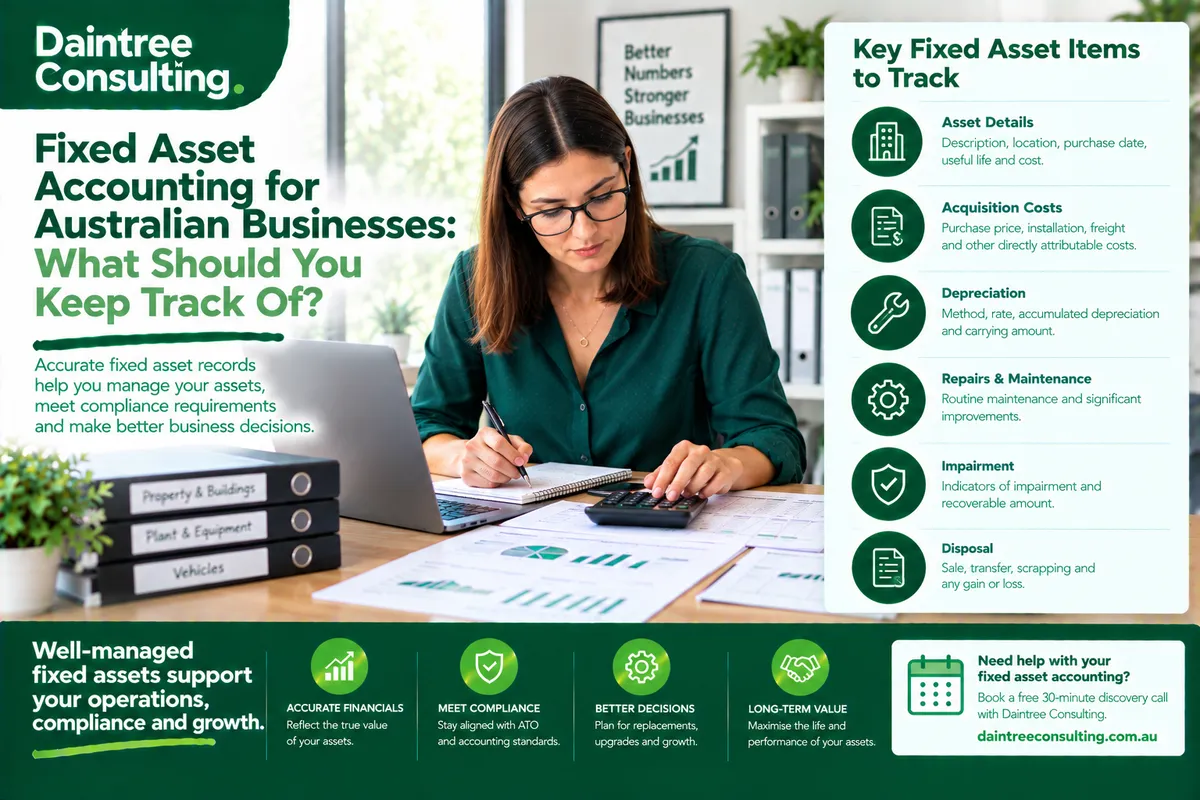
Fixed Asset Accounting for Australian Businesses: What Should You Keep Track Of?
Businesses often invest significant amounts in assets that support their day-to-day operations.
This might include vehicles, machinery, computers, office equipment, furniture, fit-outs, tools, production equipment and other long-term assets.
Want expert help? Daintree Consulting's accounting services can take this off your plate. Book a free consultation.
But buying an asset is only the beginning.
Businesses also need reliable records showing what they purchased, when they purchased it, how much it cost, how it is being depreciated, whether it has been improved or impaired, and what happens when it is eventually sold or disposed of.
This is where fixed asset accounting becomes important.
For Australian businesses, accurate fixed asset records can support financial reporting, tax preparation, budgeting, audit preparation and better decisions about future purchases and replacements.
Under AASB 116 Property, Plant and Equipment, qualifying property, plant and equipment is recognised as an asset when the relevant recognition criteria are met. The standard addresses the asset's cost, carrying amount, depreciation, impairment and derecognition.
So what should a business actually keep track of?
What is fixed asset accounting?
Fixed asset accounting is the process of recording and managing long-term assets used by a business.
These assets are generally expected to provide benefits to the business over more than one reporting period.
Examples can include:
Motor vehicles
Machinery
Manufacturing equipment
Computers and technology
Office furniture
Buildings
Leasehold improvements
Tools and equipment
Commercial fit-outs
Certain specialised business equipment
The exact accounting treatment depends on the nature of the asset, the applicable accounting framework and the circumstances of the business.
For businesses preparing financial statements under Australian Accounting Standards, AASB 116 deals with property, plant and equipment and addresses matters including recognition, measurement, depreciation, impairment and disposal.
The objective is not simply to maintain a list of everything the business owns.
A good fixed asset accounting process should help explain how the business's asset balances have changed over time.
Why does fixed asset accounting matter?
Poor fixed asset records can create problems well beyond the fixed asset register itself.
For example, if a business purchases a $100,000 piece of equipment but the transaction is incorrectly recorded as an expense, the financial statements may not properly reflect the business's assets and expenses.
Similarly, if an asset is sold but remains on the accounting records, the balance sheet can be overstated.
Other issues can arise when:
Depreciation is calculated incorrectly
Assets are recorded at the wrong cost
Repairs are incorrectly capitalised
Capital improvements are treated as ordinary expenses
Disposed assets are not removed
Assets are duplicated
Asset locations are not updated
Useful lives are no longer appropriate
Impairment indicators are overlooked
Accurate fixed asset accounting helps create a clearer picture of the resources the business uses to generate revenue.
What should a fixed asset register include?
A fixed asset register is one of the most useful tools for managing business assets.
The exact information included will depend on the business, but a useful register may contain:
Asset description
Asset category
Asset identification number
Purchase date
Date available for use
Supplier
Purchase price
Directly attributable acquisition costs
Location
Person or department responsible
Useful life
Depreciation method
Depreciation rate
Accumulated depreciation
Carrying amount
Impairment information
Disposal date
Disposal proceeds
Gain or loss on disposal
Supporting documentation
The register should also be capable of being reconciled to the general ledger.
That connection is important.
A fixed asset register can contain detailed information about individual assets, while the general ledger contains the accounting balances used in the financial statements.
The two should be consistent.
1. Asset description
Start with a clear description of the asset.
"Equipment" is unlikely to be enough for a business with hundreds of assets.
A better description might identify:
Type of equipment
Brand
Model
Serial number
Vehicle registration
Location
Internal asset number
The more clearly an asset can be identified, the easier it is to verify later.
This can be particularly useful during an asset review, audit or disposal process.
2. Purchase date and date available for use
The purchase date is important, but it may not be the only date that matters.
Businesses should also consider when an asset became available for use.
For example, a business might purchase a machine in June but spend several weeks installing and commissioning it.
The accounting treatment may therefore need to consider when the asset was in the location and condition necessary for its intended use.
Keeping relevant dates in the asset records helps the accountant determine the appropriate accounting and depreciation treatment.
3. Acquisition cost
Businesses should maintain documentation supporting the cost of each significant asset.
This can include:
Supplier invoices
Purchase contracts
Import documentation
Freight records
Installation invoices
Construction costs
Other directly attributable costs
Under AASB 116, the cost of qualifying property, plant and equipment includes the purchase price and certain directly attributable costs required to bring the asset to the location and condition necessary for it to operate as intended.
However, not every cost associated with buying an asset becomes part of its accounting cost.
For example, AASB 116 distinguishes directly attributable costs from items such as general administration and other costs that are not included in the asset's carrying amount.
This is one reason businesses should not simply capitalise every invoice connected with a project without considering the applicable accounting requirements.
4. Asset category
Grouping assets into appropriate categories can make fixed asset accounting much easier.
Common categories might include:
Motor vehicles
Cars, vans, trucks and other business vehicles.
Plant and equipment
Machinery, production equipment and specialised business equipment.
Office equipment
Computers, printers, furniture and other office assets.
Buildings and property
Commercial buildings and other qualifying property-related assets.
Leasehold improvements
Fit-outs and improvements made to leased premises, where applicable.
The categories used should make sense for the business and support its financial reporting requirements.
5. Depreciation
Depreciation is one of the most important parts of fixed asset accounting.
Under AASB 116, depreciation is the systematic allocation of an asset's depreciable amount over its useful life.
The accounting treatment therefore requires the business to consider factors such as:
Cost
Residual value
Useful life
Depreciation method
Expected pattern of consumption of economic benefits
Businesses should not automatically assume that every asset should be depreciated using the same rate.
Different assets can have different useful lives and consumption patterns.
For example, a computer system may have a very different useful life from a building or heavy manufacturing machine.
Accounting depreciation is not necessarily the same as tax depreciation
This distinction is particularly important for Australian businesses.
Accounting depreciation is used to determine how the cost of an asset is allocated in the financial statements.
Tax depreciation or decline in value is determined under Australian tax law.
The ATO explains that capital assets used to produce assessable income may generally qualify for deductions for their decline in value under the uniform capital allowances rules, subject to the applicable requirements.
The tax treatment can involve different methods, effective-life rules, business-use considerations and specific concessions.
As a result, the depreciation expense recorded in the financial accounts does not necessarily equal the deduction available in the business's tax return.
This is why businesses should avoid treating their accounting depreciation schedule as automatically being their tax depreciation calculation.
The two may need to be tracked separately.
6. Useful life
A business needs to consider how long an asset is expected to provide economic benefits.
Under AASB 116, useful life is based on the period over which the asset is expected to be available for use or, in some circumstances, the number of production or similar units expected to be obtained.
Useful life is a matter of judgement.
Factors that can affect the expected useful life include:
Expected usage
Wear and tear
Maintenance
Technological changes
Obsolescence
Expected replacement cycles
Legal or contractual restrictions
The business's asset management policies
A useful life should therefore not simply be copied from an old asset register without considering whether it remains appropriate.
7. Residual value
Residual value is another consideration when calculating accounting depreciation.
It represents the estimated amount the business expects to obtain from disposing of the asset at the end of its useful life, after considering relevant disposal costs.
For some assets, the residual value may be insignificant.
For others, it may be more relevant.
The business should document significant assumptions where appropriate.
AASB 116 requires the residual value and useful life of an asset to be reviewed at least at each financial year-end.
If expectations change, the resulting change is accounted for as a change in accounting estimate under the applicable requirements.
8. Repairs and maintenance
One of the common fixed asset accounting questions is:
Should this cost be capitalised or expensed?
Not every amount spent on an existing asset should be added to the asset's carrying amount.
Routine repairs and maintenance are generally treated differently from expenditure that meets the requirements for recognition as part of an asset.
For example:
Routine servicing
May generally be an expense.
Major replacement
May potentially qualify for recognition as part of the asset when the applicable recognition criteria are met.
AASB 116 specifically addresses replacement parts and major inspections.
This distinction matters because incorrectly capitalising routine repairs can overstate assets and understate expenses.
On the other hand, incorrectly expensing qualifying capital expenditure can understate assets.
9. Asset improvements and upgrades
Businesses often modify or upgrade existing assets.
Examples include:
Major machinery upgrades
Building improvements
Significant technology upgrades
Replacement of major components
Production-line improvements
The accounting treatment depends on what the expenditure represents and whether it meets the relevant recognition criteria.
Businesses should keep invoices and supporting documentation that clearly explain the nature of the work.
A description such as "machine upgrade" may not provide enough information for the accountant to determine the correct treatment.
Detailed project records can make the accounting process much easier.
10. Asset location
A fixed asset register should ideally identify where significant assets are located.
For example:
Head office
Warehouse
Factory
Retail location
Construction site
Customer site
Company vehicle fleet
Location information can help management identify missing assets and can make physical verification more efficient.
It can also become important when a business has multiple locations.
An asset register that says a piece of equipment exists but does not identify where it is located may be much less useful than one that provides clear asset information.
11. Asset ownership and supporting documents
Businesses should retain evidence supporting significant assets.
This may include:
Purchase invoices
Contracts
Finance agreements
Registration records
Ownership documents
Asset warranties
Insurance records
Valuation documents
Installation records
The type of documentation required depends on the asset and the circumstances.
ASIC notes that company financial records can include invoices, receipts, books of prime entry and working papers, and that companies generally need to retain financial records for at least seven years.
Maintaining a well-organised document trail can therefore help with both accounting and broader record-keeping obligations.
12. Impairment
An asset can remain on the accounting records even when its economic value or ability to generate benefits has changed.
Businesses should therefore consider whether there are indicators that an asset may be impaired.
Potential indicators can include:
Physical damage
Technological obsolescence
Significant underutilisation
Changes in market conditions
Poor asset performance
Significant changes affecting the business
The asset becoming redundant
AASB 116 directs entities to AASB 136 for impairment considerations.
The purpose is to prevent assets from being carried at amounts that exceed their recoverable amount where an impairment loss is required.
Impairment can therefore be an important part of year-end financial reporting.
13. Assets that are fully depreciated but still in use
A business may have assets that are fully depreciated in the accounting records but are still being used.
For example, an older computer system or piece of equipment might have reached the end of its accounting useful life but continue operating.
This does not necessarily mean the business should automatically remove the asset from its records.
The business should maintain appropriate records and consider the applicable accounting treatment.
AASB 116 also identifies fully depreciated property, plant and equipment that is still in use as information that users of financial statements may find relevant.
This is another reason why the asset register should reflect the actual status of assets rather than simply deleting an asset when accumulated depreciation reaches its original cost.
14. Asset disposals
Eventually, businesses sell, trade in, scrap or otherwise dispose of assets.
When this happens, the asset register needs to be updated.
The business should record information such as:
Disposal date
Disposal method
Sale proceeds
Costs of disposal
Asset's carrying amount
Accumulated depreciation
Any resulting gain or loss
Under AASB 116, the carrying amount of property, plant and equipment is derecognised on disposal or when no future economic benefits are expected from its use or disposal.
The resulting gain or loss is generally recognised in profit or loss.
A common bookkeeping problem is leaving disposed assets on the register.
This can cause the balance sheet and fixed asset schedule to become inaccurate.
15. Tax treatment when assets are disposed of
Disposal can also have tax consequences.
Australian tax rules for depreciating assets can involve balancing adjustments and other specific rules.
The ATO explains that the tax treatment of a depreciating asset can depend on factors such as its adjustable value, termination value and taxable use.
This means a business should not assume that the accounting gain or loss on disposal is automatically the same as the tax result.
The accounting records and tax records may need to be reconciled separately.
16. Business-use percentage
Some assets may have mixed business and private use.
This can be particularly relevant for:
Motor vehicles
Mobile devices
Computers
Equipment used partly outside the business
For tax purposes, deductions may need to be adjusted where an asset is not used entirely for a taxable purpose.
The business should therefore retain appropriate records supporting the extent of business or taxable use where required.
This can include usage records, logbooks or other relevant evidence depending on the asset and applicable tax rules.
17. Finance arrangements
Businesses may acquire assets using:
Business loans
Hire purchase
Equipment finance
Other financing arrangements
The asset records should still clearly identify the underlying asset and its cost and accounting treatment.
The financing arrangement should also be recorded separately in the accounting system.
This creates a clearer distinction between:
The asset
and
How the asset was financed.
For example, buying a machine using finance does not mean the loan itself should be treated as the asset.
The accounting records need to reflect both the asset and the related financing appropriately.
18. Leased assets
Not every asset used by a business is owned outright.
Some assets are obtained through leases.
Lease accounting can involve requirements under AASB 16 Leases, depending on the circumstances.
Businesses should therefore avoid automatically placing every leased asset into a traditional owned fixed asset register without considering the applicable accounting treatment.
Lease agreements should be retained and provided to the accountant when preparing financial statements.
Fixed asset accounting and financial reporting
Fixed assets can have a significant effect on a business's financial statements.
They can affect:
Balance sheet assets
Depreciation expense
Profit
Carrying amounts
Cash flow information
Asset turnover measures
Financing information
Impairment calculations
Disclosures
For entities applying AASB 116, financial statement disclosures for each class of property, plant and equipment can include measurement bases, depreciation methods, useful lives or depreciation rates, gross carrying amounts, accumulated depreciation and movements in carrying amounts.
This means accurate underlying records are important not only for bookkeeping but also for financial reporting.
What should businesses reconcile?
A fixed asset accounting process should include regular reconciliation between the supporting records and the accounting system.
Consider reconciling:
Fixed asset register to general ledger
The total asset balances should be consistent with the relevant ledger accounts after considering appropriate reconciling items.
Additions to invoices
New assets should be supported by invoices and other documentation.
Disposals to sale records
Disposed assets should be supported by sale invoices, trade-in documentation or other evidence.
Depreciation to accounting records
Depreciation schedules should agree with the amounts recorded in the general ledger.
Asset finance to loan records
Where assets are financed, the finance records should reconcile with the underlying liabilities.
Physical assets to the register
Where appropriate, businesses should periodically verify that significant assets actually exist and are located where the records indicate.
How often should fixed asset records be reviewed?
There is no single review frequency that suits every business.
A business with a small number of straightforward assets may have different needs from a manufacturer with hundreds of machines across multiple locations.
However, businesses should avoid treating the fixed asset register as something that only gets reviewed at tax time.
Useful review points can include:
Month-end
Quarter-end
Financial year-end
Before an audit
After major asset purchases
After significant disposals
During budgeting
During business restructuring
When locations change
When major equipment is replaced
Regular review can help prevent small errors from accumulating over several years.
Common fixed asset accounting mistakes
1. Treating every purchase as an expense
Some purchases may meet the requirements for asset recognition rather than being immediately expensed.
2. Capitalising every repair
Routine repairs and maintenance do not automatically become part of an asset's carrying amount.
3. Using outdated depreciation assumptions
Useful lives and residual values may need to be reviewed.
4. Forgetting disposals
Selling or scrapping an asset without removing it from the accounting records can distort the balance sheet.
5. Losing purchase documentation
Without supporting records, it can become difficult to verify an asset's cost and history.
6. Mixing accounting and tax depreciation
Financial reporting depreciation and tax decline-in-value deductions can be different.
7. Not tracking asset locations
This can make physical verification and asset management more difficult.
8. Ignoring impairment indicators
An asset that has become obsolete or significantly damaged may require further accounting consideration.
9. Failing to reconcile the asset register
A detailed asset register is less useful if it does not agree with the accounting records.
A practical fixed asset checklist for Australian businesses
Before the end of the financial year, consider reviewing:
New asset purchases
Purchase invoices
Asset descriptions
Asset locations
Asset identification numbers
Depreciation calculations
Useful lives
Residual values
Repairs and maintenance
Major upgrades
Impairment indicators
Assets sold
Assets scrapped
Trade-ins
Finance arrangements
Lease arrangements
Physical asset records
Fixed asset register
General ledger balances
Tax depreciation information
The exact requirements will depend on the business, accounting framework, asset types and tax circumstances.
How better fixed asset records help business owners
Fixed asset accounting is not only about compliance.
Good asset records can also support better business decisions.
For example, management may use asset information to understand:
Which equipment is approaching replacement
How much capital expenditure may be required
Which assets are underutilised
How much the business has invested in equipment
Whether assets are being maintained appropriately
How depreciation is affecting reported profit
How asset purchases affect cash flow
Whether financing may be required for future purchases
This information can become particularly useful when preparing budgets and forecasts.
A business planning a major expansion, for example, may need to understand both its existing asset base and the additional capital expenditure required to support growth.
When should a business review its fixed asset process?
A review can be worthwhile when:
The business is growing rapidly
Asset purchases have increased
The business has multiple locations
Equipment is frequently replaced
The business has recently acquired another business
The fixed asset register contains old or incomplete information
The business is preparing for an audit
Financial reporting has become more complex
Management is planning significant capital expenditure
The accounting system has recently changed
A growing business can quickly outgrow a simple spreadsheet-based asset list.
As the number and value of assets increase, businesses may need more structured processes for recording, reconciling and reviewing them.
Fixed asset accounting vs tax depreciation
These terms are sometimes used interchangeably, but they should not be.
Fixed asset accounting focuses on how assets are recognised, measured and presented in the financial records.
Tax depreciation focuses on deductions available under Australian tax law.
The ATO's rules for depreciating assets can involve effective life, decline-in-value methods, taxable use, immediate deductions and other specific provisions.
The applicable tax treatment can change, and concessions may have specific eligibility requirements.
Businesses should therefore avoid relying on a generic depreciation rule or an old tax schedule without checking the current requirements for the relevant financial year.
This is particularly important when planning major asset purchases.
How Daintree Consulting can help with fixed asset accounting
Managing fixed assets becomes more difficult when a business has multiple locations, vehicles, equipment purchases, finance arrangements or significant capital expenditure.
Daintree Consulting can help Australian businesses maintain more reliable financial records and improve the processes surrounding fixed assets.
Support can include:
Fixed asset register review
Asset accounting
Depreciation schedules
Balance-sheet reconciliations
Capital expenditure tracking
Asset disposal accounting
Financial reporting
Management reporting
Accounting process reviews
Preparation of financial information for tax and assurance requirements
The objective is to help management maintain clearer records and understand how fixed assets affect the business's financial position and performance.
If your fixed asset register is outdated, difficult to reconcile or no longer reflects the assets your business actually uses, it may be time to review the process.
Need help with fixed asset accounting?
Daintree Consulting provides Accounting Services for Australian businesses that need reliable financial records, reconciliations and clearer financial reporting.
Book a free 30-minute discovery call with Daintree Consulting to discuss your accounting requirements.
Frequently Asked Questions
What is fixed asset accounting?
Fixed asset accounting is the process of recording, depreciating, reviewing and ultimately removing long-term business assets from the accounting records when they are disposed of or no longer provide future economic benefits.
What assets are included in fixed asset accounting?
Common examples include machinery, vehicles, computers, office equipment, furniture, buildings, equipment and certain business fit-outs. The appropriate accounting treatment depends on the nature of the asset and the applicable accounting framework.
What should a fixed asset register contain?
A register can include the asset description, purchase date, cost, location, useful life, depreciation method, accumulated depreciation, carrying amount, disposal information and supporting documentation.
Is accounting depreciation the same as tax depreciation?
No. Accounting depreciation is determined under the applicable financial reporting framework, while tax depreciation or decline in value is determined under Australian tax law. The two calculations can produce different results.
How often should a fixed asset register be updated?
It should be updated whenever relevant asset transactions occur, including purchases, disposals, transfers and significant changes. Businesses should also periodically reconcile the register to the accounting records.
What happens when a business sells a fixed asset?
The asset generally needs to be removed from the accounting records, along with its accumulated depreciation and carrying amount. The resulting difference between the relevant disposal proceeds and carrying amount can result in a gain or loss for accounting purposes.
Should repairs be included in the cost of a fixed asset?
Not automatically. Routine repairs and maintenance are generally treated differently from expenditure that meets the requirements for recognition as part of an asset. The nature of the expenditure should be considered under the applicable accounting requirements.
Can a fully depreciated asset remain in the business?
Yes. An asset can be fully depreciated in the accounting records while still being used by the business. The asset register should continue to reflect the asset appropriately while it remains relevant.
Why is fixed asset reconciliation important?
Reconciliation helps ensure that the fixed asset register agrees with the accounting records and that purchases, depreciation, disposals and other movements have been recorded correctly.
What records should businesses keep for fixed assets?
Depending on the asset, businesses may need purchase invoices, contracts, finance documents, registration records, depreciation schedules, disposal records, valuation information and other supporting documentation.
Talk to Daintree about your accounting
Our ex-Big 4 team gives clear, senior-reviewed advice so you can act with confidence.
Book a free consultation →
Or explore our accounting services.
