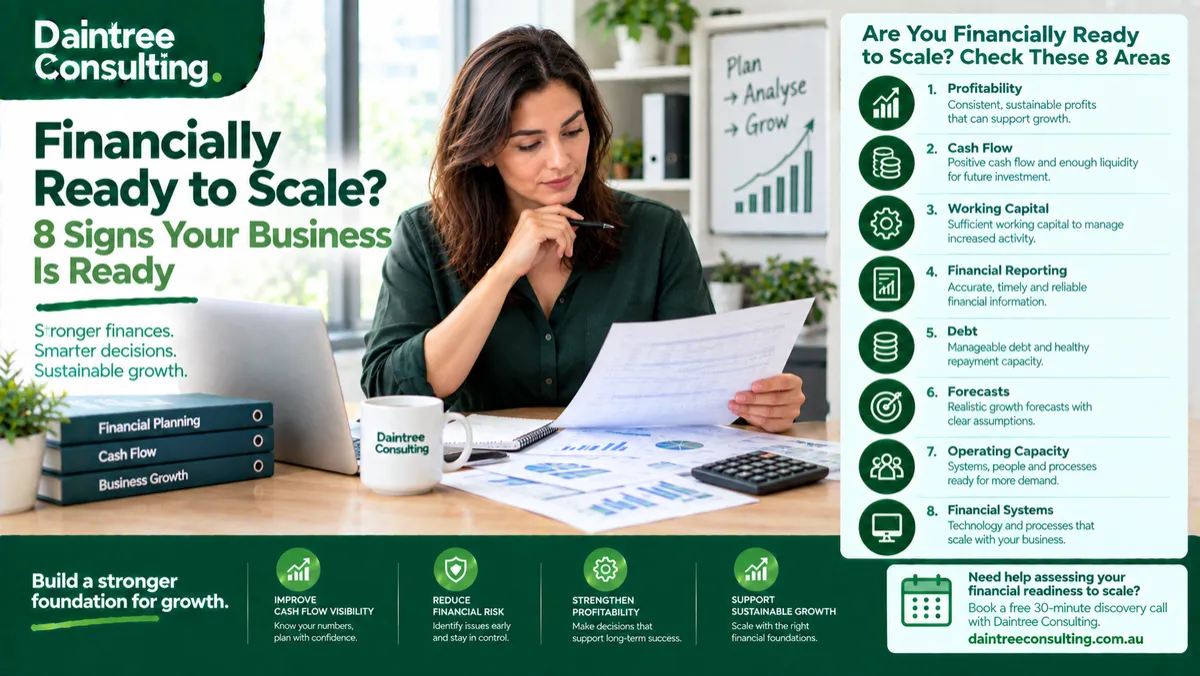
How to Know If Your Business Is Financially Ready to Scale
Growing a business can be exciting.
More customers, more revenue, a larger team and new markets can all look like signs that the next stage of growth is within reach.
Want expert help? Daintree Consulting's business advisory services can take this off your plate. Book a free consultation.
But there is an important question business owners should ask before committing to expansion:
Is the business financially ready to scale?
Growth does not automatically make a business stronger.
A business can increase its sales while putting more pressure on cash flow, working capital, staff, systems and management.
That is why financial readiness matters.
Before taking on significant new costs, hiring additional employees, opening another location, investing in equipment or entering a new market, business owners should understand whether the existing business can financially support the next stage.
A proper assessment should look beyond revenue.
It should consider profitability, cash flow, working capital, debt, financial reporting, operating costs and the assumptions behind the growth plan.
What does it mean to be financially ready to scale?
Being financially ready to scale means having enough financial strength, visibility and planning capability to support growth without creating unnecessary financial pressure.
It does not necessarily mean having a large amount of cash sitting in the bank.
A business may be financially ready to scale with a combination of:
Strong and sustainable profitability
Predictable cash flow
Adequate working capital
Reliable financial reporting
Manageable debt
A realistic growth forecast
Sufficient operating capacity
Clear control over costs
Appropriate funding where required
Financial systems that can handle increased activity
The exact requirements will vary between businesses.
A service business scaling its team will have different financial requirements from a manufacturer investing in equipment or a retailer increasing its inventory.
The important question is whether the financial structure of the business can support the specific type of growth being considered.
Why revenue growth does not necessarily mean you are ready to scale
Revenue is often the first number business owners look at when considering growth.
Suppose a business has increased annual revenue from $2 million to $3 million.
That sounds positive.
But what if:
Profit margins have fallen?
Customers are taking longer to pay?
Inventory requirements have increased?
Payroll has grown faster than revenue?
The business has taken on significant debt?
The owner is funding operations personally?
Cash reserves are declining?
Management reporting is already struggling to keep up?
The business may be growing without becoming financially stronger.
Growth can require cash before the additional revenue arrives.
You might need to pay employees, suppliers, rent, equipment costs, marketing expenses or other operating costs before customers pay for the resulting sales.
This is why cash flow needs to be considered alongside profitability.
A cash-flow statement tracks money moving into and out of the business and can help identify future shortages and surpluses.
8 signs your business may be financially ready to scale
1. Your business is consistently profitable
Before expanding, look at whether the existing business model is producing sustainable profits.
A profitable month is not enough.
Ideally, you want to understand the underlying trend.
Review:
Revenue
Gross profit
Gross margin
Operating expenses
Operating profit
Net profit
Profit margin
Profit by product or service
Profit by customer segment where relevant
The question is not simply:
“Are we making money?”
It is:
“Is the existing business model generating enough sustainable profit to support the next stage?”
If profitability depends on temporary conditions, one unusually large customer or an unsustainably low cost structure, scaling may magnify the underlying problem rather than solve it.
A business that loses money at its current size does not automatically become profitable by becoming larger.
More sales can also mean more expenses.
That is why profitability should be assessed before expansion rather than assumed to follow it.
2. Your cash flow can support the growth plan
Profit and cash are not the same thing.
A business can report a profit while having limited cash available to fund expansion.
This can happen when:
Customers pay slowly
Inventory absorbs cash
Suppliers require faster payment
Loan repayments are increasing
Large expenses occur before revenue is collected
Tax obligations become due
Capital expenditure is required
Before scaling, prepare a cash-flow forecast that reflects the proposed growth plan.
Consider:
Expected sales
Customer payment timing
Payroll
Supplier payments
Rent
Marketing
Equipment
Technology
Tax obligations
Loan repayments
Other expansion costs
Business.gov.au recommends using cash-flow forecasting to estimate future income and costs and identify whether the business will have enough income to cover its costs.
The forecast should also be realistic.
Do not build a growth plan around the assumption that every customer will pay immediately or every sales target will be achieved exactly as planned.
3. You understand your working capital requirements
Working capital is one of the areas that can catch growing businesses by surprise.
As sales increase, the business may need to fund more:
Inventory
Customer receivables
Work in progress
Supplier commitments
Payroll
Operating expenses
This means the business can need more cash precisely because it is growing.
A balance sheet can help business owners understand assets, liabilities, working capital and liquidity.
Before scaling, ask:
How much additional working capital will this growth require?
Then consider where that money will come from.
It may come from:
Existing cash reserves
Faster customer collections
Supplier terms
Business profits
Finance
Investor funding
Other sources appropriate to the business
The important thing is to identify the requirement before the cash becomes a problem.
4. Your financial reporting is reliable
You cannot make confident growth decisions if you do not trust your financial information.
Before scaling, you should be able to understand reasonably quickly:
How much revenue the business is generating
Which areas are profitable
What customers owe
What the business owes suppliers
How much cash is available
What major expenses are coming up
How actual performance compares with the budget
How current performance compares with previous periods
Business.gov.au recommends regularly reviewing key financial documents including the balance sheet, profit and loss statement, cash flow statement and budget to understand financial health and identify trends.
If management spends days trying to work out what the numbers mean, scaling may add complexity faster than the business can handle it.
Good financial reporting does not need to be complicated.
It needs to be accurate, timely and relevant to the decisions management is making.
5. You have a realistic growth forecast
A growth plan should not be based entirely on optimism.
It should be based on assumptions that can be tested.
For example:
How many additional customers are expected?
What will the average customer spend?
How quickly will sales increase?
What additional employees are required?
What will wages cost?
What additional equipment is needed?
How much marketing will be required?
How long will customers take to pay?
What happens if sales are 20% below expectations?
This is where budgeting and forecasting become particularly useful.
A budget describes what you plan to earn and spend, while a forecast uses current information and trends to estimate what may happen next.
For a scaling decision, both can be useful.
The budget can define the intended plan.
The forecast can show whether the business is currently tracking towards it.
6. Your costs are under control
Scaling often means spending more.
The issue is whether the additional spending is producing enough value to justify the increase.
Review your major costs before committing to expansion.
Consider:
Payroll
Rent
Software
Marketing
Insurance
Contractors
Suppliers
Financing
Vehicles
Equipment
Professional services
Look for costs that are increasing faster than revenue.
Also consider whether the business has fixed costs that will increase significantly as it scales.
For example, hiring five additional employees creates an ongoing cost.
Purchasing equipment can create financing, maintenance and depreciation costs.
Opening another location can add rent, staffing, utilities and other overheads.
The growth plan should account for these costs rather than focusing only on projected revenue.
7. You have enough financial capacity to handle a slower growth scenario
One of the best tests of financial readiness is to stop assuming that everything goes according to plan.
What happens if:
Sales are slower than expected?
Customers pay later?
Costs increase?
A major customer leaves?
Recruitment takes longer?
A new service takes longer to become profitable?
The expansion requires more working capital?
Interest costs increase?
A planned funding source is delayed?
This is where scenario planning can be useful.
Instead of having one forecast, consider several scenarios.
Base case
What happens if the growth plan performs broadly as expected?
Downside case
What happens if sales are lower or costs are higher than expected?
Strong-growth case
What happens if demand is stronger than expected and the business needs to invest faster?
The objective is not to predict the future perfectly.
It is to understand how sensitive the business is to changes in the assumptions behind the growth plan.
8. Your financial systems can handle a larger business
Scaling is not just about having enough money.
It is also about having financial processes that can handle more activity.
If the business already struggles with:
Late bookkeeping
Unreconciled accounts
Slow invoicing
Poor debtor follow-up
Inaccurate payroll
Delayed management reports
Manual spreadsheets
Unclear financial responsibilities
those problems may become more difficult as transaction volumes increase.
Before scaling, review whether your financial processes can grow with the business.
This might involve improving:
Accounting software
Bookkeeping
Payroll
Accounts payable
Accounts receivable
Bank reconciliation
Month-end processes
Financial reporting
Budgeting
Cash-flow forecasting
The objective is not to introduce technology for its own sake.
It is to create processes that give management reliable information as the business becomes more complex.
What financial numbers should you review before scaling?
There is no single set of numbers that determines whether a business is ready to scale.
However, several areas deserve attention.
Revenue
Review:
Revenue growth
Recurring versus one-off revenue
Revenue by customer
Revenue by product or service
Customer concentration
Sales pipeline
Strong revenue growth can support expansion, but revenue alone does not show whether the growth is profitable.
Gross margin
Gross margin can help show how much revenue remains after direct costs.
If sales increase while gross margins decline, additional revenue may not produce the expected financial benefit.
Look at whether margins are:
Stable
Improving
Declining
Different across products or services
Different across customer groups
Operating profit
Operating profit can provide a clearer picture of the underlying performance of the business after operating expenses.
Consider whether the existing operation generates enough profit to help fund expansion or support additional financing obligations.
Cash flow
Review actual cash movements rather than relying only on the profit and loss statement.
Look at:
Operating cash flow
Customer collections
Supplier payments
Payroll
Tax payments
Loan repayments
Capital expenditure
The timing matters.
A profitable business can still experience a cash shortage if money leaves the business before customers pay.
Debtors
Review how quickly customers pay.
If accounts receivable is increasing faster than sales, growth could be consuming more working capital.
Ask:
Are customers paying within agreed terms?
Are overdue invoices increasing?
Is one customer responsible for a large proportion of receivables?
Will the proposed growth increase the amount of money tied up in debtors?
Debt
Debt can be useful for funding growth, but it needs to be considered alongside cash flow and repayment capacity.
Review:
Current debt
Interest costs
Repayment schedules
Existing facilities
Proposed borrowing
Security requirements
Ability to service additional debt
If external funding is part of the growth plan, reliable financial information becomes particularly important. Business.gov.au recommends understanding income, expenses, debt and cash flow when preparing for business finance.
How much cash should a business have before scaling?
There is no universal cash-reserve figure that applies to every business.
A professional services business with recurring revenue may have very different cash requirements from a construction business with long payment cycles or a retailer carrying substantial inventory.
Instead of asking:
“How much cash should we have?”
ask:
“How much cash will this particular growth plan require, and what happens if the plan takes longer than expected?”
Consider:
Existing monthly operating costs
Growth-related costs
Working capital requirements
Debt repayments
Tax obligations
Payroll
Capital expenditure
Customer payment timing
Seasonal fluctuations
Contingency requirements
The right level of liquidity depends on the business's circumstances and risk profile.
Is profitability enough to show that a business is ready to scale?
No.
Profitability is important, but it is only one part of financial readiness.
A business could be profitable while:
Cash is tied up in receivables
Inventory is increasing
Debt is high
Margins are declining
Systems are inadequate
The owner is funding cash shortfalls
Major capital expenditure is required
This is why a financial readiness assessment should consider the profit and loss statement, balance sheet and cash flow together.
Business.gov.au describes these financial statements as key tools for reviewing the financial health and position of a business.
What if the business is not financially ready to scale?
That does not necessarily mean the growth opportunity needs to be abandoned.
It may mean the business needs to strengthen its financial position first.
Depending on the circumstances, that could involve:
Improving margins
Review pricing, supplier costs, customer profitability and service delivery costs.
Improving collections
Reduce the time between invoicing customers and receiving payment.
Reducing unnecessary costs
Review recurring expenses and identify costs that are not supporting the current strategy.
Building cash reserves
Retain more cash before committing to major expansion.
Restructuring debt
Where appropriate, review existing financing and repayment requirements with professional advice.
Improving financial reporting
Create more reliable management accounts and cash-flow forecasts.
Improving working capital
Review inventory, receivables and supplier terms.
Phasing the expansion
Instead of making every investment at once, consider whether growth can be introduced in stages.
Sometimes the best growth strategy is not to expand immediately.
It is to strengthen the business so that expansion becomes more manageable.
Financial readiness vs operational readiness
Money is not the only constraint.
A business can have sufficient cash but still not be ready to scale operationally.
Consider whether you have:
Enough skilled employees
Effective management
Reliable suppliers
Suitable technology
Documented processes
Adequate customer service capacity
Appropriate quality controls
Clear accountability
If sales double but the business cannot deliver the additional work, growth can create customer dissatisfaction and operational pressure.
Financial readiness and operational readiness therefore need to be considered together.
What should you do before committing to expansion?
Before making a major growth decision, work through a structured review.
Step 1: Establish the current position
Review your:
Profit and loss
Balance sheet
Cash flow
Debtors
Creditors
Debt
Key financial ratios
Business KPIs
Step 2: Define the growth plan
Be specific about what scaling actually means.
Is it:
More customers?
A larger team?
A new location?
New equipment?
A new service?
Geographic expansion?
Increased production?
Acquisition?
Each type of growth has different financial requirements.
Step 3: Estimate the additional costs
Identify the costs required before and during the expansion.
Do not forget costs that may not appear obvious at first.
Step 4: Build a cash-flow forecast
Model when cash will come in and when it will leave.
Test different scenarios.
Step 5: Review funding requirements
Determine whether existing cash is sufficient or whether external funding may be required.
Step 6: Identify financial risks
Ask what could cause the plan to fail financially.
Step 7: Decide whether to proceed, adjust or delay
The result does not have to be “yes” or “no”.
You may decide to:
Proceed immediately
Proceed in stages
Change the growth plan
Improve profitability first
Secure funding first
Strengthen systems first
Delay expansion until conditions improve
The important thing is to make the decision using reliable information.
How an outsourced CFO can help assess financial readiness
As a business approaches a more complex stage of growth, financial management often needs to become more sophisticated.
An outsourced CFO can help management look beyond basic bookkeeping and focus on areas such as:
Cash-flow forecasting
Financial modelling
Scenario planning
Management reporting
Working capital
Business KPIs
Funding preparation
Growth planning
Financial risk
Decision support
This can be particularly useful when the business has an accountant handling compliance but needs more forward-looking financial management.
The goal is not simply to produce more reports.
It is to turn financial information into useful information for decisions.
How Daintree Consulting can help
Daintree Consulting provides business advisory and outsourced CFO support for Australian businesses navigating growth, financial pressure and important commercial decisions.
If you are considering expansion, the first step may be understanding whether the business's current financial position can support the plan.
Daintree can help businesses review areas such as:
Profitability
Cash flow
Working capital
Financial forecasts
Business performance
KPIs
Growth assumptions
Funding requirements
Financial risks
The aim is to give owners and leadership teams clearer financial information so they can make informed decisions about the next stage of the business.
If you are asking “Are we financially ready to scale?”, it may be time to look beyond your sales numbers and assess the full financial picture.
Book a free 30-minute discovery call with Daintree Consulting to discuss your growth plans and current financial position.
Frequently Asked Questions
What does it mean to be financially ready to scale?
Being financially ready to scale means having sufficient financial strength, cash-flow visibility, working capital, profitability and financial systems to support a specific growth plan. The requirements depend on the type and size of the proposed expansion.
How do I know if my business is financially ready to scale?
Review profitability, cash flow, working capital, debt, margins, financial reporting, operating costs and the assumptions behind the growth plan. You should also model what happens if sales are lower or costs are higher than expected.
Does a profitable business automatically have enough cash to grow?
No. Profit and cash flow are different. A profitable business can have cash tied up in customer receivables, inventory or other working capital requirements.
What financial reports should I review before scaling?
At a minimum, review the profit and loss statement, balance sheet, cash-flow information, budget and forecast. Also consider debtors, creditors, debt, margins and other KPIs relevant to the business.
Should I borrow money to scale my business?
That depends on the business, the growth opportunity, cash-flow requirements, existing debt and the terms and risks of the proposed funding. Funding decisions should be based on the business's financial position and appropriate professional advice rather than simply the desire to grow.
What if my business is not financially ready to scale?
You may be able to strengthen the business first by improving profitability, cash flow, collections, working capital, financial reporting or funding capacity. Scaling can also be phased rather than undertaken all at once.
Final takeaway
Scaling a business is not simply a matter of generating more sales.
Growth can require significant investment before the financial benefits arrive.
That is why being financially ready to scale means understanding more than your revenue.
You need to understand your profitability, cash flow, working capital, debt, operating costs and financial capacity.
You also need reliable forecasts that show what could happen under different scenarios.
If the numbers show that the business can support the expansion, you have a stronger foundation for moving forward.
If they show financial pressure, that information is equally valuable.
It gives you the opportunity to strengthen the business before committing more resources.
The goal is not to grow as quickly as possible. It is to build a business that can support growth without losing financial control.
Important Publishing Note: Financial forecasts, budgets, projections and growth scenarios are based on assumptions and professional judgement and are not guarantees of future results. Financial readiness depends on the business's structure, industry, cash flow, funding arrangements, profitability, operating model and growth plans. This article provides general information only and should not be treated as personal financial or business advice. Daintree Consulting should confirm its current service scope and any business-specific claims before publication.
Talk to Daintree about your next business decision
Our ex-Big 4 team gives clear, senior-reviewed advice so you can act with confidence.
Book a free consultation →
Or explore our business advisory services.
