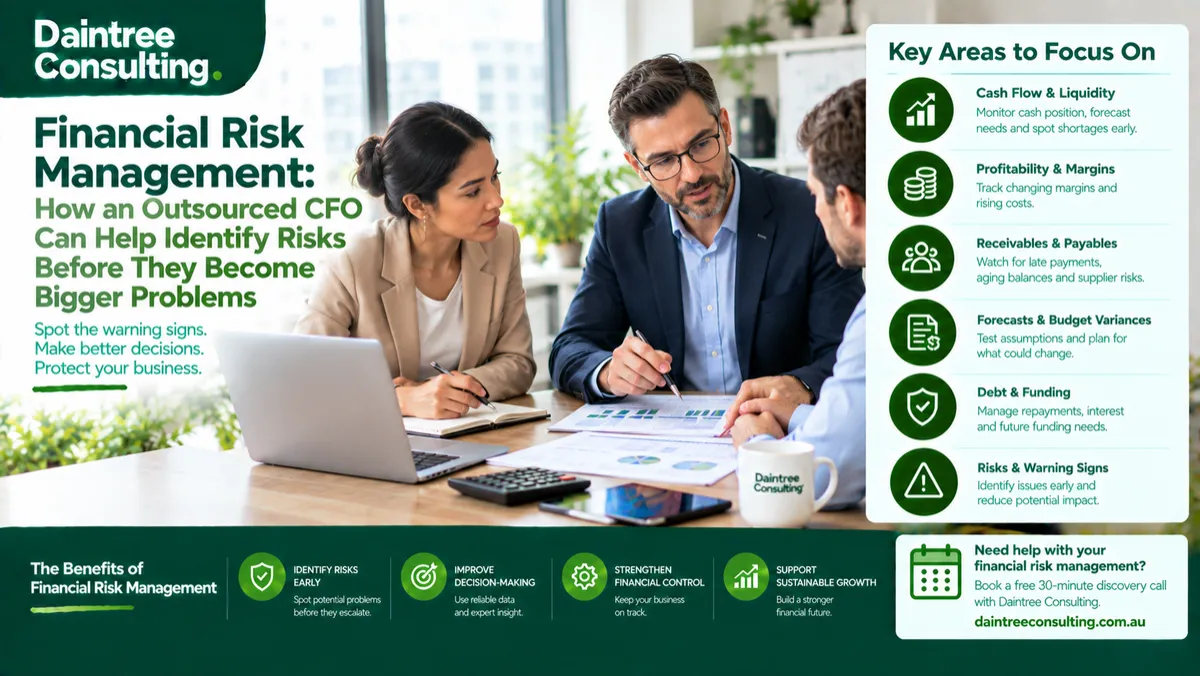
How an Outsourced CFO Can Help Identify Financial Risks Before They Become Bigger Problems
Financial problems rarely appear overnight.
A business may look profitable while cash is becoming tighter. Customer payments may be slowing down, margins may be shrinking, debt may be increasing, or operating costs may be rising faster than revenue. By the time these issues become obvious, the business may have fewer options available.
Want expert help? Daintree Consulting's outsourced CFO services can take this off your plate. Book a free consultation.
This is where financial risk management becomes important.
For growing Australian businesses, financial risk management is not simply about responding when something goes wrong. It involves regularly reviewing financial information, identifying warning signs, understanding what could happen next and taking action before a small issue becomes a larger financial problem.
An outsourced CFO can provide the financial oversight needed to do this.
Rather than focusing only on historical accounts, an outsourced CFO can help business owners and leadership teams interpret financial information, identify emerging risks, test assumptions and establish reporting processes that make potential problems easier to see.
Quick Answer
An outsourced CFO can support financial risk management by monitoring cash flow, profitability, working capital, debt, customer concentration, financial forecasts, budgets, costs and key performance indicators.
The role is not to predict every problem or guarantee that a business will avoid financial difficulty. Instead, it is to help management identify potential issues earlier, understand their financial impact and make better-informed decisions.
For example, an outsourced CFO may identify:
Cash flow pressure caused by slow customer payments
Declining profit margins despite increasing revenue
Rising overheads that are reducing profitability
Excessive reliance on one customer or revenue source
Increasing debt or upcoming funding requirements
Large differences between budgeted and actual results
Tax, payroll or other upcoming financial commitments
Forecast assumptions that may no longer be realistic
Working capital tied up in receivables or inventory
Financial risks associated with rapid business expansion
The earlier these issues are identified, the more opportunity management may have to respond.
What Is Financial Risk Management?
Financial risk management is the process of identifying, assessing and managing financial risks that could negatively affect a business.
Business.gov.au describes business risks broadly as anything that could have a negative impact on a business. Its risk-management guidance recommends identifying risks, analysing their likelihood and consequences, evaluating them and then deciding how they should be treated.
For financial management, this means looking beyond a single profit-and-loss statement.
A business might be exposed to financial risk through:
Cash flow
Customer payments
Supplier costs
Profit margins
Debt
Interest and financing costs
Tax and other financial obligations
Inventory
Business expenses
Customer concentration
Funding requirements
Capital expenditure
Growth assumptions
Economic or market changes
Some risks are outside management's control. Others can be reduced through better planning, reporting and decision-making.
The objective is not to eliminate every risk. That is rarely realistic.
The objective is to understand which risks matter most and take appropriate action before they create unnecessary financial pressure.
Why Financial Risks Can Be Difficult to See
One of the biggest challenges for business owners is that financial problems are not always visible in the headline numbers.
For example, revenue could increase by 20% while cash flow deteriorates.
That could happen because customers are taking longer to pay, inventory requirements have increased, suppliers require earlier payment or the business is spending heavily to support growth.
Similarly, a business can report a profit while experiencing cash shortages.
This is why financial risk management requires more than asking:
"Are we making a profit?"
A better set of questions might include:
Are customers paying on time?
Are margins changing?
Are costs increasing faster than revenue?
How much cash will the business need over the next three to six months?
Are actual results materially different from the budget?
Is debt increasing?
Are financial commitments approaching?
How dependent is the business on a small number of customers?
Are current forecasts still realistic?
Does the business have enough financial capacity for its plans?
Business.gov.au recommends regularly reviewing financial information such as the budget, balance sheet, profit and loss statement and cash flow statement to understand the financial position of a business.
An outsourced CFO can help turn these numbers into a more forward-looking financial risk management process.
1. Monitoring Cash Flow Before It Becomes a Crisis
Cash flow is one of the most important areas of financial risk management.
A profitable business can still experience financial pressure if cash is tied up in unpaid invoices, inventory or other working-capital requirements.
Business.gov.au notes that reduced cash flow can create difficulty paying debts and day-to-day operating costs. Warning signs can include late customer payments, difficulty paying suppliers or taxes and low profit margins.
An outsourced CFO can help management monitor:
Current cash position
Expected customer receipts
Supplier payments
Payroll commitments
Tax and other upcoming obligations
Loan repayments
Capital expenditure
Seasonal cash requirements
Expected cash surpluses or shortages
A cash flow forecast can then provide a forward-looking view of where pressure may arise.
Business.gov.au explains that cash flow forecasting can help businesses predict shortages and surpluses and plan ahead for future payments.
The important point is timing.
Knowing that cash may become tight several months from now gives management more opportunity to investigate options than discovering the problem when an important payment is already due.
2. Identifying Declining Profit Margins
Revenue growth does not automatically mean financial health is improving.
If the cost of delivering products or services increases faster than revenue, gross margins can deteriorate.
An outsourced CFO can monitor changes in:
Gross profit
Gross margin
Operating expenses
Net profit
Profit by product or service
Profit by customer or business segment
Labour costs
Supplier costs
Overhead costs
For example, a business may report:
Revenue up → Profit flat → Margin down
That pattern deserves investigation.
The cause could be higher supplier prices, discounting, inefficient labour allocation, rising overheads or a change in the mix of products and services being sold.
Identifying the movement is only the first step. The CFO's role is to help management understand why it is happening and what decisions may need to be considered.
3. Comparing Actual Results With the Budget
A budget is useful, but it becomes much more valuable when actual results are regularly compared with it.
An outsourced CFO can establish a recurring budget-versus-actual review that highlights significant variances.
For example:
Revenue is below expectations
Advertising costs are higher than planned
Labour costs have increased
Gross margin is below budget
Receivables are taking longer to collect
Capital expenditure is higher than expected
A variance does not automatically mean something is wrong.
There may be a reasonable explanation.
The important question is:
Why is the result different from what we expected?
If the variance is temporary, management may simply need to monitor it.
If it reflects a structural change, the budget or business strategy may need to be reconsidered.
4. Testing Financial Forecasts and Assumptions
Forecasts can create risk when they rely on assumptions that are no longer realistic.
An outsourced CFO can help management review assumptions behind:
Revenue growth
Customer acquisition
Pricing
Gross margins
Staffing
Supplier costs
Rent and overheads
Capital expenditure
Debt repayments
Working capital
Funding requirements
Instead of relying on a single forecast, management can also consider different scenarios.
For example:
Base case: What happens if current assumptions continue?
Downside case: What happens if revenue is lower or costs increase?
Growth case: What happens if demand increases faster than expected?
Scenario analysis does not predict what will happen. It helps management understand how different assumptions could affect the business.
That can make financial risk management more practical because risks can be considered before decisions are made.
5. Watching Working Capital
Working capital can quietly create financial pressure as a business grows.
A company may generate more sales but need significantly more cash to support those sales.
An outsourced CFO can review:
Accounts receivable
Accounts payable
Inventory
Payment terms
Collection patterns
Supplier commitments
Cash conversion
Working-capital requirements
For example, if sales are increasing but customer payments are becoming slower, the business may need additional working capital to fund its operations.
Likewise, holding excessive inventory can tie up cash that could otherwise be used elsewhere.
Regular working-capital analysis helps management see whether growth is actually generating the financial capacity expected.
6. Identifying Customer Concentration Risk
Revenue concentration is another financial risk that may not be obvious from a standard monthly report.
If one customer represents a large percentage of revenue, the business may be financially exposed if that customer reduces spending, changes suppliers or stops trading.
An outsourced CFO can help management analyse:
Revenue by customer
Customer concentration
Recurring versus one-off revenue
Customer payment behaviour
Contract terms
Revenue by product or service
Customer profitability
This does not mean a business should automatically avoid large customers.
Instead, the purpose is to understand the exposure and consider whether the business needs greater diversification or contingency planning.
7. Reviewing Debt and Funding Risk
Debt can support investment and growth, but it also creates future financial commitments.
An outsourced CFO can help management monitor:
Outstanding debt
Repayment schedules
Interest costs
Available facilities
Funding requirements
Debt-to-cash-flow relationships
Upcoming refinancing requirements
The financial impact of new borrowing
This becomes particularly important when a business is planning a major investment, acquisition, expansion or other significant expenditure.
Understanding the future cash commitments before taking on additional debt can help management make more informed funding decisions.
8. Looking for Early Warning Signs
Financial risk management is particularly valuable when it establishes a consistent process for identifying warning signs.
Potential indicators can include:
Cash reserves consistently falling
Increasing overdue receivables
Supplier payments becoming difficult
Margins declining
Expenses rising faster than revenue
Increasing reliance on debt
Repeated budget overruns
Frequent emergency funding requirements
Tax or other financial obligations becoming difficult to meet
Forecast cash shortages
Declining customer profitability
ASIC has recently highlighted increasing cash-flow pressure, overdue tax or superannuation, unpaid suppliers and reliance on personal funds as warning signs that may accompany financial difficulty for small businesses. ASIC also stresses the importance of recognising problems early and seeking advice before options become more limited.
These indicators do not automatically mean a business is in financial trouble.
They are signals that deserve investigation.
9. Improving Financial Reporting for Leadership
Financial risk management becomes difficult when decision-makers do not have timely, reliable information.
An outsourced CFO can help develop a management reporting pack that focuses on the information leadership actually needs.
Depending on the business, this could include:
Profit and loss
Balance sheet
Cash flow
Budget versus actual
Key financial KPIs
Accounts receivable
Accounts payable
Working capital
Debt
Revenue trends
Margin analysis
Forecasts
Risk indicators
The goal is not to create more reports simply for the sake of reporting.
The goal is to create information that helps management answer:
What is happening?
Why is it happening?
What could happen next?
What decision do we need to make?
10. Turning Financial Information Into Action
Identifying a financial risk is only useful if someone does something about it.
An outsourced CFO can help management move from financial reporting to action by helping define:
The issue
The potential financial impact
The likely causes
The urgency
Available options
Responsible people
Required actions
Follow-up dates
For example, if receivables are increasing, the response might involve reviewing customer payment terms, collection processes and overdue accounts.
If margins are declining, management may need to examine pricing, supplier costs, labour utilisation or service profitability.
If cash flow is expected to tighten, management may need to reconsider spending, timing of investment or funding requirements.
The appropriate response will depend on the circumstances of the business.
When Should a Business Consider an Outsourced CFO?
Not every business needs a full-time CFO.
An outsourced CFO can provide access to senior financial leadership without requiring the business to employ a full-time executive in that role.
This can be particularly relevant when:
The business is growing quickly
Financial decisions are becoming more complex
The owner is spending too much time on financial issues
Management reporting is not providing enough insight
Cash flow is becoming harder to predict
The business is considering significant investment
Funding requirements are increasing
There are multiple revenue streams or entities
Financial risks are becoming harder to monitor internally
The business needs more forward-looking financial analysis
The key question is not simply whether the business is "large enough" for a CFO.
It is whether the business has enough financial complexity and decision-making requirements to benefit from additional financial leadership.
How Financial Risk Management Can Support Better Business Decisions
Good financial risk management does not mean avoiding every risk.
Businesses need to take calculated risks to invest, hire, expand, develop new products and pursue opportunities.
The purpose of financial risk management is to understand the financial consequences before making those decisions.
For example, before expanding into a new location, management might assess:
Expected revenue
Start-up costs
Additional staffing
Rent and overheads
Working-capital requirements
Break-even point
Cash-flow impact
Funding requirements
Downside scenarios
That analysis does not determine whether the expansion should happen.
It gives management better information to make the decision.
What an Outsourced CFO Should Not Do
An outsourced CFO should not be viewed as someone who can eliminate financial risk entirely.
No financial professional can guarantee that a business will avoid unexpected losses, economic changes, customer failures or other events.
Forecasts are also based on assumptions and professional judgement. Actual results can differ from projections.
The value of outsourced CFO support is in establishing better financial visibility, stronger analysis and more disciplined decision-making.
It is about helping management see potential issues earlier and understand the financial implications of important decisions.
Building a Practical Financial Risk Management Process
A useful process does not have to be unnecessarily complicated.
A growing business could establish a recurring process that includes:
Step 1: Review financial results
Look at the latest profit and loss, balance sheet and cash flow information.
Step 2: Compare actual results with expectations
Identify significant budget and forecast variances.
Step 3: Review cash flow
Look at current cash, expected receipts, upcoming payments and forecast cash requirements.
Step 4: Monitor key risks
Review margins, receivables, debt, customer concentration, costs and other business-specific indicators.
Step 5: Update forecasts
Adjust assumptions when actual results or business conditions change.
Step 6: Identify actions
Determine which risks require attention and who is responsible for the next step.
Step 7: Review regularly
Financial risk management should be an ongoing process rather than a once-a-year exercise.
Business.gov.au recommends regularly reviewing financial performance and updating cash flow and budgets so businesses can identify problems earlier.
Final Thoughts
Financial risks are easier to manage when they are visible.
The challenge for many growing businesses is not a lack of financial information. It is having the time, systems and financial expertise to interpret that information and identify what deserves attention.
An outsourced CFO can help bridge that gap.
By reviewing cash flow, margins, working capital, budgets, forecasts, debt, customer concentration and other financial indicators, an outsourced CFO can help business owners identify potential risks before they become larger problems.
The objective is not to eliminate uncertainty.
It is to give leadership a clearer view of the financial position, understand potential risks and make decisions with better information.
For Australian businesses that are growing or facing increasing financial complexity, financial risk management can become an important part of maintaining financial control and planning for the future.
If your business needs more visibility over its financial position, forecasts, cash flow and emerging risks, professional CFO support can help establish a more structured approach.
Daintree Consulting provides outsourced CFO services for Australian businesses that need senior financial insight without necessarily employing a full-time CFO. Book a free 30-minute discovery call to discuss your business's financial reporting, forecasting and financial management needs.
Frequently Asked Questions
What is financial risk management?
Financial risk management is the process of identifying, analysing and managing financial risks that could negatively affect a business. It can include monitoring cash flow, profitability, debt, working capital, costs, forecasts and other financial indicators.
How can an outsourced CFO help with financial risk management?
An outsourced CFO can review financial performance, cash flow, budgets, forecasts and key financial indicators to help identify potential risks. They can also help management understand the potential financial impact and develop appropriate actions.
What financial risks should a growing business monitor?
Common areas include cash flow, declining margins, increasing costs, overdue receivables, customer concentration, debt, working capital, funding requirements, budget variances and unrealistic financial forecasts.
Can an outsourced CFO prevent financial problems?
No. An outsourced CFO cannot eliminate financial risk or guarantee future results. Their role is to improve financial visibility, identify potential warning signs and support better-informed financial decisions.
When should a business consider an outsourced CFO?
An outsourced CFO may be useful when financial decisions are becoming more complex, management reporting is insufficient, cash flow is harder to predict, the business is growing quickly or leadership needs more forward-looking financial analysis.
Is financial risk management only important when a business is struggling?
No. Financial risk management is useful before financial difficulty occurs. Regular monitoring can help businesses identify emerging issues while there may still be more options available to respond.
Important Publishing Note: This article provides general information about financial risk management and outsourced CFO support. It is not accounting, tax, legal, insolvency or financial advice. Financial risks, reporting requirements and appropriate actions depend on the circumstances of each business. Forecasts, budgets and projections are based on assumptions and professional judgement, and actual results may differ. Australian regulatory and tax requirements can change, so current requirements should be checked before publication or when applying information to a specific business.
Talk to Daintree about your finance function
Our ex-Big 4 team gives clear, senior-reviewed advice so you can act with confidence.
Book a free consultation →
Or explore our outsourced CFO services.
